Tag: Einfamilienhäuser

  • Solar energy on track

    Solar energy on track

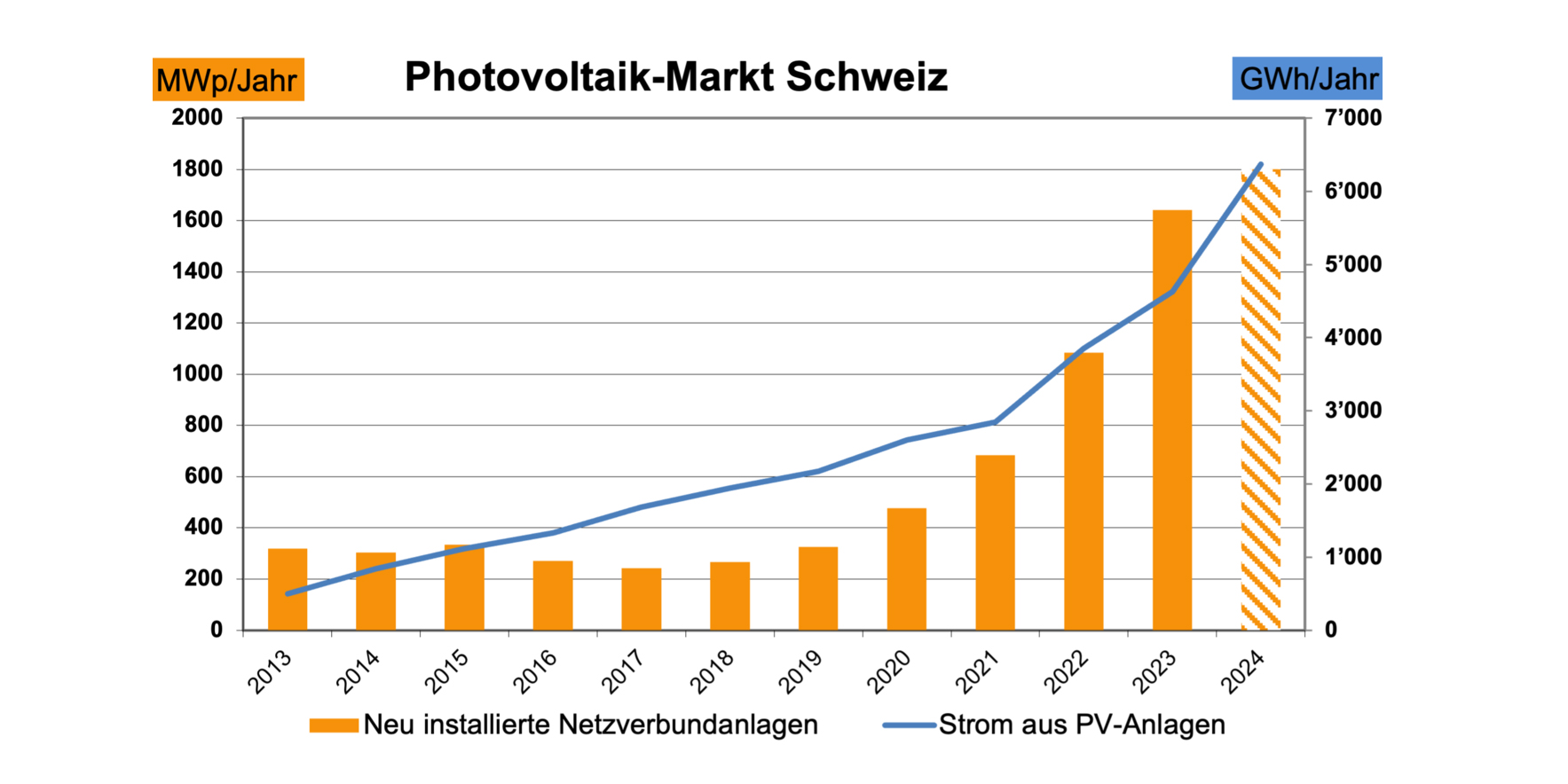
    In 2024, 1,798 megawatts of new photovoltaic capacity were installed in Switzerland, an increase of 10 % compared to the previous year. The total output rose to 8.2 gigawatts, which covered over 10 % of the national electricity demand. Despite below-average solar radiation and rising electricity consumption, the annual production corresponds to the consumption of around two million households.

    Security of supply through winter electricity
    Photovoltaics is not just a summer technology; from October 2024 to April 2025, 2.4 terawatt hours of solar power were generated, a third of annual production. This contribution significantly relieved the pressure on Switzerland’s reservoirs. Without solar energy, Switzerland would have had to import significantly more electricity.

    Decline in the single-family home segment
    While larger systems continued to grow strongly, the expansion on single-family homes fell by 3 %. This slowed overall growth, as around a third of installed capacity was previously based on this segment. According to Swissolar, the reason for this restraint is the uncertainty surrounding the new Electricity Act.

    Battery storage systems are gaining in importance
    The expansion of battery storage systems also increased by 4%. The commercial sector in particular is showing increased momentum. Today, 47% of PV systems on single-family homes are already equipped with battery storage. The total storage capacity is just under 900 MWh, enough for 100,000 households for one day.

    International momentum confirms global trend
    Around 597 GW of photovoltaic capacity was installed worldwide in 2024, an increase of 33%. With 908 watts per capita, Switzerland is in 10th place in an international comparison. Global solar power production rose to 2,000 TWh.

    Changing framework conditions
    The new Electricity Supply Act creates important foundations for local electricity consumption, but also leads to uncertainty. In particular, there is a lack of practicable solutions for local electricity communities and market-based purchase remuneration. Swissolar is calling for concrete improvements to better utilise the potential of local use and storage solutions.

    Slowdown with prospects
    Swissolar expects the market to decline by around 10% to 1600 MW in 2025 due to regulatory transition phases. Stabilisation is expected from 2026. The targets of 18.7 TWh of solar power by 2030 and 35 TWh from new renewable energies by 2035 are achievable with continuous expansion of between 1,800 and 2,000 MW per year.

  • Prices for residential property on the rise

    Prices for residential property on the rise

    Anyone who purchased residential property in the first quarter of 2025 had to pay around 0.7 per cent more across Switzerland than in the previous quarter, according to the Federal Statistical Office(FSO) in a press release on the current Swiss Residential Property Price Index. Year-on-year, the experts at the FSO have observed a 4.1 per cent increase in residential property prices. The Swiss Residential Property Price Index is compiled by the FSO on a quarterly basis.

    In the quarter under review, prices for single-family homes rose comparatively strongly with an average increase of 1.5 per cent compared to the previous quarter. Prices for owner-occupied flats rose by only 0.1 per cent across Switzerland in the same period. Year-on-year, prices for single-family homes were 3.6 per cent higher across Switzerland, while prices for condominiums were 4.6 per cent higher.

    In terms of municipality type, the price increase for single-family homes was strongest in the intermediate municipalities at 3.4 per cent. In the urban municipalities of large conurbations, on the other hand, the experts registered a 0.4 per cent fall in prices for single-family homes. In the case of condominiums, the largest increase of 1.2 per cent was observed in the urban municipalities of medium-sized conurbations. By contrast, prices for owner-occupied flats in the urban municipalities of a small conurbation or outside a conurbation fell by 1.7 per cent compared to the previous quarter.

  • Home ownership is becoming more expensive

    Home ownership is becoming more expensive

    Prices for owner-occupied residential property rose in the third quarter of 2024 compared to both the previous quarter and the previous year, Raiffeisen Switzerland reported in a press release on the banking group’s latest transaction price index. “The price momentum on the Swiss owner-occupied property market has not weakened any further recently, so its low point is probably behind us,” says chief economist Fredy Hasenmaile. “The already significantly more favourable financing conditions and the prospect of further interest rate cuts should boost demand for residential property.”

    Prices for single-family homes in the quarter under review were 1.6 per cent higher than in the previous quarter. In a year-on-year comparison, the experts at Raiffeisen Switzerland observed an increase of 3.3 per cent. Prices for condominiums were up 0.9 per cent quarter-on-quarter and 2.8 per cent year-on-year.

    In a regional comparison, prices for single-family homes in Central Switzerland rose the most year-on-year at 13.7 per cent. Central Switzerland also led the way for condominiums with an increase of 7.9 per cent. By contrast, prices for single-family homes in the Bern and Lake Geneva regions fell by 2.1 and 3.4 per cent respectively year-on-year.

  • Prices for residential property move in opposite directions

    Prices for residential property move in opposite directions

    April brought strong price increases for single-family homes, SMG Swiss Marketplace Group(SMG) announces in a press release on the current Swiss Real Estate Offer Index. Specifically, SMG’s experts observed prices that were on average 1.2 per cent higher than in March. The SMG Swiss Marketplace Group brings together the digital marketplaces of TX Group, Ringier and Mobiliar.

    “Although the dream of owning a home is still widespread among the population, prospective buyers have become more selective”, Martin Waeber, Managing Director Real Estate at SMG Swiss Marketplace Group, is quoted as saying in the press release. It therefore remains to be seen “whether the increased asking prices can actually be realised”.

    By contrast, prices for condominiums in April were on average 1.2 per cent lower than in March. A year-on-year increase of 1.1 per cent was thus measured. According to SMG experts, this is the lowest annual growth rate since the beginning of 2020.

    A decline of 0.2 per cent was recorded for asking rents compared to the previous month. Compared to April 2023, however, asking rents were 2.7 per cent higher. SMG experts observed particularly sharp month-on-month declines in Eastern Switzerland and Central Switzerland. In north-west Switzerland and the Lake Geneva region, on the other hand, asking rents rose.

  • No easy task: marketing Swiss luxury properties

    No easy task: marketing Swiss luxury properties

    The price increase in the luxury segment in Switzerland, which reached almost 10 per cent in 2022, is coming to an end. Last year, prices for luxury homes rose by an average of around 2 per cent. Single-family homes in particular slowed down, with an increase of just over 1 per cent in 2023 compared to 8 per cent in the previous year. Growth in condominiums fell from 9 to 3 per cent. Overall, the luxury property market performed slightly weaker than the market as a whole, with prices currently 25 per cent higher than pre-coronavirus levels.

    Little support
    In the current geopolitical situation, Switzerland is considered a safe haven due to its stable institutions and high standard of living, which is a strong attraction. However, luxury property has become more expensive due to the strong franc and price trends, which has dampened international demand. The average wealth of Swiss households (excluding property) has remained unchanged in recent years. Economic growth is not particularly strong, which is affecting demand for high-priced property. According to UBS property economist Katharina Hofer, a slight decline in luxury property prices is expected for the current year.

    Three out of four of the most expensive locations are in the mountains. St. Moritz tops the list with prices per square metre of over CHF 42,000. Gstaad is close behind in the luxury segment (39,000 francs per square metre). Cologny on Lake Geneva records prices of over 35,000 francs per square metre, similar to Verbier. In other municipalities with a high proportion of luxury properties in the Geneva region and on Lake Zurich, luxury properties are priced from CHF 25,000 per square metre. For a property in good condition on 1,500 square metres of land, a purchase price of eight to ten million francs can be expected there. In Ticino, luxury prices start at just under 20,000 francs per square metre.

    Lower-cost locations are gaining ground
    A decade ago, the renowned luxury resorts of St. Moritz, Gstaad and Verbier already held their place at the top of the most expensive Swiss municipalities and were able to defend this position unchallenged. Katharina Hofer explains: “In general, luxury markets, especially traditional ones, show remarkable stability over a longer period of time. Short-term price corrections have been largely offset over the last decade.” In the Lake Zurich and Geneva regions, there have been few changes on average in the ranking of the 100 most expensive Swiss municipalities. The situation is quite different in Central Switzerland, where the municipalities analysed in the canton of Zug have moved up an average of more than 30 places within a decade. This illustrates how attractive the low-tax strategy has long made the location, particularly for people with high incomes and assets. However, the biggest winner of the last ten years is the up-and-coming municipality of Andermatt in the canton of Uri, which is increasingly being perceived as a luxury destination thanks to the construction of numerous high-priced properties. In Ticino, on the other hand, price levels have not been able to keep pace with the other municipalities due to an oversupply of luxury flats.

  • Property market shows slight easing

    Property market shows slight easing

    Prices for single-family homes fell by 1.0 per cent in February compared to January, according to the SMG Swiss Marketplace Group(SMG) in a press release on the current Swiss Real Estate Offer Index. This means that the significant rise in prices at the beginning of the year has been reversed, write the SMG experts. The SMG Swiss Marketplace Group combines the digital marketplaces of TX Group, Ringier and Mobiliar.

    Over the last twelve months, prices for single-family homes have remained relatively stable with only a slight increase of 0.1 per cent. SMG’s experts have also registered a stabilisation in the market for condominiums. A zero round was observed here in February. Following significantly stronger increases in previous years, prices have risen by an average of just 2.9 per cent across Switzerland over the last twelve months.

    Asking rents for flats fell by an average of 0.6 per cent across Switzerland in February compared to January. Within the regions, asking rents were lower than in the previous month, particularly in Central Switzerland, the greater Zurich region, Ticino and Eastern Switzerland. In contrast, asking rents in the Central Plateau and the Lake Geneva region rose slightly.

    “After several months of increases, February brought a ray of hope for flat seekers”, Martin Waeber, Managing Director Real Estate at SMG Swiss Marketplace Group, is quoted as saying in the press release. According to him, this is partly due to the planned maintenance of the reference interest rate under rental law at its current level.

  • Prices for condominiums on the rise

    Prices for condominiums on the rise

    Prices for residential property developed differently in October, the SMG Swiss Marketplace Group reports in a press release on the current Swiss Real Estate Offer Index. The SMG Swiss Marketplace Group brings together the digital marketplaces of TX Group, Ringier and Mobiliar.

    Specifically, prices for condominiums rose by 0.7 per cent in October after a pause in September. The experts at SMG Swiss Marketplace Group have observed a year-on-year increase in prices of 2.1 per cent. By contrast, prices for single-family homes were 0.3 per cent lower in October than in September. In a year-on-year comparison, prices were 0.2 per cent lower.

    “The continued growth in asking prices for condominiums is remarkable considering that the supply of available condominium units has increased significantly since the beginning of the year,” said Martin Waeber, Managing Director Real Estate at SMG Swiss Marketplace Group, in the press release. “The housing market has also seen a slight increase in the supply of existing properties in recent months, which has contributed to the stabilisation of prices for single-family homes.”

    Asking rents rose by 0.4 per cent in October compared to the previous month. A year-on-year increase of 2.7 per cent was observed. The experts at SMG Swiss Marketplace Group attribute the increase to the continuing shortage of supply in the centres.

  • Canton Zurich identifies untapped potential for solar power

    Canton Zurich identifies untapped potential for solar power

    Falling prices for solar installations have fuelled the construction of new photovoltaic systems in the canton of Zurich, as an analysis by the cantonal statistics office shows. According to this, there were at least 12,600 active photovoltaic systems in the canton at the end of 2021. Almost all of them were installed after 2010, according to the data. They produced about 0.3 terawatt hours of solar electricity per year, which is roughly equivalent to the annual electricity consumption of the canton of Appenzell Ausserrhoden.

    Despite the increase in installations, the analysis finds that there is still a great deal of untapped potential for solar power. About half of all Zurich systems are installed on single-family homes. There is still a need to catch up with multi-family houses and buildings that are not used for residential purposes. The latter also offer space for larger systems with a higher installed capacity.

    The analysis identifies further potential in new buildings. When the new cantonal energy law comes into force in September 2022, all new buildings will have to contribute to covering their electricity demand. It can therefore be assumed that new systems will be installed in the coming years.

    The Canton of Zurich wants to achieve zero greenhouse gas emissions by 2040 – or by 2050 at the latest. Accordingly, according to its own information, it attaches great importance to the use of the existing potential for renewable electricity production. ce/ssp

  • Prices for residential property rise despite interest rate turnaround

    Prices for residential property rise despite interest rate turnaround

    The market for owner-occupied residential property remains unaffected by the turnaround in interest rates, Raiffeisen Switzerland informs in a release on the current transaction price index of the cooperative banking group. According to the index, prices for single-family homes in the second quarter of 2023 were 1.3 per cent higher than in the previous quarter. A year-on-year increase of 6.1 per cent was observed. Prices for condominiums increased by 1.2 per cent quarter-on-quarter and 5.1 per cent year-on-year.

    “In the power struggle between thin supply and higher financing costs due to interest rates, the supply shortage currently continues to hold the upper hand,” Fredy Hasenmaile, chief economist at Raiffeisen Switzerland, is quoted as saying in the statement. The experts of the banking group have observed the greatest increase in central Switzerland. Here, prices for single-family homes increased by 18.8 per cent year-on-year. At the same time, prices for condominiums rose by 11.3 per cent. The smallest increases were recorded for single-family homes in Bern (+3.4 per cent) and northwestern Switzerland (+3.3 per cent). For condominiums, the smallest increase of 1.4 percent was observed in the Zurich region.

    Prices for single-family homes went up more in urban municipalities than in other types of municipalities, at 7.3 per cent. For condominiums, tourist communities led the way with a year-on-year increase of 7.9 per cent.

  • Raiffeisen sieht robusten Markt für Wohneigentum

    Raiffeisen sieht robusten Markt für Wohneigentum

    Der Markt für selbstgenutztes Wohneigentum präsentiert sich laut dem von Raiffeisen Schweiz ermittelten Transaktionspreisindex im ersten Quartal 2023 robust. So hat Stockwerkeigentum um 2,4 Prozent angezogen im Vergleich zum Vorquartal. Für ein Einfamilienhaus mussten zuletzt 0,3 Prozent weniger bezahlt werden. Im Jahresvergleich sind die Preise für Stockwerkeigentum um 7,5 Prozent gestiegen. Für Einfamilienhäuser ergab sich ein Anstieg um 6,1 Prozent.

    Analysten gehen von einer Abschwächung der Preisdynamik für selbstgenutzte Wohnimmobilien aus. „Preiseinbrüche, wie sie teilweise im Ausland zu beobachten sind, bleiben jedoch unwahrscheinlich, zu knapp ist hierzulande das Angebot“, wird Francis Schwartz, Ökonom bei Raiffeisen Schweiz, in einer Medienmitteilung zum jüngsten Transaktionspreisindex der Genossenschaftsbankengruppe zitiert.

    Nach Regionen betrachtet weist Stockwerkeigentum in der Region Genfersee die höchste Teuerung (+8,7 Prozent) gegenüber dem Vorjahr auf. Die Westschweiz verzeichnete im selben Zeitraum die geringsten Preisanstiege (+4,7 Prozent). Bei Einfamilienhäusern wurde der höchste Preisdruck in der Innerschweiz (+14,7 Prozent) und der Ostschweiz (+14,1 Prozent) festgestellt. In Zürich (+2,1 Prozent) und der Südschweiz (+3,1 Prozent) lag die Teuerungsrate tiefer.

    Die Aufschlüsselung der Preisentwicklung auf Gemeindetypen zeigt eine hohe Nachfrage nach Eigentum in Zentren und urbanen Gemeinden. So verzeichneten Häuser in urbanen Gemeinden gegenüber dem Vorjahr einen höheren Preisanstieg (+7,5 Prozent) als Objekte in anderen Gemeindetypen. Eigentumswohnungen wurden vor allem in Zentrumsgemeinden (+8,5 Prozent) teurer. Den geringsten Anstieg der Hauspreise (+5 Prozent) hat die Erhebung für touristische Gemeinden ergeben.

  • Swiss real estate market – turnaround in interest rates, so what?

    Swiss real estate market – turnaround in interest rates, so what?

    After years of oversupply, the signs on the rental housing market are now clearly pointing to a shortage. Although demand will continue to exceed the supply of housing in the future, the real estate industry has so far not reacted with higher housing production. As long as rents do not rise sharply, there will be no incentive to expand residential construction in the current market environment. “The remaining vacancy reserves will soon be exhausted. Because the demand from immigration, individualization and demographic aging continues to increase,

    while at the same time fewer and fewer new homes are being built. Significant increases in asking rents are therefore only a matter of time and the topic will move up the political agenda,” says Neff.

    Densification progresses slowly
    It's getting tighter and tighter in Switzerland. The new buildings in this country are getting taller, the apartments in them are getting smaller and more and more people live in the residential zones. So the scarce land is being used more and more economically. However, because land use per person continues to rise and more and more people are living in Switzerland, the pace of densification is far from sufficient to stop urban sprawl. “High hurdles stand in the way of the faster densification demanded by spatial planning. The construction costs of projects with higher density are significantly higher than for a new building on a green field. In addition, strict, inflexible and inconsistent building and zoning regulations limit, complicate or make densification efforts impossible. A very liberal objection practice increases the planning effort for projects with high consolidation potential and leads to ever greater administrative effort," says Martin Neff. For example, the average time from the submission of a building application to the granting of a building permit for buildings with more than three apartments has increased significantly in the last 20 years from 92 days to 150 days.

    Bursting bubbles in the virtual world
    Trading in digital assets based on blockchain technology has experienced a real hype in the course of the cryptocurrency boom. In the meantime, land and real estate can also be purchased in the digital world, the so-called metaverse. The more attractive a piece of digital soil is, the more people will pay for it. The relative attractiveness is strongly defined by how many players are in the vicinity of the property on average. The market for digital real estate has experienced enormous price increases. At the beginning of January 2021, for example, in one of the best-known Mataverses "The Sandbox", the average plot of land was still being traded for less than 150 US dollars. By the end of the year, the price had risen to over $16,000, an increase in value of almost 11,000 percent. By the end of June 2022, prices had collapsed to $2,500. Such a bubble formation with subsequent bursting has been observed in many Metaverse projects in recent months. Among other things, this is favored by the fact that many projects are tied to cryptocurrencies for technical reasons, the future of which cannot yet be estimated either. "Due to the extreme volatility, the obvious tendency to bubble and the questionable intentions of many providers, virtual real estate remains primarily a playing field for speculators who are very willing to take risks," says Martin Neff.

    The “Immobilien Schweiz” study offers a detailed quarterly assessment of the Swiss real estate market. The current study and further information are available at raiffeisen.ch/casa.

  • Privately used residential property is becoming more expensive

    Privately used residential property is becoming more expensive

    According to a media release from Raiffeisen Switzerland on the quarterly transaction price index, owner-occupied homes have to dig deeper into their pockets than in the first quarter and also compared to the previous year. Accordingly, the purchase of a condominium increased in price by 3.5 percent in the second quarter. Compared to the same period last year, there was a price increase of 7.7 percent. A single-family house costs 1.3 percent more than in the previous quarter. Year-on-year, prices for this type of property have risen by 8.7 percent.

    According to the Raiffeisen chief economist Martin Neff, who was quoted in the media release, the price dynamic is due to the shortage of supply in the home ownership market. Neither the interest rate hike nor the heightened uncertainties in the reporting period would have changed that.

    In the case of condominiums, the highest increase in prices compared to the previous year was in the Zurich region, where prices rose by 11 percent. In contrast, the Bern region has the lowest rate compared to 2021 at 3.5 percent. 10.6 percent more has to be paid for a condominium in tourist areas.

    The price spiral is also driving up the costs for single-family homes. In the Western Switzerland region, the segment has increased in price by 12.8 percent, in the Northwestern Switzerland region the value is 10.4 percent.

    Broken down by place of residence, there is a pronounced desire for private home ownership in the countryside, where the prices for a single-family house have soared by 12 percent. In city centers, house prices are 8.7 percent higher than last year.

  • Homes are getting more expensive

    Homes are getting more expensive

    The real estate platform homegate.ch , which belongs to the TX Group , has published the “Home Market Price Analysis” report, which was drawn up jointly with the Swiss Real Estate Institute . It examines the price development of real estate in the four regions of Berne, Lake Geneva, Northwestern Switzerland and Zurich. According to the results , home sales prices have increased in 2021.

    In the Geneva region, the price increase for owner-occupied homes was the highest at 8.9 percent. However, prices have been falling in 2020. The increase is therefore described as a “catch-up effect”. At 8 percent, Zurich recorded the second largest price increase.

    When it comes to prices for condominiums, the Zurich region continues to be the most expensive. In contrast, the most expensive single-family homes are in the Lake Geneva region. However, the Northwestern Switzerland and Bern regions are also catching up. For example, average single-family house prices grew the most in Northwest Switzerland at 11 percent, followed by the Bern region (9.1 percent).

    On average, prices for single-family homes and condominiums rose by 9 percent and 8.3 percent respectively in 2021. According to the report, this is the highest price dynamic for residential property in the regions examined for ten years.

    Second home prices have risen particularly sharply by 35 percent in 2021 after falling by more than 20 percent last year. “Price increases for first homes are astounding, but for second homes, due to the strict supply restrictions imposed by the second homes initiative, a market has been created that is ideal for real estate speculation,” explains Peter Ilg, head of the Swiss Real Estate Institute.

  • Home ownership is becoming more expensive

    Home ownership is becoming more expensive

    According to a statement from the Federal Statistical Office ( FSO ), the Swiss residential property price index closed at 107.8 points in the third quarter of 2021. Compared to the previous quarter, this corresponds to growth of 2.4 percent. In a year-on-year comparison, the analysts of the FSO measured an increase in prices of 6.9 percent. The base value of the index was set at 100 points in the fourth quarter of 2019.

    With the changes compared to the previous quarter, the analysts identify higher prices for single-family houses in the reporting quarter for all types of municipalities. The strongest increase of 3.4 percent was observed in single-family houses in urban communities in a small agglomeration or outside an agglomeration. On average, prices rose by 2.4 percent.

    The prices for condominiums rose by an average of 2.3 percent in the same period. The price increase of 4.4 percent was most pronounced in urban communities within large agglomerations. In urban communities of small agglomerations or outside of agglomerations, however, the analysts observed an average decline in prices for condominiums of 0.5 percent.

  • Homeownership prices continue to rise

    Homeownership prices continue to rise

    The Swiss real estate market continues to pick up. As reported by the Federal Statistical Office , the Swiss residential property index rose by 2.2 percent in the second quarter of 2021 compared to the previous quarter. At the end of June it stood at 105.3 points. The value of 100 was reached in the fourth quarter of 2019. Compared to the second quarter of the previous year, inflation was 4.7 percent.

    In all types of municipalities nationwide, prices for both single-family houses and condominiums rose compared to the previous quarter, with single-family homes by 2.6 percent and condominiums by 1.8 percent. The increase in single-family houses with an increase of 4.6 percent was particularly pronounced in rural communities. Condominium prices rose the most in the intermediate communities, by 2.9 percent.

  • Homeownership achieves record prices

    Homeownership achieves record prices

    Those who want to live in their own four walls have to dig deeper into their pockets. The prices for owner-occupied residential property rose to new record levels in the second quarter, informs Raiffeisen Switzerland in a statement on the current transaction index of the cooperative banking group. "Despite the rampant pandemic and historical economic upheavals, the desire for home ownership remains strong," Martin Neff is quoted as saying. For the chief economist at Raiffeisen Switzerland, the “unchecked price increases” are signs of a “very tight supply” demand for residential property.

    The prices for single-family homes in the second quarter of 2021 were 2.1 percent above those of the previous quarter, the announcement further explains. In a year-on-year comparison, prices rose by 6.1 percent. An increase of 2.4 percent compared to the previous quarter was observed for condominiums. In a year-on-year comparison, prices were 4.9 percent higher.

    In terms of regions, the analysts at Raiffeisen Switzerland recorded the highest year-on-year increase in single-family homes with 11.3 percent in the Lake Geneva region. In Eastern Switzerland and Central Switzerland, too, prices were more than 9 percent higher than in the same quarter of the previous year. The prices for condominiums rose within the year by 7.9 and 7.0 percent respectively in the regions of southern Switzerland and Bern. Far higher prices than in the previous year were achieved for condominiums, especially in tourist communities.

  • Single-family houses are very popular even in times of crisis

    Single-family houses are very popular even in times of crisis

    The speed at which sellers have been able to sell their homes over the past year has varied widely across regions. While single-family houses in the greater Zurich area became even scarcer and were sold within an average of 43 days, it took 100 days longer in Ticino. This is the finding of the Swiss Real Estate Institute of the Zurich School of Economics (HWZ) and the online real estate marketplace Homegate in their biannual evaluation of real estate advertisements on the Internet.

    Accordingly, the average advertisement time for single-family houses on the leading online real estate portals in Switzerland rose by 26 percent in 2020 from 61 to 77 days. This development was driven by the regions of Ticino and Waadt / Wallis. In Ticino, advertisements were on the Internet 60 percent longer before they were sold than in 2019. In the Vaud / Wallis region, it took 25 percent longer and thus 71 days to sell a house than in the previous year.

    The authors of the study see a possible reason for the increase in the average tendering time in the uncertainty in the crisis year, which made many wait and see. Nevertheless, the demand remained high. “In some regions it took a little longer to sell a property for a short time. But we can see that the tide has already turned again and that single-family houses are very popular even in times of crisis, ”Jens Paul Berndt, CEO of Homegate, is quoted in a press release.

  • Single-family houses are becoming more expensive

    Single-family houses are becoming more expensive

    According to a report from the Federal Statistical Office ( FSO ), the Swiss residential property price index (IMPI), which was determined for the first time, closed at 100.8 points in the third quarter of 2020. Compared to the previous quarter, this corresponds to growth of 0.2 percent. In a year-on-year comparison, the analysts of the FSO measured an increase in prices of 2.6 percent. The base value of the index was set at 100 points in the fourth quarter of 2019.

    With regard to the changes compared to the previous quarter, the analysts identify opposing developments in single-family homes and condominiums in the quarter under review. The prices for single-family homes had risen by 1.1 percent in a quarterly comparison. By contrast, prices for condominiums were 0.6 percent lower in the quarter under review than in the previous quarter.

    The analysts had observed particularly significant increases in the prices for single-family houses of 2.6 and 2.2 percent in the urban communities of the large agglomerations and the rural communities. The most significant declines in prices for condominiums were registered in the intermediate and rual communities, each with minus 1.1 percent.