Tag: EKZ

  • Renewable energies drive long-term strategy

    Renewable energies drive long-term strategy

    The Zurich Cantonal Electricity Works (EKZ) has had a challenging financial year in 2024/25. According to the annual report, total output fell by only 4.2 per cent to 1,176.4 million Swiss francs. However, operating profit before interest and taxes fell by 64.9 per cent to 18.8 million.

    Nevertheless, profits rose by 24.9 per cent to CHF 186.3 million. According to astatement, this is a result of the company’s investments in the electricity producer Axpo and the Graubünden cantonal utility Repower. The canton and the municipalities with a stake in EKZ will receive a distribution of CHF 46.6 million, around CHF 9 million more than in the previous year.

    The decline in operating income is partly due to the drop in electricity production in Germany and France. Wind power production fell by 14.9 per cent to 517.9 gigawatt hours, while solar power production from photovoltaics fell by 11.5 per cent to 253.2 gigawatt hours.

    EKZ has continued to invest in the expansion of renewable energies in Switzerland. The Madrisa Solar plant in Klosters GR was partially connected to the grid. In Embrach ZH, construction began on the solar plant on the roofs of Embraport. In addition, 4,886 new private solar plants with a total output of 100.5 megawatts were connected to the grid. In the previous year, there were 3,839 systems with 77.7 megawatts. In addition, around 17,500 parking spaces in underground car parks were equipped with EKZ’s charging management system.

    Urs Rengel speaks of a strong annual result. “Uncontrollable fluctuations due to weather, prices, demand and market developments are part of today’s energy system and are likely to continue to increase significantly, both to the benefit and detriment of EKZ,” the EKZ CEO is quoted as saying in the press release. “Investments in production facilities have a long time horizon and we are convinced that they will make a valuable contribution in the long term.”

  • Energie 360° and EKZ hold takeover talks

    Energie 360° and EKZ hold takeover talks

    The City of Zurich announced back in 2024 that it was looking for new partnerships for Energie 360°. After withdrawing from the municipal heat supply, the company is increasingly focusing on projects outside the city area. In order to secure its long-term future, the city conducted market research with external support and spoke to several interested parties.

    It is now clear that Zurich and EKZ are conducting exclusive negotiations regarding a possible takeover. According to the press release, the talks are intended to clarify whether the merger of the two energy companies can create added value for the canton and the city.

    Synergies for the canton’s energy future
    EKZ has extensive experience in the construction and operation of complex energy infrastructures and already supplies 100 percent renewable energy in the electricity sector. A merger with Energie 360° would enable the canton of Zurich to manage large parts of its energy supply from a single source in future.

    For Energie 360°, integration into EKZ would mean the consistent continuation of its transformation. Away from fossil gas and towards renewable energy networks, biogas and charging infrastructure for electromobility. This would see the canton of Zurich take a significant step towards net zero in a national comparison.

    Observers see this bundling as an opportunity to better coordinate regional energy production, grid infrastructure and security of supply. At the same time, the planned takeover offers the opportunity to deploy resources and expertise more efficiently in an increasingly fragmented market.

    Decision expected by the end of 2026
    Two bodies will decide whether the merger actually goes ahead. The municipal council on the city side and the Board of Directors on the EKZ side. The negotiations should be completed by the end of 2026.

    The sale would be a significant strategic step for Zurich. It would involve the disposal of an important energy company, but also the opportunity to unite behind the goal of decarbonization in the canton. If the takeover is successful, an energy player would emerge in the Zurich area that consistently relies on renewable sources for electricity, heat and mobility, thus setting the course for a climate-neutral future.

  • EKZ invests in new substation in Dielsdorf

    EKZ invests in new substation in Dielsdorf

    EKZ is building a new substation in Dielsdorf. According to a media release from the energy supplier, the investment will amount to a good 14 million Swiss francs. Commissioning is planned for autumn 2025.

    EKZ wants to ensure security of supply in the future. According to the information, electricity demand in the Dielsdorf region has risen on the one hand due to the increasing electrification of society. On the other hand, the industrial area of Dielsdorf requires additional electrical energy.

    Green Datacenter from Lupfig is currently building the Zurich Metro Campus there. It reportedly consists of three energy-efficient high-performance data centres and a business park with office space. The first data centre has been in operation since December 2022, and the groundbreaking ceremony for two more is planned for this year. Construction of the first office building also began in January.

    According to EKZ, the campus will be supplied via the new Dielsdorf substation and secured via the existing Regensdorf and Steinmaur substations. “Secure power supply via two independent substations is central to secure data centre operations, because data centres are the backbone of digitalisation,” Green CEO Roger Süess is quoted as saying. “In addition to investing in a secure supply, we at Green actively develop sustainable concepts and use waste heat. We also pay attention to high energy efficiency.”

  • Zurich Wind – Zurich cooperation for the use of Zurich wind energy

    Zurich Wind – Zurich cooperation for the use of Zurich wind energy

    With its Energy Strategy and Energy Planning 2022, the Zurich cantonal government has defined the direction of travel in the canton of Zurich: away from imported, fossil fuels towards renewable, domestic energy. EKZ, ewz and Stadtwerk Winterthur therefore intend to jointly implement wind projects at the sites defined by the Canton of Zurich and specified in the Cantonal Structure Plan. The governments of the cities of Zurich and Winterthur have approved a corresponding cooperation agreement. Michael Baumer, Zurich City Councillor: “With EKZ, ewz and Stadtwerk Winterthur, three strong partners have joined forces to further expand local energy production and supply the population in the city and canton of Zurich with even more renewable energy.” Winterthur city councillor Stefan Fritschi adds: “With wind projects in the canton of Zurich, we are jointly making a valuable contribution to renewable electricity production and to our climate and energy policy goals.” Zurich Wind, the Zurich cooperation for the use of Zurich wind energy, is intended to ensure the development, but also the financing, construction and operation of wind power plants in the canton of Zurich. Wind projects are not welcomed everywhere by the population. According to Urs Rengel, CEO EKZ, the partners are aware of this: “Zürich Wind relies on dialogue and will only realise wind projects with the support of the local population.” With Zürich Wind, the three partners want to send a clear signal for a renewable power supply in the canton of Zurich.

    On 7 October 2022, the canton of Zurich presented its plans for the evaluation of wind energy areas in the cantonal structure plan. Wind power plants are also to contribute to the future supply of electricity with renewable energies in the canton of Zurich. Security of supply is becoming increasingly important and solutions must be found in particular to meet the demand for electricity in winter. Wind turbines are particularly suitable for contributing to security of supply, as electricity production is mainly in winter due to wind conditions, when production from photovoltaic plants is low due to a lack of optimal solar radiation in the midlands.

    Wind potential in the Canton of Zurich
    On behalf of the federal government, the Canton of Zurich’s Department of Construction prepared a basic report on wind energy regarding the situation in the Canton of Zurich and published it last autumn. The report shows that it is also possible to use wind energy in the canton of Zurich. Around 50 areas are defined as potential areas. Whether the realisation of wind power plants is feasible in these areas and whether the wind yield is economical has to be clarified in specific projects. The canton’s goal is to complete the guideline planning with the determination of locations by the end of 2025.

    Source www.ewz.ch

  • Living ecologically – also in apartment buildings

    Living ecologically – also in apartment buildings

    Dazzled by the sun, Bernard Illi looks out from under his flat cap over the field width in Emmen: “In 1943, the patron Alfred Friedrich Schindler initiated the Schindler-Dörfli himself.” The social housing project enabled its employees to buy their own home on extremely favorable terms. In the end there were 56 very simple single-family houses. «This place is associated with great tradition and full of history. After all, people lived here together for decades who helped the Swiss elevator company Schindler to achieve a worldwide reputation,” says Illi thoughtfully.

    “We wanted to open a new chapter here and revive the innovative and sustainable spirit of yesteryear.”

    The Schindler-Dörfli is gone today. It has given way to a modern settlement with 530 apartments. A project that Bernard Illi accompanied for almost 20 years. Illi has great respect for the historic residential area. As early as 1995, when he was CFO of Schindler Management, it became apparent that restructuring would no longer be worthwhile and that a new concept would have to be developed. Since then, Bernard Illi, who managed the project from the start and also after his retirement in 2009 as a delegate of the Alfred Schindler Fund, has experienced many a political tug of war: “We wanted to open a new chapter here and at the same time revive the innovative and sustainable spirit of that time to let.”

    Energy contracting – a carefree package for real estate
    This idea is reflected in the energy system that EKZ built in one of the superstructures for 73 condominiums. A holistic, renewable energy concept in the contracting model. This means that the general contractor GENU Partner AG completely outsources the complex issues relating to energy supply. EKZ takes on the financing, design, construction and subsequent operation of the facility – a carefree package for real estate. “Especially in economically uncertain times, when the demands seem to be increasing every day, the support of a reliable energy partner relieves the burden enormously,” explains project manager Philippe Sonderegger.

    Renewable energy also in the tenancy
    Because buyers and tenants in housing estates are also increasingly demanding the use of renewable energy technologies. However, the use of such energy systems is not a trivial matter, it requires a professional conception. David Bühler develops such energy concepts at EKZ: “In Emmen, they wanted a future-oriented overall concept for heating, domestic hot water, cooling, photovoltaic systems and e-mobility that is cleverly coordinated and enables simple billing.”

    In order to be able to implement such a system, extensive clarifications are required. Test drilling was therefore carried out in Emmen to clarify the availability of groundwater. This is used today to heat the superstructure using heat pumps and to cool it passively in summer.

    David Bühler, Head of Engineering and Sales.

    Cleverly powered
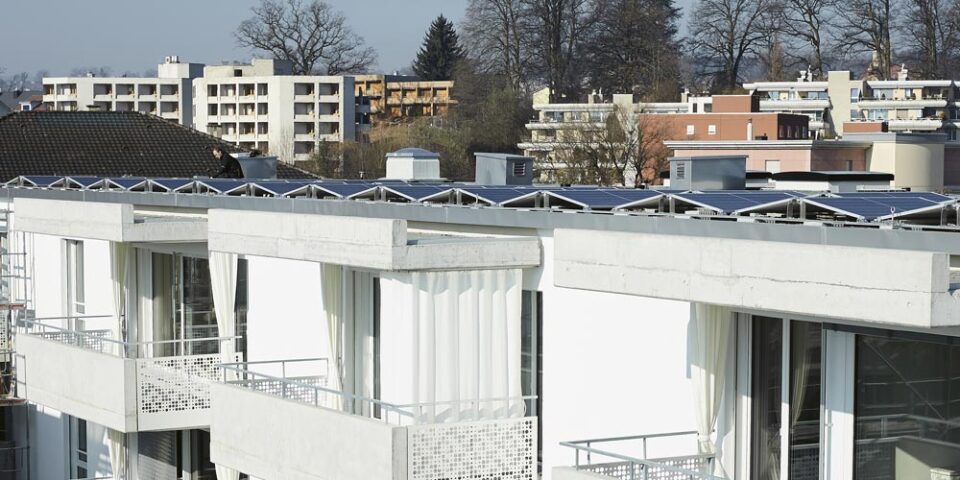
    A holistic energy system for 73 apartments:
    Heat pumps fed by groundwater
    four roofs with photovoltaic systems
    Charging system connection for electromobility
    passive cooling via the groundwater in summer
    System optimized for self-consumption
    a contact point at EKZ during operation

  • IJZ Schlieren receives a photovoltaic system and e-charging stations

    IJZ Schlieren receives a photovoltaic system and e-charging stations

    The municipal properties on Rütistrasse in Schlieren will be equipped with a photovoltaic system and e-charging stations by decision of the city council. In its most recent meeting, the city council for installation and operation signed the electricity works of the canton of Zurich ( EKZ ), according to the latest edition of the city council news. The IJZ innovation and start-up center Schlieren is housed in the building complex on Rütistrasse.

    The photovoltaic system will be installed on the roof of the commercial building. According to the city council news, EKZ will install 1080 panels on an area of 4200 square meters. They should produce an output of 355,000 kilowatt hours per year.

    Six charging stations for electric vehicles will also be set up. They are not only available to employees and visitors of the IJZ Schlieren. Outside business hours, they can also be used by the general public.

    For the project, it is envisaged that the electricity works of the Canton of Zurich will finance and install the systems on the two main roofs at Rütistrasse 12/14 and 16/18 as well as an additional six e-charging stations along the Rütistrasse 12/14 facade and for 20 years with one Operate full guarantee. After the end of the contract period, the installations become the property of the property owner.

    The total costs are given as around CHF 554,520.

  • Zurich airport region – digitization and development

    Zurich airport region – digitization and development

    [smartslider3 slider=”9″]

    The event was moderated by Monika Schärer, who confidently guided the guests through the afternoon. After a brief welcome, Arun Banovi, owner of immo!nvest/immoTable, and Christoph Lang, managing director of FRZ Flughafenregion Zürich, were briefly asked about the economic region and the connection with immo!nvest.

    In addition, Fabian Streiff from the Zurich Business Development Agency gave the first presentation and presented the region in more detail. From this it emerged that the canton of Zurich is a globally significant hub for artificial intelligence (AI). He also introduced us to the innovation hubs in the Zurich airport region, including the Digital Health Center (Bülach), The Circle (Kloten) and the Zurich Innovation Park (Dübenorf).

    As the second speaker, Hans Egloff, President of HEV Switzerland, brought us closer to the topic of digitization in the real estate industry. Using various examples, he explained the opportunities and risks of digitization. For example, the AHV number serves as a personal identifier in the electronic land register and this entails a large group of authorized users and thus a large potential for misuse.

    Before the break, Tindaro Milone, Head of Large Plants, presented the EKZ and explained what is currently happening in the energy sector. For example, the scarcity of resources, climate change, politics and customer needs. He then presented the future of energy, it is mainly about decarbonization, digitization and decentralization. Of course, sustainability is also a topic that is very topical and will continue to occupy you in the future. He completed his presentation on the subject of electricity storage.

    After the first part of the program there was a break that was used for the first talks. There were also cool drinks, refreshing fruits and delicious cakes.

    This was followed by Dadvan Yousuf, who introduced us to his platform “Dohrnii”, where everyone can easily learn about cryptocurrencies in a playful way. The presentation also included the Dohrnii Markplace, the DHN Token and the Dohrnii DAO. Finally, he made the connection and opportunities between cryptocurrencies and the real estate industry.

    Then Christoph Axmann, Chartered Surveyor MRICS at Wüest Partner, came on stage. With overviews of the population and employment development, he showed the demand in the Glattal-Furttal region. Then he showed which offer can be used to cover inquiries. Below that are investments, quantities, supply in relation to inventory and prices. Finally, he showed the development potential in the airport region.

    The last speaker was René Götz from the business development department of the city of Bülach. He introduced the business location Bülach, showed the positioning, spoke about the goals and available development areas. The key sectors of the region, the space requirements of companies and the Digital Health Center Bülach were also included in the presentation.

    The crowning glory was the exciting panel discussion with Doris Meier (Mayor of Bassersdorf), Christoph Lang (Managing Director of the FRZ Zurich Airport Region), Fabian Streiff (Local Promotion Canton of Zurich) and Heinz Eberhard (Eberhard companies).

    During the aperitif with delicious appetizers and ice cream, there was a lot of networking. The atmosphere was very good and relaxed. Especially when the draw for the competition was due. You could win a trip to the Top of Europe – Jungfrau Joch with overnight stay and dinner for 2 people. This great prize was sponsored by eSMart, which celebrated its 10th anniversary last year. Monika Schärer made it exciting and presented the award to the delighted winner Markus Nussbaum.

    We would like to take this opportunity to thank all guests and speakers for the exciting afternoon. A big thank you also goes to the Eventalm for the great and flexible organization, the friendly service and the delicious treats. But we don’t want to forget our partners either, without you such an event would not have been possible! Thanks to EKZ, eternit, eSMART, Seitzmeir, Sunrise, SVIT Zurich, Rigips, PropTechMarket, Woonig and FRZ.

    We hope to see some of you in Lausanne on October 6th and in Basel on November 24th. Until then, we wish you a nice summer!

  • The Valley gets ecological heating and cooling from EKZ

    The Valley gets ecological heating and cooling from EKZ

    Mettler2Invest has commissioned EKZ with the ecological heating and cooling supply of The Valley, the energy supplier informs in a press release . The company was awarded the contract in the corresponding tender in autumn 2021. “EKZ convinced us with a comprehensive technical and ecological overall concept, with great flexibility and thorough advice,” Peter Mettler, CEO of Mettler2Invest, is quoted in the press release.

    The energy supplier will install ambient air heat pumps on the historic site of the Maggi factory. Mettler2Invest receives the so-called energy carefree package for site developers, explains EKZ. The systems remain the property of the energy supplier. Site developers and property owners benefited “from manageable costs and a carefree package for all questions relating to energy supply”.

    Within the agreed 30-year contract period, EKZ wants to avoid around 44,000 tons of CO2 through the systems. Commissioning is scheduled for autumn next year. The Valley area has a floor space of 21,650 square meters and offers space for around 125 companies.

  • Building the future of energy

    Building the future of energy

    The property right at the entrance of the municipality is less than 10 kilometers away from the city of Winterthur and is still an idyllic piece of land, with a direct connection to the banks of the Töss and with a view of meadows and forest. The goals of the Energy Strategy 2050 are being built here. The Verde Blu development has been inhabited since autumn 2019. So far, so normal. It is noteworthy, however, that this development covers a large proportion of its energy requirements itself and that exclusively from renewable sources. "The specifications of the Energy Strategy 2050 are an opportunity for the real estate industry," explains Dieter Stutz from Atlantis AG, which is active in the areas of environmental consulting, settlement planning and architecture and who developed the project. The heat supply via groundwater was the best and most convincing solution for the area. Atlantis planned and implemented this complex construction project together with EKZ.

    Sustainable living as a need
    The new construction project Verde Blu with nine residential and commercial buildings comprises 108 condominiums as well as various commercial areas that are used by a Migros branch, a community and a physiotherapy practice, among other things. An old, listed barn serves as a common room and provides rustic charm on the site. In contrast to this is the state-of-the-art technology that supplies the system with energy: groundwater is used as a heat source for the heating and hot water, which supplies the houses with decentralized heat pumps via a so-called anergiering. An anergy ring is a cold local heating system that, in contrast to conventional local heating systems, works with transfer temperatures below 30 degrees Celsius. Anergy networks therefore have no heat losses in the lines, but even achieve additional energy gains through the environmental heat. In summer, the buildings can be passively cooled with the groundwater via the anergy ring.

    A photovoltaic system that is optimally designed to meet the needs of the building provides the electrical energy for the building. The complex was only built after the apartments had already been occupied. Because they wanted to leave the decision for or against solar power to the owners. The fact that the system with a peak output of 100 kilowatts was approved by an overwhelming majority at the first owners' meeting in winter 2019 speaks for itself. Martin Nicklas, who is responsible for modern energy solutions at EKZ, is not surprised: "In the real estate sector, we have long known the need to make a contribution to sustainability in the living area as well." A charging infrastructure for the 209 parking spaces was installed in the lower-level garage. Thanks to load curve management, it is possible to charge the cars in stages if a whole fleet of electric vehicles should one day populate the garage.

    Well-coordinated system
    In Kollbrunn, power generation as well as heating and cooling generation and electromobility are combined in an integrated energy system. The centerpiece is an intelligent control system that maximizes the self-consumption rate and takes over load management. In this way, what is actually the most important goal can be achieved: that the electricity produced by the PV system is also consumed as much as possible on site. The controller uses weather forecasts from an external weather portal for this purpose. An algorithm in the control system evaluates this data and decides on the previous evening whether enough solar power will be produced the next day to charge the boiler and storage tank of the heating system. If the solar production is too low, the boilers are charged during the night at the low tariff, otherwise the system waits until enough solar power is available the next day to start the heat pump.

  • Revolutionary energy storage

    Revolutionary energy storage

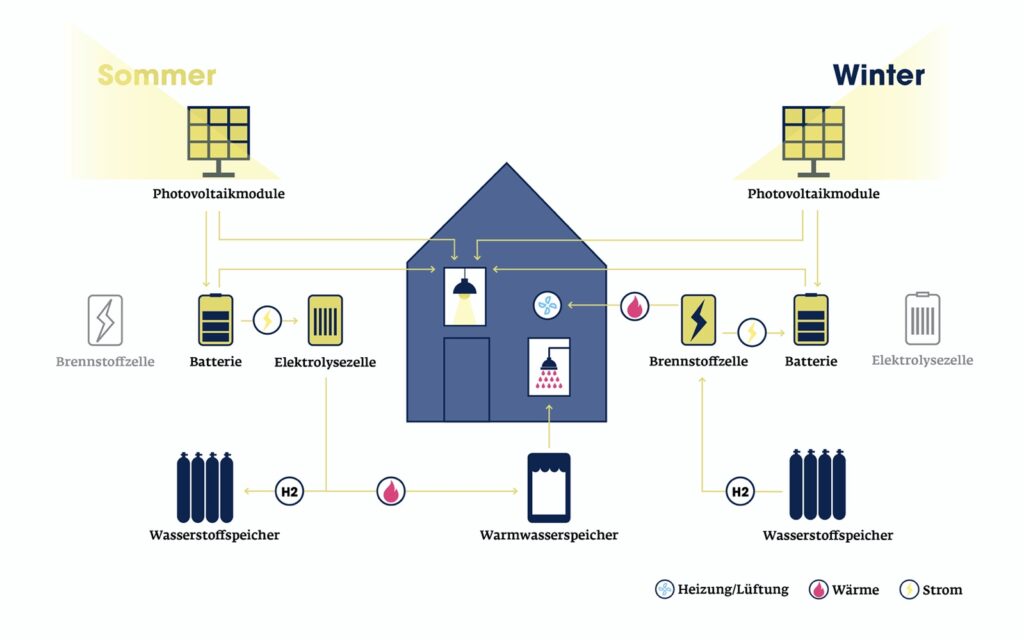
    The apartment buildings in Seebrighof store solar power in the form of hydrogen. Dr. Martin Nicklas, Head of Energy Contracting at EKZ, explains the revolutionary power-to-gas concept: “On summer days, the solar system on the roof of the Seebrighof will produce more electricity than the residents can use. The so-called power-to-gas plant turns this into hydrogen. In winter the energy requirement is higher. Then the stored hydrogen is converted into energy. Around 55 percent of this is used to generate electricity in the system’s fuel cells. The remaining 45 percent of the energy escapes as waste heat, which is used to heat the building. ” The hydrogen is produced from tap water that is processed directly in the plant. Oxygen is created as a quasi waste product, which escapes into the ambient air. This is environmentally friendly because in winter the hydrogen is converted back into water and renewable energy with oxygen from the air. This closes the cycle. The system only uses locally produced solar power for production, and the public power grid is relieved.

    EKZ as a pioneer
    With a battery in the house, short-term fluctuations in solar power production in the summer are absorbed and, for example, solar power is stored for the night. The P2G system constantly converts the excess remaining free into hydrogen. As a result, it can be implemented more cost-effectively and operated more efficiently. For Nicklas, EKZ is taking on a pioneering role in the conversion to renewable energy supply: “For the first time in Switzerland, a P2G system is being implemented that can also be used cost-effectively in other properties of different sizes – even in existing buildings. With the system, we are testing the potential of seasonal energy storage from solar power for the winter. ” There are a few properties with hydrogen systems in Switzerland, including in the canton of Zurich. The difference in the project in the Seebrighof is the standardized concept, which can be easily and inexpensively applied to other buildings.

    Power-to-gas system
    But it gets even better: thanks to the power-to-gas system, most of the solar power can be used locally. The electrical efficiency of the P2G system is around 30 to 35 percent across all processes. The rest is generated as waste heat, which is used for hot water heating in summer and for heating in winter. Would you be able to supply yourself with energy completely independently at the Seebrighof? – «This would be technically possible and is already being done in this way in individual properties. However, this would be very costly and was therefore not the aim of this project. “

    Safe hydrogen storage
    Appropriate safety precautions must be taken when storing flammable and potentially explosive gases such as natural gas or hydrogen. These measures are checked by the authorities to ensure safe installations. Hydrogen is usually stored outdoors, with any leakage gas quickly volatilizing and thus preventing an explosive mixture. In the current case, according to Nicklas, the H2 is stored in commercially available gas cylinders that fully meet Swiss safety standards and norms.

    When is a P2G system worthwhile?
    The answer depends on many factors and must always relate to the specific building project and the requirements of the client, as Nicklas explains: “The fundamental question is how often the hydrogen storage tank can be charged per year. Because with each charging cycle, the system generates a contribution margin that contributes to amortization. We are also testing this potential with the system and are further developing the concept accordingly. ” The client of the Seebrighof is also demonstrating a pioneering spirit with the project. In this way, she does not only have the system installed from a purely monetary point of view. One would like to lead the way here and make a contribution to reducing the supply gap in winter – making society more independent of energy imports from fossil sources. The facility at Seebrighof can be financed well thanks to its cost-effective implementation, says Nicklas. She makes a significant contribution to research into seasonal storage technologies: “How economically effective the technology is is the subject of our investigations. In the next few years, however, we expect another significant price reduction on the hydrogen market, which could give the technology a boost.

    Energy strategy 2050
    In the Federal Council’s Energy Strategy 2050, storage technologies based on gases and liquids have a high priority. With the first standardized power-to-gas system, EKZ has reached an important milestone that could serve as an example for future developments. Nicklas concludes: “If we want to fully feed heat and power supply as well as mobility with renewable energy sources, we need efforts in all areas. Hydrogen as a storage medium can help to defuse the challenges of power supply in winter ».

  • Comprehensive energy systems by EKZ

    Comprehensive energy systems by EKZ

    The pressure on holistic ecosystems around real estate and their energy solutions is growing. EKZ simplifies this task with clever solutions.

    The combination and central management of electricity generation and storage, heat and cooling generation and electromobility in an integrated energy system leads to the simplification of property management, maximum living and working comfort and optimal energy efficiency in production. In addition, ecological sustainability is ensured.

    The goals of the Energy Strategy 2050 are being built here. Most of the Verdeblu development has been completed and inhabited since autumn 2019. It is noteworthy that this development covers a large proportion of its energy needs itself, and that exclusively from renewable sources.

    "The specifications of the Energy Strategy 2050 are also an opportunity for the real estate industry," explains Dieter Stutz from Atlantis AG, which is active in the areas of environmental consulting, settlement planning and architecture and who developed the project. The heat supply via groundwater was the best and most convincing solution for the area. Atlantis planned and implemented this complex construction project together with EKZ.

    On-site energy production
    The “Grand Chemin” development was built in Epalinges in western Switzerland, with some of the electricity required being produced on site by a photovoltaic system (PV). A new multi-family house is being built in Emmen (LU), which will be characterized by four heat pump systems with groundwater as an energy source and a photovoltaic system with ZEV. Seen in this way, the future of energy has long since begun in this country as well.

    Text: Mohan Mani, Image: zVg.

  • Building the future of energy

    Building the future of energy

    The property right at the entrance to the municipality is less than 10 kilometers away from the city of Winterthur and is still an idyllic piece of land, with a direct connection to the banks of the Töss and with a view of meadows and forest. The goals of the Energy Strategy 2050 are being built here. The Verde Blu development has been inhabited since autumn 2019. So far, so normal. It is noteworthy, however, that this development covers a large proportion of its energy requirements itself and that exclusively from renewable sources. “The specifications of the Energy Strategy 2050 are an opportunity for the real estate industry,” explains Dieter Stutz from Atlantis AG, which is active in the areas of environmental consulting, settlement planning and architecture and who developed the project. The heat supply via groundwater was the best and most convincing solution for the area. Atlantis planned and implemented this complex construction project together with EKZ.

    Sustainable living as a need
    The new construction project Verde Blu with nine residential and commercial buildings comprises 108 condominiums as well as various commercial areas that are used by a Migros branch, a community and a physiotherapy practice, among other things. An old, listed barn serves as a common room and provides rustic charm on the site. In contrast to this is the state-of-the-art technology that supplies the system with energy: groundwater is used as a heat source for the heating and hot water, which supplies the houses with decentralized heat pumps via a so-called anergiering. An anergiering is a cold local heating system that, in contrast to conventional local heating systems, works with transfer temperatures below 30 degrees Celsius. Anergy networks therefore have no heat losses in the lines, but even generate additional energy gains from the ambient heat. In summer, the buildings can be passively cooled with the groundwater via the anergy ring.

    A photovoltaic system, which is optimally designed to meet the needs of the building, provides the electrical energy for the building. The complex was only built after the apartments had already been occupied. Because they wanted to leave the decision for or against solar power to the owners. The fact that the system with a peak output of 100 kilowatts was approved by an overwhelming majority at the first owners’ meeting in winter 2019 speaks for itself. Martin Nicklas, who is responsible for modern energy solutions at EKZ, is not surprised: “In the real estate sector, we have long known the need to make a contribution to sustainability in the living area too.” A charging infrastructure for the 209 parking spaces was installed in the lower-level garage. Thanks to load curve management, it is possible to charge the cars in stages if a whole fleet of electric vehicles should one day populate the garage.

    Well-coordinated system
    In Kollbrunn, power generation as well as heating and cooling generation and electromobility are combined in an integrated energy system. The centerpiece is an intelligent control system that maximizes the self-consumption rate and takes over load management. In this way, what is actually the most important goal can be achieved: that the electricity produced by the PV system is also consumed as much as possible on site. The control uses weather forecasts from an external weather portal for this purpose. An algorithm in the control system evaluates this data and decides on the previous evening whether enough solar power will be produced the next day to charge the boiler and storage tank of the heating system. If the solar production is too low, the boilers are charged during the night at the low tariff, otherwise there is a wait until there is enough solar power available the next day to start the heat pump.

    On-site energy production
    The “Grand Chemin” development was built in Epalinges in western Switzerland, with some of the electricity required being produced on site by a photovoltaic system (PV). A new multi-family house is being built in Emmen (LU), which will be characterized by a heat pump with groundwater and a PV with ZEV. Two examples out of many that show that the future of energy has long since begun.

    Comprehensive energy systems for your property

  • Hibernate with solar power

    Hibernate with solar power

    Buildings are increasingly becoming small power plants, since photovoltaic modules capture solar energy on more and more roofs. But the sun doesn't always shine and the demand for electricity fluctuates greatly over the year. Storage technologies are therefore in demand. Geothermal probes provide heat in winter, but no electricity. Batteries, on the other hand, make technical sense, but they are short-term storage devices and therefore not seasonal electricity storage devices. With the Seebrighof development in Hausen am Albis, the electricity works of the canton of Zurich are therefore taking a different, new approach. The 28 apartments in the attached farmhouse and the new building draw solar energy from the roof of the house. So that this is also available in winter, EKZ is installing a hydrogen storage facility – one of the first of its kind in Switzerland.

    If, on summer days, the solar system delivers more electricity than the residents consume, it does not get back into the grid. Instead, the power-to-gas plant uses it to make hydrogen. In winter, when the energy requirement is higher, the system converts the hydrogen back into energy. "In the fuel cells of the plant, around 55 percent of this electricity is generated," explains Georg Putzi, Product Manager Energy Contracting at EKZ. The remaining 45 percent of the stored energy escapes as waste heat, which heats the building.

    Seasonal electricity storage offers several advantages. The system is environmentally friendly because it only needs tap water and locally produced solar power. The public power grid is relieved. A battery compensates for short-term fluctuations, so the P2G system can be operated more efficiently.

    In summer, the power-to-gas system uses solar energy to make hydrogen; in winter, it converts it back into energy.

    The system in Hausen am Albis is based on a standardized concept that EKZ developed. This makes the technology cheaper, more adaptable and scalable. It can also be used for larger residential complexes or retrofitted in old buildings. "If there is already a solar system with an association for self-consumption (ZEV), the hydrogen technology can be supplemented," says Putzi. The technology can also be easily combined with heat pump systems, as in Hausen am Albis. In winter the environment supplies the heat (e.g. geothermal probes, groundwater or air), the hydrogen storage system supplies the electricity.

    The P2G system has no particular influence on the building services; it just needs space near the heating center. In contrast, the gas storage facility is architecturally relevant. For safety reasons, it must be positioned outside the building so that the volatile hydrogen can escape in an emergency. The gas storage consists of gas cylinders, which are grouped as a bundle and covered with a housing that the architects can adapt.

    With the system, the client increases the energy self-sufficiency and saves electricity costs in winter. "The P2G system is currently not yet cost-covering," says Georg Putzi. If the electricity prices rise in the future and the costs for the system fall, it will become significantly more economical. “Such pioneering work is important in order to gain experience and develop the market further,” says Putzi. Switzerland currently imports a lot of electricity in winter. If Germany switches off the coal-fired power plants, the winter shortage will be even greater. Storage technologies based on gases and liquids are therefore given high priority in the Federal Council's Energy Strategy 2050. With a P2G system, the buildings can help alleviate the challenges in terms of power supply in winter.

  • The borders disappear in the Limmatstadt

    The borders disappear in the Limmatstadt

    The customer magazine " blue " of the electricity works of the canton of Zurich ( EKZ ) dedicates its cover story to the development of the Limmatstadt. In conversation in Schlieren and at urban development centers along the Limmattalbahn, the managing director of the Limmatstadt AG location promotion company, Jasmina Ritz, explains the idea behind the project. “A city is emerging” is the title of the latest edition of “blue” with a photo of Jasmina Ritz on the roof of the Bio-Technopark in Schlieren. "Here we are in the epicenter of the urban development of the Limmatstadt," Ritz is quoted as saying. And: "From up here you can no longer see any boundaries."

    With this sentence and in the long conversation with the author Luc Descombes, the person responsible at Limmatstadt AG makes it clear that the advantages and strengths of the individual communities should be brought together in the common vision of the Limmatstadt. "That is why a common self-image is so central," Ritz is quoted as saying. According to the text of “blue”, at least 200,000 people live in the catchment area of the so-called Limmatstadt, depending on the perspective. In the opinion of Jasmina Ritz, this deserves “a strong joint appearance and powerful location marketing”.

    In the main story published under the second title "Vision Limmatstadt", the examples of the communities of Schlieren and Dietikon show the emergence of a "liveable city" across the canton border into Aargauische Spreitenbach. The importance of the Limmattalbahn, which is currently under construction, for regional merging is emphasized. Jasmina Ritz says: “Wherever a tram goes, urban space is created. The Limmattalbahn is crucial for the positive development of the region. "

    The EKZ's commitment in this area is made clear in "blue" with the company projects. The Dietikon EKZ hydropower station supplies 4,500 households, the Oberengstringen substation has been providing an additional 80 megawatts since 2020 and the EKZ has been laying dozens of kilometers of new lines and conduits for the Limmat Valley Railway since 2020 to strengthen the future power grid in the Limmat city. "Blue" appears twice a year with a circulation of 300,000 copies throughout the canton. The magazine goes to every household.

  • EKZ achieves good operating results with stable sales

    EKZ achieves good operating results with stable sales

    EKZ draws a positive balance for the 2019/20 financial year with stable sales, expansion of the production of renewable energy, especially in wind power, and an operating result that has enabled a profit distribution of CHF 41.3 million to the canton and municipalities for the first time. According to the press release, the operating result (EBIT) was CHF 61.3 million and the company's result, i.e. total income minus total expenses, was CHF 88.2 million.

    EKZ's electricity sales remained stable in the first half of 2020 despite the lockdown. The lower sales among traders and the closure of shopping centers have been compensated for by shifting to higher sales in home offices. The EKZ supplies around 315,000 households and businesses with renewable energy.

    The production capacities from renewable energy were expanded. The EKZ in Switzerland relies on the expansion of solar energy and domestic hydropower. The Dietikon river power plant was put back into operation. In Spain and Portugal the investment focus was on solar energy, in France and Germany on electricity production from wind power. With above-average wind conditions, 496 gigawatt hours of electricity were generated from wind energy, reports the EKZ.

    Other focal points of the shopping center were charging solutions for tenants, apartment or house owners as well as the prosumer area. These are electricity consumers who are producers themselves at the same time as their own solar systems.

    EKZ has been involved inPrimeo Energie AG since January 1st to work together in energy sales for energy supply companies and business customers.

  • Jasmina Ritz promotes the idea of the Limmatstadt

    Jasmina Ritz promotes the idea of the Limmatstadt

    According to Jasmina Ritz, the Limmat Valley and the idea of the Limmat City is more than just the route between Baden and Zurich. The managing director of Limmatstadt AG , now based in Schlieren, pointed out in an interview in the customer magazine "blue" of the electricity works of the canton of Zurich ( EKZ ) that the change from an agglomeration area to a coherent urban area has long been taking place there. "We accompany this change, bundle resources, combine the advantages and strengths of the individual communities into a common Limmat city", Ritz is quoted as saying. It names four important cornerstones for the realization of the idea of transforming the many municipalities – which are not to be merged – into a city on the Limmat: Networking of municipalities and politicians, the economy and the population. As a second point, Ritz mentions the positioning of the region with a common face, the development of the region as well as image promotion and the creation of a supra-regional awareness.

    From Jasmina Ritz's point of view, the Limmattalbahn is very important for the desired cohesion. The managing director is quoted as saying that it is not just a huge commitment to the federal and cantonal region. The railway networks the communities and is the backbone of urban development, "Without the tram, the Limmat Valley would have been just an agglomeration", Ritz is quoted as saying in "blue".

    This growing together and a shared cross-border vision was made possible by the development in the Limmat Valley. In the past, this was only perceived as an industrial location and a traffic axis. But a common city on the Limmat with its numerous municipalities would have much more economic and political weight. Limmatstadt AG is setting a cultural and economic agenda for the entire region. The regional magazine "36 km" – named after the length of the Limmat between Zurich and Baden – draws attention to regional products or recommends the best hiking trails, bike routes and the like. The daily newsletter “punkt4 Limmatstadt”, in which the activities of the companies are exclusively present, contributes to the “branding strategy”, ie the anchoring of the name Limmatstadt in the consciousness. Ritz: "There is no other region."

  • The first free space solar system from EKZ is on the grid

    The first free space solar system from EKZ is on the grid

    EKZ 's Algibicos solar power plant near the southern Spanish city of Murcia started operations on Tuesday, according to a media release . This means that the Zurich-based energy company's first large open-space solar power plant has gone online.

    On an area of 85 hectares, it will produce a little over 90 gigawatt hours of electricity per year. This corresponds to the annual consumption of more than 20,000 households. With over 300 days of fine weather, the area was one of the sunniest in all of Europe. In addition, the yield is increased by movable solar panels that are oriented towards the sun.

    "Compared to Swiss systems, around twice as much electrical energy can be generated," said Jean-Marc Degen, senior project manager at EKZ Renewables, in the press release. In addition, plants of this size are hardly feasible in Switzerland. The meanwhile low production costs and the sunny location enabled profitable operation, even without state feed-in tariffs.

  • EKZ supplies the Limmat Valley with a further 80 megawatts

    EKZ supplies the Limmat Valley with a further 80 megawatts

    With the facility in Oberengstringen, the electricity works of the canton of Zurich (EKZ) put their third substation in Limmat Valley into operation. The Limmattal is now supplied by the three substations Schlieren, Dietikon and Oberengstringen. The new substation with an output of 80 megawatts will gradually be put into operation by next February.

    "This means that we are very well prepared for the steadily growing energy demand in the region", Hans-Peter Häberli, Head of Construction and Systems at EKZ, is quoted in an interview . The economic upswing in the Limmattal with the settlement of new companies, a large data center and the Limmattalbahn is causing the demand for electricity to rise sharply. Häberli: “We have generally seen strong increases in load in the Limmat Valley over the past few years. In the future, the energy demand will be driven by the Limmattalbahn and the establishment of a data center in the region. The Schlieren substation, which previously supplied the region with energy, must therefore be relieved. Its capacity would soon no longer be sufficient. "

    The electrical energy is converted in the new substation. In the case of Oberengstringen, EKZ takes over the electricity with a voltage of 110 kilovolts from the Axpo high-voltage network. The energy is converted to 16 kilovolts with two 40-megawatt transformers, according to the EKZ website. After that, the electricity would be further stepped down until it is fed into the grid for end users such as housing estates.

    The connection of the new plant is to take place gradually by February. According to Häberli, Oberengstringen will then be fully connected to the Axpo high-voltage network. The communities of Ober- and Unterengstringen, Weiningen and parts of Schlieren are then supplied.