Tag: elektrizität

  • STRABAG builds utility lines in Arbon

    STRABAG builds utility lines in Arbon

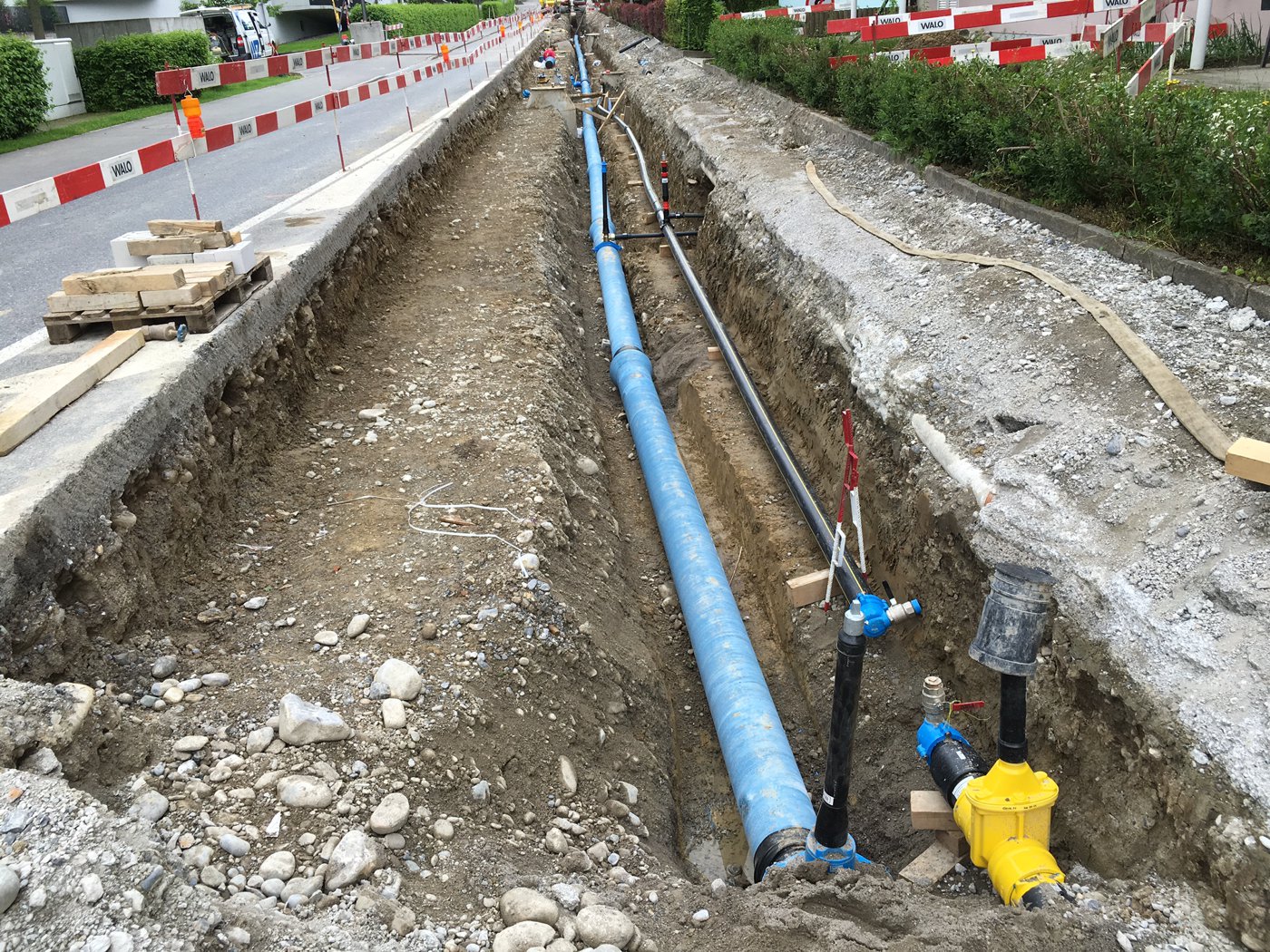
    The Schlieren-based construction company STRABAG AG is building new underground pipes in Arbon, according to a press release. According to the company’s press release, the service lines in Amriswilerstrasse and Egnacherstrasse in Arbon were in a state of serious disrepair. These service lines for water, electricity, gas and the Swisscom data cables are being completely renewed. A new rainwater drain will also be created as part of the work.

    According to STRABAG, the project is characterised by the cooperation between the municipality and the utility company. The construction costs will be borne jointly.

    According to STRABAG, the last renovation of the utility lines was decades ago. Surprises were therefore inevitable during the work. For example, the employees had to uncover power lines by hand. During the process, a mistake would have led to the power being switched off in the entire neighbourhood.

    At the same time, the traffic flow and the interests of neighbours had to be kept in mind. One junction leading to an agricultural machinery park was particularly tricky because there was no way to divert traffic there. However, Ivo Schlappritzi’s team found a solution and a complete closure was avoided without delaying the construction work.

    “Thanks to careful planning and close collaboration with Innoplan Bauingenieure AG, we were able to successfully overcome the challenges on this construction site. Together as a team, we ensured that the new utility lines could be handed over to the municipality of Arbon on schedule in autumn 2025,” said Schlappritzi, STRABAG construction manager for civil engineering and road construction in the Mittelland region.

    Innoplan Bauingenieure AG is an engineering office for structural and civil engineering based in Arbon.

  • Falling electricity prices in 2025

    Falling electricity prices in 2025

    The Swiss Federal Electricity Commission has published its calculations for electricity tariffs in 2025. A typical Swiss household with a consumption of 4,500 kWh will pay 29 centimes per kilowatt hour in the coming year, which corresponds to a reduction of 3.14 cents/kWh compared to 2024. This price reduction will result in an annual saving of 141 francs and reduce the electricity bill to a total of 1,305 francs.

    The reductions affect both grid costs and energy tariffs. While the grid costs for a typical household will fall by 4 per cent from 12.71 cents/kWh to 12.18 cents/kWh, the energy tariffs will fall by 12 per cent to 13.7 cents/kWh. Charges to local authorities (1 Rp./kWh) and the grid surcharge (2.3 Rp./kWh) will remain unchanged. There are signs of similar reductions for small and medium-sized companies.

    Fluctuating prices depending on the grid operator
    Electricity tariffs vary greatly depending on the grid operator. This is mainly due to differences in in-house production and procurement strategies. Some grid operators that focus more on long-term procurement are better able to compensate for short-term price fluctuations, but bear higher costs over longer periods. The differences in energy procurement strategies lead to considerable price differences between the regions.

    Reasons for the price reductions
    The more stable wholesale electricity prices are one of the main reasons for the easing of tariffs. Following the significant price increases in 2023 and 2024, wholesale prices are currently quoted at around EUR 90/MWh, which represents a decrease compared to the previous year’s EUR 150/MWh. This market easing will now have a gradual impact on energy tariffs.

    Another factor is the reduction in costs for the winter reserve. While these were still at 1.2 Rp./kWh in 2024, they will fall to 0.23 Rp./kWh in 2025. The return on capital for the grid, the so-called WACC, has also fallen slightly, which also has a cost-reducing effect.

    Procurement strategies and own production as key
    The tariffs in the basic supply are strongly influenced by the production and procurement portfolio of the energy suppliers. In-house production and the timing of electricity procurement are decisive factors. Grid operators that spread their procurement strategies over longer periods of time are better able to cushion price fluctuations on the wholesale market. The level of in-house production also influences the production costs, which are sometimes lower than market prices.

    However, grid costs remain relatively high due to the high market prices, as they are also affected by electricity price-dependent components such as active power losses and ancillary services (AS). Swissgrid provides these ancillary services for the short-term stability of the system and passes the costs on to the grid operators, who in turn charge them to end consumers.

    Transparency for consumers
    ElCom has published the 2025 electricity tariffs for all municipalities and grid operators. These can now be viewed on the website www.strompreis.elcom.admin.ch and offer consumers the opportunity to compare tariffs and find out about the development of electricity prices.

  • CKW activates minimum remuneration for solar power

    CKW activates minimum remuneration for solar power

    CKW wants to protect operators of small solar plants from very low market prices, especially in summer, and help them to amortise the plant. To this end, the Axpo subsidiary is already applying the minimum remuneration for solar power planned by the federal government from the billing for the second quarter of 2024, CKW announced in a press release. Operators of solar plants with an output of up to 150 kilowatts are expected to receive a minimum price for their solar power from the beginning of 2025 if the reference market price set by the Swiss Federal Office of Energy is particularly low.

    CKW is basing the amount of the minimum remuneration currently paid on the draft ordinance. It provides for different minimum remuneration per kilowatt hour depending on the size of the plant. In addition, the Lucerne-based energy service provider also voluntarily acquires a guarantee of origin for solar power. This amounts to 2 centimes per kilowatt hour for small solar plants and 1 centime per kilowatt hour for plants with an output of 100 kilowatts or more.

    In the press release, CKW also advises operators of photovoltaic systems to optimise their own consumption. This is particularly worthwhile in phases with low reimbursements. In addition to its own energy management solutions and battery storage systems, CKW also recommends joining forces with neighbours to optimise self-consumption. The new Electricity Act, which was approved by voters on 9 July, also opens up further options such as the formation of local electricity communities or virtual associations for self-consumption.

  • New pipeline cadastre portal creates transparency and added value in the construction industry

    New pipeline cadastre portal creates transparency and added value in the construction industry

    Zurich has introduced a new, advanced system for visualising infrastructure networks. The canton of Zurich’s pipeline register provides a complete visualisation of all above-ground and underground pipelines responsible for water, wastewater, electricity, district heating, gas and communications. Centralising this data in a single information system makes it much easier to access relevant information for planning, construction and maintenance work.

    Simplified access to information
    Previously, interested parties had to obtain information on pipelines individually from the respective owners or operators – a time-consuming process. With the new pipeline cadastre portal, the canton of Zurich now offers a central point of contact that enables users to access this important data quickly and easily. Over 500 works operating in the canton regularly update their data in this system, ensuring the accuracy and reliability of the information.

    Wide range of applications
    The portal serves a wide range of users, including public administrations, construction companies, rescue and security services and private individuals. The precise information on the type and location of pipelines improves planning reliability for construction projects and facilitates the maintenance and expansion of existing infrastructure. Although the portal is not intended to be used for the direct planning of excavation work, it helps to significantly reduce the risk of damage by providing clear documentation of pipe routes.

    Simple operation and access to data
    The pipe cadastre portal is designed to be user-friendly. Users can search by municipality, parcel or street and select the medium of interest. The corresponding pipes are then displayed on the digital map. The data is easily accessible and available in standard formats. Additional information such as ownership and contact details of the relevant works are also provided.

    The portal can be accessed at: https://leitungskataster.zh.ch. Prior registration is required to use the portal.

  • EWN dispenses with alpine solar plants

    EWN dispenses with alpine solar plants

    The Nidwalden cantonal electricity utility(EWN) has examined a total of six sites in its supply area for their suitability for the construction of alpine solar plants. In a first step, two sites were assessed as suitable in principle.

    However, extensive investigations revealed that the steepness of the terrain at both sites posed particular challenges for the construction and financing of the plants, EWN writes in a press release. EWN refers to the pressure of the snow, avalanches, landslides and possible rockfalls. Possible protective measures would have been so expensive that the plants would no longer have been economically viable.

    EWN has therefore decided not to pursue the two projects for the time being. Should the general conditions change, they could be reactivated.

    Among other things, EWN operates the Dallenwil hydropower plant and a solar plant on the Stans country park. It also holds a stake in Repartner Produktions AG, a joint venture between Repower and other regional energy suppliers for joint participation in renewable energy projects.

  • ABB invests 500 million euros in electrification

    ABB invests 500 million euros in electrification

    ABB and the European Investment Bank(EIB) have signed a financing agreement for a loan totalling 500 million euros, ABB announced in a press release. The Zurich-based technology company intends to use the funds to develop semiconductor-based circuit breakers, environmentally friendly switchgear and technologies to improve efficiency and automation in buildings. The funds will be channelled into corresponding research by ABB in Switzerland, Germany, Italy, the Czech Republic, Finland, Norway, Poland and other European countries.

    “Electrification is crucial in the fight against climate change,” EIB Vice-President Ambroise Fayolle is quoted as saying in the press release. “With our loan to ABB, we are supporting a company with a long history of developing electrical products and a strong commitment to promoting practical solutions that make the European economy greener.”

    The new power distribution solutions are intended for use in functional buildings, industrial operations and microgrids, for example. The development and commercialisation of technologies is a high priority in ABB’s growth strategy. Last year, the company invested around 1.67 billion dollars, or around 4 per cent of its consolidated sales, in research and development.

  • Canton Schaffhausen increases stake in cantonal works

    Canton Schaffhausen increases stake in cantonal works

    The canton of Schaffhausen is buying a temporarily owned 10 percent stake from its power station, informs the canton administration in a message . The shares were sold by the canton to EKS three years ago when the canton took over a total of 25 percent of EKS from Axpo Holding . At that time, the canton had sold the remaining 15 percent to EKT Holding AG ( EKT ) from Thurgau.

    The canton paid Axpo a total of CHF 53 million in 2017 to acquire the block of shares. They were reapplied by reselling 10 percent to EKS at a price of 21.2 million francs and reselling 15 percent to EKT at a price of 31.8 million francs.

    In January of last year, the canton considered buying back the shares held by EKS as part of its ownership strategy, the announcement further explains. The EKS never intended to hold the shares itself in the long term, it says there. As the purchase price, the two partners have agreed the price of 21.2 million francs already paid for the transaction three years ago.

    After the transaction, the canton will hold an 85 percent stake in its cantonal works. The remaining 15 percent of the EKS should remain in the possession of EKT. The canton administration wrote that this was welcomed “particularly with a view to the synergy potential in the network area, both by the government council of the canton of Schaffhausen and the government council of the canton of Thurgau as well as the boards of directors of EKS and EKT”.

  • LafargeHolcim intensifies efforts to achieve climate goals

    LafargeHolcim intensifies efforts to achieve climate goals

    As the first globally active building materials group, LafargeHolcim has committed itself to scientifically sound goals for reducing its CO2 footprint, explains the Zug-based cement giant in a press release . Specifically, LafargeHolcim will participate in the Science-Based Targets Initiative ( SBTi ) campaign. Its aim is to motivate companies to set scientifically sound, measurable objectives with which the climate target of limiting global warming to 1.5 degrees Celsius can be met.

    As part of the campaign, LafargeHolcim will reduce CO2 emissions per tonne of cementitious building materials to 475 kilograms, the company explains in the press release. Furthermore, the Zug-based building materials group wants to increase the use of low-carbon and CO2-neutral building materials. In addition, the company's footprint is to be reduced by increasing the reuse and recycling of waste and by-products. Overall, LafargeHolcim aims to reduce direct greenhouse gas emissions and CO2 emissions from purchased electricity by more than 20 percent by 2030 compared to 2018.

    "As the world's largest cement manufacturer, we are playing a key role in overcoming the challenges of today's climate crisis," said Magali Anderson, Chief Sustainability Officer of LafargeHolcim, quoted in the press release. "On our way to becoming a 'net-zero' company, we are not only part of the solution, but we also support our customers in achieving their carbon reduction goals."