Tag: Elektrizitätswerke des Kantons Zürich

  • Hibernate with solar power

    Hibernate with solar power

    Buildings are increasingly becoming small power plants, since photovoltaic modules capture solar energy on more and more roofs. But the sun doesn't always shine and the demand for electricity fluctuates greatly over the year. Storage technologies are therefore in demand. Geothermal probes provide heat in winter, but no electricity. Batteries, on the other hand, make technical sense, but they are short-term storage devices and therefore not seasonal electricity storage devices. With the Seebrighof development in Hausen am Albis, the electricity works of the canton of Zurich are therefore taking a different, new approach. The 28 apartments in the attached farmhouse and the new building draw solar energy from the roof of the house. So that this is also available in winter, EKZ is installing a hydrogen storage facility – one of the first of its kind in Switzerland.

    If, on summer days, the solar system delivers more electricity than the residents consume, it does not get back into the grid. Instead, the power-to-gas plant uses it to make hydrogen. In winter, when the energy requirement is higher, the system converts the hydrogen back into energy. "In the fuel cells of the plant, around 55 percent of this electricity is generated," explains Georg Putzi, Product Manager Energy Contracting at EKZ. The remaining 45 percent of the stored energy escapes as waste heat, which heats the building.

    Seasonal electricity storage offers several advantages. The system is environmentally friendly because it only needs tap water and locally produced solar power. The public power grid is relieved. A battery compensates for short-term fluctuations, so the P2G system can be operated more efficiently.
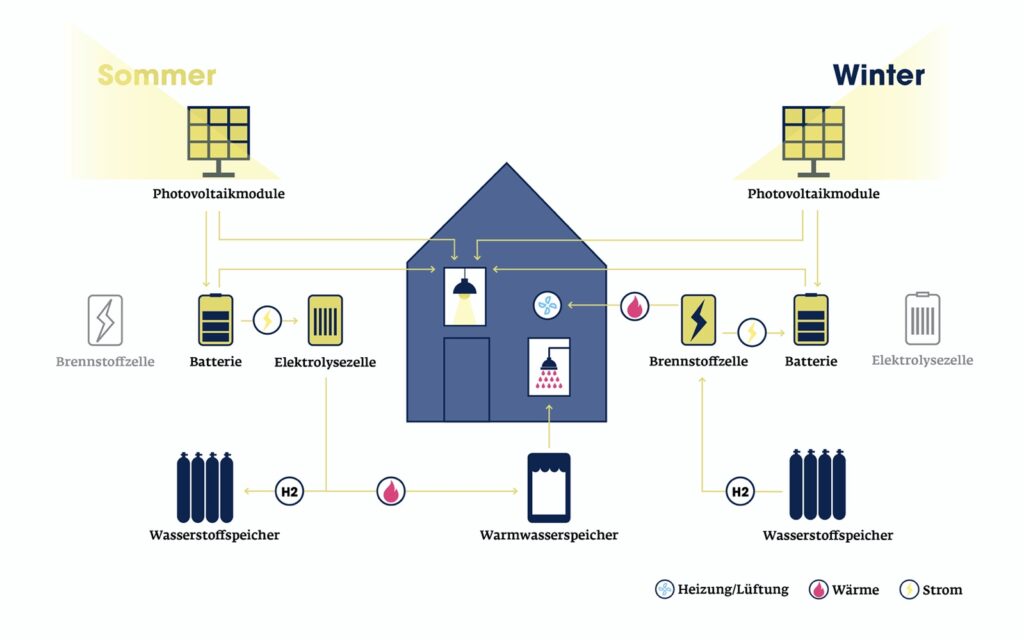
    In summer, the power-to-gas system uses solar energy to make hydrogen; in winter, it converts it back into energy.

    The system in Hausen am Albis is based on a standardized concept that EKZ developed. This makes the technology cheaper, more adaptable and scalable. It can also be used for larger residential complexes or retrofitted in old buildings. "If there is already a solar system with an association for self-consumption (ZEV), the hydrogen technology can be supplemented," says Putzi. The technology can also be easily combined with heat pump systems, as in Hausen am Albis. In winter the environment supplies the heat (e.g. geothermal probes, groundwater or air), the hydrogen storage system supplies the electricity.

    The P2G system has no particular influence on the building services; it just needs space near the heating center. In contrast, the gas storage facility is architecturally relevant. For safety reasons, it must be positioned outside the building so that the volatile hydrogen can escape in an emergency. The gas storage consists of gas cylinders, which are grouped as a bundle and covered with a housing that the architects can adapt.

    With the system, the client increases the energy self-sufficiency and saves electricity costs in winter. "The P2G system is currently not yet cost-covering," says Georg Putzi. If the electricity prices rise in the future and the costs for the system fall, it will become significantly more economical. “Such pioneering work is important in order to gain experience and develop the market further,” says Putzi. Switzerland currently imports a lot of electricity in winter. If Germany switches off the coal-fired power plants, the winter shortage will be even greater. Storage technologies based on gases and liquids are therefore given high priority in the Federal Council's Energy Strategy 2050. With a P2G system, the buildings can help alleviate the challenges in terms of power supply in winter.

  • The borders disappear in the Limmatstadt

    The borders disappear in the Limmatstadt

    The customer magazine " blue " of the electricity works of the canton of Zurich ( EKZ ) dedicates its cover story to the development of the Limmatstadt. In conversation in Schlieren and at urban development centers along the Limmattalbahn, the managing director of the Limmatstadt AG location promotion company, Jasmina Ritz, explains the idea behind the project. “A city is emerging” is the title of the latest edition of “blue” with a photo of Jasmina Ritz on the roof of the Bio-Technopark in Schlieren. "Here we are in the epicenter of the urban development of the Limmatstadt," Ritz is quoted as saying. And: "From up here you can no longer see any boundaries."

    With this sentence and in the long conversation with the author Luc Descombes, the person responsible at Limmatstadt AG makes it clear that the advantages and strengths of the individual communities should be brought together in the common vision of the Limmatstadt. "That is why a common self-image is so central," Ritz is quoted as saying. According to the text of “blue”, at least 200,000 people live in the catchment area of the so-called Limmatstadt, depending on the perspective. In the opinion of Jasmina Ritz, this deserves “a strong joint appearance and powerful location marketing”.

    In the main story published under the second title "Vision Limmatstadt", the examples of the communities of Schlieren and Dietikon show the emergence of a "liveable city" across the canton border into Aargauische Spreitenbach. The importance of the Limmattalbahn, which is currently under construction, for regional merging is emphasized. Jasmina Ritz says: “Wherever a tram goes, urban space is created. The Limmattalbahn is crucial for the positive development of the region. "

    The EKZ's commitment in this area is made clear in "blue" with the company projects. The Dietikon EKZ hydropower station supplies 4,500 households, the Oberengstringen substation has been providing an additional 80 megawatts since 2020 and the EKZ has been laying dozens of kilometers of new lines and conduits for the Limmat Valley Railway since 2020 to strengthen the future power grid in the Limmat city. "Blue" appears twice a year with a circulation of 300,000 copies throughout the canton. The magazine goes to every household.

  • EKZ supplies the Limmat Valley with a further 80 megawatts

    EKZ supplies the Limmat Valley with a further 80 megawatts

    With the facility in Oberengstringen, the electricity works of the canton of Zurich (EKZ) put their third substation in Limmat Valley into operation. The Limmattal is now supplied by the three substations Schlieren, Dietikon and Oberengstringen. The new substation with an output of 80 megawatts will gradually be put into operation by next February.

    "This means that we are very well prepared for the steadily growing energy demand in the region", Hans-Peter Häberli, Head of Construction and Systems at EKZ, is quoted in an interview . The economic upswing in the Limmattal with the settlement of new companies, a large data center and the Limmattalbahn is causing the demand for electricity to rise sharply. Häberli: “We have generally seen strong increases in load in the Limmat Valley over the past few years. In the future, the energy demand will be driven by the Limmattalbahn and the establishment of a data center in the region. The Schlieren substation, which previously supplied the region with energy, must therefore be relieved. Its capacity would soon no longer be sufficient. "

    The electrical energy is converted in the new substation. In the case of Oberengstringen, EKZ takes over the electricity with a voltage of 110 kilovolts from the Axpo high-voltage network. The energy is converted to 16 kilovolts with two 40-megawatt transformers, according to the EKZ website. After that, the electricity would be further stepped down until it is fed into the grid for end users such as housing estates.

    The connection of the new plant is to take place gradually by February. According to Häberli, Oberengstringen will then be fully connected to the Axpo high-voltage network. The communities of Ober- and Unterengstringen, Weiningen and parts of Schlieren are then supplied.