The salt battery, an integral part of early electromobility, is a safe and durable storage medium that is convincing in various applications. In contrast to lithium-ion batteries, the salt battery uses a solid, ceramic electrolyte that is neither flammable nor explosive. In Switzerland, Empa researchers are working with industrial partners to further improve the performance and efficiency of this technology.
Advantages over conventional batteries The solid-state architecture and high operating temperature of around 300°C make the salt battery particularly suitable for extreme applications such as tunnelling or offshore installations, where safety is a top priority. Due to its temperature resistance and low-maintenance design, it is also used for the emergency power supply of mobile phone antennas, which have to work reliably for decades even under harsh conditions.
Economic efficiency and challenges One disadvantage of the salt battery is its high operating temperature, which requires a basic consumption of energy. Empa researchers such as Meike Heinz and Enea Svaluto-Ferro are therefore working on cell structures that enable the battery to heat itself during use and thus work more efficiently. Despite the additional energy requirement, the salt battery is considered more economical and stable than many alternatives in certain applications.
Resource-saving raw materials and recycling systems Another advantage is the availability of the required raw materials: Sodium and aluminium are inexpensive and plentiful, making battery production cost-effective and sustainable. Empa’s current research focus is on reducing the nickel content in the cells in order to further reduce the ecological footprint. In future projects, zinc could even replace nickel – an option that could further improve access to sustainable energy storage systems.
Future prospects As research progresses, the salt battery could find its way from specialised fields of application to broad, stationary applications. Its use as a long-lasting and safe storage system for residential areas or neighbourhoods is being seriously considered. It thus offers an innovative alternative to lithium-ion batteries and shows how research at Empa can set the course for the future of energy storage.
Researchers at DTU have developed an innovative material that could replace lithium in batteries: Potassium silicate, a widely available mineral extracted from common rock. According to the scientists, this solid-state battery could be an environmentally friendly, efficient and safe alternative to current lithium-ion batteries in around ten years’ time.
Challenges of current lithium-ion batteries Lithium-ion batteries currently used in electric cars have their limits. The capacity, safety and availability of lithium are limited. The mining of lithium is not only expensive, but often takes place under questionable conditions. The metal is also relatively rare, which makes scaling difficult and hinders the transition to sustainable electromobility.
In view of the growing interest in electric cars, the need for new, powerful and more environmentally friendly batteries is increasing. This requires the development of new materials for the anode, cathode and electrolyte as well as innovative battery concepts. Researchers around the world are working to find these new “recipes” to reduce carbon emissions from the transport sector.
The breakthrough with potassium silicate as a solid-state electrolyte Researcher Mohamad Khoshkalam from DTU has patented a superionic material based on potassium silicate. This mineral is one of the most common on earth and can be found in ordinary rocks. A major advantage of this new material is its insensitivity to air and moisture, which makes it ideal for use in batteries.
The milky-white, wafer-thin material can conduct ions at around 40 degrees Celsius and remains resistant to moisture. These properties make the scaling and production of future batteries much easier. As the material can be produced in an open atmosphere and at room temperature, it significantly reduces production costs. In addition, it does not require expensive and environmentally harmful metals such as cobalt, which are used in current lithium-ion batteries.
Potential and prospects The development of the potassium silicate solid-state battery could represent a significant turning point in the electric car industry. By utilising widely available, environmentally friendly materials, the dependence on rare and environmentally harmful metals could be reduced. This would not only reduce production costs, but also increase the sustainability and efficiency of batteries.
The DTU researchers are confident that their discovery can be brought to market maturity in the coming years. If this is successful, solid-state batteries made of rock could have a decisive impact on the future of electromobility and make a major contribution to reducing carbon emissions.
This ground-breaking technology proves once again that innovative approaches and research results are crucial to mastering the challenges of the modern world and finding sustainable solutions.
Enormous solar potential After a steady increase over the years, photovoltaics recorded a record increase in 2020. According to the "Solar energy statistics" of the Federal Office of Energy (SFOE), around 118,000 photovoltaic systems with an output of almost 3 gigawatts were installed at the end of 2020. The strong market growth continued in 2021, so that according to Swissolar, photovoltaics (PV) today covers more than 6 percent of Switzerland's electricity requirements. Experts assume that this trend will continue, not least in view of the efforts towards much more energy independence.
Ecological and economic advantages Photovoltaic systems bring a whole range of advantages for owners of real estate portfolios. On the one hand, they can protect themselves against rising electricity prices. On the other hand, they already meet possible future self-production specifications today. Also with regard to subsidies, new rules will make the production of solar power more attractive in the future. In addition, portfolio owners with their own solar systems benefit from a clear reputation advantage.
In most cases, PV power from your own roof is cheaper than power from the grid. The fact that power consumption due to heat pumps and electromobility will continue to rise in the future contributes to the financial attractiveness of PV systems. Improving the ecological balance sheet is also becoming increasingly important, because sustainability aspects are part of the strategy of more and more companies. Furthermore, PV systems are also interesting because they increase the value of real estate. If the photovoltaic systems produce more electricity than can be consumed on site, it is possible to use the solar power in other properties.
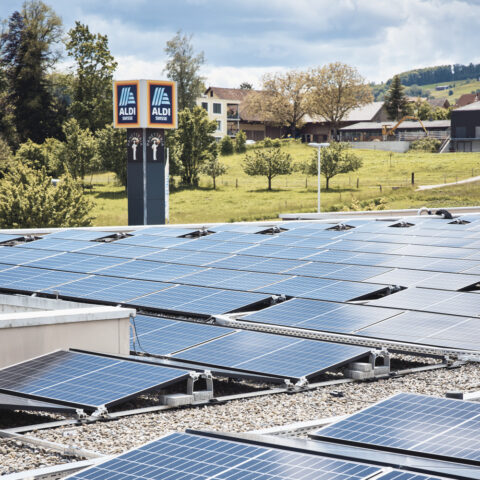
In the ALDI SUISSE solar project, for example, sustainability and cost-effectiveness play a key role. In just over a year, ewz equipped 68 store roofs between Romanshorn and Geneva with photovoltaic systems. ALDI SUISSE uses most of the solar power itself for its own branch operations. Thanks to the large PV systems, the implemented solution enables a high solar yield with an average self-consumption of 55 to 60 percent.
High self-consumption increases profitability There is already a heat pump in around 90 percent of new buildings, and new registrations of electric cars are continuing to rise sharply. However, heat pumps and electric vehicles are only really low in CO2 if they use renewable electricity. The combination with a photovoltaic system therefore makes sense: Solar power reduces CO2 emissions, and high self-consumption increases the profitability of the PV system. This is because the production costs for solar power are lower than the electricity tariff for households and because the energy suppliers pay a low tariff for the solar power fed into the grid.
A good way of using a large part of the solar power yourself is to organize several end users in a group for self-consumption (ZEV). These are possible both in rental properties and among property owners. The degree of self-consumption of photovoltaic systems is on average 30 to 40 percent. This value can be significantly increased with self-consumption solutions.
A large part of the electricity is used on site through the targeted control of consumers such as heat pumps or electric vehicles. The advantage for property owners and their tenants: the cost of solar power, at 8 to 16 centimes per kilowatt hour, is lower than the electricity tariff for households, which costs 15 to 25 centimes per kilowatt hour.
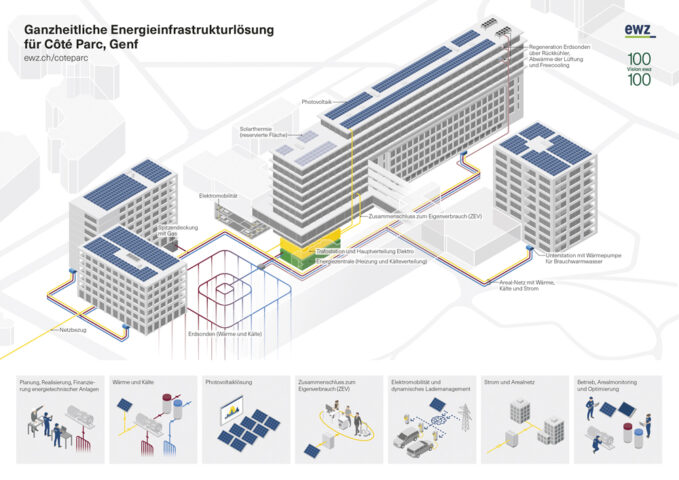
An interesting practical example of this is the "Côté Parc" project in Geneva. 776 photovoltaic panels on the roofs of the area form the basis for an integrated solar solution with heat pumps, charging stations for electric cars and the area's own power grid, including self-consumption for the users.
For property owners with large roof areas (from approx. 700 m2), a contracting model is an option worth considering. The provider takes over all services – from planning to financing, implementation to operation over several decades. Including the integration of photovoltaic systems, it is a holistic energy solution with heating, cooling, electromobility and self-consumption models.
Business customers of ewz can rely on efficient and tailor-made solutions from competent teams with many years of experience. Investment, maintenance and repair costs are not incurred during the contract period. After the end of the contract period – usually 20 to 30 years – the photovoltaic system becomes the property of the customer.
The Lucerne University of Applied Sciences and Arts ( HSLU ) has designed a practical example of sustainable living without CO2 emissions: a mobile home. The electricity that the Solar Butterfly needs inside is produced by fold-out solar wings. This also charges the electric towing vehicle. According to a press release , students led by Stephen Wittkopf are significantly involved in the implementation of the project. He heads the knowledge and innovation transfer at the Department of Technology & Architecture at the HSLU.
The Solar Butterfly is currently being built near Lucerne in central Switzerland. Its construction material consists largely of plastic waste that is collected from the sea and then transformed. The motorhome is 10 meters long and 13 meters wide with the sun panel wings up. They offer a total of 80 square meters of space for generating solar power.
The project was initiated by Swiss environmental pioneer Louis Palmer. 15 years ago he was the first person to circumnavigate the world in a solar-powered car. From May 2022, the Solar Butterfly will travel around the world together with its passengers. On this trip around the world they want to identify 1000 inspiring projects against global warming, record them and then publish them.
The two towers rise around 60 meters into the sky and thus shape the character of the Leutschenbach district in the north of the city of Zurich. However, “The Metropolitans” is not only visually impressive, it is also a showcase project when it comes to electromobility. The underground car park was equipped in such a way that a sustainable infrastructure for e-vehicles is available for the residents of the 212 apartments.
Clear decision When the residential towers were completed in 2015/16, there was only one charging station in the underground car park. Little by little, other residents had their parking lot equipped. “There was a certain amount of wild growth,” explains Christian Steiger, who, as the delegate of the condominium owners, accompanied the expansion from the start. “When other owners expressed their interest in a charging station, we set up a project team to find a uniform solution”. The team obtained offers and recommended the charging solution from ewz after a thorough examination. “Working with ewz in the evaluation phase was very pleasant and productive,” explains Steiger. “We were also impressed by the price-performance ratio, the know-how and the complete solution.” The joint owners’ meeting followed the recommendation and decided, by far more, in favor of the ewz solution.
Novel ceiling pillars After the award, ewz submitted a funding application to the City of Zurich, which covered up to 60 percent of the costs for the charging infrastructure as part of the 2000 watt contribution. The application was approved – implementation could begin in spring 2021. In a first phase, all 187 parking spaces in the underground car park were connected with a ribbon cable. This means that when you register, you only need to install and connect the charging station. Several dozen residents did this directly: in the summer of 2021, over 80 parking spaces were already equipped with a “easee” charging station.
Depending on the location of a parking lot, the charging station is either mounted on the wall (wallbox) or suspended from the ceiling. Such ceiling pillars, each with up to four charging stations, are ideal for parking spaces in the middle of underground garages and impress with their high-quality design. According to Christian Steiger, the feedback on the new charging infrastructure is very positive. “The charging stations look good and work perfectly,” he sums up.
Load management saves costs The charging infrastructure of “The Metropolitans” includes dynamic load management. It ensures that all connected e-cars receive sufficient electricity and are charged the next morning. At the same time, the system ensures that the need for charging is coordinated with the needs of the households. This automatic load balancing of the “easee” charging stations has the advantage that up to three times as many electric vehicles can be charged at the same time – 24 hours a day and thanks to a standard tariff at no additional cost. This prevents overloads or even power failures and ensures a reliable, stable power supply. In addition, thanks to the load management, an expensive expansion of the connected load of the two residential towers could be avoided.
Simple billing While the basic expansion of the charging infrastructure was paid for jointly by all floor owners using a distribution key, the individual owner pays for the charging station himself. After that, only low costs are incurred in operation. The users receive a chip card (RFID card) so that they can identify themselves at their charging station and enable charging. The ewz package also includes an app that shows the electricity used and the costs at all times. You will be billed monthly via a credit card that is stored in the app. Users only pay ewz CHF 9.90 per month for these services.
Advantages of the ewz charging solution Through the partnership, the residents benefit from a future-proof complete solution. The project team and the administration really appreciate having a single point of contact with ewz as the general contractor for the planning, implementation and operation of the charging infrastructure. This guarantees an efficient, practice-oriented solution with simple scalability. Ewz’s 24-7 customer service and its reputation as a city partner strengthen the customer’s feeling of security. You can also rest assured that your electric vehicles will only be charged with green electricity.
More than a third of energy consumption occurs in traffic, writes the Federal Office of Energy ( SFOE ) in a press release . The increased use of electric cars is intended to increase efficiency here. The communication names the expansion of the corresponding charging infrastructure as an important factor in promoting e-mobility.
In order to be able to document the development of the charging infrastructure, providers of charging stations and the SFOE have set up a joint data infrastructure, the SFOE explains further in the communication. With their help, the availability of public charging stations in Switzerland is displayed in real time on the www.ich-tanke-strom.ch portal. This data is used by the SFOE to generate key figures for the public charging infrastructure. They are made available on the portal as data visualization. The SFOE makes the underlying data available as open data on the opendata.swiss portal.
20 providers are now taking part in the project to document the development of the public charging infrastructure, including the largest charging networks in Switzerland, evpass, MOVE, swisscharge and Plug'n Roll. Interested providers of public charging stations are invited to join the project.
The city of Schlieren has purchased its first electric garbage truck. One of the three refuse vehicles in Schlieren has reached its useful life and needs to be replaced, according to a message . Since the city has been relying on e-mobility when purchasing new vehicles for reasons of sustainability since 2020, an electric model was also selected for the new refuse vehicle. This is being built by Designwerk Products AG in Winterthur.
At its meeting on January 13, the city council approved the expenditure of 775,000 francs. The municipal parliament approved the budget for the procurement of the refuse vehicle on December 16, 2020.
According to the announcement, the first electric refuse vehicle in Schlieren offers several advantages in operation. On the one hand there is the CO2 reduction. But the operating costs also pay off. Because the energy costs for electricity are much cheaper compared to diesel. The maintenance and repair costs are also less expensive than with diesel, because there are fewer wearing parts with electric motors than with burn-out motors. In addition, there were no HVF charges – the heavy vehicle charge – or road traffic charges. With a service life of ten years, the electric vehicle is therefore much cheaper than a diesel-powered vehicle, according to the city council's justification.
Urban Connect AG was able to successfully conclude a seed financing round, according to a media release. The Mobility-as-a-Service company took in 2.5 million francs.
According to the announcement, Urban Connect is Europe's first multimodal mobility platform that enables companies to operate low-emission fleets. Urban Connect offers all vehicles – from electric bikes and electric scooters to electric cargo bikes and electric cars for shared use. They can be booked via an app. In addition, the app allows the "simple" integration of existing vehicle fleets. This offer helps companies "to create greener, smarter and healthier work environments – and cleaner cities for everyone," CEO Judith Häberli is quoted in the press release.
Part of the financing round that has now been concluded is a loan guarantee from the technology fund of the Federal Office for the Environment . According to its website, this “guarantees loans to Swiss companies whose innovative products enable a sustainable reduction in greenhouse gas emissions”. This support “allows us to intensify our activities”, says Judith Häberli.
The fresh funds would flow into the further development of the digital mobility platform, "especially for the control of large vehicle fleets", it says in the announcement. Furthermore, the development of our own data analysis software is planned. With their help, Urban Connect can give its customers data-based recommendations for the effective utilization of their vehicle fleets.
Wir verwenden Cookies zur Unterstützung und Verbesserung unserer Dienste. Mit der Nutzung dieser Website erklären Sie sich mit der Verwendung von Cookies einverstanden. Weitere Informationen finden Sie in unserer Datenschutzerklärung.