Tag: Elektronik

  • Wooden computer mouse

    Wooden computer mouse

    Printed circuit boards are the invisible backbone of electronics. Until now, they have mostly been based on fossil plastics. Their conventional production uses glass fiber-reinforced epoxy resin. A petroleum-based material that is almost impossible to recycle at the end of its life cycle and requires costly disposal. This recycling problem is becoming increasingly urgent in view of the growing quantities of electronic waste.

    Empa’s “Cellulose and Wood Materials” laboratory has therefore developed a carrier material based on wood that can be completely biodegraded. Under the leadership of Thomas Geiger, the team in the EU project HyPELignum developed a technology in which lignocellulose – a previously underutilized by-product of wood processing – is transformed into a robust, functional board.

    Closing the loop between function and cycle
    At its core, the new material consists of a mixture of cellulose fibrils and lignin. Finely tuned mechanical processes create a stable mesh that hardens in a “hornified” board. The printed circuit boards made from this material can be printed with conductor tracks and fitted with electronic components.

    Moisture resistance remains the key challenge. This is because it is precisely the material’s openness to water that makes it biodegradable at the end of its life. A conflict of objectives that the Empa team wants to resolve even better in future. In their first experiment, they have already succeeded in building a fully functional computer mouse and other devices. After use, these could be composted under suitable conditions and valuable metals and components simply recovered.

    From research to practice
    The developers at the Empa laboratory are working closely with companies such as Profactor to transform the new circuit boards into products ready for series production. The potential for industry is huge. Especially in the case of short-lived electronic items, this creates a solution that conserves resources, reduces disposal costs and minimizes the ecological footprint.

    The HyPELignum project also emphasizes sustainable overall strategies. The focus is not only on raw materials and production, but also on life cycle analyses and industrial partnerships. With demonstration devices and planned industrial scaling, the aim is to make the leap from laboratory solution to market-ready product by 2026.

  • Where electricity will come from in 2050

    Where electricity will come from in 2050

    For Switzerland to become CO₂-neutral by 2050, transport, heat supply and industry must be largely electrified. Today’s electricity demand of 56 terawatt hours will increase to around 75 TWh by 2050. At the same time, 23 TWh will come from nuclear energy. The necessary reorganisation of the energy system is far-reaching in technical, economic and social terms.

    Massive expansion of renewable energy
    According to the EDGE report, around 60 % of electricity must be covered by new renewable energies by 2050, specifically 45 TWh per year. This would be possible with 28 TWh from photovoltaics, 13 TWh from wind power and 4 TWh from biomass. To achieve this, photovoltaic capacity would have to be quadrupled to 26.8 GW. Wind power would need to be expanded 80-fold to 8.4 GW, especially for winter operation. According to the researchers, this is hardly realisable without strong subsidies.

    Limiting electricity imports makes the system more expensive
    The new Electricity Act limits net electricity imports in winter to 5 TWh. In order to meet this target, an additional 80 % more wind power, 11 % more gas capacity and 10 % more solar capacity would be required. This would increase electricity generation costs by 20 % and electricity prices could more than double.

    Europe remains decisive
    If European electricity trading were to be severely restricted, e.g. through a 70 % reduction in cross-border grid capacities, Switzerland would have to expand wind power by a further 20 %. Supply costs would rise by an additional 8 %. A survey by the EDGE consortium shows the conflicting priorities. 60 % of the population would like to cooperate with Europe, while at the same time 70 % want energy independence and favour domestic energy sources.

    Investments flow abroad
    Another study shows that more than half of the annual investments made by Swiss energy suppliers in large-scale renewable energy projects are channelled mainly to Germany, France and Italy. Only 1 % of these funds are invested in Switzerland. There is a lack of suitable projects or framework conditions in Switzerland. This means that Switzerland is often financing the energy transition indirectly, but not at home.

    Net zero has its price
    The cost of living could rise between 2020 and 2050, for example due to CO₂ taxes, emissions trading or higher production costs. The annual consumption loss of a household could be 0.63-0.75 %, depending on the global climate protection pathway. Without offsetting options abroad, the costs could rise to up to 1%. In the long term, however, this would be more favourable than the consequences of unchecked climate change.

    The energy transition is feasible and challenging
    A CO₂-neutral electricity supply by 2050 is technically possible if photovoltaics and wind power are massively expanded, imports are used intelligently and investments are channelled in a targeted manner. Access to the European electricity market remains crucial. At the same time, we need broad social support and an understanding that inaction will be more expensive than a bold transformation.

  • New measurement technology detects corrosion in reinforced concrete without intervention

    New measurement technology detects corrosion in reinforced concrete without intervention

    Retaining walls, tunnels and bridges made of reinforced concrete characterise the Swiss cityscape and infrastructure. However, many of these structures are already several decades old – and chemical changes in the concrete affect the steel used. If the reinforcing steel begins to rust, the structure loses stability. The damage is particularly problematic in inaccessible places where conventional testing methods fail.

    Electrochemical measurements as a new solution
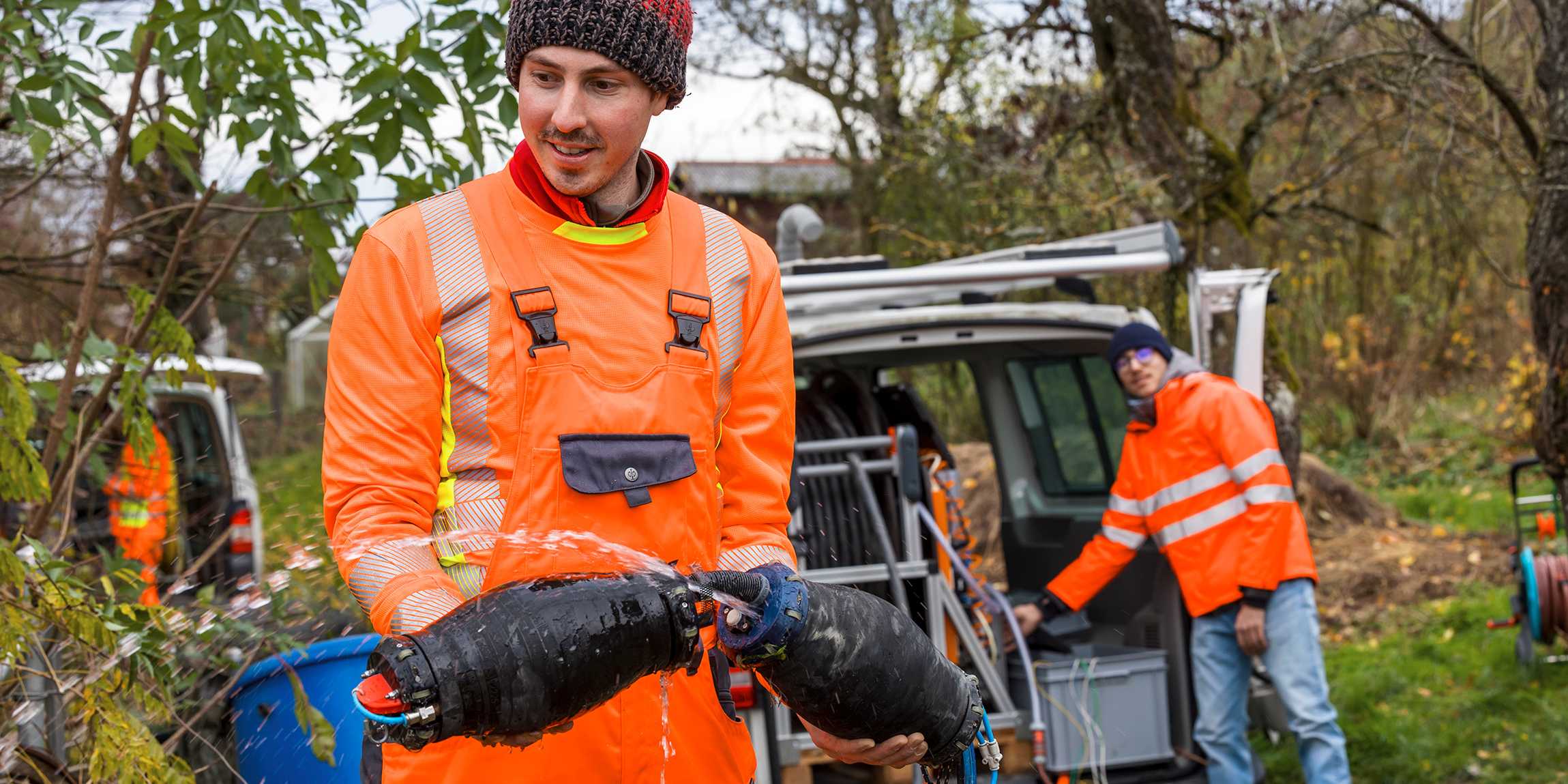
    Until now, engineers have had to break open parts of the concrete to check for corrosion damage. A time-consuming and often inadequate procedure. Talpa has developed a new method that works via drainage pipes. A special probe is inserted into the pipe and uses electrochemical signals to measure the likelihood of corrosion in the surrounding reinforced concrete.

    “This has never been done before,” explains Lukas Bircher, one of the developers. “Previously, you had to remove entire concrete surfaces to find damage and could still easily miss a critical area.” With the new technology, entire sections of wall can now be systematically tested without destruction or costly construction work.

    Measurements during operation – without a construction site
    The method has already been successfully tested, including on a 200 metre-long retaining wall in Zurich-Höngg. The principle is a probe that is inserted into the drainage pipe and fixed in place with inflatable seals. The system then directs water into the measuring area, creating a conductive connection between the electrodes of the probe and the steel in the concrete. Based on the recorded electrical signals, the team can recognise whether and to what extent corrosion is present.

    A new measurement is taken every 25 centimetres to record the condition of the entire section of wall. “This allows us to specifically identify those areas that actually pose a risk,” says Bircher. “This not only saves time, but also high costs for unnecessary interventions.”

    50 years after the construction boom – the need for renovation is growing
    Many of the reinforced concrete structures affected today date from the boom period between 1960 and 1980. Retaining walls from the 1970s in particular often contain cavities that favour corrosion. Previously, damage had to be identified by means of time-consuming spot checks, with a high risk of overlooking critical areas. The new method offers a comprehensive and reliable analysis for the first time.

    From research to start-up Talpa-Inspection
    The technology has such great potential that Bircher founds the start-up Talpa-Inspection together with two colleagues. The name “Talpa”, Latin for “mole”, symbolises the innovative way of making deeply hidden damage visible. Supported by an ETH Pioneer Fellowship, the team is further developing the technology and preparing to enter the market.

    Future prospects, automation and scaling
    The measurement is currently still partly manual, but the team is already working on an automated version. The aim is to make the probe more robust and further accelerate the measurement process. Demand is high. In Switzerland alone, there are over 1,000 kilometres of potentially affected reinforced concrete structures.

    “Our method offers a real opportunity to extend the service life of existing structures,” says Bircher. “We hope that it will soon establish itself as a standard procedure for structural diagnostics.”

  • IneltecSwiss electrical industry celebrates a powerful comeback

    IneltecSwiss electrical industry celebrates a powerful comeback

    After a seven-year hiatus, ineltec opens its doors on 11 and 12 September and offers the Swiss electrical industry a central meeting place. Halls 1 and 2 of Messe Zürich are expecting 162 exhibitors and an expert audience who will be able to find out about the latest developments and trends on 11,000 square metres of exhibition space.

    Noëlle Marti, the new director of the electrical trade fair, is delighted with the response: “All participants can look forward to full halls at Messe Zürich. We are overwhelmed by all the positive feedback and the rush for tickets.” Ineltec 2024 is more than just a trade fair – it offers a platform for knowledge transfer, networking and innovative technologies.

    Focus on innovation and knowledge transfer
    The realignment of ineltec aims to concentrate on the essentials. Innovation, knowledge transfer and the direct exchange between people and technologies. In contrast to previous years, oversized stand areas have been deliberately avoided in order to make the event more compact and focussed. The motto “Back to the roots, but with a modern twist” aptly describes the spirit of this year’s trade fair.

    Lectures, innovations and workshops will take centre stage from 9 a.m. to 5 p.m. on both days of the trade fair. The Speakers Corner will be the centre of professional exchange. After the trade fair closes, after-work events invite participants to network in a relaxed atmosphere and reflect on the day’s events.

    In-depth events for professionals
    The eleven events organised by industry associations and exhibitors offer detailed insights into current topics in the electrical industry. Whether new planning tools, electrical systems, artificial intelligence or electromobility – professionals can look forward to a wide range of innovations and trends that they can integrate directly into their day-to-day work.

    Special highlight
    At the Startup Pitch on Wednesday afternoon, innovative young companies will meet the professional audience. The Startup Academy Switzerland supports the companies through mentoring and promotes dialogue between creative minds and experienced industry experts.

    Promoting young talent at the centre of ineltec
    Young talent is also the focus of ineltec. Under the auspices of EIT.swiss, guided tours for young talent are organised, allowing students to interact with exhibitors in a fun way and gain insights into the latest technologies. This initiative enables young talents to make their first valuable connections for their professional future and lay the foundations for a career in the electrical industry.

    Ineltec offers valuable information and guidance not only to experienced professionals, but also to those just starting out in their careers. On the ineltec.ch website, all visitors will find specific information on 14 current topics in the electrical industry, new products, company profiles and events on offer.

  • Zurich cantonal government invites the public to participate in the fifth-generation agglomeration programmes

    Zurich cantonal government invites the public to participate in the fifth-generation agglomeration programmes

    In order to receive federal funding, the agglomeration programmes must meet certain requirements. These include analysing the current situation and identifying development trends in the areas of settlement, landscape and transport. On this basis, future scenarios are developed and necessary measures are derived. Between 30 and 50 per cent of these measures can then be co-financed by the federal government, provided they are ready for implementation.

    The programmes cover various regions and focus on specific priorities. In the Limmat Valley, the focus is on multimodal transfer points and the electrification of bus transport. In the city of Zurich and the Glattal, transport hubs and cycle networks are being expanded. Winterthur’s measures focus on public transport and pedestrian and cycle-friendly urban development.

    The new programme for the lowlands and the Furttal valley focuses on designing road spaces to be compatible with residential areas. In the Zurich Oberland, the focus is on the accessibility of regional centres and multimodal transfer points.

    Participation and consultation procedure
    The public consultation procedure was launched on 3 July 2024 by government decree no. 765/2024 and runs from 5 August to 20 September 2024. During this period, cities, municipalities, planning regions, transport companies, associations and the public are invited to comment. Neighbouring cantons and neighbouring agglomeration programmes such as Schaffhausen and Obersee are also invited to participate.

    Government Councillor Carmen Walker Späh emphasises the importance of the programmes: “Everyone benefits from a modern infrastructure. An efficient infrastructure is the lifeblood of the economy.”
    The drafts of the agglomeration programmes and other relevant documents will be available from 5 August at zh.ch/ap5.

  • Innovation and networking in the Swiss electrical industry

    Innovation and networking in the Swiss electrical industry

    The newly launched ineltec 2024 offers a platform for over 140 exhibitors to showcase their latest products and services in the fields of electrical engineering, building automation, e-mobility and more across 11,000 square metres of exhibition space. The trade fair not only attracts a large number of experts, but also decision-makers from the entire industry who are looking for innovative solutions and sustainable technologies. The topics of e-mobility and smart building technologies are a particular focus, as these areas are expected to undergo decisive developments in the coming years.

    Interactive platforms for professional dialogue
    In addition to the traditional trade fair experience, ineltec reloaded also offers digital access via its content platform ineltec.ch, where exhibitors and visitors can network and gather information in advance. In addition, the two marketplaces with bistros and an interaction zone ensure a lively exchange and offer space for daily events such as innovation pitches and moderated discussions. These formats are designed to provide participants with new ideas and practical knowledge for their day-to-day work.

    Focus on young talent and networking
    Another focus of ineltec 2024 is the promotion of young talent and networking among industry participants. The events, such as the start-up pitches and after-work events, not only provide a platform for new ideas, but also offer valuable networking opportunities. The aim is to build a bridge between established companies and innovative start-ups and at the same time actively involve young talent in the industry.

    Future-oriented discussions and further training
    ineltec 2024 also places a strong focus on further training and discussions on key industry topics such as the integration of AI in building automation and the impact of ESG directives on electrical engineering. By participating in these round tables and presentations, trade visitors will gain valuable insights into the future development of the electrical industry and can thus prepare themselves for the challenges ahead.

    Ineltec 2024 promises to be an unmissable event for all electrical industry professionals, providing not only a showcase for technological innovations, but also a central platform for professional exchange and training.

  • Holcim cooperates with the largest climate incubator in North America

    Holcim cooperates with the largest climate incubator in North America

    Holcim is now working with Greentown Labs to accelerate the development of new climate technologies for sustainable construction. The premium partnership with Greentown Labs, called Terawatt, gives Holcim preferential access to promising start-ups focussing on innovative and sustainable building solutions, according to a press release. The aim is for Holcim to become an early adopter of cutting-edge technologies for the decarbonisation of the construction industry.

    Greentown Labs is the largest incubator for climate technology start-ups in North America. The business incubator, with locations in Somerville, Massachusetts, and Houston, Texas, is home to more than 200 start-ups. Since its foundation in 2011, it has supported over 525 start-ups with laboratory space, shared offices, machine and tool workshops, electronics, software and business resources and a large network of experts. Holcim is also joining the Greentown Industry Leadership Council, which provides strategic advice to Greentown on issues such as shortening the time from technology development to market.

    “The combination of Holcim MAQER Ventures, our venture capital programme, with Greentown’s outstanding selection of successful climate tech start-ups will serve as a catalyst to reinvent how the world builds for a regenerative future,” Holcim’s Head of Sustainability Nollaig Forrest is quoted as saying. Through MAQER Ventures, Holcim says it is working with hundreds of start-ups in its open innovation ecosystem and is conducting research in 15 areas, from ultra high-strength concrete to 3D printing.

  • Quantum technology from carbon

    Quantum technology from carbon

    It is promising, but also perplexing and confusing: quantum technology is expected to provide us with technological breakthroughs in the coming decades, such as smaller and more precise sensors, highly secure communication networks and powerful computers that can help develop new medicines and materials, control financial markets and predict the weather in the shortest possible time.

    For this, we need so-called quantum materials: substances that exhibit pronounced quantum physical effects. One of these is graphene. This two-dimensional structural form of carbon has unusual physical properties, such as extraordinarily high tensile strength, thermal and electrical conductivity. If one restricts the already two-dimensional material even more spatially, for example to a narrow band, controllable quantum effects arise.

    This is precisely what Mickael Perrin’s team is exploiting: In the Empa laboratory “Transport at Nanoscale Interfaces”, headed by Michel Calame, scientists in Perrin’s team are researching graphene nanoribbons. “Nanoribbons of graphene are even more fascinating than graphene itself,” explains Perrin. “By varying their length and width, as well as the shape of their edges, and by adding other atoms to them, you can give them all kinds of electrical, magnetic and optical properties.”

    Real precision work – down to the atom
    Research on the promising ribbons is not always easy. The narrower the band, the clearer its quantum properties – but the more difficult it is to control a single band. But this is precisely what is needed to understand the special features and possible applications of this quantum material in detail.

    In a new study recently published in the journal Nature Electronics, Perrin, Jian Zhang and their team have succeeded for the first time in making electrically conductive contact with individual long, atomically precise graphene nanoribbons. No trivial task: “A graphene nanoribbon that is only nine carbon atoms wide measures just one nanometre in width,” says Zhang. To contact individual ribbons, the researchers used equally small electrodes: carbon nanotubes with a diameter of just one nanometre as well.

    The precision that is indispensable for such an experiment already begins with the starting materials. The researchers obtained the graphene nanoribbons from Empa’s “nanotech@surfaces” laboratory under the direction of Roman Fasel, with whom they have been working for a long time. “Roman Fasel and his team have been working on graphene nanoribbons for a long time and can synthesise many different types of them with atomic precision from individual starting molecules,” explains Perrin. The starting molecules came from the Max Planck Institute for Polymer Research in Mainz.

    If you want to advance the state of the art, interdisciplinarity is key. Thus, different international research groups were involved in the study, each with their own area of expertise: the carbon nanotubes were produced by a research group at the University of Beijing, and Empa scientists worked with researchers from the University of Warwick to interpret the results. “A project like this would not be possible without cooperation,” Zhang emphasises.

    Contacting individual ribbons with the nanotubes was a challenge for the researchers. “The carbon nanotubes and the graphene nanoribbons are grown on separate substrates,” Zhang explains. “First, the tubes have to be transferred to the experimental substrate and contacted with metal electrodes. Then we cut them using high-resolution electron beam lithography to separate them into two electrodes each.” Finally, the tapes are transferred to the same substrate. Precision is essential here: Even the slightest rotation of the substrates can prevent successful contact. “Access to a high-quality infrastructure at the “Binnig and Roher Nanotechnology Center” at the IBM research centre in Rüschlikon was crucial for testing and implementing this technology,” says Perrin.

    Dreams of the future
    The scientists confirmed the success by measuring charge transport. “Quantum effects are usually more pronounced at low temperatures, which is why we carried out the measurements at temperatures close to absolute zero in a high vacuum,” explains Perrin, while also mentioning a particularly promising property of graphene nanoribbons: “Thanks to their extremely small size, their quantum properties are very robust. We expect them to still be detectable even at room temperature.” According to the researcher, this could allow us to develop quantum technologies that do not require an elaborate cooling infrastructure.

  • Jaisli-Xamax is building underground in Bern

    Jaisli-Xamax is building underground in Bern

    The Dietiker electrical company Jaisli-Xamax AG carried out the electrical work for connecting innovative X-ray devices in the newly designed radio-oncology department at Inselspital in Bern. According to the press release , the special thing about the construction work was that the new building within the Bern University Clinic, which belongs to the Insel Group, is located underground. A three-story, underground building has been erected there. In the so-called intermediate building, which is not visible from the outside, there are treatment and examination rooms with waiting rooms as well as the technology rooms of the tumor center.

    According to a press release from Inselspital, a state-of-the-art center for the radio-oncological treatment of cancer patients has been put into operation on three floors, 20 meters below ground, in two years' time. Three devices of the latest generation are available to treat patients with precise radiation therapy.

    The demanding task of connecting these Ethos devices was in the hands of Jaisli-Xamax. At peak times, there were 20 employees working there, three of whom were apprentices. Construction manager Eduard Harder is quoted as saying that Jaisli-Xamax is proud “that we were able to make our contribution to such an important and forward-looking project”.