Energy consumption in the canton of Zug amounts to almost 3,000 gigawatt hours per year, with buildings and mobility accounting for the largest share. The cantonal government’s new energy and climate strategy (EKS) aims to reduce energy consumption and rely more heavily on renewable energies. At the same time, the government wants to strengthen security of supply in the canton and reduce greenhouse gas emissions to net zero by 2050. With clear interim targets up to 2030, the government is concretising the path to these ambitious goals.
Investments in solar power and energy storage A central component of the strategy is to increase the production of solar power in the canton. At the same time, investments in innovative energy storage technologies such as hydrogen are planned. “We want to shape the energy infrastructure of the future through close collaboration with industry and science,” explains Construction Director Florian Weber. Buildings in the canton should also increasingly serve as energy producers and thus become an energy hub.
Sustainability in agriculture and negative emission technologies As part of the KERB sustainability project, the canton is focussing on measures in agriculture to reduce CO2 emissions. Forests and moors play a central role in CO2 sequestration. For unavoidable emissions, the canton is focussing on negative emission technologies that are intended to permanently remove CO2 from the atmosphere. A study is to determine the potential of these technologies in the canton.
Adapting to climate change In addition to reducing emissions, the canton of Zug is also preparing for the effects of climate change. A cantonal natural hazard strategy aims to minimise climate-related risks such as heat and invasive pests. At the same time, investments are being made in climate-adapted road surfaces and sustainable forest management to ensure both protection and recreational areas.
Mit steigenden Temperaturen verzeichnet Zürich eine Zunahme von Klimaanlagen-Nutzung, was den Energiebedarf in der Stadt signifikant erhöht. CoolCity reagiert auf diesen Trend mit einem ambitionierten Konzept, das den Energiebedarf für Heizung und Kühlung nachhaltig decken soll.
Ein strategisch positioniertes Energiezentrum Im Herzen von Zürich, im ewz-Unterwerk Selnau, wird eine 4.000 m² große Energiezentrale errichtet. Diese dient als zentrale Schnittstelle für die effiziente Verteilung von Wärme und Kälte und ist ein Schlüsselelement des städtischen Energieversorgungsnetzes. Das Projekt gewährleistet eine optimale Temperaturversorgung für seine Nutzer: 67°C für Heizung und circa 12°C für Kühlung, direkt aus dem Seewasser. Vor Ort angepasste Temperaturen durch Wärmepumpen und Kühlanlagen sorgen für höchste Effizienz und Komfort.
Ein nachhaltiges Energieverteilungssystem Der Kern von CoolCity bildet ein ausgeklügeltes System aus primären und sekundären Kreisläufen. Diese Struktur ermöglicht eine flexible Bereitstellung von Wärme oder Kälte und wird im Sommer durch energiesparendes Freecooling ergänzt. Es ist nicht nur ein Projekt für die Gegenwart, sondern auch ein zukunftsorientierter Schritt hin zu Zürichs Ziel, bis 2040 Netto-Null-Emissionen zu erreichen. Die Nutzung von Tiefenwasser des Zürichsees zur Gebäudebeheizung und -kühlung reduziert CO₂-Emissionen um durchschnittlich 80 Prozent gegenüber fossilen Brennstoffen.
Überwindung von Herausforderungen Trotz breiter Zustimmung sind bei der Realisierung ökologische, gesetzliche und technische Herausforderungen zu meistern. Eine enge Zusammenarbeit zwischen den Fachleuten von ewz, Anex und anderen Beteiligten ist essenziell, um innovative Lösungen für den Tiefbau und die kontinuierliche Energieversorgung zu entwickeln.
Die schrittweise Inbetriebnahme von CoolCity ist ab 2031 geplant. Dies ermöglicht eine adaptive Optimierung des Systems an die sich wandelnden Bedürfnisse Zürichs. Durch diese Entwicklung übernimmt der Zürichsee eine doppelte Funktion: Neben einem Naherholungsgebiet wird er zur Basis einer nachhaltigen Energieversorgung der Stadt.
CoolCity steht für den Pioniergeist Zürichs und dessen Streben, innovative Lösungen für eine nachhaltige Zukunft zu schaffen. Durch die intelligente Nutzung von Seewasser für die städtische Energieversorgung setzt das Projekt neue Maßstäbe in der ökologischen Stadtentwicklung.
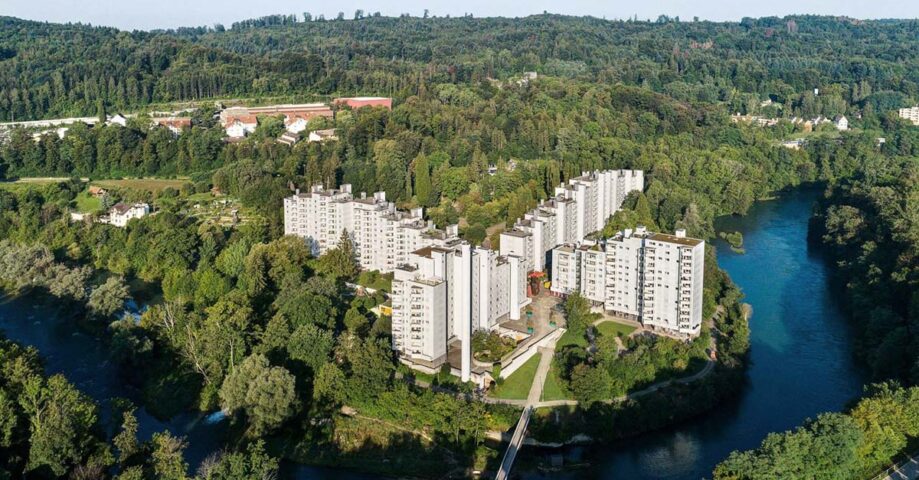
The Webermühle development in Neuenhof houses 368 rental apartments. The settlement on a peninsula in a loop of the Limmat was built on the industrial site of a former weaving mill and was ready to move into in 1984 after ten years of construction. Planned by the architectural office Steiger Partner AG and built by Ernst Göhner AG, the Webermühle with its different volumes offers living space for up to 1,500 residents. Despite the very high density, the apartments with the four rows of high-rise buildings arranged in a cross shape are characterized by a surprising foresight. Since 2008, the buildings realized in the “Göhner 3” modular construction system have been owned by a real estate fund from Credit Suisse Asset Management.
Ecologically and economically sustainable renovation A good 40 years after moving in, the apartments no longer met today’s standards – neither in terms of appearance nor in terms of comfort. With an analysis of the building structure, the client started planning an extensive partial renovation in 2009, which was implemented in stages between 2012 and 2014. The portfolio strategy of Credit Suisse Asset Management attaches great importance to ecologically and economically sustainable solutions. With the modernization of the Webermühle, one wanted to make the living and green space more attractive for the tenants and to maintain the value of the property. On the other hand, the building technology should be brought up to date and thus the energy consumption should be significantly reduced. Better connections to public transport were also an important goal: Since the construction of a new inclined lift in 2015, Wettingen train station can be reached within a few minutes on foot.
Heat supply: switch to flow heat The core of the energetic renovation is the reorientation of the heat supply. To this end, the client defined a clear goal right from the start: in future, the heat supply in the Webermühle should be at least 70 % CO 2 -free. Due to the size of the facility, Credit Suisse Asset Management wanted to have the heating system replaced by a contractor instead of producing heat itself. The sustainability of the solution proposed by ewz with a river water heat pump convinced the client even after a detailed examination by specialists.
White paper on the topic of energy-efficient refurbishment In addition to the practical example “Webermühle”, the white paper “Energy-related renovations as an opportunity for the real estate industry”, which was created in close cooperation between ewz and the research and consulting company intep, offers insights into the relevance of energy-related renovations.
Knowing that the building sector is responsible for about a quarter of emissions, there is an urgent need to renovate the building stock. Because the few climate-friendly and energy-efficient new buildings will not have a major effect on the entire sector. At the moment we are in a renovation backlog. The current renovation rate of one percent must be doubled in order to achieve the climate targets.
Practical experience shows that during renewal processes, too little attention is paid to energy-related refurbishment compared to replacement new buildings. The landowners often lack basic information that shows them the economic, ecological and social potential of energy-related renovations. The whitepaper is intended to make a contribution to precisely this. There is a basic overview of the urgency, legal framework, benefits, opportunities and possible strategies of energy-related renovations.
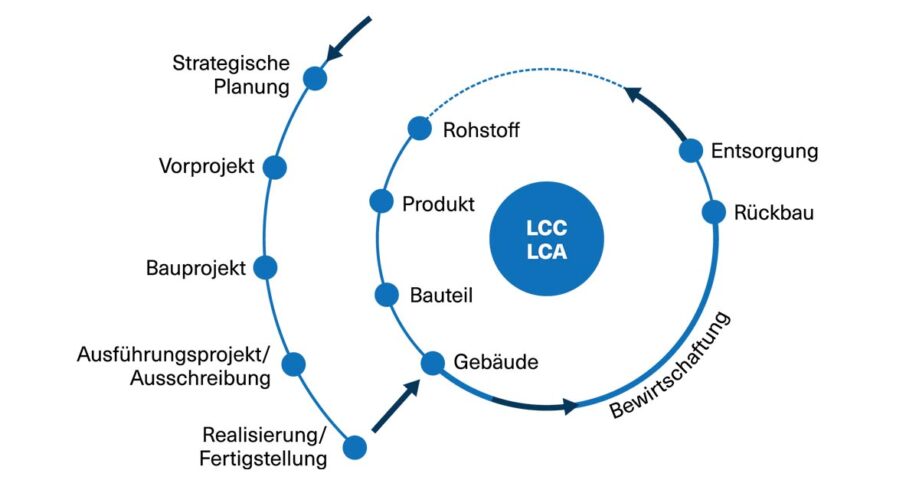
The results of an ecological balance sheet (life cycle analysis, LCA) and an analysis of the life cycle costs (LCC), for example, form an excellent basis for decision-making. These quantitative assessment methods take into account the entire building life cycle.
The life cycle analysis (LCA) to determine the environmental impact and the analysis of the life cycle costs (LCC) offer quantitative decision bases for energy renovation. (Source: Kellenberger (intep), 2021)
The ECO-Qube project examines how the electrical and thermal worlds can be brought together with IT infrastructure. For this purpose, the waste heat potential of micro data centers for building heating is to be examined. The field tests are taking place in the newly installed data center in Empa ‘s NEST research building and at two other locations in Turkey and the Netherlands.
ECO-Qube is designed for three years. After that, the team wants to provide guidelines for planners and operators of buildings. The project is supported by the EU funding program Horizon 2020. It brings together research and industry partners from Switzerland, Turkey, Spain, Germany, Sweden and the Netherlands. “Our goal is to reduce both the energy requirements and the CO2 emissions of small data centers by a fifth,” says Çağatay Yılmaz, Innovation Manager at the Turkish IT solution provider Lande and project manager of ECO-Qube, in an Empa press release quoted.
With the help of big data structures and artificial intelligence, sensor data from the individual IT components is accumulated and combined with air flow simulations for precise cooling. At the same time, the computing loads would be distributed in such a way that the systems work as energy-efficiently as possible.
The three data centers will also be integrated into the energy systems of the surrounding districts. If possible, they should be powered by renewable energy. “It is interesting for us to consider the micro data center not just as an electrical consumer, but as a dynamic component in the overall system,” explains Philipp Heer, head of the Energy Hub energy research platform at Empa.
The Webermühle development in Neuenhof houses 368 rental apartments. The settlement on a peninsula in a loop of the Limmat was built on the industrial site of a former weaving mill and was ready to move into in 1984 after ten years of construction. Planned by the architectural office Steiger Partner AG and built by Ernst Göhner AG, the Webermühle with its different volumes offers living space for up to 1,500 residents. Despite the very high density, the apartments with the four rows of high-rise buildings arranged in a cross shape are characterized by a surprising foresight. Since 2008, the buildings realized in the “Göhner 3” modular construction system have been owned by a real estate fund from Credit Suisse Asset Management.
Ecologically and economically sustainable renovation A good 40 years after moving in, the apartments no longer met today’s standards – neither in terms of appearance nor in terms of comfort. With an analysis of the building structure, the client started planning an extensive partial renovation in 2009, which was implemented in stages between 2012 and 2014. Credit Suisse Asset Management’s portfolio strategy attaches great importance to ecologically and economically sustainable solutions. With the modernization of the Webermühle, one wanted to make the living and green space more attractive for the tenants and to maintain the value of the property. On the other hand, the building technology should be brought up to date and thus the energy consumption should be significantly reduced. Better connections to public transport were also an important goal: Since the construction of a new inclined lift in 2015, Wettingen train station can be reached within a few minutes on foot.
Heat supply: switch to flow heat The core of the energetic renovation is the reorientation of the heat supply. To this end, the client defined a clear goal right from the start: in the future, the heat supply in the Webermühle should be at least 70% CO 2 -free. Due to the size of the facility, Credit Suisse Asset Management wanted to have the heating system replaced by a contractor instead of producing heat itself. The sustainability of the solution proposed by ewz with a river water heat pump convinced the client even after a detailed examination by specialists.
Poenina Holing AG from Opfikon and Burkhalter Holding AG from Zurich have announced the start of their merger negotiations in a press release . The aim is to get “a strong, local provider” on the way who “could design and install future-oriented building technology across trades”, it says.
According to the Federal Energy Strategy 2050, energy consumption in buildings is to be halved by upgrading the building services. The companies Poenina and Burkhalter, which specialize in building technology, want to contribute to reducing consumption by offering all building technology services from a single source in the future. This marks a "future-oriented offer in the field of building technology" and could make a contribution to the energy transition.
At the same time, both companies expect a growth spurt and the creation of additional jobs. With the presence of the Burkhalter Group throughout Switzerland, Poenina wants to open up new customer segments. Poenina plans to provide information on further plans at the balance sheet media conference on March 31.
The property right at the entrance to the municipality is less than 10 kilometers away from the city of Winterthur and is still an idyllic piece of land, with a direct connection to the banks of the Töss and with a view of meadows and forest. The goals of the Energy Strategy 2050 are being built here. The Verde Blu development has been inhabited since autumn 2019. So far, so normal. It is noteworthy, however, that this development covers a large proportion of its energy requirements itself and that exclusively from renewable sources. “The specifications of the Energy Strategy 2050 are an opportunity for the real estate industry,” explains Dieter Stutz from Atlantis AG, which is active in the areas of environmental consulting, settlement planning and architecture and who developed the project. The heat supply via groundwater was the best and most convincing solution for the area. Atlantis planned and implemented this complex construction project together with EKZ.
Sustainable living as a need The new construction project Verde Blu with nine residential and commercial buildings comprises 108 condominiums as well as various commercial areas that are used by a Migros branch, a community and a physiotherapy practice, among other things. An old, listed barn serves as a common room and provides rustic charm on the site. In contrast to this is the state-of-the-art technology that supplies the system with energy: groundwater is used as a heat source for the heating and hot water, which supplies the houses with decentralized heat pumps via a so-called anergiering. An anergiering is a cold local heating system that, in contrast to conventional local heating systems, works with transfer temperatures below 30 degrees Celsius. Anergy networks therefore have no heat losses in the lines, but even generate additional energy gains from the ambient heat. In summer, the buildings can be passively cooled with the groundwater via the anergy ring.
A photovoltaic system, which is optimally designed to meet the needs of the building, provides the electrical energy for the building. The complex was only built after the apartments had already been occupied. Because they wanted to leave the decision for or against solar power to the owners. The fact that the system with a peak output of 100 kilowatts was approved by an overwhelming majority at the first owners’ meeting in winter 2019 speaks for itself. Martin Nicklas, who is responsible for modern energy solutions at EKZ, is not surprised: “In the real estate sector, we have long known the need to make a contribution to sustainability in the living area too.” A charging infrastructure for the 209 parking spaces was installed in the lower-level garage. Thanks to load curve management, it is possible to charge the cars in stages if a whole fleet of electric vehicles should one day populate the garage.
Well-coordinated system In Kollbrunn, power generation as well as heating and cooling generation and electromobility are combined in an integrated energy system. The centerpiece is an intelligent control system that maximizes the self-consumption rate and takes over load management. In this way, what is actually the most important goal can be achieved: that the electricity produced by the PV system is also consumed as much as possible on site. The control uses weather forecasts from an external weather portal for this purpose. An algorithm in the control system evaluates this data and decides on the previous evening whether enough solar power will be produced the next day to charge the boiler and storage tank of the heating system. If the solar production is too low, the boilers are charged during the night at the low tariff, otherwise there is a wait until there is enough solar power available the next day to start the heat pump.
On-site energy production The “Grand Chemin” development was built in Epalinges in western Switzerland, with some of the electricity required being produced on site by a photovoltaic system (PV). A new multi-family house is being built in Emmen (LU), which will be characterized by a heat pump with groundwater and a PV with ZEV. Two examples out of many that show that the future of energy has long since begun.
BKW is renewing its aging substations in the Bernese communities of Huttwil, Niederbipp and Bannwil, the energy service provider informed in a message . The reason given there is the increasing energy demand in Oberaargau. Various companies are planning to expand their capacities here, writes BKW.
BKW plans to invest around CHF 11 million in the renewal of the three substations. The work will be carried out jointly with the subsidiaries AEK and onyx , as the systems also supply the areas of these subsidiaries, according to the announcement. The areas around Niederbipp, Densingen, Bannwil, Herzogenbuchsee and Huttwil are to be equipped with “state-of-the-art network technology” by 2023, writes BKW.
The work in Huttwil is about to be completed, the energy service provider continues in the message. Here the 50 kilovolt system was renewed and housed in a new building. Work in Niederbipp has been going on since August last year. The old 16 kilovolt system will be replaced by a more powerful new one. A new 50 kilovolt switchgear is to be installed in Bannwil.
With the facility in Oberengstringen, the electricity works of the canton of Zurich (EKZ) put their third substation in Limmat Valley into operation. The Limmattal is now supplied by the three substations Schlieren, Dietikon and Oberengstringen. The new substation with an output of 80 megawatts will gradually be put into operation by next February.
"This means that we are very well prepared for the steadily growing energy demand in the region", Hans-Peter Häberli, Head of Construction and Systems at EKZ, is quoted in an interview . The economic upswing in the Limmattal with the settlement of new companies, a large data center and the Limmattalbahn is causing the demand for electricity to rise sharply. Häberli: “We have generally seen strong increases in load in the Limmat Valley over the past few years. In the future, the energy demand will be driven by the Limmattalbahn and the establishment of a data center in the region. The Schlieren substation, which previously supplied the region with energy, must therefore be relieved. Its capacity would soon no longer be sufficient. "
The electrical energy is converted in the new substation. In the case of Oberengstringen, EKZ takes over the electricity with a voltage of 110 kilovolts from the Axpo high-voltage network. The energy is converted to 16 kilovolts with two 40-megawatt transformers, according to the EKZ website. After that, the electricity would be further stepped down until it is fed into the grid for end users such as housing estates.
The connection of the new plant is to take place gradually by February. According to Häberli, Oberengstringen will then be fully connected to the Axpo high-voltage network. The communities of Ober- and Unterengstringen, Weiningen and parts of Schlieren are then supplied.
Wir verwenden Cookies zur Unterstützung und Verbesserung unserer Dienste. Mit der Nutzung dieser Website erklären Sie sich mit der Verwendung von Cookies einverstanden. Weitere Informationen finden Sie in unserer Datenschutzerklärung.