Tag: Energieeffizienz

  • Regional butcher’s shop focuses on sustainability and short transport routes

    Regional butcher’s shop focuses on sustainability and short transport routes

    Metzgerhuus Stadt und Land AG in Füllinsdorf is working at almost full capacity. According to Managing Director Raffael Jenzer, the small regional butcher’s shop already processes around 30 cattle, 30 calves, 70 pigs and 20 sheep every week. The transport routes are short: the animals come from over 300 farms in the Basel region. The meat is used by 13 butchers in the region and over 125 direct-marketing farms.

    The Metzgerhuus, which opened in June 2025, also includes a self-service shop that is open every day. It offers 500 products from regional suppliers. In addition, the Metzgerstübli has already hosted around 80 events with over 1000 visitors. The first cookery courses have also been successfully launched.

    The Metzgerhuuse building itself is a power station. Thanks to its solar façade, solar modules on the roof, heat recovery and heavy insulation, it produces more energy than it consumes. It is therefore Minergie A-certified.

    The small regional butcher’s shop was founded by five butcher families from Baselland and Basel-Stadt, the Butchers’ Association of Basel and the Basel Butchers’ and Farmers’ Co-operative, who together raised CHF 4 million in capital. They no longer wanted to drive the region’s cattle to the Mittelland for slaughter.

    The two cantons of Basel supported the project with 2.5 million francs as part of the regional development project “Genuss aus Stadt und Land” (PRE). 120 lenders supported the Metzgerhuus with a total of almost 1 million francs. Anyone who still wants to support the Metzgerhuus financially today can buy so-called solar shopping vouchers: For 1,000 francs, interested parties can invest in solar modules; the proceeds are paid back in vouchers for meat.

  • Innovation project to serve as a starting point for the new construction industry

    Innovation project to serve as a starting point for the new construction industry

    The BioHaus am Waldsee in the US state of Minnesota has turned 20. The building, located on the Waldsee campus of Concordia Language Villages, is the first building in America ever to be certified as a Passive House by the German Passive House Institute. The project was originally realised by Stephan Tanner and his team from Integrale Planung GmbH (Intep) in Zurich. It also served as the starting point for TANNER Building Products and its related ventures, according to a press release.

    The BioHaus is characterised by materials and technologies such as Passive House-certified windows and doors, high-performance ventilation systems, external shading elements and vacuum insulation panels, which were imported from Europe to the US for the project at the time. It was built at a time when the Passive House standard was still largely unknown in North America and the necessary materials, technologies and construction expertise were lacking locally.

    The project was supported by the German Federal Environmental Foundation and was intended to demonstrate that advanced environmental technologies can also be successful abroad. “BioHaus has not only proven that Passive Houses can work in America. It has also helped others to follow this example,” the statement reads.

    The project also gave rise to Stephan Tanner’s company, TANNER Building Products. Based in Watertown, Minnesota, the company started in 2006 as Peak Building Products and supplied the advanced materials for the BioHaus. “What began as a necessity – importing components that no one else had – sparked an entire industry,” the company explains in the press release.

  • Building Services Group boosts profits and continues to grow

    Building Services Group boosts profits and continues to grow

    According to a press release, the Burkhalter Group has closed the 2025 financial year with “excellent results”. All relevant key performance indicators have once again improved compared with the previous year. The building services provider recorded revenue growth of 1.8 per cent to CHF 1.2 billion, as well as a 6 per cent increase in EBIT (earnings before interest and taxes) to CHF 73.8 million and a consolidated profit of CHF 61.3 million (previous year: CHF 57.2 million, up 7.3 per cent). Earnings per share rose to CHF 5.78, representing an increase of 7.2 per cent on the previous year. As a result of this positive performance, the Board of Directors is proposing an increased dividend of CHF 5.20 per share to the Annual General Meeting.

    The drivers of growth are sustained high demand for building services engineering and efficiency gains from optimised and digitalised processes. Targeted acquisitions also contributed to the positive performance. In 2025, the Group acquired Mathieu Ingenieure AG in Visp (VS) and Gattiker Elektro GmbH in Uster (ZH). Four further acquisitions followed at the start of 2026: BZ-Dépannage Sàrl in Lonay, Vaud; Enplan AG in Herisau, Appenzell Ausserrhoden; Elektro Gasser AG in Lalden, Valais; and Caotec SA in Brusio, Graubünden. According to the company, this strengthens the Burkhalter Group’s regional presence, expands its expertise and increases its market share. The acquisition strategy remains a central component of growth.

    The company is confident about the 2026 financial year. Driven by government support programmes and continued high levels of construction activity, demand for energy-efficient building services solutions remains strong. The Group expects to be able to achieve a moderate increase in earnings per share for the 2026 financial year as well.

  • Hydrogen can do a lot, but not everything

    Hydrogen can do a lot, but not everything

    The Fraunhofer ISI analyzed 774 individual statements as part of a meta-fact check and condensed them into 77 core statements. The result was not a new opinion paper, but a synthesis of the current state of knowledge. The result is nuanced, but the key points are unambiguous. Lead author Nils Bittner puts it in a nutshell: hydrogen can have an enormous impact where there are no equivalent alternatives. Where such alternatives do exist, its use costs valuable resources and time.

    The efficiency bottleneck
    The basic problem lies in physics. Green hydrogen is produced by electrolysis. Depending on the process, this requires around 50 to 60 kWh of electricity per kilogram. Compression, transportation and reconversion swallow up further energy. In the end, often only a fraction of the kilowatt hours originally used remain. Heat pumps and battery-powered vehicles therefore use the same electricity many times more efficiently.

    Where H₂ remains indispensable
    Nevertheless, there are areas in which hydrogen has no viable alternative. The steel industry needs it to reduce iron ore, the chemical industry as a raw material for ammonia and methanol. Aviation, shipping and heavy goods transport can hardly be directly electrified. Hydrogen is the fuel of choice here. There is also currently no comparable alternative for the seasonal long-term storage of energy over weeks and months. In Switzerland, this assessment is in line with the federal government’s hydrogen strategy, which envisages H₂ primarily for high-temperature process heat and transport sectors that are difficult to decarbonize.

    The chicken-and-egg problem is slowing down the ramp-up
    A functioning hydrogen economy requires infrastructure such as pipelines, cavern storage facilities and electrolysis plants. However, companies only invest when the supply is secured and network operators only build when there is sufficient demand. This chicken-and-egg problem is slowing down the market ramp-up considerably. The Fraunhofer ISI therefore recommends concentrating on industrial clusters instead of a nationwide network extending into residential areas.

    Imports only solve half the problem
    Germany will have to import up to 80 percent of its hydrogen requirements. Transportation over long distances usually requires conversion into ammonia or liquid hydrogen, with further energy losses. This creates new global supply chains instead of fossil dependencies. Switzerland will not become self-sufficient in hydrogen either. The cantons of Basel-Stadt and Basel-Landschaft adopted a joint hydrogen strategy for the first time in February 2026 and calculate a demand of 0.4 to 3.4 percent of total energy requirements for 2050, concentrated on industry and heavy goods vehicles.

  • Industrial company once again ranks among the most sustainable worldwide

    Industrial company once again ranks among the most sustainable worldwide

    KONE has made it onto the A list in the sustainability ratings for companies just published by CDP, known as the CDP Scores 2025. This list comprises the top 4 per cent of the more than 22,100 companies from around the world that were assessed. The ratings range from D to A and show how ambitious and effective companies are in terms of climate, water security and forests.

    According to a press release, the lift manufacturer has been disclosing its data via CDP since 2009 and has now achieved a CDP rating of A or A- for the 13th consecutive time. At the end of January, KONE was ranked 54th in this year’s Global 100 Most Sustainable Corporations in the World list by Corporate Knights, placing it second among engineering companies.

    “This recognition reflects our systematic efforts to integrate sustainability into everything we do – from our products and services to our operations and partnerships,” said Kirsi Simola-Laaksonen. He is KONE’s Senior Vice President and responsible for sustainability and the environment.

    He goes on to explain that the proportion of renewable drives in KONE lifts will have increased significantly by 2025. This has improved the energy efficiency of the products and reduced both the company’s own CO2 emissions and those of its customers. As over 99 per cent of emissions come from the product and value chain, the company is “actively working with suppliers to identify opportunities to reduce emissions from the materials used in our products”.

    KONE has been headquartered in Espoo, Finland, since 1910. KONE (Switzerland) AG has been operating in Switzerland since 1996. The company employs over 60,000 people in more than 70 countries.

  • Technology fund supports AI-based energy optimisation

    Technology fund supports AI-based energy optimisation

    Scandens can finance upcoming business developments with a guarantee from the technology fund. According to a statement by Dominik Bucher, co-founder and CCO of the Zurich-based cleantech company, receiving this guarantee confirms its approach: “Enabling the right investment decisions for real estate portfolios – economically sound and future-proof” while making the best possible decisions for the climate and the environment. “We are delighted to be part of the technology fund,” said Bucher.

    Founded in 2021 as a spin-off from the Swiss Federal Institute of Technology Zurich, the company launched software in 2023 that makes it easier to plan and implement energy-efficient building renovations. With this artificial intelligence-based internet application, owners of real estate portfolios as well as private homeowners can check whether and which renovation measures make economic and ecological sense.

    According to a statement from Scandens, the software displays over 500 renovation combinations and creates a plan that serves as a basis for implementation. This is intended to save time and promote sustainable decisions.

    With the technology fund, the federal government promotes innovations that reduce greenhouse gases or resource consumption, favour the use of renewable energies and increase energy efficiency. Guarantees make it easier for innovative companies to take out loans. The guarantee is granted to banks or other suitable lenders. To cover guarantee losses, a maximum of CHF 25 million per year from the proceeds of the CO2 levy is paid into a technology fund.

  • Modernized shopping center boosts usage and energy efficiency

    Modernized shopping center boosts usage and energy efficiency

    Schlieren-based Halter AG has completed the modernization and redesign of the Signy Centre in Signy-Avenex. The renovation included two buildings with administrative and commercial space, three floors with around 50 stores and five parking decks with a total of around 1,100 parking spaces. According to Halter, the project started in 2023 and has now been completed with the official handover to customers.

    As part of the renovation, the technical systems and security facilities in the Signy Centre were modernized. Halter also redesigned the shopping center and its outdoor facilities. According to the company, the completed renovations increase the comfort and safety of employees and customers in the shopping center. The site’s energy and environmental footprint has also been improved.

    The project also involved the companies Burckhardt and ARFOLIA, which were responsible for the architecture and landscape architecture respectively. While sd ingénierie was involved as the civil engineer, Caeli Ingénierie took on the role of technical engineer. The last fire protection engineer was srg engineering.

  • Swiss premiere in building automation

    Swiss premiere in building automation

    Today’s modern buildings are highly complex systems. They combine heating, cooling, ventilation, lighting, security, photovoltaics and storage solutions to form an integrated whole. Building automation ensures that these components work together optimally, with less energy consumption, more stable operation and greater comfort. In the context of the Energy Strategy 2050 and the decarbonization of the building stock, the need for specialists who understand both technology and data and system logic is growing rapidly. The state recognition of the Building Automation HF course takes this need into account and creates a clearly defined, quality-assured career path

    First state-recognized Building Automation HF in Switzerland
    sfb in Dietikon is the first university of applied sciences in Switzerland to successfully pass the recognition procedure of the State Secretariat for Education, Research and Innovation for its Building Automation HF course. The degree is thus federally recognized and embedded in the formal education system. According to the school management, this guarantees training that is geared towards the current requirements of the industry, standards and regulation and remains compatible in the long term. At the same time, the recognition strengthens the visibility of the profession vis-à-vis building owners, planning offices, energy suppliers and the real estate industry

    Practical profile from energy efficiency to building informatics
    In terms of content, the course has a clear practical focus. It teaches specialist skills in energy efficiency, building IT, networked systems and modern automation solutions. From sensor and control technology to data analysis and optimization in operation. The aim is to train specialists who can support the entire life cycle of smart buildings, from planning and design, project management, commissioning, operation, maintenance and ongoing optimization. This broad qualification creates the basis for sustainable, economical building solutions and enables companies to reduce operating costs, emissions and failure risks

    Specialists for the digital transformation in the building sector
    Building automation specialists HF work at the interface between technology, IT and operations. They understand building technology systems as well as data rooms, interfaces and security requirements. For companies in the fields of building technology, energy, facility management and real estate development, this means a tangible competitive advantage. They gain access to specialists who are proficient in the latest technologies and can also actively drive forward the digital transformation of buildings. According to sfb, it is precisely this profile that is in demand when it comes to putting smart building and net zero strategies into practice

    Course structure and target groups
    The recognized course is aimed at specialists with relevant basic vocational training in the electrical, HVAC, building or IT professions. In six semesters, the course leads to the final thesis and the protected title of “Certified Building Automation Technician HF”.

  • Photovoltaic system on company roofs in Aarau

    Photovoltaic system on company roofs in Aarau

    Over the next six weeks, HKG Engineering AG will be installing a photovoltaic system on the roofs of its own company buildings at the Aarau site. According to a press release, 184 high-efficiency modules are planned there, which will generate 93,000 kilowatt hours of electricity per year.

    The energy generated will be sufficient to cover the company’s own requirements in the offices and for charging electric vehicles. The system will also reduce the load on the neighboring Aarhof property, which is currently under construction.

    With this investment, HKG is sending out a clear signal for sustainable action. The aim is to reduce CO2 emissions in the building sector and reduce dependence on external energy.

  • On the way to the AI revolution

    On the way to the AI revolution

    The debate about the power consumption of AI systems is not just a political issue. Data centres and highly scaled hardware consume enormous amounts of energy and the constant increase in the size of models is further exacerbating this trend. “We can’t scale indefinitely,” explains Klimovic, “so research into more sustainable solutions is essential.”

    Economical model architectures
    One approach is the introduction of sparsity (density reduction) in neural networks. Models only activate relevant parts of their system, whereas classic approaches always utilise the entire network. “Mixture-of-experts models follow this logic. They distribute queries specifically to specialised modules. This saves energy without sacrificing quality.

    GPUs are valuable, but often unused
    Klimovic sees a central problem in the low utilisation of GPUs, even though they consume an enormous amount of power. Bottlenecks occur in particular during data pre-processing and communication between several GPUs. Computing utilisation is often below 50 percent. New software solutions are needed to prevent valuable resources from lying idle.

    Efficiency through intelligent frameworks
    Your research group develops systems that focus on automation and optimisation.

    Sailor is a platform that automatically parallelises training jobs via GPUs, thereby increasing GPU efficiency.

    Modyn and Mixtera are systems for smarter data selection that train models faster and with less data.

    DeltaZip is a platform that efficiently manages fine-tuned model variants. It compresses differences between models (“deltas”), which reduces loading times and makes inference faster and more resource-efficient.

    Sustainability in training and inference
    Efficiency gains play a key role not only in training, but also in the application, known as inference. In view of the billions of daily interactions with chatbots, the conservation of energy and hardware resources is becoming a globally urgent task.

    Academic freedom and open science
    Klimovic emphasises the importance of academic research. Less driven by economic constraints, it can pursue long-term innovations. She emphasises the role of the Swiss AI initiative, which was launched in 2023 and is based on the CSCS’s almost climate-neutral Alps supercomputer. With over 10 million GPU hours and CHF 20 million in funding, it is the world’s largest open science and open source initiative for basic AI models.

    The AI revolution will only be sustainable if efficiency becomes the guiding principle. In algorithms, hardware and system architectures. Projects such as Sailor, Modyn and DeltaZip show concrete ways in which enormous energy savings can be combined with technical excellence. For Klimovic, one thing is certain: “In the future, high-quality AI will not only mean intelligence, but also resource conservation.”

  • Prices for residential property remain stable

    Prices for residential property remain stable

    “Residential property prices go on holiday in July”, ImmoScout24 headlines a press release on the current ImmoScout24 Purchase Index. It is compiled monthly by the property marketplace belonging to SMG Swiss Marketplace Group AG in collaboration with IAZI, a consultancy specialising in real estate. According to the current index, prices for single-family homes in July remained at the previous month’s level. Prices for condominiums rose by just 0.1 per cent.

    According to the experts at ImmoScout24 and IAZI, prospective buyers are increasingly looking at energy efficiency as well as price and location when choosing a property. “Those who pay attention to sustainable construction methods or invest in energy-efficient modernisation and solar panels will benefit in the long term and even twice over,” explains Martin Waeber, Managing Director Real Estate at SMG Swiss Marketplace Group, in the press release. In addition to lower electricity and heating costs, Waeber cites a comparatively stable property value: “Market data shows that energy-efficient houses and flats are less susceptible to price fluctuations”.

    From a regional perspective, only the greater Zurich region and eastern Switzerland are clearly bucking the trend for single-family homes, with an increase of 1.2 per cent and a decrease of 0.9 per cent respectively. In the case of owner-occupied flats, Northwestern Switzerland is cited as the “upward outlier” with an increase of 2.3 per cent. The biggest drop in prices for condominiums was recorded in Central Switzerland with 1.1 per cent.

    ImmoScout24 is a division of SMG Swiss Marketplace Group AG. This combines the digital marketplaces of TX Group, Ringier and Mobiliar.

  • Lift refurbishment with a focus on comfort and safety

    Lift refurbishment with a focus on comfort and safety

    KONE has replaced the outdated lifts of a competitor in the Im Tiergarten neighbourhood of Zurich for 466 occupied rental flats. Within 18 months, the lift manufacturer from Brüttisellen installed a total of 46 of its MonoSpace 500DX lifts in one of Zurich’s largest residential complexes.

    According to a company statement, this model adapts flexibly and with millimetre precision to the existing shaft. The payload of most of the passenger lifts has been increased from 320 to 480 kilograms. The new cabins are also significantly larger. According to KONE, they are monitored around the clock via the company’s digital asset management system and serviced proactively. This should lead to around 30 per cent fewer breakdowns.

    The owners had decided to forego vacancy notices and to carry out further refurbishment measures while the building was occupied. According to KONE, it was able to adhere to the tight schedule thanks to a special logistics concept with overnight delivery and close coordination with the owners and residents.

    The successful complete replacement in the Im Tiergarten development is one of KONE’s largest lift modernisation projects in Europe to date. According to Christian Herbst, KONES Director of Modernisation for Germany, Austria and Switzerland, “it shows that we are well positioned to meet an increasingly important demand in the market: the efficient modernisation of even a large number of installations, in close coordination with partners and under difficult conditions such as renovating while the building is occupied”.

  • New innovation centre for thermal coating solutions

    New innovation centre for thermal coating solutions

    OC Oerlikon Corporation AG, a thermal spray and coating solutions company headquartered in Pfäffikon, has invested CHF 40 million in its new innovation and production centre on the Reichhold campus in the canton of Aargau. The company is now celebrating the laying of the foundation stone for the new site, construction of which is due to begin shortly, according to a press release. Commissioning is scheduled for the first quarter of 2027. With 250 employees in future, the facility will bring together research and development, engineering, production and sales in one building complex.

    Oerlikon plans to develop modern thermal spray technologies and laser-based technologies as well as provide various services at the Reichhold Campus. “The new Campus Reichhold will play a central role in the further development of our aerospace and general industry businesses by bringing together the entire value chain in a collaborative environment,” said Prof Dr Michael Süss, Executive Chairman of Oerlikon, in the press release.

    The technology developed at the Reichhold campus is intended to improve heat resistance, durability and corrosion protection in industrial high-performance components. In future, it will be used primarily by customers in the aerospace, automotive and general industry sectors. A test rig for aerospace turbine components will also enable the validation of thermal spray coatings under real-life conditions.

    In addition, Oerlikon plans to implement comprehensive measures to reduce the environmental impact in the areas of energy consumption, mobility and resource management at the new site.

  • New findings from 45,000 building permits

    New findings from 45,000 building permits

    The white paper “Retrofitting the Future, The Costs, Timelines, and Strategies Shaping Swiss Real Estate”, which was produced in collaboration with E4S, combines comprehensive data analyses with practical recommendations for action. The aim is to paint a realistic picture of renovation activity in Switzerland. The researchers have systematically investigated the dynamics of renovations, both in terms of speed and costs as well as the type of projects.

    Findings from 45,000 building permits
    By analyzing more than 45,000 building permits issued, the report provides a detailed overview of the actual pace of renovation in Switzerland for the first time. The results show that positive trends are definitely emerging. At the same time, however, it is clear that only a small proportion of renovations are directly aimed at improving energy efficiency. This means that the transition to more climate-friendly buildings has so far remained incomplete.

    Strategic importance of real estate funds
    A central aspect of the report is the role of real estate investment vehicles (REIVs) in achieving the climate targets by 2050. In order to achieve these targets, REIVs must mobilize an average of 13 percent of their net assets, or CHF 28.3 billion, for energy improvements. However, the study points to major differences between the individual market players when it comes to implementing these investments. Some will have to go far beyond the average requirement.

    New tools for well-founded decisions
    The white paper is part of a series of CRML initiatives designed to provide decision-makers with a solid data basis.

    PRESS Scoresa comprehensive ESG rating system for over 126 Swiss real estate funds that takes environmental and social criteria into account.

    PRESS Index: The first sustainable stock market index based on ESG performance metrics, creating transparency in the real estate sector.

    ES Score Whitepaper: An in-depth analysis of 20,000 buildings managed by REIVs to identify regional differences and prioritize investments.

    These tools have a common goal, they make change in the real estate sector measurable and highlight areas for action that often remain hidden. This creates a basis on which decision-makers can not only react, but also proactively steer.

    Focus on future-oriented strategies
    “By combining current data and project typologies, we can move from a theoretical and retrospective view to a concrete and prospective reading of ongoing changes,” explains Dr. Nathan Delacrétaz, one of the authors of the report. Together with his colleagues, Professors Eric Jondeau and Fabio Alessandrini, he makes it clear that it is not enough to simply manage the status quo for existing buildings.

    The researchers emphasize that REIVs will have to focus more on three strategic approaches in future: adapting their portfolios through targeted acquisitions and sales, renovating existing buildings and developing new, energy-efficient properties. The targeted upgrading of underperforming properties will also play a key role in improving the sector’s energy balance in the long term.

    Quantitative basis for the real estate turnaround
    The white paper provides a rare insight into the actual dynamics of renovation and construction activities in Switzerland. It makes it clear that building permits are a key indicator of progress towards climate neutrality, but also a warning. Only if these renovations are specifically geared towards energy efficiency and climate neutrality can the targets set be achieved.

  • ProKilowatt 2025 tenders set new standards

    ProKilowatt 2025 tenders set new standards

    The submission phase for projects and programs to increase electricity efficiency in the industrial and service sectors as well as in households has been running since November 2024. With 49 applications submitted by mid-April 2025 alone, interest is around 30 percent higher than in the previous year. A record that underlines the potential for sustainable energy savings.

    Flexibility for companies – paperless and plannable
    The uncomplicated, digital application process and prompt processing within just four weeks make it easier for companies to integrate efficiency projects into their operational planning in a way that fits perfectly. Larger projects with a subsidy of up to six million francs can also be submitted at any time from this year onwards – a milestone for ambitious projects such as the replacement of large production facilities or the bundling of smaller measures.

    Concrete savings
    A project in the retail sector has already been approved for up to six million francs. Replacing existing refrigeration units will save an annual amount of electricity equivalent to the consumption of 4,500 households. Projects in industry also range from the replacement of presses and the optimization of printing machines to more efficient blowers in wastewater treatment plants.

    Competitive tenders as an instrument for the future
    The ProKilowatt program is financed by the Swiss Federal Office of Energy and implemented by CimArk SA in Sion. The subsidy, financed via a surcharge on the high-voltage grids, provides impetus for an energy-saving and competitive economy. The next deadline for project applications is November 2, 2025 – an important date for all companies that want to reduce their energy costs with innovative measures and contribute to the energy transition at the same time.

  • BLKB Fund Management AG launches sustainable property fund

    BLKB Fund Management AG launches sustainable property fund

    BLKB Fund Management AG, the Binningen-based subsidiary of Basellandschaftliche Kantonalbank(BLKB), has launched its first sustainable property fund. According to a press release, the BLKB (CH) Sustainable Property Fund will primarily invest in energy-efficient properties in Northwestern Switzerland and the neighbouring regions of Bern, Central Switzerland and Zurich. It is aimed at qualified investors who wish to invest in a high-quality property portfolio with a predominantly residential focus.

    The initial issue has a volume of up to CHF 160 million. BLKB also intends to invest in the fund. The proceeds of this issue are to be used to acquire a property portfolio with a market value of CHF 177 million. The portfolio, for which BLKB has already acquired seven of the eight properties in the past two years, consists of energy-efficient properties in good locations. It is characterised by a high proportion of residential properties with a low vacancy rate. Currently, 80 per cent of the property assets in the BLKB (CH) Sustainable Property Fund are located in Northwestern Switzerland.

    “The launch of the sustainable property fund with a focus on Northwestern Switzerland is an important milestone. The property sector offers attractive yield opportunities for investors and at the same time has a major impact on energy efficiency, which is particularly relevant for climate neutrality,” Michel Molinari, CEO of BLKB Fund Management AG, is quoted as saying in the press release.

    The subscription period is expected to run from 24 June to 23 July 2025 with payment on 30 July 2025.

  • New certificate verifies energy efficiency in operation

    New certificate verifies energy efficiency in operation

    The Basel-based Minergie association presented its new Minergie Betrieb certificate in Bern on May 22. It is awarded to property owners who make a contribution to climate protection with low energy consumption and low operating costs, explained Minergie in a press release on the launch. While the existing Minergie building standard certifies structural energy efficiency, Minergie operation is intended to prevent incorrect or inefficient settings in building technology.

    “The new Minergie Operation certificate now bridges the gap between planning, construction and operation by checking and certifying the settings of the building technology and the associated energy consumption based on automatically recorded energy data and evaluations,” Sabine von Stockar, Head of Education and Development at Minergie, is quoted as saying in the press release. “This ensures that the potential for energy efficiency is guaranteed during ongoing operations.”

    For the first time, Minergie operation can be awarded after the building technology has been in operation for at least one year. The certificate is aimed in particular at “property owners with large portfolios and sustainable ambitions”, explains Minergie. In addition to the Minergie building standard, the certification process for Minergie operation can result in energy savings of 15 percent across the entire portfolio. The association recommends recertification after three years.

  • How efficiently do heat pumps work

    How efficiently do heat pumps work

    Heat pumps are considered a key technology for the energy transition in the building sector. But how efficiently do they work in everyday life? Researchers at ETH Zurich have analyzed 1023 systems in ten European countries over a period of two years as part of the largest field study to date. The results show that actual efficiency varies greatly, with a number of dramatic deviations from the technical standards.

    Misconfiguration and oversizing
    Many heat pumps are incorrectly set up or oversized. The heating curve is often set too high, night setbacks lead to unnecessary additional heating and high heating limits extend running times. In Switzerland, 41% of the systems tested were found to have an excessive temperature range. 17 % of the air source heat pumps in the international study were even below the applicable efficiency standards.

    Digital tools as a solution
    The researchers are calling for uniform European standards for the digital monitoring of heat pumps. Intelligent control systems and algorithms could continuously analyse operating efficiency and provide suggestions for optimization. Initial pilot projects with smart meters and AI-supported data evaluation in Switzerland confirm this potential.

    Efficiency increases acceptance
    Efficient operation not only reduces electricity consumption, but also increases confidence in the technology. This is crucial for establishing heat pumps as a climate-friendly solution across the board. The ETH studies show that the technology is ready; what is needed now are standards, monitoring and greater awareness of its operation.

  • EPFL researchers improve efficiency of solar cells with rubidium

    EPFL researchers improve efficiency of solar cells with rubidium

    Researchers at EPFL have discovered a method for reducing the energy loss of perovskite solar cells, according to a press release. Perovskite solar cells are based on semiconductors with a wide bandgap, but they often suffer from phase separation, which causes a drop in performance over time. The integration of rubidium (Rb) is intended to stabilise the semiconductor material and at the same time improve the energy efficiency of the solar cell. By utilising the lattice voltage of the perovskite film, the researchers were also able to ensure that the Rb ions are fixed in the right place.

    The researchers led by Lukas Pfeifer and Likai Zheng from Michael Grätzel’s group at EPFL also used the X-ray diffraction method to verify and analyse this effect. They discovered that, in addition to the lattice stress, the introduction of chloride ions also makes a decisive contribution to the stabilisation of the material. The chloride ions equalise the size differences between the incorporated elements and thus ensure a more uniform ion distribution. The result is a more uniform material with fewer defects and a more stable electronic structure.

    The new perovskite composition reached 93.5 per cent of its theoretical limit with an open circuit voltage of 1.30 volts. This is one of the lowest energy losses ever measured in perovskite semiconductors. An improved photoluminescence quantum yield also indicates a more efficient conversion of sunlight into electricity.

    Increasing the efficiency of perovskite solar cells could lead to more efficient and cost-effective solar modules and thus reduce dependence on fossil fuels. Perovskites could also be used for LEDs, sensors and other optoelectronic applications. The EPFL’s findings could therefore also accelerate the commercialisation of these technologies.

  • Gartenstadt Bergacker living with a future

    Gartenstadt Bergacker living with a future

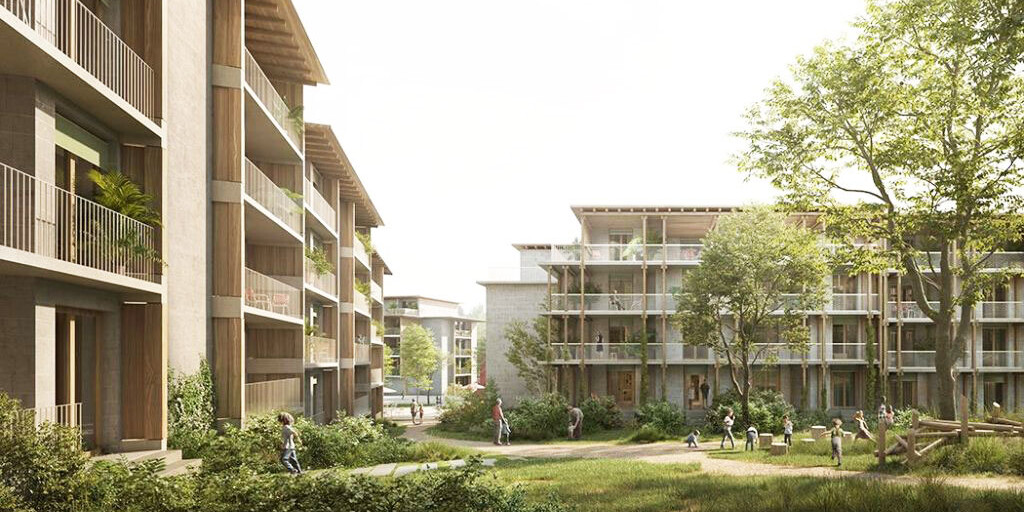
    The approximately 70-year-old buildings on the Bergacker estate are no longer up to date and are in need of renovation. It is not feasible to renovate them while they are occupied, which is why the owners, Swiss Life for the western part of the site and Habitat 8000 for the eastern area, have decided in favour of a comprehensive replacement building.

    Test planning was carried out back in 2019 to develop a sustainable urban planning solution. The result is a concept based on four-storey terraced buildings that are arranged along the slope and create generous, green open spaces. These “garden courtyards”, developed by EMI Architekten and Maurus Schifferli Landschaftsarchitekt, tie in with the original garden city idea and promote the quality of life.

    Sustainability as a guiding principle
    The entire construction project is designed in accordance with the highest sustainability standards and aims to achieve the “Gold” certificate of the Swiss Sustainable Building Standard. Energy is supplied by geothermal probe heat pumps and photovoltaic systems, making the neighbourhood largely self-sufficient in renewable energy. Green roofs and climate-resistant outdoor spaces with wildflower meadows and shady trees promote biodiversity. At the same time, a large proportion of the garden courtyards remain unsealed in order to improve natural water management.
    In addition to ecological sustainability, the social component also plays a central role. The new building will create a total of 270 flats with 1.5 to 5.5 rooms, which are aimed at a broad public, from singles and families to older people. The focus is on affordable living space that is suitable for all stages of life.

    Living quality through intelligent architecture
    The new buildings make optimum use of the hillside location to offer maximum living comfort. A noise-reduced mezzanine floor has been created on the street side, while the rooms on the garden side have generous ceiling heights and offer direct access to the green open spaces. The floor plans are designed in such a way that morning sun in the kitchens and evening sun in the living rooms ensure a pleasant indoor climate. Each flat has two outdoor areas in the form of a loggia, a balcony or a terrace with a private garden.

    Particular emphasis is placed on communal areas. In a participatory process, tenants expressed a desire for seating, playgrounds, barbecue areas and urban gardens, which are now being integrated into the planning.

    Staggered implementation for a smooth transition
    To ensure an orderly transition for residents, the new building will be realised in several stages. The construction project planning should be completed by the end of 2025 before the first construction phase starts in 2026. The first new buildings are expected to be occupied in 2028, while the other construction phases should be completed by 2030.

    Swiss Life tenants will be actively supported throughout the entire process. They will receive help in finding accommodation, have priority when re-letting within the neighbourhood and benefit from flexible notice periods.

    A showcase project for sustainable living
    Gartenstadt Bergacker is becoming a forward-looking neighbourhood that combines sustainable construction with a high quality of living and a social mix. Conscious planning and the involvement of the tenants will create an environment worth living in that fulfils ecological, economic and social requirements in equal measure. The project sends out a strong signal for the future of sustainable living in the city of Zurich.

  • Digitalisation and AI as the answer to skills shortages and climate targets

    Digitalisation and AI as the answer to skills shortages and climate targets

    The construction industry needs both digitalisation and AI in response to increasing complexity and data density. According to a HSLU press release on the seminar organised by its Institute of Building Technology and Energy(IGE), both are also needed to increase efficiency in times of a shortage of skilled workers, declining productivity and an urgently needed reduction in greenhouse gases from buildings.

    This annual IGE event is aimed at specialists in energy, building and construction technology and architecture. This year’s event attracted 110 participants.

    Several speakers shed light on the latest developments in AI for the construction industry. For example, Bruno Michel from IBM Research spoke about “artificial stupidity” when generative AI generates incorrect information with poor training data from the internet. Jörn Plönnings from the University of Rostock also emphasised that a lack of training data is a major problem for the construction industry. However, AI is neither a curse nor a blessing, but simply a necessity in view of the increasing complexity and flood of data.

    Marcel Imfeld from Schindler Aufzüge and Roman Steffen from Trafiko spoke about intelligent mobility, which enables denser construction or fewer parking spaces in neighbourhoods, for example. The automated monitoring of buildings was also covered in various presentations.

    The HSLU presented its Lightscore project, which aims to launch an evidence-based integrative lighting assessment. It is also working on a new SIA standard for the energy efficiency of data centres. And finally, Roger Buser from HSLU reported on his journey through India with the emission-free solar vehicle Solar Butterfly made of ocean PET, where he encountered numerous innovative solutions to combat climate change.

  • Historic spa centres in the canton of Vaud sustainably renovated

    Historic spa centres in the canton of Vaud sustainably renovated

    The renovated buildings in Bière, Dommartin, Romainmôtier, Rougemont and Vufflens-le-Château date from the 17th to 19th centuries. The restoration was carried out with the utmost care in order to preserve the historical substance. At the same time, facades, roofs, windows, insulation and technical installations were modernised to increase energy efficiency without changing the original character of the buildings.

    “Every restored stone, every renovated roof conveys a message to future generations, that of a canton that takes care to preserve its heritage. By modernising these five cures, we are combining heritage conservation with sustainable development,” emphasised Isabelle Moret, Head of the Cultural Heritage Department, during her visit to the site.

    Strengthening the local economy through traditional crafts
    The renovations were carried out in close collaboration with regional craftsmen. This not only strengthens the local economy, but also provides the canton with valuable craftsmanship expertise. The project shows that monument protection and sustainability are not opposites, but together form a forward-looking strategy for building culture.

  • AI offers companies opportunities in climate protection

    AI offers companies opportunities in climate protection

    Artificial intelligence offers numerous tools that companies can use to improve their climate protection and adapt their business to climate change. This is shown in a white paper that the swisscleantech association has developed with the consulting firm Accenture. The paper offers both a practical methodology for companies to analyse their own measures and a detailed overview of the market.

    Representatives of companies operating in Switzerland show which AI tools they are already using. Swisscom, for example, uses the solution from 42hacks, based in Trogen AR, to optimise the mobility of its employees thanks to the AI-supported analysis of their mobile phone data. The algorithms of viboo from Dübendorf ZH enable the intelligent control of thermostats and heating systems.

    Siemens has turned the Siemens Smart Infrastructure campus in Zug, which will be completed in 2023, into a climate-neutral showcase project for the sustainability of buildings. At the centre of this is the digital building platform Building X, which is part of Siemens Xcelerator.

    Google and SAP also discuss their AI-supported climate protection measures in the white paper.

    The widespread use of AI will increase the energy requirements of data centres. Their share of global electricity consumption could rise from the current 1 to 2 per cent to 10 per cent by 2030. The white paper also shows how their energy efficiency can be increased. “Rising power consumption can already be partially mitigated through the use of AI and other efficiency measures,” swisscleantech Co-Managing Director Michael Mandl is quoted as saying in a press release accompanying the white paper. “However, this will require further regulatory and political efforts.”

    In general, swisscleantech emphasises the opportunities offered by AI. “Our analysis has shown that AI already offers enormous potential to help companies achieve their climate targets,” says Co-President Fabian Etter.

  • Heat-repellent coating for energy-efficient buildings

    Heat-repellent coating for energy-efficient buildings

    The Schlieren-based company HeiQ, which specialises in textile technologies and synbiotics, will be presenting its Xpectra heat-insulating coating at the BAU 2025 trade fair in Munich from 13 to 17 January. According to a press release, this transparent heat-reflecting coating for walls increases energy efficiency in buildings.

    The coating, which is available as a spray solution, improves the heat transfer coefficient by up to 25 per cent, the statement continues. The U-value is the heat transfer coefficient and indicates the heat flow through a building component depending on the temperature difference between the warm and cold sides.

    Commenting on the coating, the Schlieren-based company says that HeiQ Xpectra offers the construction industry major advantages in thermal insulation technology. The aim is to achieve an outstanding insulating effect with a cost-efficient, simple wall coating. This will enable homes to achieve reduced energy consumption that fulfils the strict requirements of the EU Energy Performance of Buildings Directive and will help buildings in the EU to become climate-neutral by 2050.

    In addition to wall coatings, HeiQ Xpectra can also be used for transparent heaters, signature management, printed electronics and more, according to the company. HeiQ Xpectra could therefore change numerous industries.

    HeiQ is a spin-off from the Swiss Federal Institute of Technology in Zurich(ETH), is based at the IJZ Innovation and Young Entrepreneurs Centre and is a member of Start Smart Schlieren.

  • New technology for sustainable building insulation under development

    New technology for sustainable building insulation under development

    Aeroskin Tech is looking for investors. The spin-off from the Swiss Federal Institute of Technology in Zurich(ETH) has developed a technology for insulating buildings based on aerogels. So far, Aeroskin Tech has developed prototypes of spray insulation materials and insulation panels, the ETH announced in a press release. Now the technology is to be introduced to industrial production in a pilot plant.

    “We want to offer sustainable and high-performance insulation for buildings,” says Daniel Sanz Pont, founder of Aeroskin Tech and research associate of Robert Flatt, Professor of Building Materials in Civil Engineering at ETH Zurich, in the press release. The insulation materials based on aerogels are characterised by a two to two-and-a-half times better effect than conventional insulation materials. This is due to the nanoporous structures of aerogels, explains Sanz Pont. In the tiny pores, the air molecules collide more frequently with the pore walls than with each other. “This effect makes aerogels the best thermal insulation materials of all,” says Sanz Pont.

    The young entrepreneur did not found the ETH spin-off with partners, but on his own. “Thanks to my diverse education, I combine many competences in my person,” explains Sanz Pont. “I have also received coaching and expanded my training and experience in the field of business management, and I have been supported by outstanding experts from ETH throughout these years.” For upcoming challenges and the next step, the young entrepreneur also has experienced mentors at his side “from whom I can learn more quickly”.

  • Final construction phase for sustainable development in Rotkreuz

    Final construction phase for sustainable development in Rotkreuz

    Zug Estates is tackling the final construction project in the development of the Suurstoffi site in Rotkreuz, which began in 2010. The Zug real estate company announced in a press release that the ground-breaking ceremony for the two new buildings Suurstoffi 43 and 45 was held at the beginning of December together with representatives from the authorities and project partners. Together with a central park, they are due to be completed by mid-2027.

    Zug Estates is creating around 14,400 square metres of office and training space in the two new properties. A further 1,100 square metres have been designed as living space for student accommodation. Once completed, the Suurstoffi 45 property will be home to the Central Switzerland Health Education Centre(XUND). The training centre is relocating from Alpnach OW to Rotkreuz in order to meet the growing demand for practical healthcare training and changing training models. XUND and Zug Estates signed a long-term rental agreement for Suurstoffi 45 in September.

    The final development project for the site “fits seamlessly into the Suurstoffi site, both architecturally and in terms of sustainability”, writes Zug Estates. “The existing, almost emission-free energy system” will have another geothermal probe field. The proportion of grey energy will be lower than in comparable properties thanks to a reduced basement level and the optimisation of façades, building services and statics.

  • Revolutionary technology for the computer world

    Revolutionary technology for the computer world

    The increasing complexity of neural networks poses enormous challenges for conventional computer technologies. Electronic hardware is increasingly reaching its limits. This is where MIT’s revolutionary development comes in. A photonic processor that uses light instead of electrons for calculations and heralds a new era of high-speed processing.

    At the heart of the system is a fully integrated optical neural network that combines linear and non-linear operations. While linear calculations are performed using light-based matrix multiplications, the new technology overcomes the previous hurdle of non-linear operations. This was solved by special non-linear optical functional units that efficiently combine optics and electronics.

    Speed and efficiency in the nanosecond range
    The photonic processor processes classification tasks in less than half a nanosecond. A speed that sets new standards. The technology significantly reduces latency times and is extremely energy-efficient. The optical signals are not converted into electrical currents until the final output. This combination enables impressive accuracy values of over 96 per cent during training and more than 92 per cent during inference.

    Scalable integration for practical applications
    A key advantage of photonic chips is their scalability. They can be integrated into existing systems using commercial manufacturing processes. MIT is thus not only opening up new perspectives for AI applications, but also for energy-intensive areas such as big data and data centres. MIT’s photonic AI chips mark a technological breakthrough in the world of computing. Using light as a computing medium enables ultra-fast, energy-efficient and scalable AI calculations – a step into a new future of data processing.

  • Sustainable power generation for the canton of Aargau

    Sustainable power generation for the canton of Aargau

    The new installation of photovoltaic systems at the Buchenhof site in Aarau by the Canton of Aargau ‘s Real Estate Department(IMAG) is intended to make an important contribution to the canton’s sustainable electricity generation, according to a press release. In view of the upcoming renovation cycle for the flat roofs of the administrative site, the IMAG) has determined that Buchenhof offers good conditions for the expansion of photovoltaic systems on the flat roofs, it continues. In addition to the structural condition, the potential for sustainable electricity generation measures was also examined.

    The expansion planned for 2025 is part of the cantonal energieAARGAU strategy and will help to reduce external energy consumption thanks to the defined optimum number of photovoltaic modules. Due to the high energy requirements of the cantonal data center, 100% of the electricity produced by the photovoltaic systems will be consumed internally.

    “The fact that Buchenhof will be able to use the electricity generated by the photovoltaic system in future means that energy purchasing costs can be reduced. The system also makes an important contribution to the canton’s climate-neutral energy supply,” said Markus Dieth, Head of the Department of Finance and Resources.

    “Immobilien Aargau has also taken biodiversity into account when expanding the photovoltaic systems,” continued Cantonal Councillor Dieth. In order to preserve the wild orchids on the roofs, the number of photovoltaic modules to be installed has been optimized.

  • Over 200 projects selected for more sustainability

    Over 200 projects selected for more sustainability

    In its second funding round, the Swiss Climate Foundation has selected a further six climate-innovative projects and technologies for funding. This means that more than 200 grants have already been awarded since the foundation was established in 2008, the foundation announced in a press release. “It’s great to see the sophisticated projects with which the individual SMEs together generate an enormously positive impact on climate protection,” said Foundation President Thomas Hügli.

    The projects recognised in the second funding round cover a wide range of topics. Laborex from Mendrisio TI, for example, is being funded for its mini biogas power plant, which generates energy from livestock biomass. Digit Soil from Adliswil ZH is also active in the field of agriculture. The spin-off from the Swiss Federal Institute of Technology in Zurich is working on a digital individual fertiliser planner.

    Two other subsidised projects are in the field of recycling. WasteFlow from Lausanne uses intelligent sensors to optimise recycling rates. Grensol from Thalwil ZH, on the other hand, is working on a method for recovering recyclable raw materials from plastic waste from cars and household appliances.

    Mycrobez is being promoted for its alternative to petroleum-based foams. The Basel-based company produces natural foam from mushroom roots and locally sourced biological side streams. Lumatics aims to reduce CO2 emissions in the construction industry by optimising cement production. The four-step programme of the young company from Brugg AG saves on fuels and raw materials.

  • “Best of Research 2024” goes to Lisa Pantenburg

    “Best of Research 2024” goes to Lisa Pantenburg

    The “Best of Research 2024” award from the Swiss Real Estate Institute is considered one of the most important awards in the field of property research. Lisa Pantenburg impressed the jury with her thesis on the decarbonisation of the Swiss building stock. The award ceremony took place as part of the Swiss Real Estate Institute’s symposium at the HWZ in Zurich, where the best scientific papers of the year were presented.

    Focus on climate targets and building refurbishment
    The award-winning work analyses the challenges and opportunities associated with the decarbonisation of the building stock. The aim is to show ways in which Switzerland can achieve the net-zero target by 2050. The focus is on owners of owner-occupied single-family homes and rented apartment buildings, who must be specifically motivated to implement energy-efficient renovations.

    Example project as a pioneer of the energy transition
    A single-family home in Zurich, which has been modernised with comprehensive energy measures, provides an illustrative example of the possibilities of building refurbishment. By installing a heat pump and a photovoltaic system as well as improving the building envelope, annual energy savings of over 30% were achieved. This project illustrates the potential of sustainable refurbishments, which make a significant contribution to achieving climate targets.

    Research for a sustainable future
    Lisa Pantenburg’s work not only provides theoretical findings, but also practical recommendations for action. She sheds light on the social, legal and economic aspects that are necessary to increase the renovation rate in Switzerland. These results show how research can make an important contribution to the sustainable development of the property sector.

    Lisa Pantenburg’s award emphasises the importance of excellent scientific work and highlights how innovative thinking can overcome the challenges of the energy transition.