Tag: Energiekonzept

  • Werkstadt Zurich: Transformation into a climate-friendly neighbourhood

    Werkstadt Zurich: Transformation into a climate-friendly neighbourhood

    SBB is transforming the 42,000-square-metre Werkstadt site in Zurich into a vibrant urban space, to be completed by 2035. This will preserve the fabric of its historic buildings, which will one day be joined by both new buildings and extensions to create an exciting cluster. The transformation of the former SBB workshops will be exceptionally sustainable, featuring climate-conscious building measures, circular economy elements and an innovative energy concept.

    Developing existing buildings
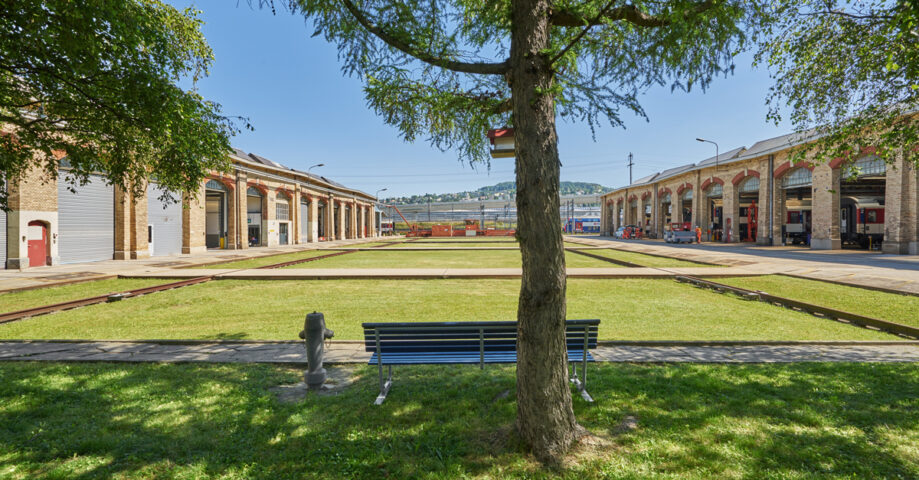
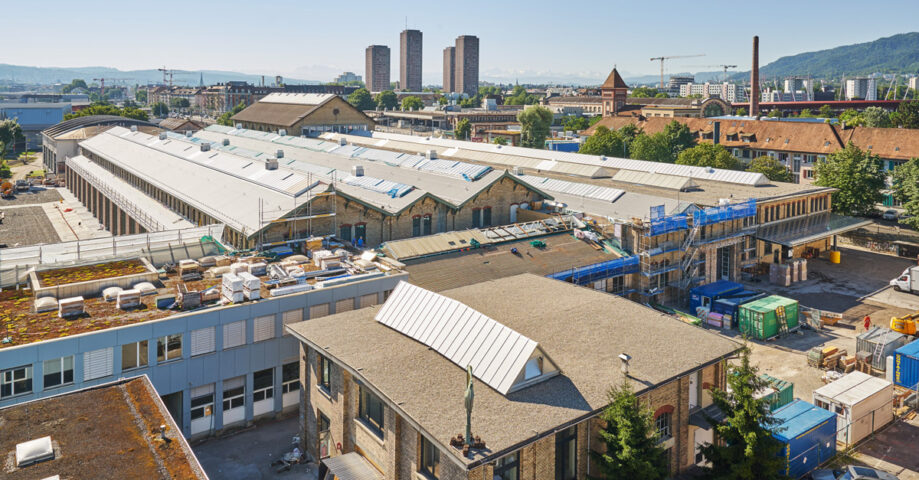
    In close coordination with the monument preservation authorities, the existing buildings will be gradually renovated and joined by new buildings and extensions in the coming years. At the heart of the site, the former carriage workshop ‘Building Q’ will allow for a diverse usage mix under one roof from 2023. The development will offer an exciting interplay between the fabric of historic buildings, structural densification and public use of outdoor space.
    © SBB AG, Martin Zeller

    Environmentally friendly construction
    ‘SBB wants to be climate-neutral by 2030, and climate-compatible construction is an important factor in achieving this objective,’ said Gabriele Bühler, Project Manager at SBB. Various climate-conscious building measures have been incorporated into the planning of the site. That includes configuring the new buildings to promote the circulation of cool air currents. Where possible, the roof water will be allowed to seep into an above-ground system for further cooling. Surfaces will remain unsealed where possible. The transformation follows a systemic approach that considers the building along its entire life cycle. The aim is to keep CO2 emissions as low as possible. To ensure circularity, all construction components are recorded on the Madaster platform. There is also a particular focus on reusing components. 

    Energy concept: 100% renewable
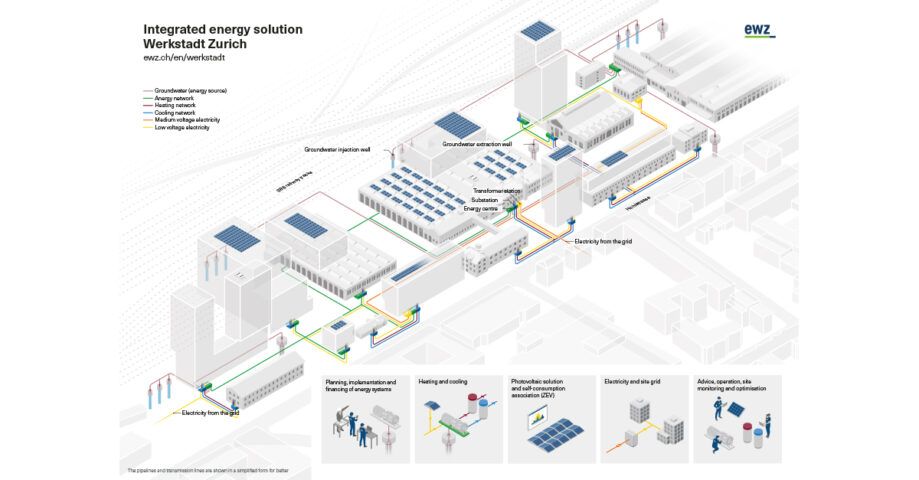
    ewz was able to win SBB’s public tender with an energy solution based on 100 per cent renewable energies. Groundwater, which is collected in four wells on the site, serves as a source of heating and cooling. From these wells, the water flows to the energy centres in the larger buildings, which house heat pumps and cooling machines that bring the water to the required temperature. An anergy network connects all the buildings and ensures that excess energy is exchanged between the building groups. For example, excess heat or cold in one building can be used in another. This system also has the advantage of not requiring groundwater boreholes in every building: the smaller buildings are connected to the energy centres via a local heating network. Heating and cooling is generated without any CO₂ emissions, as the rest of the electricity also comes from renewable sources. The use of a monovalent energy system will ultimately lead to a CO2 reduction of over 2,100 tonnes per year.
    High self-consumption of solar power
    ewz also plans, finances, creates and operates the transformer systems and medium-voltage lines to supply the site with electrical energy. ‘Some of the electricity that the people in the Werkstadt use on the site is produced there using photovoltaics,’ explains Markus Fischer, Head of Sales at ewz Energy Solutions. To this end, SBB and ewz want to make the best possible use of the roof areas for solar power production. Both the roof of Building Q, at the centre of the site, and the roofs of other buildings with a suitable structure and orientation for generating solar power are to be kitted out with photovoltaic systems. SBB requires its tenants on the site to form a self-consumption association (ZEV). ‘When completed, the ZEV will consist of around 300 parties that will use locally produced electricity on the site. This allows us to achieve a high self-consumption rate, which, in turn, makes a significant contribution to the cost-effectiveness of the photovoltaic systems,’ says Markus Fischer. He expects self-consumption on the Werkstadt site to be almost 100 per cent when completed.
    © SBB AG, Martin Zeller

    The benefits of contracting
    For the owner, this form of collaboration has various benefits, including keeping financial risks and management costs very low. If a system fails, ewz makes sure it gets back into operation as quickly as possible. To ensure that the system can be operated efficiently, ewz will start undertaking energy-related operational optimisations shortly after commissioning. As part of an ongoing process, the systems will be optimised and adapted to the actual needs relating to their use. By extension, this ensures that they consume as little energy as possible, generate minimal costs and offer maximum convenience for users.

    Werkstadt Zürich is a successful example of a forward-looking approach to repurposing a historic industrial site. With the targeted renovation and expansion of existing buildings and a ground-breaking energy concept, the developers – together with the planners and ewz – are creating added value for future users and the environment alike. Find out more about the Werkstadt site’s innovative energy concept here.


    https://www.ewz.ch/en/business-customers/real-estate.html

  • Innovative quarter on the Henz site

    Innovative quarter on the Henz site

    At the Suhr Süd train station, an innovative quarter is being created that combines living and working. To this end, the Henz area – the former location of the steel trading company of the same name – is being completely converted. Condominiums and rental apartments are being built here, some of which can be moved around at the push of a button. The four to twelve storey buildings are characterized, among other things, by their open courtyards. The new quarter connects to the urban train station quarter in the north. In the south, according to the SSA Architekten AG commissioned with the project, the “scale transition to the Helgenfeld and Frohdörfli developments” is successful.
    59 condominiums and 143 rental apartments as well as studios and movements – these are furnished apartments with movable modules – as well as commercial, restaurant and service areas are to offer residents a meeting point for young and old after completion in autumn 2023. A 40 meter high building with 12 floors will be particularly striking. Here, on areas of 72 to 119 square meters, 2.5 to 5.5 room apartments with loggias are being built that are for sale. A restaurant and at least two should be on the ground floor
    Service companies settled
    will.

    The garden house has four floors. The condominiums are designed as 2.5 to 5.5 room apartments. With living areas of 68 to 129 m2, loggias, terraces or garden seats, the larger apartments are particularly suitable for families. The so-called courtyard building provides for 15 condominiums. Two more buildings with rental apartments and studios are being built along Gränicherstrasse and Bernstrasse West.

    A public square with a café and playground as well as various open spaces connect the area with the surrounding quarters via a network of paths. The property on the southwest corner of the area offers additional outside space. On the other side of the street, a green area belonging to the Henz area with a playground and pavilion is being built. Various commercial and service areas are planned on the ground floors of the building. These uses are intended to enliven and enrich the quarter. The studio areas allow flexible use of living and working.

    The sustainable energy strategy includes the supply of district heating from the Buchs waste incineration plant. The energy for the gentle cooling of the apartments in the high-rise is generated by solar energy. Photovoltaic systems on the site generate part of the household electricity. The parking garage is equipped with a charging infrastructure for e-bikes and electric cars.

    Condominiums can be configured online by their future residents. Visiting your own four walls in the future is already possible thanks to virtual reality (VR). Halter AG is continuously registering bookings for this offer: "Customers are thrilled with how well they can imagine the premises and, in particular, the view and the ceiling height of 2.60 to 2.80 meters," says Agathe Siffrin from Primus Property AG who takes care of sales for Halter AG. “The combination of VR, configurator and showroom is the optimal solution for showing apartments that will only be ready for occupancy in around two years”, she continues. As of today, over 50 percent of the condominiums are already reserved. The rental starts next year. Interested parties can register for the one to two-hour VR and advisory tour free of charge via the website.

  • The best sustainable house is in Switzerland

    The best sustainable house is in Switzerland

    This year's Häuser Award had the motto The best sustainable houses, explains the magazine “Häuser” in a message . In addition to new buildings, conversions and extensions were expressly included. With regard to the properties, the jury of the houses award primarily examined the handling of the land, the energy concept, the choice of materials, the construction methods and the technologies used.

    The small house in Jonschwil designed by Lukas Lehnherr was able to qualify as the winner. "With the renovation of a coach house, the architect Lenherr succeeded in squaring the circle," the message quoted from the jury's reasoning for the decision. “An amazingly spacious house was built on a tiny area that fits perfectly into the townscape.” Architect Lehnherr from Quinten SG can look forward to the prize money of 7,000 euros associated with the award. The builders will receive a further 1000 euros from the cooperation partner of the award, the Association of Private Builders eV

    The jury awarded second prize to the extension of a Munich town house by architect Anton Mang. The third prize went to the Binnewies house in Münsterland. The expansion of a farm in the Taunus was honored with the award for outstanding interior design. The Green Dwelling near Hanover won the readers' award in 2021 decided by the magazine's readers.

  • Bluefactory implements an innovative energy and water concept

    Bluefactory implements an innovative energy and water concept

    The Bluefactory Friborg-Freiburg AG will implement an exemplary concept at the location of its low-carbon innovation quarter in the middle of Freiburg from spring. It is supposed to control their energy and water flows. She developed it together with the energy supplier Groupe E and SINEF AG , which focuses on water, energy and industrial pipelines. According to a statement from Groupe E, the first phase of implementation is estimated at CHF 11 million. The concept can also be used in other quarters.

    For this purpose, the supply networks to be created should optimally use the local natural resources – Pilettes source, geothermal energy, sun – and the facilities located in the vicinity such as water storage tanks, sewer pipes, cable ducts and the district heating network. All of this is aimed at a circular economy. It is intended to reduce the district's energetic and ecological footprint and promote biodiversity. Last but not least, users should also feel comfortable with it.

    Groupe E will implement an energy concept based on the principle of heat exchange at low temperatures. The thermal energy comes directly from the ground, from the Pilettes source, as well as from rainwater and sewage. Peak loads are covered by the nearby Freiburg district heating system. Photovoltaic systems provide the daily electricity.

    The concept for water management developed by SINEF AG enables the reintroduction of a more natural water cycle in the city center. Rainwater, for example, is collected and wastewater is cleaned on site. Collected water is used for flushing toilets, cleaning and irrigation. Urine-based fertilizer is produced on site.