Tag: Energiekosten

  • New white paper: unlocking synergies with integrated energy solutions

    New white paper: unlocking synergies with integrated energy solutions

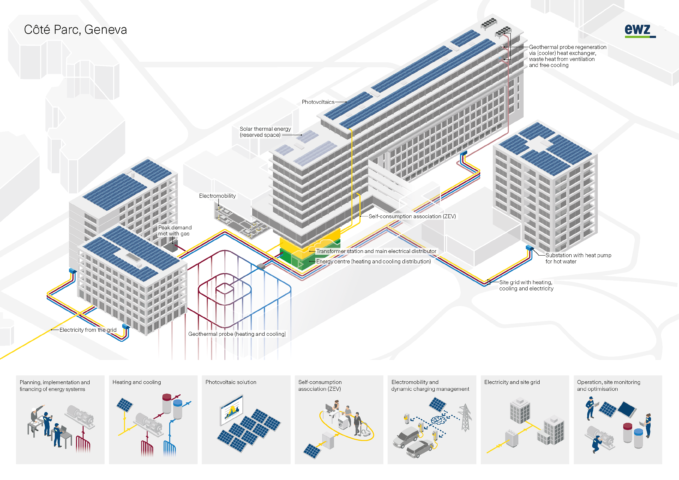
    Integrated energy solutions for sites and complexes generate added value for all stakeholders. They intelligently network all of the energy supply components for an ideal interaction of production, consumption and storage within an overall system. This unleashes efficiency potential, increases the degree of self-sufficiency and secures long-term supply to new and existing properties. The new ewz and Faktor Journalisten white paper entitled ‘Integrated energy solutions for sites and complexes’ offers property owners a knowledge base they can use during the planning process.

    Components of integrated energy solutions
    To exploit synergies, you need to plan the energy solution as a networked system from the beginning.
    Heating and cooling from local, renewable sources
    Thermal networks are a good way of supplying sites or complexes with carbon-free or carbon-neutral local heating and cooling. They can be implemented and operated on different scales (for complexes, sites or entire neighbourhoods) and at different temperature levels. The energy for high-temperature networks largely comes from wood or the waste heat generated by waste incineration plants, while networks with low to medium temperature levels often use geothermal heat, lake and river water, ground water and waste heat (from computing centres, for example). The lowest operating temperatures are achieved by anergy networks or low-temperature networks, which also cool buildings in summer with the free cooling method. Various network types can be combined for greater efficiency (see Côté Parc and Greencity).

    Harness solar power with a high rate of self-consumption
    A self-consumption association (ZEV) maximises the amount of energy consumed on site, which means that the photovoltaic installation is paid off quicker. What’s more, solar power is often cheaper than electricity from the public grid for ZEV participants. Local electricity communities (LEG), which are expected to be introduced in 2025 or 2026, enable solar power supply across properties and use the distribution grid.

    Microgrids for security in planning and supply
    Site electricity grids can be used to supply complexes, sites or neighbourhoods with electrical energy. Microgrids, or smart grids fitted with smart components, incorporate both generators and consumers of electricity. They help to ensure grid reliability by selectively switching on consumers, charging storage systems or throttling production.

    Charging infrastructure and electromobility – the new standard
    Electromobility is another important aspect of sustainable sites. To meet the growing demand for electric charging stations, it is a good idea to address construction of the charging infrastructure early on. Load management can help coordinate the electricity requirements of the charging station(s) with that of the other consumers in the building, and to regulate charging.

    Storing energy for enhanced efficiency
    With the share of renewable energies set to increase in the future, energy storage will become increasingly important. For example, electric car batteries configured for bidirectional charging can be used for storage purposes. Stationary battery storage systems are another means of absorbing surplus solar power and making it available again as required. Thermal storage units can be charged with solar power that would otherwise have to be fed into the public grid. This helps prevent peak loads, and also means that heat generators can set up in smaller dimensions. Geothermal probe fields can absorb excess heat (e.g. from solar panels or waste heat) to regenerate the ground and to cool spaces.

    Reducing emissions and cutting costs in the long term
    Continuous energy monitoring is a good way to cut energy costs and reduce greenhouse gas emissions in the long term. Continuous monitoring of the electricity, heating and cooling consumption values in a property, for example, can serve as a basis for adjustment. Energy monitoring is also important for ESG reporting, which is already mandatory for certain companies. By constantly reviewing consumption data and ensuring professional operation, companies have an opportunity to reach their efficiency and environmental targets and to create transparency in their dealings with various stakeholder groups.

    ‘Energy as a service’
    The ‘use, don’t own’ principle is ideally suited to integrated energy solutions for entire complexes or sites. For customers, this not only reduces their investment of time, but also the financial risk, while ensuring a significantly higher security of supply. When a client chooses an ‘energy as a service’ model, they outsource the planning, construction, operation and/or financing of the entire energy infrastructure for decades. This also ensures that the systems are operated reliably and efficiently.

    Learn more in our new white paper entitled ‘Integrated energy solutions for sites and complexes’.

  • BASE initiative to increase energy efficiency

    BASE initiative to increase energy efficiency

    The Servetia initiative from BASE – Basel Agency for Sustainable Energy aims to help Swiss companies achieve greater energy efficiency and has launched the Servitisation model for this purpose, according to a press release. For companies, energy costs have a significant impact on profitability, which makes energy efficiency an important opportunity, the press release continues. By optimising energy consumption, companies can not only reduce their costs, but also lower their CO2 emissions, achieve their sustainability goals and prepare for future energy regulations.

    Servetia presents an innovative approach to overcoming these challenges through servitisation. The underlying model, also known as Energy Efficiency-as-a-Service (EaaS), shifts the focus from owning energy systems to utilising the services they provide, such as heating or cooling, without the need for capital investment. The solution providers retain ownership of the systems and take care of implementation, operation, maintenance and upgrades.

    By working with BASE, the Enterprise for Society Centre(E4S) and the Fondation Valery, Servetia provides access to these cutting-edge technologies. Using BASE’s extensive experience, tools such as standardised contracts and financial analyses have been developed to support the introduction of the model.

    Over the past year, Servetia has built up a partner network that includes solution providers from energy technologies to metering and digitalisation, financiers, public institutions and companies in order to exploit the full potential of servitisation in Switzerland, according to the press release.

  • Strategies against urban heat islands: The importance of green spaces and water

    Strategies against urban heat islands: The importance of green spaces and water

    The challenge facing urban and industrial centres in the face of global warming is the phenomenon of heat islands, which is exacerbated by a combination of climate change and urbanisation. The overheating of urban areas results from a lack of vegetation and an excess of heat-absorbing surfaces such as concrete and asphalt. The high density of buildings and the lack of air circulation on narrow streets further exacerbate the problem.

    To combat the negative effects of these heat islands, such as increased energy costs for air conditioning, air pollution and health risks, cities such as Zug and Zurich have begun to integrate comprehensive climate analyses and models into urban planning. The aim is to design new neighbourhoods in such a way that they contribute to reducing heat and do not lead to the creation of heat islands.

    However, the adaptation of existing structures requires additional efforts. Many cities are exploring a combination of greening, the creation of water features and the use of building materials that absorb less heat. One example of this is the city of Sion, which has built a Japanese garden on the roof of an agricultural school and created a pond in front of the school building. In addition, soil sealing is being broken up and replaced with lighter-coloured asphalt to reduce heat storage.

    It is clear that individual measures are not enough to solve the complex problem of heat islands. A holistic approach based on the motto “More green and blue instead of grey” is required to maintain and improve the quality of life in urban areas, even in hot summer conditions.

  • Galileo cooperates with solar manufacturer Pagra from Poland

    Galileo cooperates with solar manufacturer Pagra from Poland

    Galileo and Pagra have signed a partnership agreement for the Polish market. According to a press release , the Zurich-based platform Galileo, which specializes in renewable energies, and the photovoltaic provider Pagra from Rogaszyce in Poland want to join forces to reduce the energy bills of companies in Poland.

    Galileo, which traded as Galileo Green Energy GmbH until mid-July, has acquired a 35 percent stake in Pagra as part of the partnership, with the option to further increase its stake after 24 months, according to the partnership announcement.

    “Pagra is a dynamic company that is at the forefront of the energy transition in Poland. It develops very effective power supply solutions for business customers in Poland,” Ingmar Wilhelm, CEO of Galileo, is quoted as saying. These customers are suffering from the sharp rise in wholesale prices, as price volatility is high and supply security is low, Wilhelm continued. Galileo will support Pagra in expanding its business across Poland and will complement its technical and energy competencies.

    Since 2020, Pagra has been offering photovoltaic roof systems in south-west and central Poland and is now expanding its activities throughout Poland. Business customers are offered the opportunity to save on investment costs by concluding a long-term electricity supply contract based on a photovoltaic system financed by the installer. This solution is called Energy-as-a-Service (EaaS).

    "We see a growing interest in this solution from both private companies and public institutions," Kornel Dybul, President of Pagra, is quoted as saying.

  • Asking rents continue to rise

    Asking rents continue to rise

    The Homegate rental index now stands at 117.9 points. This means that asking rents increased again by 0.3 percent in June, and by 1.3 percent since the beginning of the year. According to a media release from the real estate marketplace, this is “in stark contrast to the rental price development before the COVID 19 pandemic, when rising vacancies in the Swiss rental apartment market caused nervousness among investors”.

    Because the net rents have also become more expensive, the increased energy costs alone cannot be held responsible. In fact, building applications have been declining for the last two years. At the same time, there is brisk demand for rental apartments. “So just a few years ago there was concern about an oversupply of rental apartments, but these are again extremely scarce in sought-after locations.”

    Homegate describes the half-year increases in the cantons of Zug (5.4 percent) and Graubünden as well as in Appenzell (4.3 percent each) as remarkable. The increases were lowest in the cantons of Basel-Landschaft (0.6 percent) and Ticino (0.5 percent).

    In the cities, demand has increased again since the infrastructure started up again after the first phases of the pandemic, particularly in Zurich (4.8 percent). Lausanne (2.5 percent) and Lugano (1.8 percent) were also above the national average. Only in St.Gallen were rents slightly down (minus 0.2 percent).

  • Climate neutral by 2050

    Climate neutral by 2050

    Many homeowners cannot afford a renovation. Long-term loans are now intended to support builders who want to make their property climate-friendly but do not have sufficient financial resources or prefer to invest their money in their core business. At least that's what the state wants. Whether and how this can be done remains questionable. Because the financial institutions intended for this, such as banks and insurance companies, are hardly interested in loans with terms of more than 30 years. The federal government therefore wants to act as a security guarantor. A pilot project in Berne is now to examine whether this financing idea is realistic.

    The Zuger Energeek Group AG proposes another way. "With Energeek®, the solar panel with rental for you", she gets people to invest in solar energy, whether they own real estate or not. Energeek provides the solar panels and the real estate projects. Anyone who wants to invest can buy one or more panels online and then rent them out to a project company. Upon purchase, the buyer also benefits immediately from the one-time payment (EIV), the federal subsidy for solar systems. The panels acquired will be integrated into a larger panel network that generates electricity sustainably; the buyer of these panels thus becomes a producer of electricity through renewable energy with the right to rental income. A minimum rental price is guaranteed when the contract is signed. However, upward rent adjustments are possible at any time. For example, when the price of electricity rises with inflation. The purchased solar panels can also be resold, inherited or given away at any time together with the rental agreement and the associated rental income.

    Another big advantage: so that solar panels and the projects work very efficiently, solar trackers are used whenever possible and in addition to the permanently installed PV area. With these, the panels are not permanently installed, but rotate according to the sun. This means that, for example, the morning and evening sun is also optimally used. Or discover the smallest gap in the cloud on a cloudy day and use it to generate electricity. This achieves an increase in production of an additional + 63% kWh on average. This in comparison to permanently installed solar panels.

    Energeek Group AG presents the projects for which solar panels can be purchased on its website. The buyer can decide for himself which project the acquired panels should be rented to. For example, a project on a horse farm and hotel in the Freiberge is currently on offer. There, the group, together with its certified partners, will set up photovoltaic systems on a planned area of 1,590 square meters and thus supply the hotel building infrastructure, neighbors, heat pumps and e-charging station(s) with electricity. A panel in this project currently costs a little more than CHF 900, the annual rental income is CHF 82.50. A respectable return.
    More information at www.energeek.biz