Renewable electricity can be stored in chemical energy carriers such as hydrogen, synthetic fuel and methane (Power-to-X). According to a press release from the Swiss Power-to-X Collaborative Innovation Network SPIN, more than 50 projects in this area are already underway in Switzerland.
Together with the Coalition for Green Energy & Storage(CGES), SPIN is therefore launching a tracker that provides an overview of known projects in Switzerland. The resulting map makes visible those projects that have gone beyond laboratory tests and have already become demonstration projects or even commercial applications. SPIN collects the data, CGES visualizes it.
“The tracker facilitates collaboration by providing a structured database that promotes synergies between stakeholders and supports decision-making,” Christoph Sutter and Antonello Nesci, co-directors of CGES, are quoted as saying in the press release.
Martin Bäumle sees power-to-X technologies as the key to defossilizing the economy. “With the tracker, we are creating transparency, strengthening collaboration and helping to turn promising ideas into scalable solutions,” said the National Councillor (Green Liberal/ZH) and Co-President of SPIN. “Reliable data can help policy makers to adapt regulations and investors to identify new opportunities.”
The map will be presented at the CGES annual event, which will take place on November 21 at Swissgrid in Aarau. CGES is a coalition of partners from business, academia and the public sector for green energy, founded by the ETH Domain.
At the post office in the village of Kaltenbach, which belongs to the municipality of Wagenhausen, surplus solar power from the summer months can in future be utilised in winter. This will be made possible by a SeasON demonstration system in the new post office delivery centre in Kaltenbach, Matica AG announced in a press release. The thermochemical process developed by the company in collaboration with Lucerne University of Applied Sciences and Arts utilises caustic soda for the loss-free storage of electricity and waste heat.
When the electricity is stored, water is removed from the caustic soda solution and transferred to a separate tank. Concentrated caustic solution and separate water can then be stored at room temperature. If the stored energy is to be utilised, the concentrated caustic solution is diluted again with the separated water. The resulting mixing heat is supplemented by condensation heat. It is generated by vaporising the water in the closed system with the help of low-temperature heat from a heat exchanger.
“For us and the team at Lucerne University of Applied Sciences and Arts, the realisation of the project in Kaltenbach is another important milestone on the way to the market launch of our innovative over-seasonal energy storage system SeasON,” said Matica CEO Marc Lüthi in the press release. “The experience gained from building the system, installing it and analysing the operating phase is essential for the efficient further development of our pioneering solution.”
The Wagenhausen-based company installed its first demonstration plant in Frauenfeld in 2024. A third system is planned for spring 2026 in a housing estate in North Rhine-Westphalia.
The retreat of glaciers in the Alps increases the potential for electricity production from hydropower and energy storage. This is shown in the report“Analysis of the hydropower potential of glacier melt“, which the Federal Council approved on December 6, according to a press release.
According to the report, the retreat of the glaciers leads to an additional potential of 1470 gigawatt hours for the production of electricity. Of this, 340 gigawatt hours came from the expansion of existing plants and 1130 gigawatt hours from new plants.
The potential for seasonal storage of hydropower, which could be turbined in winter, is even greater at 2430 gigawatt hours. Of this, 1300 gigawatt hours are attributable to the expansion of existing storage facilities and 1130 gigawatt hours to new constructions.
However, the use of this potential is likely to be limited by conflicts with other interests. For example, potential new plants with a production of 540 gigawatt hours would be located in designated floodplain areas and therefore cannot be used as things stand at present. Plants with an annual production of 910 gigawatt hours would have conflicts with floodplain areas, but would not be located in such exclusion zones.
The economic viability of storage projects can be secured to a large extent by existing funding instruments. However, renewals and expansions could be slowed down because concessions expire. Operators would first have to secure their investments in negotiations with the local authorities before investing.
The report fulfills postulate 21.3974 of the National Council’s Committee for the Environment, Spatial Planning and Energy from August 24, 2021.
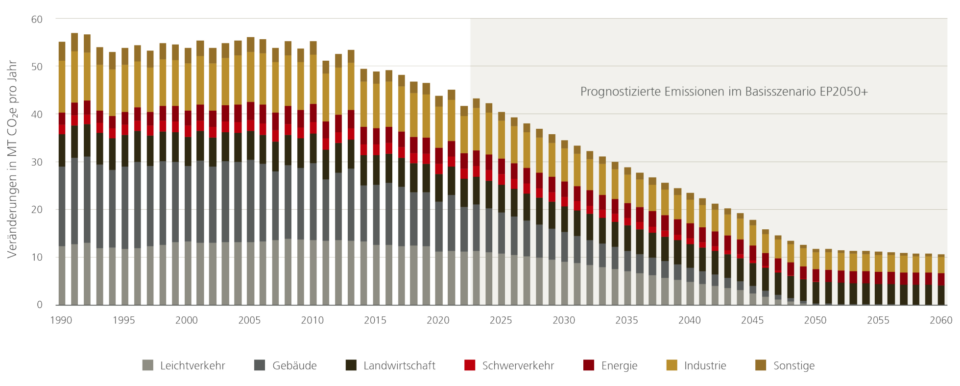
Switzerland compares favourably with other countries. Its carbon intensity is the lowest of all OECD countries and electricity generation is already largely CO₂-free. Emissions were reduced by 24% between 1990 and 2022. This is a remarkable achievement while at the same time doubling its economic strength. This strong starting position offers Switzerland the opportunity to take a leading role in green technologies such as carbon capture or low-carbon cement.
Renewable energies and energy storage are key In order to continue decarbonisation, electricity generation capacity must be increased from the current 27 gigawatts to over 60 GW by 2050. This is particularly challenging as the four remaining nuclear reactors will be shut down by 2034. A massive expansion of renewable energies and innovative solutions for the seasonality of supply and demand are required. Increasing energy storage capacities and efficient demand management will also play a key role.
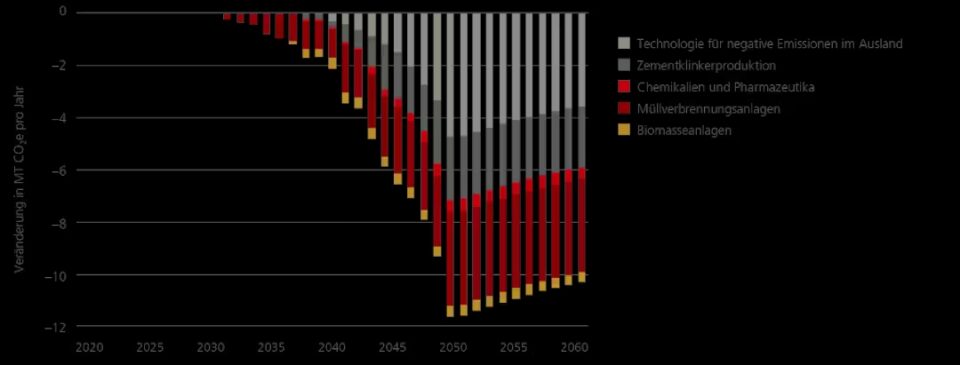
Michael Baldinger, Chief Sustainability Officer at UBS, explains: “For sectors that cannot completely eliminate their emissions, carbon capture technologies are crucial. This presents Switzerland with technological, logistical and financial challenges, but at the same time opens up opportunities in green markets.”
Regulatory changes set the course The legal basis for the transition will be defined by significant regulatory changes in 2025. These include the Electricity Act, the CO₂ Act and the Climate and Innovation Act. Adapting to EU requirements will also increase the number of Swiss companies subject to reporting requirements from 300 to 3,500. These changes require targeted investments and close cooperation between the business, political and financial sectors.
Financial sector as a key player According to estimates by the Swiss Bankers Association (SBA), CHF 13 billion is required annually to achieve net zero. The Swiss financial sector plays a decisive role here. It offers financing options such as bank loans, bonds and blended finance solutions that support the market entry of new technologies. It can also advise companies on the transformation and act as a link between investors and companies.
Pumped storage power plants are a proven method of storing energy, but have their limits on land. The StEnSea project transfers this principle to the seabed, where space and conditions are ideal for this technology. The prototype consists of a hollow concrete sphere that stores or generates electricity through water inflow and outflow.
Field test and mode of operation A three-metre sphere was successfully tested in Lake Constance. Now a 400-tonne concrete sphere with a diameter of nine metres is to be anchored off Long Beach, California. The sphere is pumped empty to store energy and generates electricity by returning water to drive a pump turbine.
The prototype has an output of 0.5 MW and a capacity of 0.4 MWh. The Fraunhofer team plans to scale up the system to spheres with a diameter of 30 metres, which can achieve an output of 30 MW and a capacity of 120 MWh.
Advantages and potential applications Water depths of 600 to 800 metres are ideal for this storage technology. The pressure and wall thickness allow for cost-efficient constructions. There are possible locations worldwide, for example off Norway, Portugal or the US coast. The technology is also suitable for deep lakes or flooded open-cast mines.
The global storage potential is estimated at 817,000 GWh, which is significantly higher than the capacity of conventional pumped storage power plants. Applications range from arbitrage transactions to the stabilisation of power grids through control reserve.
Cost-effectiveness and scaling With storage costs of around 4.6 cents per kilowatt hour and a service life of the concrete sphere of up to 60 years, the technology is cost-effective. The efficiency per storage cycle is 75 to 80 per cent. A pilot park with six spheres could achieve 520 storage cycles per year.
Prospects for the energy transition Bernhard Ernst, project manager at the Fraunhofer IEE, emphasises the importance of the StEnSea technology: “The global energy transition is increasing the need for storage enormously. Our underwater spherical storage systems are a cost-effective solution for short to medium storage periods.”
The StEnSea spherical storage tanks offer a pioneering technology for energy storage. With the test run off the Californian coast, the Fraunhofer team is taking an important step towards scaling up and commercialisation. The technology has the potential to revolutionise energy storage worldwide in the long term.
Researchers from the Dübendorf-based Materials for Energy Conversion Laboratory of the Swiss Federal Laboratories for Materials Science and Technology(Empa) are continuing an Innosuisse project started by Ticino-based salt battery manufacturer Horien Salt Battery Solutions. The aim of the research collaboration is to develop economically attractive and usable salt batteries, according to a press release. Salt batteries are batteries in which the electrolyte is a solid, namely a ceramic ion conductor based on sodium aluminium oxide. The cathode is based on a granulate of common salt and nickel powder. The sodium metal anode is only formed during charging. Unlike conventional lithium-ion batteries, salt batteries are not flammable. They can therefore be used in areas where lithium-ion batteries are not permitted, such as in mining and tunnelling or on oil and gas platforms. Further advantages are their longevity and the significantly cheaper procurement of the raw materials. In contrast to the lithium-ion competition, the raw materials are cheap and available in large quantities, according to the press release.
One disadvantage of these batteries is their high operating temperature. To be ready for use, a salt battery requires a temperature of 300 degrees Celsius. The researchers are looking for options to make the applications more economical. “Depending on the application, it is more economical to keep a battery warm than to cool it,” Empa researcher Meike Heinz is quoted as saying in the press release.
Another endeavour is to operate the solid-state batteries nickel-free. The aim is to replace the cathode material nickel with other metals such as zinc. The aim is to establish salt batteries as long-term stationary storage systems thanks to their safety, long service life and the absence of critical raw materials.
The salt battery, an integral part of early electromobility, is a safe and durable storage medium that is convincing in various applications. In contrast to lithium-ion batteries, the salt battery uses a solid, ceramic electrolyte that is neither flammable nor explosive. In Switzerland, Empa researchers are working with industrial partners to further improve the performance and efficiency of this technology.
Advantages over conventional batteries The solid-state architecture and high operating temperature of around 300°C make the salt battery particularly suitable for extreme applications such as tunnelling or offshore installations, where safety is a top priority. Due to its temperature resistance and low-maintenance design, it is also used for the emergency power supply of mobile phone antennas, which have to work reliably for decades even under harsh conditions.
Economic efficiency and challenges One disadvantage of the salt battery is its high operating temperature, which requires a basic consumption of energy. Empa researchers such as Meike Heinz and Enea Svaluto-Ferro are therefore working on cell structures that enable the battery to heat itself during use and thus work more efficiently. Despite the additional energy requirement, the salt battery is considered more economical and stable than many alternatives in certain applications.
Resource-saving raw materials and recycling systems Another advantage is the availability of the required raw materials: Sodium and aluminium are inexpensive and plentiful, making battery production cost-effective and sustainable. Empa’s current research focus is on reducing the nickel content in the cells in order to further reduce the ecological footprint. In future projects, zinc could even replace nickel – an option that could further improve access to sustainable energy storage systems.
Future prospects As research progresses, the salt battery could find its way from specialised fields of application to broad, stationary applications. Its use as a long-lasting and safe storage system for residential areas or neighbourhoods is being seriously considered. It thus offers an innovative alternative to lithium-ion batteries and shows how research at Empa can set the course for the future of energy storage.
Energy consumption in the canton of Zug amounts to almost 3,000 gigawatt hours per year, with buildings and mobility accounting for the largest share. The cantonal government’s new energy and climate strategy (EKS) aims to reduce energy consumption and rely more heavily on renewable energies. At the same time, the government wants to strengthen security of supply in the canton and reduce greenhouse gas emissions to net zero by 2050. With clear interim targets up to 2030, the government is concretising the path to these ambitious goals.
Investments in solar power and energy storage A central component of the strategy is to increase the production of solar power in the canton. At the same time, investments in innovative energy storage technologies such as hydrogen are planned. “We want to shape the energy infrastructure of the future through close collaboration with industry and science,” explains Construction Director Florian Weber. Buildings in the canton should also increasingly serve as energy producers and thus become an energy hub.
Sustainability in agriculture and negative emission technologies As part of the KERB sustainability project, the canton is focussing on measures in agriculture to reduce CO2 emissions. Forests and moors play a central role in CO2 sequestration. For unavoidable emissions, the canton is focussing on negative emission technologies that are intended to permanently remove CO2 from the atmosphere. A study is to determine the potential of these technologies in the canton.
Adapting to climate change In addition to reducing emissions, the canton of Zug is also preparing for the effects of climate change. A cantonal natural hazard strategy aims to minimise climate-related risks such as heat and invasive pests. At the same time, investments are being made in climate-adapted road surfaces and sustainable forest management to ensure both protection and recreational areas.
“To ensure a secure electricity supply in Switzerland and to achieve the goal of net-zero greenhouse gas emissions, electricity production from local renewable energies must be rapidly and significantly expanded,” says the State Chancellery of the Canton of Zurich in a press release on a planned partial revision of the Energy Act. Specifically, the canton of Zurich wants to make the installation of solar systems on suitable roofs with an area of 300 square metres or more mandatory. The canton estimates that this would allow around 60 per cent of a total annual potential of 6 terawatt hours of solar power from roofs to be exploited.
The installation of solar systems on large roofs should be mandatory for both new and existing buildings. Existing buildings may be retrofitted when the roof is renovated, but by 2040 at the latest. The requirement should also only apply “if the solar installation is economical over its entire service life”. The corresponding bill has been submitted for consultation until the end of November.
In addition to the obligation for solar systems, the partial revision provides for the promotion of technologies for seasonal energy storage. This is to be funded by a subsidy fund managed by the electricity grid operators, which will be financed by a levy of a maximum of 0.5 centimes per kilowatt hour of electricity. Competitive tenders are planned, from which projects with the most winter electricity per subsidised franc will benefit, as well as support for seasonal storage technologies that are still under development.
Four projects will receive support from the EKT Energy Foundation. According to a press release, 20 applications were submitted to the foundation board for consideration in the second round of awards. All of the projects are working towards a secure, sustainable energy supply and the realisation of climate targets. They were convincing due to their high practical orientation and their connection to the canton of Thurgau. They are also “good examples of how both the Thurgau economy and Thurgau agriculture can benefit from the EKT”, according to Foundation Board President Fabian Etter.
One of the research projects is in the field of agrivoltaics. Ways of dual utilisation of agricultural land are being investigated, both for the production of crops and solar power. A test plant with semi-transparent photovoltaic modules from the Arenenberg Agricultural Competence Centre is intended to provide insights into the suitability of varieties, weather protection, irrigation and light management.
Two other projects relating to energy storage are also being funded, as these are central to the restructuring of the energy supply. One is being carried out at the animal carcass collection centre in the city of Frauenfeld, which is involved in the pilot project. The prototype of a sorption heat pump is being investigated. This will allow the waste heat generated during cooling to be stored thermochemically together with the electrical energy from the photovoltaic system during the summer months. The second energy storage project is a preliminary study investigating the opportunities and framework conditions for using modular sand batteries as heat storage systems.
The EKT Energy Foundation sees further innovative approaches for the energy transition in the Thurgau Energy Utilisation from Underground 2023 project. The funding will be awarded in combination with a loan and is intended to support the basic research and planning work required to apply for funding from the canton and the federal government. The aim of the research is to gain insights into the utilisation of geothermal energy sources.
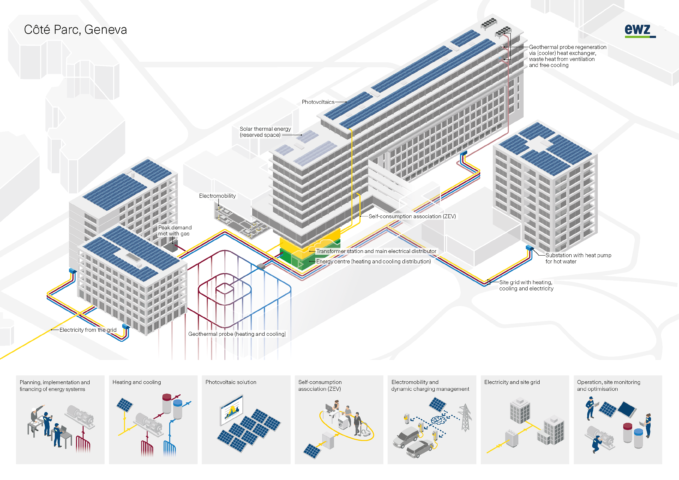
Integrated energy solutions for sites and complexes generate added value for all stakeholders. They intelligently network all of the energy supply components for an ideal interaction of production, consumption and storage within an overall system. This unleashes efficiency potential, increases the degree of self-sufficiency and secures long-term supply to new and existing properties. The new ewz and Faktor Journalisten white paper entitled ‘Integrated energy solutions for sites and complexes’ offers property owners a knowledge base they can use during the planning process.
Components of integrated energy solutions To exploit synergies, you need to plan the energy solution as a networked system from the beginning.
Heating and cooling from local, renewable sources Thermal networks are a good way of supplying sites or complexes with carbon-free or carbon-neutral local heating and cooling. They can be implemented and operated on different scales (for complexes, sites or entire neighbourhoods) and at different temperature levels. The energy for high-temperature networks largely comes from wood or the waste heat generated by waste incineration plants, while networks with low to medium temperature levels often use geothermal heat, lake and river water, ground water and waste heat (from computing centres, for example). The lowest operating temperatures are achieved by anergy networks or low-temperature networks, which also cool buildings in summer with the free cooling method. Various network types can be combined for greater efficiency (see Côté Parc and Greencity).
Harness solar power with a high rate of self-consumption A self-consumption association (ZEV) maximises the amount of energy consumed on site, which means that the photovoltaic installation is paid off quicker. What’s more, solar power is often cheaper than electricity from the public grid for ZEV participants. Local electricity communities (LEG), which are expected to be introduced in 2025 or 2026, enable solar power supply across properties and use the distribution grid.
Microgrids for security in planning and supply Site electricity grids can be used to supply complexes, sites or neighbourhoods with electrical energy. Microgrids, or smart grids fitted with smart components, incorporate both generators and consumers of electricity. They help to ensure grid reliability by selectively switching on consumers, charging storage systems or throttling production.
Charging infrastructure and electromobility – the new standard Electromobility is another important aspect of sustainable sites. To meet the growing demand for electric charging stations, it is a good idea to address construction of the charging infrastructure early on. Load management can help coordinate the electricity requirements of the charging station(s) with that of the other consumers in the building, and to regulate charging.
Storing energy for enhanced efficiency With the share of renewable energies set to increase in the future, energy storage will become increasingly important. For example, electric car batteries configured for bidirectional charging can be used for storage purposes. Stationary battery storage systems are another means of absorbing surplus solar power and making it available again as required. Thermal storage units can be charged with solar power that would otherwise have to be fed into the public grid. This helps prevent peak loads, and also means that heat generators can set up in smaller dimensions. Geothermal probe fields can absorb excess heat (e.g. from solar panels or waste heat) to regenerate the ground and to cool spaces.
Reducing emissions and cutting costs in the long term Continuous energy monitoring is a good way to cut energy costs and reduce greenhouse gas emissions in the long term. Continuous monitoring of the electricity, heating and cooling consumption values in a property, for example, can serve as a basis for adjustment. Energy monitoring is also important for ESG reporting, which is already mandatory for certain companies. By constantly reviewing consumption data and ensuring professional operation, companies have an opportunity to reach their efficiency and environmental targets and to create transparency in their dealings with various stakeholder groups.
‘Energy as a service’ The ‘use, don’t own’ principle is ideally suited to integrated energy solutions for entire complexes or sites. For customers, this not only reduces their investment of time, but also the financial risk, while ensuring a significantly higher security of supply. When a client chooses an‘energy as a service’ model, they outsource the planning, construction, operation and/or financing of the entire energy infrastructure for decades. This also ensures that the systems are operated reliably and efficiently.
Learn more in our new white paperentitled ‘Integrated energy solutions for sites and complexes’.
Wir verwenden Cookies zur Unterstützung und Verbesserung unserer Dienste. Mit der Nutzung dieser Website erklären Sie sich mit der Verwendung von Cookies einverstanden. Weitere Informationen finden Sie in unserer Datenschutzerklärung.