Tag: Energiesystem

  • Intelligent energy management optimizes power consumption in buildings

    Intelligent energy management optimizes power consumption in buildings

    A predictive control algorithm developed by Empa optimizes energy management in buildings in such a way that security of supply is guaranteed throughout the entire energy system. Automated building systems communicate directly with energy providers and the power grid.

    According to a report by Empa, automated systems can optimize electricity consumption in such a way that both grid stability and consumer flexibility are guaranteed at all times. At the same time, energy surpluses are not necessarily stored locally, but fed into the power grid wherever possible so that demand can be met at all times.

    During the practical test by Empa’s Urban Energy Systems Lab in its NEST test building in Dübendorf, the focus was on reducing CO2 emissions, the flexibility of energy demand and the comfort of the residents. Using the predictive control algorithm, the team succeeded in optimizing energy management within the building with the following setup: a photovoltaic system for electricity production, a battery storage system, a heat pump and a bidirectional charging station for electric vehicles.

    The system reportedly reduced the building’s CO2 emissions by more than 10 percent. The building was able to communicate the consumption and feed-in of electricity in advance. “The experiment has therefore shown that the flexible availability of renewable energies is not a problem a priori,” says Empa.

    However, in order to implement these results on a large scale, buildings will have to be consistently digitalized in the future. The technology developed by scientist Federica Bellizio is to be brought to market by the start-up Kuafu. She was recently awarded the Empa Entrepreneur Fellowship for her work.

  • Ein Pionier in der Nanotechnologie zur Energiegewinnung

    Ein Pionier in der Nanotechnologie zur Energiegewinnung

    Im Zentrum dieser bahnbrechenden Forschung steht die Verbindung von Thermodynamik und Quantenmechanik, um durch Nanotechnologie effiziente Energiesysteme zu entwickeln. Der Wissenschaftler, der sich dieser Herausforderung stellt, ist bereits seit zwölf Jahren im Bereich der Quantenelektronik tätig und hat seinen Fokus auf die Umwandlung von Abwärme in elektrische Energie gerichtet. Seine Arbeit mit Graphen-Nanobändern, einem Material aus einer einzelnen Schicht von Kohlenstoffatomen, verspricht neue Wege in der Energiegewinnung.

    Die Qualität seiner Forschung wurde bereits mit prestigeträchtigen Auszeichnungen wie dem ERC Starting Grant und einem Eccellenza-Professorenstipendium des Schweizerischen Nationalfonds gewürdigt. Der Forscher, der sowohl eine Forschungsgruppe an der Empa leitet als auch Assistenzprofessor für Quantenelektronik an der ETH Zürich ist, hat seine akademische Laufbahn an der TU Delft begonnen und sich stets für konkrete Anwendungen der Physik interessiert.

    In seinem Labor an der Empa erforscht er die Anwendung von Graphen-Nanobändern, die an der Empa unter der Leitung von Roman Fasel hergestellt werden. Die spezifischen physikalischen Eigenschaften dieser Bänder sind entscheidend für ihre Nutzbarkeit in einer Reihe von Quantentechnologien. Eine bedeutende Entdeckung seiner Gruppe war, dass die Quanteneffekte dieser Bänder auch bei -23°C noch weitgehend erhalten bleiben, was die Möglichkeit ihrer nwendung bei Raumtemperatur in Aussicht stellt.

    Die Technologie, an der der Wissenschaftler arbeitet, befindet sich noch in der Entwicklungsphase, und die Herausforderungen in der Nanofabrikation sind gewaltig. Trotzdem ist sein Ziel, die fundamentalen Grundlagen für die Anwendung dieser fortschrittlichen Technologie zu schaffen und damit ihren praktischen Einsatz in der Zukunft zu ermöglichen. Seine Forschung könnte letztendlich dazu beitragen, den Stromverbrauch elektronischer Geräte zu reduzieren und einen wesentlichen Beitrag zur Energieeffizienz zu leisten.

  • AEW Energie takes over 50 per cent of GA-Werkstatt.ch

    AEW Energie takes over 50 per cent of GA-Werkstatt.ch

    GA-Werkstatt.ch (GAW) is now owned equally by AEW Energie AG and the previous sole owner, Rotkreuz-based Herzog Kull Group Holding(HKG). With their new joint venture, the partners want to meet the increased demand in the field of building management for commercial properties. As stated in a joint press release, they aim to take a holistic approach and assume the project management role of a general energy company or total energy company.

    Both companies are convinced that a building will be an increasingly relevant element in the future energy system as a consumer, producer and store of energy. By working more closely together, they want to offer integrated energy solutions from a single source throughout the country.

    The competences of the new partners will complement each other: HKG will gain expertise in the planning of medium and high-voltage systems, according to the press release. The collaboration will enable a holistic view of buildings and grids in all areas of target grid planning. By acquiring a stake in GAW, AEW is expanding its portfolio of grid and energy-related services to include building technology, thereby strengthening its position as a provider of integrated energy services for its customers. Its associated company Virtual Global Trading AG is contributing its digitalisation expertise.

  • 4000 scenarios for the climate change

    4000 scenarios for the climate change

    Mankind currently emits 42 billion tonnes of carbon dioxide per year. According to calculations by the Intergovernmental Panel on Climate Change (IPCC), only around 300 to 600 billion tonnes may be added since 2020, otherwise the goal of limiting global warming to 1.5 degrees Celsius will hardly be achievable. Evangelos Panos from the PSI’s Laboratory for Energy System Analysis agrees with this conclusion: “It could be close, because in 70 per cent of our scenarios the world will exceed the 1.5 degree Celsius mark in the next five years.”

    Which climate measures have the greatest success?
    Against the backdrop of climate change, numerous political, economic and social decisions have to be made. However, these are subject to numerous uncertainties. It is understandable that those responsible are looking for reliable bases for one of the central questions, for example: Which measures have the greatest effect and are also economically advantageous in order to achieve the net zero emissions target, as Switzerland has set itself, for example? Answers are now provided by a large computer simulation that was developed on this topic. It couples climate models with economic models and 1200 technologies for the provision and use of energy and for the reduction of greenhouse gas emissions. As part of the study, a supercomputer calculated 4000 scenarios for 15 regions of the Earth, taking into account possible developments in ten-year steps up to the year 2100 in each case. “This requires sophisticated data analysis and visualisation techniques,” adds co-author James Glynn, head of the analysis platform for modelling energy systems at Columbia University in the USA. The final file is 700 gigabytes. The research article on it has now been published in the trade medium Energy Policy.

    What makes the work of Evangelos Panos and the co-authors so special: For the first time, their integrated assessment models take into account many of the uncertainties inherent in the models. Previous scenarios usually assume that all parameters for the future are known, such as when which technologies will be available and what they will cost, or how large the expansion potential for renewable energies is. Moreover, IPCC calculations focus solely on technology options, i.e. on the question of what effects the choice of certain technologies will have on the climate. The uncertainties in climate models and how the climate reacts to economic growth are left out of the equation, as are many other uncertainties, for example regarding population development or political measures. “The most important contribution of our research is that it enables policy makers to make concrete decisions about climate action with full knowledge of the existing uncertainties,” emphasises co-author Brian Ó Gallachóir from University College Cork.

    18 uncertainty factors and 72 000 variables
    When researchers want to calculate scenarios that contain many variables and uncertainties, they often resort to the so-called Monte Carlo method. The Monte Carlo method does not predict the future. “Rather, it lays out a kind of data map with what-if decision paths,” says Evangelos Panos. This was also the case in the current study: the team varied 72 000 variables for each scenario. “We considered 18 uncertainty factors, including population and economic growth, climate sensitivity, resource potential, the impact of changes in agriculture and forestry, the cost of energy technologies and the decoupling of energy demand and economic development,” explains James Glynn of Columbia University.

    Sound basis for national paths to energy transition
    In order to break down individual scenarios focusing on political and economic issues to the different national paths to energy transition, additional, national-specific parameters must be taken into account. “An energy system that enables the transition to a carbon-free economy is capital intensive and requires the mobilisation of resources from all actors,” Panos sums up. This requires tailor-made analyses at the national level: “Our study provides a sound basis for this.”

  • Sustainability & profitability – achieving returns with climate-friendly, intelligent energy solutions.

    Sustainability & profitability – achieving returns with climate-friendly, intelligent energy solutions.

    Integrated and intelligent
    Integrated energy solutions combine different energy sources and technologies to achieve high energy efficiency and flexibility. Intelligent energy management systems are used to optimise energy consumption and reduce CO2 emissions. They help to reduce operating costs and increase property value. IWB offers companies in the construction and real estate sector carefree packages for a high return on investment. Customers can choose between centralised, decentralised or combined solutions depending on their location and portfolio strategy. To achieve an optimal sustainable energy supply and use, the early involvement of the energy partner is crucial.

    Sustainable and economical
    Implementing renewable energies and intelligent energy management systems not only saves costs and increases the value of properties, but also achieves environmental sustainability. A good ESG score is becoming increasingly important and can also influence financing options.
    Property owners can reduce CO2 emissions and optimise the energy consumption of buildings by using photovoltaic systems and climate-friendly heating solutions such as heat pumps or district heating from renewable sources. Intelligent energy management systems monitor energy consumption in real time and regulate it by automatically controlling heating, ventilation and cutting off energy peaks.

    Sensible and profitable
    Investing in good energy solutions and intelligent energy management is sensible and profitable for a sustainable real estate portfolio. With IWB as a partner in the field of energy and sustainability, companies in the real estate sector can benefit from customised, efficient and smart solutions. The focus is on developing individual solutions tailored to the specific needs and goals of the customers. Together, they can invest in a sustainable future that offers not only ecological but also economic benefits.

  • ETH Zurich and EPFL launch green energy coalition

    ETH Zurich and EPFL launch green energy coalition

    Switzerland is facing a combined energy and climate crisis. In order to achieve the set net-zero target by 2050 and at the same time avoid an energy gap, the country is dependent on renewable energy sources, seasonal storage options and an efficient connection to the European electricity market. In addition to pumped storage power plants, batteries or heat storage, synthetic fuels and gases such as hydrogen in particular offer an interesting way to store, transport and trade cheap electricity from photovoltaic plants in the summer for the winter. There are numerous promising technologies that are currently under development but not yet fully operational. This is where the “Coalition for Green Energy and Storage” comes in, which was publicly presented on 8 June at the Swiss Economic Forum in Interlaken.

    “With the coalition, we want to quickly bring existing technologies for CO2 capture and for the production and storage of carbon neutral gases and fuels to market maturity and raise them to an industrial level,” ETH President Joël Mesot explains the plan. The goal is to enable a scalable, climate-neutral and flexible energy system within a reasonable period of time.

    Wanted: partners from politics, industry and science
    Achieving this goal will require a joint effort by science, politics and industry. “The two Federal Institutes of Technology alone have 150 research groups in the field of energy, as well as around 460 researchers and four successful spin-offs in the field of CO2 capture and energy storage. Together with other research groups from PSI and Empa, the ETH Domain has both the know-how and the size to respond to current challenges together with companies,” says EPFL President Martin Vetterli. Now the two universities are looking for technology and implementation partners, as well as donors and supporters from politics and society.

    Around 20 companies and organisations have already expressed their interest in working together: Alpiq, AMAG, BKW Energie, SBB / CFF, Carvolution AG, Cemsuisse, Emil Frey Group, Edelweiss, FIR Group AG, Gaznat, Genève aéroport, GE Vernova, Gruyère Hydrogen Power SA, Implenia, MAN Energy Systems, Migros Industry, Romande Energie, Rolex, Swissmem, SWISS International Air Lines, VBSA, Viteos SA, Verband der Schweizerischen Gasindustrie / Association Suisse de l’Industrie Gazière.

    With the airline Swiss International Air Lines (SWISS) and the energy service provider Alpiq – who were present at the SEF alongside the two presidents – two heavyweights of the Swiss economy have been on board from the start. “We are proud to be part of this energy coalition. Together, we are driving forward the production of synthetic fuels, which are one of the biggest levers for us to fly ever more sustainably in the future. At the same time, new possibilities for energy storage are being created, which increases Switzerland’s security of supply and serves society as a whole,” says Swiss CEO Dieter Vranckx. The airline needs economic solutions quickly in order to achieve its own climate goals. Synthetic fuels play an important role in this. Alpiq, for its part, has a broad portfolio of hydropower and storage plants in Switzerland and is one of the pioneers in Switzerland with the production of green hydrogen in Gösgen. With numerous projects for the addition and expansion of renewable energies and various storage technologies in Switzerland and neighbouring countries, Alpiq can make a significant contribution: “With a broad coalition of business, science and society, we can achieve the set net-zero target and a sustainable energy supply at the same time. In this way we can strengthen Switzerland as a business and science location,” says Alpiq CEO Antje Kanngiesser, explaining her company’s clear commitment. The well-known philanthropist Hansjörg Wyss has also already pledged his support to the coalition.

    Planned: Research platforms in the megawatt range
    With new technical solutions, the coalition wants to create additional opportunities to exploit the seasonal differences in electricity production by means of energy storage in Switzerland and Europe. This will improve Switzerland’s security of supply and diversify energy trade with European and international partners, creating new business areas and opportunities for technology start-ups and Swiss industry. The technical options will be analysed systemically in order to find and implement the best possible solutions in terms of supply security and costs.

    The coalition will be formally established by the end of 2023 in order to launch the first projects in early 2024. Demonstrators in the megawatt range will be built on the basis of existing technologies, which should be productive from 2028 and will serve as research platforms. A budget of around CHF 100 million is needed for this project in the first phase.

  • App facilitates energy planning for buildings

    App facilitates energy planning for buildings

    With Polysun, Vela Solaris AG from Winterthur has developed a solution that should facilitate the planning of energy systems for buildings and neighborhoods. It makes it possible to simulate energy systems in these environments. In this way, possible energy systems can be displayed for an initial examination and compared with one another.

    Based on Polysun, Vela Solaris and the building technology association suissetec set up the building technology calculator web app. The association is now making the solution available to its members and customers, as stated in a message .

    “With the building technology computer, we enable our customers to take the step towards the digital conception of energy systems”, Lars Kunath, responsible for digital solutions at suissetec, is quoted as saying. He also emphasizes the “reliability of the simulation results and the high level of professionalism of Vela Solaris as a development partner”.

    “The cooperation with associations as well as manufacturers and dealers represents a real enrichment for Vela Solaris”, says Angela Krainer, Managing Director of Vela Solaris. “We always strive to make our solutions available to as large a user group as possible”.

  • This is how the paper energy system works

    This is how the paper energy system works

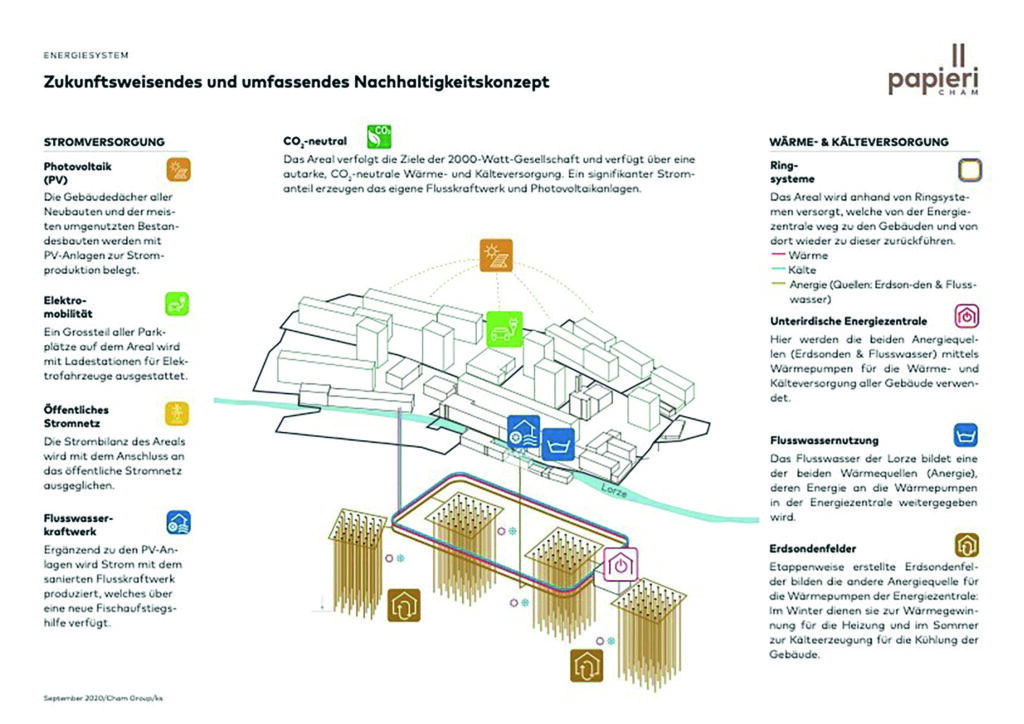
    The Papieri area is to be operated in a CO2-neutral manner and to play an important role in the implementation of the desired 2000 watt society. The sophisticated energy system consists on the one hand of its own river power plant, which has been producing electricity since 1890. Now it has been upgraded with the latest technology as part of the site development. In addition, the water from the Lorze is used as a heat source and electricity production is supported by photovoltaic systems on the building roofs. Newly installed heat pumps complete the advanced energy system. Not only is the CO2 neutral
    Real heating of the buildings in winter, but also the cooling of all residential and commercial units in summer.

    Modern technology also sets the tone when it comes to living: All apartments are equipped with fiber optic connections and a smart living system. The control of the heating, ventilation, shading or also the light and energy management can be controlled via a centrally installed touch panel or via mobile devices such as smartphones or tablets.