Tag: Energieverbrauch

  • Career prospects in Swiss timber construction

    Career prospects in Swiss timber construction

    The importance of the timber construction industry
    The timber construction industry plays a key role in Switzerland, particularly in the area of sustainable construction and energy-efficient building refurbishment. Building with wood is an environmentally friendly and climate-neutral method that ensures minimal energy consumption both during the construction phase (grey energy) and during the subsequent operation of the building. The timber construction industry makes a significant contribution to shaping Switzerland’s future.

    Career prospects and further training options
    Once they have completed their basic training, trained carpenters have numerous options open to them: They can work as highly qualified specialists in the company, gain experience on the mill or abroad or continue their education to become a foreman, foreman, technician or engineer, all the way up to master craftsman. If the vocational baccalaureate has not already been completed during the basic training programme, it can be completed as a full-time course of study within a year of completing the basic training programme. This enables a seamless transition to a higher technical college or university of applied sciences without examinations. The career plan for timber construction in Switzerland offers the opportunity for lifelong learning, individual further training and specialisation as well as various advanced training courses. Training as an energy consultant, project manager for solar systems or craftsman in monument preservation are just a few examples. A career in timber construction thus offers the opportunity to develop and orientate yourself individually according to your own wishes and needs.

    Carpenter EFZ
    Carpenters at EFZ level mainly work with wood and are proficient in timber construction activities. They work as generalists in operations as well as in shell construction and finishing. They are familiar with the requirements of the building trade and work with other tradespeople involved in construction.

    WoodworkerEBA
    Your career start with good prospects. The profession of woodworker EBA (Federal Vocational Certificate) is an independent, two-year basic training programme in the wood industry. It covers a wide range of activities in the woodworking industry as well as in timber construction.

    Certified technician
    HF Holztechnik

    HF timber construction technicians plan timber constructions independently on the basis of project plans and manage their realisation. They take on management tasks within the company or manage a department. As a team leader on the construction site, they coordinate the work with the other tradespeople.

    Vocationalbaccalaureate and business administration/entrepreneurship degree programme
    The vocational baccalaureate and the business administration degree programme NDS are industry-independent training courses. While the vocational baccalaureate primarily deepens general knowledge, the business administration programme imparts knowledge for entrepreneurial activities in higher management positions.

    Master timber construction technician with a federal diploma
    Master timber construction technicians manage a timber construction company or a larger department. They have overall responsibility for the technical, economic and personnel management, organisation and further development of the company. They liaise closely with customers, suppliers and architects.

    Dipl. Techniker/in
    HF Baufführung Holzbau

    Graduates work as a designer or operations manager in a timber company. Thanks to their extensive skills, they are “generalists for modern timber construction”: from preparing quotations, planning and realisation to execution control and invoicing.

    Master of Science in Wood Technology
    This degree programme, which is unique in Europe, combines practical relevance with research and development. The programme enables students to work in timber construction and in all processing stages of the timber industry from a technical, business and ecological perspective.

    Bachelor of Science in Wood Technology
    The training concept covers a broad spectrum – from raw materials and semi-finished products to supporting structures, furniture and energy-efficient buildings. The focus is on intelligent and innovative solutions for modern timber construction as well as sustainable products and processes using wood.

  • Uster Technologies focusses on clean electricity

    Uster Technologies focusses on clean electricity

    Uster Technologies, a company specialising in textile quality control, only uses electricity from 100% renewable energy sources at its headquarters in Uster, according to a press release. The press release on LinkedIn also states that electricity consumption in the production facilities and offices has been falling since 2019 thanks to investments to increase energy efficiency and energy-saving measures by employees.

    “Our internal awareness campaign has led to a reduction in energy consumption. Employees are increasingly following the guidelines for saving energy at their workplace,” Daniel Schlegel, Logistics Manager at Uster Technologies in Switzerland, is quoted as saying. Schlegel also gives employees tips on how to save electricity by taking simple steps. For example, he recommends switching off the PC or laptop at the end of the day instead of leaving it in standby mode. More energy can also be saved by reducing screen brightness and ambient light.

    The awareness-raising campaign run by the company’s management is also looking at ways to save energy through intelligent lighting and heating. “We are on the right path to a more sustainable operation. We are measuring and analysing our energy consumption in order to learn from this and make further improvements,” Schlegel is quoted as saying.

    Uster Technologies only published a bulletin on sustainable management in the textile industry in November 2023. It is intended to provide practical tips and specific industry knowledge in all areas of the textile value chain. In particular, yarn manufacturers are to be informed about which recycled materials they can use in the production of their fibres.

  • Large number of exhibitors for BAU 2025

    Large number of exhibitors for BAU 2025

    Last year saw the fourteenth round of competitive tenders aimed at increasing energy efficiency in various sectors. With the approval of 77 new projects, which were funded with a total of CHF 17.9 million, 2023 set a new standard in the history of this initiative. This development is also reflected in the total number of project applications submitted, which rose by around 30% year-on-year to 126. A simplified and accelerated approval procedure, which was introduced at the end of 2021, contributed significantly to this increase.

    Total funding in 2023 amounted to CHF 33 million, spread across eight programmes and 77 projects, with a cost-benefit ratio of 3.1 centimes per kWh including implementation costs. The energy savings made possible by these initiatives are estimated at around 62 gigawatt hours per year. This corresponds to the consumption of around 14,000 Swiss households and emphasises the potential of these measures to reduce energy consumption.

    The spectrum of funded projects ranges from the renovation of commercial kitchen and refrigeration systems to the optimisation of production processes by replacing electrical drives in industry. This shows the range of approaches to improving energy efficiency covered by the calls for proposals.

    A special submission round for projects with higher investment costs will be continued for 2024 in order to promote targeted large-scale investments in energy efficiency. Project applications can be submitted on an ongoing basis and completely digitally, with specific deadlines applying for larger projects with a funding volume of more than two to a maximum of six million francs.

    These developments emphasise the increasing importance of energy-efficient measures in the Swiss economy and the role of competitive tenders as a key instrument for promoting these efforts. The continuous adaptation and expansion of the programme signals a strong commitment to reducing energy consumption and supporting sustainability goals in real estate management and beyond.

  • BASE initiative to increase energy efficiency

    BASE initiative to increase energy efficiency

    The Servetia initiative from BASE – Basel Agency for Sustainable Energy aims to help Swiss companies achieve greater energy efficiency and has launched the Servitisation model for this purpose, according to a press release. For companies, energy costs have a significant impact on profitability, which makes energy efficiency an important opportunity, the press release continues. By optimising energy consumption, companies can not only reduce their costs, but also lower their CO2 emissions, achieve their sustainability goals and prepare for future energy regulations.

    Servetia presents an innovative approach to overcoming these challenges through servitisation. The underlying model, also known as Energy Efficiency-as-a-Service (EaaS), shifts the focus from owning energy systems to utilising the services they provide, such as heating or cooling, without the need for capital investment. The solution providers retain ownership of the systems and take care of implementation, operation, maintenance and upgrades.

    By working with BASE, the Enterprise for Society Centre(E4S) and the Fondation Valery, Servetia provides access to these cutting-edge technologies. Using BASE’s extensive experience, tools such as standardised contracts and financial analyses have been developed to support the introduction of the model.

    Over the past year, Servetia has built up a partner network that includes solution providers from energy technologies to metering and digitalisation, financiers, public institutions and companies in order to exploit the full potential of servitisation in Switzerland, according to the press release.

  • Ostermundigen installs smart thermostats in school

    Ostermundigen installs smart thermostats in school

    The council of the municipality of Ostermundigen recently voted in favor of the installation of 237 smart thermostats from the cleantech start-up Cleveron , based in Stettlen. According to a media release , they are intended to convert the radiators in the Dennigkofen school and reduce their heating energy consumption by up to 30 percent. The investment costs amount to 40,000 Swiss francs.

    These costs should have amortized after two to three years through the optimized energy consumption. Should the measure reduce the current energy consumption for heating by at least 8 percent, the municipality of Ostermundigen will consider equipping other school complexes and administration buildings with new thermostats.

    “With the pilot operation in the Dennigkofen school, we are testing how we can reduce energy consumption in our community-owned properties in the future. At the same time, the procurement is a contribution to minimizing the risk of energy shortages in the coming winter,” Maya Weber Hadorn, municipal councilor in Ostermundigen, is quoted as saying in the media release.

    Cleveron heating thermostats measure the temperature and humidity in rooms. They also take into account the current weather data and the outside temperature. A self-learning algorithm is designed to ensure optimal temperature regulation. All data can be displayed and evaluated via an app, and the thermostats can be controlled via it. Last fall, the municipality installed 220 Cleveron sensors in school buildings to improve air quality.

  • Bern has the most climate-friendly building stock

    Bern has the most climate-friendly building stock

    Navitas Consilium has developed an interactive tool to show the share of renewable or imported energy in the building stocks of each municipality in Switzerland, the Martigny-based energy and climate consultancy informs in a press release . The amount of greenhouse gases generated by the building stocks can also be called up using the tool. With its development, Navitas Consilium wants to help determine the need for decarbonization of building stocks for the implementation of the Swiss climate strategy.

    An interactive map can be used to show that the most densely populated areas of the country use a low proportion of renewable energy compared to rural areas. With a share of 28 percent, Lausanne is still the best of the ten major cities. For Switzerland as a whole, the values vary between 2 and 84 percent.

    At almost 40 percent, heating and hot water in buildings account for a very high proportion of total energy consumption. For the implementation of the climate strategy, Navitas Consilium therefore considers a reduction in energy consumption in combination with the use of low-emission renewable energies to be essential.

    The city of Bern is currently one step ahead when it comes to the climate-friendliness of its building stock. With 23 kilograms of CO2 equivalents per square meter per year, Bern has the lowest emissions of the ten largest cities in Switzerland. Zurich and Basel follow, each with 24 kilograms of CO2 equivalent per square meter. In general, cities with less than 10 percent energy from renewable sources have comparatively high emissions of greenhouse gases.

  • Artificial intelligence to achieve gas reduction by 15%

    Artificial intelligence to achieve gas reduction by 15%

    Die meisten Energie-Sparmaßnahmen verursachen einen erheblichen Kapitalaufwand – die KI von Arloid kann dagegen kostenlos implementiert werden, bis notwendige Einsparungen erzielt werden. Dies macht die KI-Lösung zu einer der günstigsten und einfachsten Möglichkeiten für EU-Staaten, den Energieverbrauch ohne Vorabkosten erheblich zu senken. Sobald Einsparungen festgestellt werden – dies ist üblicherweise nach 30 Tagen der Fall – kann eine prozentuale Gebühr berechnet werden.

    Eine Reduzierung des Energieverbrauchs lässt sich durch eine Reihe einfacher Schritte erreichen: Zunächst wird ein virtuelles Gebäude erstellt, das zu dem identisch ist, in dem Einsparungen erzielt werden sollen. Der digitale Gebäude-Zwilling verfügt dabei über gleiche Baumaterialien, Lage, Klima und Personal-Eigenschaften. Die KI erstellt daraufhin eine Reihe von Simulationen auf Grundlage der Live-Daten des realen Gebäudes. Der komplette Vorgang benötigt rund einen Monat.

    Die KI reguliert daraufhin selbstständig und kontinuierlich die Heiz-, Lüftungs- sowie Kühleinstellungen und führt so zu direkten, realen Einsparungen. Bisher wurden dafür notwendige Einstellungen von Gebäudetechnikern oder Hausverwaltern vorgenommen, was im Vergleich deutlich mehr Zeitaufwand erfordert. Die Automatisierung durch KI spart damit nicht nur Energie und Geld ein, sondern verbessert zugleich auch die Steuerung und den Bedienkomfort.

    Die KI von Arloid nutzt Deep Reinforcement Learning, um den Betrieb von HLK-Systemen in einer Vielzahl von Gebäuden über ein sicheres Virtual Private Network (VPN) automatisch zu verwalten. Die von der KI ausgeführten Regulierungen basieren dabei auf der Grundlage von Verstärkungsverhalten und Echtzeitdaten, um eine schnellere Optimierung und bessere HLK-Leistung zu erreichen. Durch die Steuerung jedes HLK-Geräts im System und die Aufteilung des Gebäudes in Heiz- und Kühlmikrozonen stellt arloid.ai mehr Kontrolle über die Umgebung und besseren Benutzerkomfort bereit.

    Die Technologie gewinnt nicht nur in Europa, sondern weltweit an Bedeutung, mithilfe der sich direkte Einsparungen auf schätzungsweise über 56 Mio. qm2 Fläche erzielt lassen. Dazu zählen Immobilien und Geschäftsgebäude wie u.a. Einzelhandel, Hotels, medizinische Zentren bis hin zu Lagerhäusern. Durch die Reduzierung des Gebäude-Energieverbrauchs kann so unmittelbar den Auswirkungen von Energieversorgungsproblemen, höheren Preisen und Inflation entgegengewirkt werden.

    KI sollte deshalb EU-weit weit oben auf der politischen Agenda stehen, um die Mitgliedsstaaten dabei zu unterstützen, ihre freiwilligen Gasreduktionsziele von 15 % zu erreichen. Es ist nicht so schwer zu erreichen, wie es zunächst erscheint, weil neue Technologien mit sehr wenig Aufwand eine wichtige Rolle dabei übernehmen können. In jeden Fall ist es ein offensichtlicher und erreichbarer erster Schritt in Richtung EU-Ziele und bietet jenen Ländern eine bessere Option an, die gedimmtes Licht und kürzeres Duschen empfehlen.

    Weitere Information unter: arloid.com

  • Miromico manufactures 26,000 climate sensors for Ecco2

    Miromico manufactures 26,000 climate sensors for Ecco2

    Ecco2 is increasing its production volume from over 11,000 in the past two years to 26,000 climate sensors. As a provider of intelligent solutions for buildings, the company based in Givisiez wants to reduce the consumption of heating energy. These sensors are manufactured by the Zurich high-tech company Miromico , which focuses on development services for integrated circuits, electronic systems and the Internet of Things. As stated in amedia release , Miromico has been Ecco2’s “trustworthy hardware manufacturer” for years.

    With the increased production volume, Ecco2 wants to tackle energy savings of up to 4,000,000 square meters of heated space from 2023, according to its Head of Operations, Alain Wagnières. With this production capacity, Ecco2 can fulfill its vision of saving 50,000,000 kilowatt hours of energy annually by next winter.”

    In Switzerland this year, Ecco2 won the Prix d’Innovation in the digital category at the annual event for real estate professionals, Rent Switzerland . The company was also awarded the Swisscom IoT Climate Award 2022 in silver.

  • Refurbishment of the large Webermühle development

    Refurbishment of the large Webermühle development

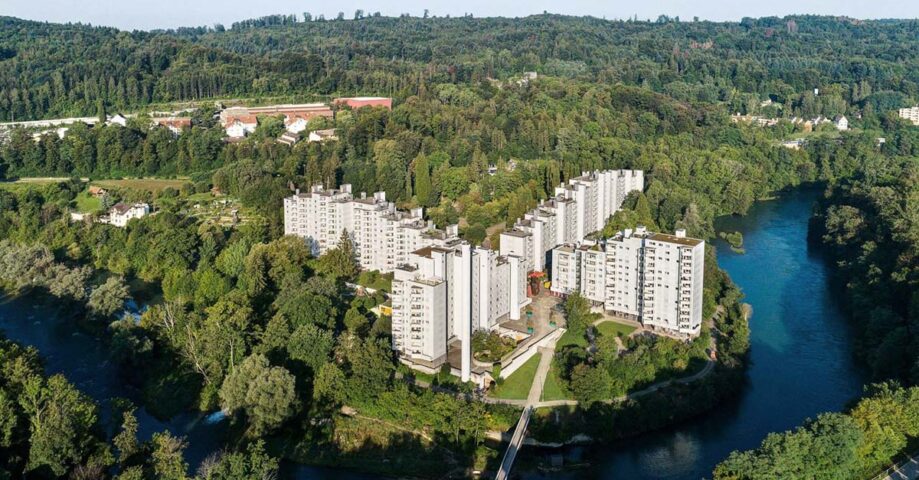
    The Webermühle development in Neuenhof houses 368 rental apartments. The settlement on a peninsula in a loop of the Limmat was built on the industrial site of a former weaving mill and was ready to move into in 1984 after ten years of construction. Planned by the architectural office Steiger Partner AG and built by Ernst Göhner AG, the Webermühle with its different volumes offers living space for up to 1,500 residents. Despite the very high density, the apartments with the four rows of high-rise buildings arranged in a cross shape are characterized by a surprising foresight. Since 2008, the buildings realized in the “Göhner 3” modular construction system have been owned by a real estate fund from Credit Suisse Asset Management.

    Ecologically and economically sustainable renovation
    A good 40 years after moving in, the apartments no longer met today’s standards – neither in terms of appearance nor in terms of comfort. With an analysis of the building structure, the client started planning an extensive partial renovation in 2009, which was implemented in stages between 2012 and 2014. The portfolio strategy of Credit Suisse Asset Management attaches great importance to ecologically and economically sustainable solutions. With the modernization of the Webermühle, one wanted to make the living and green space more attractive for the tenants and to maintain the value of the property. On the other hand, the building technology should be brought up to date and thus the energy consumption should be significantly reduced. Better connections to public transport were also an important goal: Since the construction of a new inclined lift in 2015, Wettingen train station can be reached within a few minutes on foot.

    Heat supply: switch to flow heat
    The core of the energetic renovation is the reorientation of the heat supply. To this end, the client defined a clear goal right from the start: in future, the heat supply in the Webermühle should be at least 70 % CO 2 -free. Due to the size of the facility, Credit Suisse Asset Management wanted to have the heating system replaced by a contractor instead of producing heat itself. The sustainability of the solution proposed by ewz with a river water heat pump convinced the client even after a detailed examination by specialists.

    More about the project

    White paper on the topic of energy-efficient refurbishment
    In addition to the practical example “Webermühle”, the white paper “Energy-related renovations as an opportunity for the real estate industry”, which was created in close cooperation between ewz and the research and consulting company intep, offers insights into the relevance of energy-related renovations.

    Knowing that the building sector is responsible for about a quarter of emissions, there is an urgent need to renovate the building stock. Because the few climate-friendly and energy-efficient new buildings will not have a major effect on the entire sector. At the moment we are in a renovation backlog. The current renovation rate of one percent must be doubled in order to achieve the climate targets.

    Practical experience shows that during renewal processes, too little attention is paid to energy-related refurbishment compared to replacement new buildings. The landowners often lack basic information that shows them the economic, ecological and social potential of energy-related renovations. The whitepaper is intended to make a contribution to precisely this. There is a basic overview of the urgency, legal framework, benefits, opportunities and possible strategies of energy-related renovations.

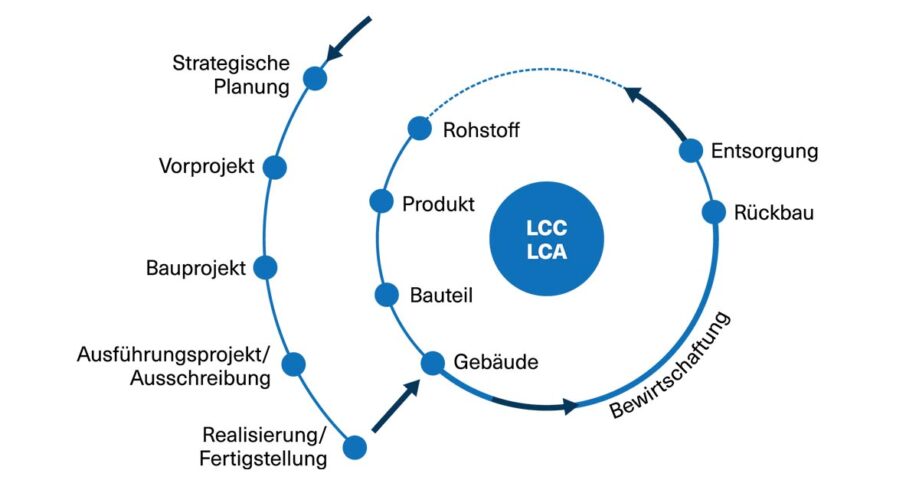
    The results of an ecological balance sheet (life cycle analysis, LCA) and an analysis of the life cycle costs (LCC), for example, form an excellent basis for decision-making. These quantitative assessment methods take into account the entire building life cycle.

    The life cycle analysis (LCA) to determine the environmental impact and the analysis of the life cycle costs (LCC) offer quantitative decision bases for energy renovation. (Source: Kellenberger (intep), 2021)

    To the white paper

  • Buildings should become power plants

    Buildings should become power plants

    The Swiss Federal Office of Energy ( SFOE ) has published its vision for the Swiss building stock by 2050 in a document . By then, the majority of buildings should be able to meet their own electricity needs from sustainable energy sources. The excess electricity is to be used for electric mobility.

    At the same time, the electricity requirements of buildings are to be reduced. Overall, the final energy consumption of the Swiss building stock by 2050 should be around 65 instead of 90 terawatt hours.

    With a few exceptions, there should no longer be any heating oil, natural gas or electricity for direct consumption for heating. Oil and natural gas heaters and stationary electrical resistance heaters are to be replaced by renewable energy sources. Energetic operational optimization should be mandatory for all buildings by 2030.

  • Building cooperative receives 40,000 francs from the climate fund Stadtwerk Winterthur

    Building cooperative receives 40,000 francs from the climate fund Stadtwerk Winterthur

    The municipal energy supplier Stadtwerk Winterthur has given the building cooperative 40,000 francs more than housing from its climate fund. It wants to finance the pilot operation of a self-learning heating controller in two houses on the 2000-watt Hobelwerk area in Oberwinterthur, according to a media release .

    The heating controller was developed by the Federal Materials Testing and Research Institute ( Empa ) in Dübendorf. It is supposed to optimize the heating systems in a climate-friendly way, "by including solar power production on the roof, the interaction between main heating (heat pump) and peak load (pellet boiler) as well as the load on the power grid," the media release said. This offers knowledge for the climate-friendly use of energy with the lowest possible load on the power grid in buildings.

  • LEDcity makes lighting intelligent

    LEDcity makes lighting intelligent

    The Zurich cleantech start-up LEDcity has further developed its intelligent lighting solutions with the lamps called Halbautonom +. The light sensors integrated in it allow the light intensity to be continuously and locally adapted to requirements. This is made possible by the integration of a radar and light sensor as well as a radio module in each individual light source. This is how the lamps can communicate with each other, according to a press release from the start-up company. According to her, her system saves up to 90 percent of energy consumption.

    This lighting system, optimized with the help of artificial intelligence, can be configured via an app. "The integration of the battery-free and wireless light switch into the luminaire network enables us to switch between lighting scenarios and to override and dim the automatically suggested lighting", Samuel Stroppel from the Dübendorf facility service provider gammaRenax is quoted as saying. "This expands the possibilities for use in training rooms enormously." Since November 2020, the conference rooms of this LEDcity customer have been illuminated by the semi-autonomous + lighting solution.

    The start-up based in Technopark Zurich is working on the further development of a fully autonomous solution that no longer needs to be initially configured, the message goes on to say. In the future, the luminaires could use the data they have collected to autonomously order a replacement if a lamp fails or even support security personnel.