Tag: erneuerbar

  • “Charter for Circular Building” twelve big ones make headway

    “Charter for Circular Building” twelve big ones make headway

    Despite great progress in recent years: Too many valuable, non-renewable raw materials are still irretrievably lost during construction. And the net zero target is still a long way off. The construction and operation of buildings and infrastructures are responsible for about 50 percent of the raw material demand, one third of the CO2 emissions and over 80 percent of the waste produced in Switzerland. If the construction industry is to become more sustainable and fit for the future, the consumption of non-renewable raw materials in construction must decrease and grey greenhouse gas emissions must fall.

    Against this background, twelve of the largest public and private construction clients in Switzerland are setting out on the path towards a circular economy. Together, they are responsible for around CHF 4 billion of building construction investments per year. By signing the “Charter for Circular Construction”, they have committed themselves to a joint ambition to reduce the use of non-renewable primary raw materials to 50 percent of the total mass by 2030, to record and greatly reduce grey greenhouse gas emissions, and to measure and greatly improve the circularity of renovations and new buildings.

    In the construction and maintenance of their properties, innovative solutions are to be developed to achieve these goals: refurbish instead of building new, build for the long term, reduce material use, reuse. The participating companies confirmed this today by signing the charter in NEST, Empa/Eawag’s modular research and innovation building in Dübendorf. They are determined to take decisive steps forward in the circular economy in the Swiss construction industry. They want to learn together and invite other building owners to join the charter.

    With the Charter, a number of the most important Swiss construction clients have committed themselves to the circular economy. The Charter is open to other partners. The charter partners want to pool their knowledge and experience in order to promote the development of the circular economy in the Swiss construction industry, in the awareness of their great responsibility for sustainable, climate-friendly construction in Switzerland.

    The focus is on voluntary cooperation and networking driven by a pioneering spirit, and on joint learning with the aim of triggering concrete steps towards circular construction.

    The common ambition is to reduce the use of non-renewable primary raw materials to 50 percent of the total mass by 2030, to record and strongly reduce the emission of indirect greenhouse gas emissions, and to record and strongly improve the circularity of renovations and new buildings. The first signatories of the charter are: Allreal; AXA Investment Managers Schweiz AG, Baudirektion Kanton Zürich, Bundesamt für Bauten und Logistik BBL, Empa, Hochbaudepartement Stadt Zürich, Post Immobilien Management und Services AG, Swiss Prime Site, Swiss Life Asset Management AG, UBS Fund Management (Switzerland) AG, Zug Estates and Zurich Invest AG.

  • Building contractors are committed to the circular economy

    Building contractors are committed to the circular economy

    The construction and operation of buildings and infrastructures account for around half of Switzerland’s total demand for raw materials. At the same time, one third of CO2 emissions and over 80 per cent of waste are generated here. Twelve of the largest public and private building contractors want to remedy this situation, the Swiss Federal Laboratories for Materials Testing and Research(Empa) informs in a press release. Together with Allreal, AXA Investment Managers Schweiz AG, the Construction Department of the Canton of Zurich, the Federal Office for Buildings and Logistics, the Building Department of the City of Zurich, Post Immobilien Management und Services AG, Swiss Prime Site, Swiss Life Asset Management AG, UBS Fund Management (Switzerland) AG, Zug Estates and Zurich Invest AG, Empa has signed the “Charter for Circular Construction“.

    The charter aims to promote the circular economy in the Swiss construction industry. To this end, the aim is to reduce the use of non-renewable primary raw materials to half of the total mass. Indirect greenhouse gas emissions are to be recorded in a first step and then greatly reduced. To this end, the Charter partners want to develop innovative solutions. As examples, the communication mentions renovating instead of building new, building for the long term, reducing the use of materials and reusing raw materials.

    The twelve initial signatories of the charter together underwrite around 4 billion francs of building construction investments annually, Empa explains. Other building owners are invited to join the charter and its goals.

  • An important day for the energy transition in the canton of Lucerne

    An important day for the energy transition in the canton of Lucerne

    12 years ago, CKW subsidiary Steiner Energie built the last hydroelectric power station in the canton of Lucerne in Malters. Even then, CKW was intensively involved in the planning of the Waldemme power plant. A lot of water flowed down the Waldemme before the excavators could finally drive up and drive their shovels into the ground.

    Within a year, some of this water will be used to produce clean, renewable electricity. At today's ground-breaking ceremony in Flühli, government councilor Fabian Peter, head of the building, environment and economic department, expressed his delight: "With the new construction of this power plant, CKW is making another important contribution to achieving the energy and climate policy goals in the canton of Lucerne. »

    Expansion of renewable energies is urgently needed
    In his speech to more than 70 invited guests, CKW CEO Martin Schwab was primarily pleased that the power plant is finally being built. Because it was a long and rocky road. Schwab positively emphasized the great commitment in Entlebuch. "The region is a pioneer in using its own local energies." At the same time, Schwab warned: “We urgently need to expand the production of renewable energy in Switzerland. The corona pandemic and the war in Ukraine clearly show how dangerous strong dependencies on foreign countries can be, »said Schwab. Today things are progressing much too slowly in Switzerland. “This is primarily due to the long approval process. The Waldemme power plant is the best example of this: it took more than 17 years from the first plans to the groundbreaking.»

    "We want to move forward and make a significant contribution to the energy transition in Switzerland – in hydropower, wind power, solar energy and other renewable technologies. But the resistance is often great. This is paradoxical, as we all want the energy transition and need more renewable energies for it."

    Electricity for 1500 households
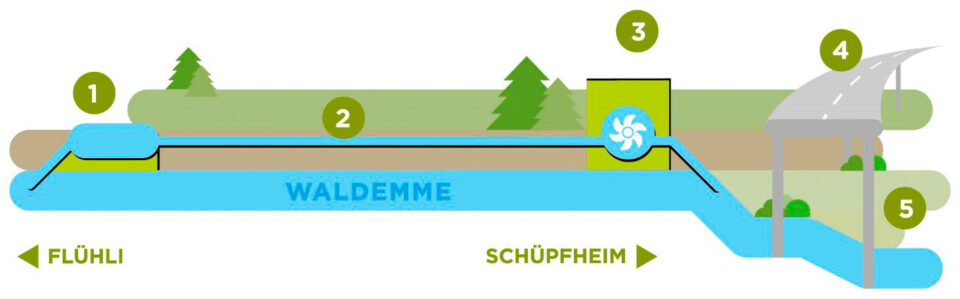
    The roughly one-year construction phase begins with the ground-breaking ceremony. The water intake is at the hamlet of Matzenbach in Flühli. From this location, part of the water from the Waldemme is routed via a 2.1-kilometer-long underground pressure line to the power plant headquarters, where ecological electricity is produced. The power plant control center is located directly in front of the Lammschlucht at the Chrutacher Bridge. Immediately afterwards, the water is fed back into the natural course of the Waldemme and flows through the Lamm Gorge. The power plant has an output of 1.4 megawatts and produces an average of 6.5 GWh of electricity. This means that clean electricity can be generated from mid-2023, which will cover the annual needs of around 1,500 average four-person households. CKW is investing CHF 12.4 million in the power plant.

    In the hamlet of Matzenbach, the water intake (1) takes part of the water from the Waldemme. In the approximately two-kilometer-long underground pressure line (2), the water is routed to the power plant center (3) at the Chrutacher Bridge (4), where it drives a turbine and generates electricity. Directly at the headquarters, the water is fed back into the natural course of the Waldemme and flows through the Lamm Gorge (5), which is untouched by the project.
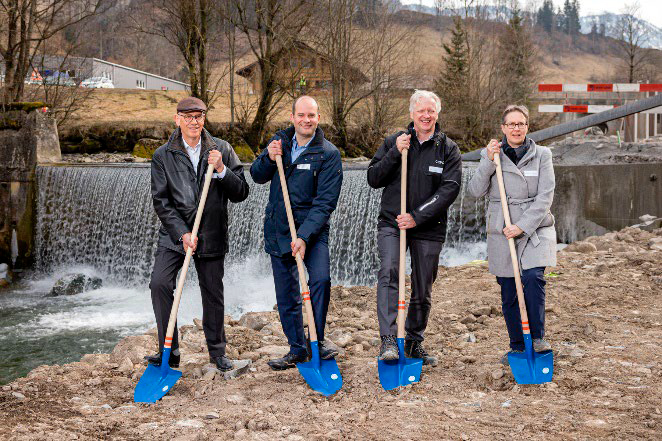
    Breaking ground at the Waldemme: (from left) Hans Lipp, Flühli municipal mayor, Fabian Peter, member of the cantonal government and head of the building, environmental and economic departments of the canton of Lucerne, Martin Schwab, CEO of CKW and Hella Schnider-Kretzmähr, Flühli municipal president.
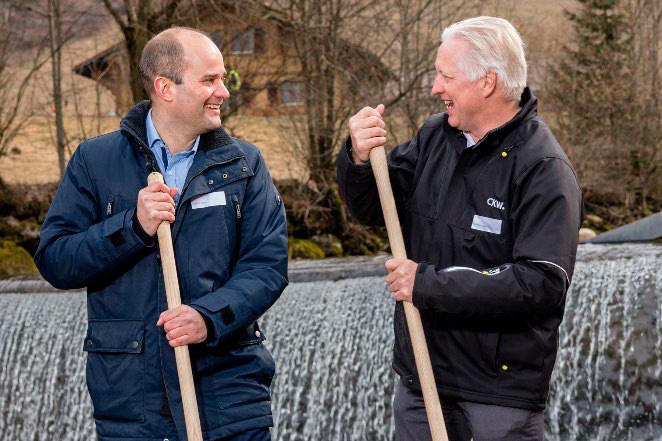
    Happy about the start of construction: Fabian Peter, member of the government and head of the building, environment and economic department of the canton of Lucerne, and Martin Schwab, CEO of CKW.

    About CKW: The CKW Group is a leading Swiss provider of integrated energy and building technology solutions. For more than 125 years, the company has been supplying electricity to over 200,000 end customers in the cantons of Lucerne, Schwyz and Uri. In addition, there are innovative products and services throughout Switzerland in the fields of connectivity & IT infrastructure, electrical engineering, energy technology, IT & communication and security. The CKW Group employs over 2,100 people. With around 350 apprentices in 14 professions, it is the largest private-sector training company in Central Switzerland.
    In the 2020/21 financial year, CKW generated sales of CHF 916 million. With 81 percent of the shares, Axpo Holding AG is the majority shareholder of CKW.
    Further information at www.ckw.ch

  • Lighthouse project in the canton of Aargau

    Lighthouse project in the canton of Aargau

    Switzerland is at the forefront of the most innovative countries in the world: "We are building a high-tech ecosystem here, based on the research focus of the Paul Scherrer Institute (PSI)," Benno Rechsteiner, CEO of Innovaare AG told Immo! Nvest. “With its top-class large research facilities, PSI is the largest research institute in Switzerland. In order to promote exchange with industry, several departments are moving into the innovation campus, which is connected to the PSI site by an underpass. This gives you direct access to the particle accelerator opposite. " Park Innovaare already houses 17 high-tech companies in existing buildings. These companies originate from research at the Paul Scherrer Institute, ETH, EPFL and CERN. "For us, a mix of research departments, large industrial companies, development-oriented SMEs and high-tech start-ups is ideal."

    Greatest possible flexibility
    In order to meet the demands of a modern innovation campus in the long term, the property must be built as flexibly as possible so that later adjustments are possible: to enter into settling companies ». says Rechsteiner, who sees the Innovaare Park as a lighthouse project in the canton of Aargau.

    Renewable energy sources
    Around 95 percent of the heat requirements of Park Innovaare are covered by waste heat from cooling and around five percent by PSI's district heating network. Highly efficient HFO machines, which draw their energy from the Aare, are used to efficiently generate the cooling energy. From this point of view, the energy requirements of the 38,000 m2 innovation campus for heating and cooling are largely met from renewable sources.

  • The first industrial power-to-gas plant is built in Dietikon

    The first industrial power-to-gas plant is built in Dietikon

    The showcase project for the use of renewable energies is being developed in collaboration between eight energy suppliers and the Swisspower public utility alliance. The project aims to show how power-to-gas systems can complement renewable electricity production and operate economically, according to a media release . The largest power-to-gas plant in Switzerland to date will have an electrolysis capacity of 2.5 megawatts and will feed synthetic renewable gas into the grid from winter 2021 to 2022.

    The operating principle of the new plant is described in the communication as follows: “The power-to-gas plant uses renewable electricity from the waste incineration plant to produce hydrogen. This is mixed with the CO2 in the sewage gas, creating renewable methane gas. Limeco thus gains a CO2-neutral energy source from waste and wastewater. ”In the existing gas network, the renewable gas replaces fossil energy sources. According to the information, this can save 4,000 to 5,000 tons of CO2 annually.

    At the groundbreaking ceremony for the construction project, Stefano Kunz, Chairman of the Board of Directors of Limeco and City Councilor of Schlieren: "With waste recycling and wastewater treatment at the same location, we have the perfect conditions to produce green gas." Ronny Kaufmann, CEO of the Swisspower public utility alliance, which who co-initiated the project, says: "The project shows: We have to work together for a renewable and climate-neutral energy system, across company boundaries." The Federal Office of Energy ( SFOE ) is supporting the project as part of its pilot and demonstration program.

    Systems like the one being built in Dietikon are important for the implementation of the Energy Strategy 2050. The plan is to replace the electricity from nuclear power with solar, water and wind power. This means that much more electricity will be produced in the summer than consumed. In winter, on the other hand, when the energy demand is greater, Switzerland has to import electricity. Power-to-gas is a key technology for storing excess renewable electricity seasonally.