Tag: Erneuerbare Energien

  • Electricity industry warns of declining security of electricity supply

    Electricity industry warns of declining security of electricity supply

    According to a press release, the Association of Swiss Electricity Companies (VSE) has presented the Swiss Electricity Supply Index for the first time. The index rates Switzerland’s electricity supply at 82 points for 2035 and only 69 points for 2050.

    The index assesses the electricity supply in five categories. Per capita electricity demand is set to rise further, mainly due to electromobility and data centres; the index gives a score of 86 points for 2050. The expansion of renewable energies is too slow, especially for winter supply. Solar panels on roofs are not sufficient for this, and projects in wind and hydroelectric power production are being delayed or cancelled. The index gives 83 points for 2050. The flexibility of the electricity system is rated at only 52 points for 2050. The federal target for the expansion of seasonal storage will be significantly missed. The expansion of electricity production receives 63 points. The phasing out of domestic nuclear power from 2040 onwards will increase demand. The expansion of the grids is rated at only 57 points.

    In its statement, the VSE points out that imports cannot be increased at will and do not offer any security in times of shortage. “Switzerland is at a decisive crossroads: without decisive energy policy decisions, concrete investments in new production capacities and a significant acceleration of the approval process, we are putting our security of supply at risk,” VSE President Martin Schwab is quoted as saying in the statement.

  • Joining forces to expand renewable electricity production

    Joining forces to expand renewable electricity production

    Swiss Renewables AG, based in Zug, and aventron AG, based in Münchenstein, want to move closer together. According to a statement, the two renewable energy producers are exploring the possibility of closer cooperation. Their aim is to exploit synergies and better tap into the potential for further expansion of renewable electricity generation.

    Both companies are subsidiaries of Swiss municipal and regional utilities. Aventron was founded in 2005 by the former Elektra Birseck Münchenstein, now Primeo Energie. In 2010, Energie Wasser Bern (ewb) acquired a stake in the company, followed by the city of Winterthur in 2013 through its municipal utility. Together, they now hold 63.3 per cent of the company. Aventron has interests in hydro, wind and solar power plants with an installed capacity of 826 megawatts in Switzerland, France, Italy, Germany, Spain and Norway.

    Swisspower Renewables, founded in 2011, is a subsidiary of Swisspower. Eleven members of Swisspower, including ewb and Stadtwerk Winterthur, as well as UBS Clean Energy Infrastructure Switzerland 2 as a strategic financial investor, hold stakes in the company. Swisspower is an association of 20 municipal utilities. Swisspower Renewables has hydro, wind and solar power plants in Germany and Italy with an installed capacity of 311 megawatts.

  • Parliament wants to speed up construction of large power plants for renewables

    Parliament wants to speed up construction of large power plants for renewables

    The federal parliament has clearly approved the so-called acceleration decree in the final vote. According to a statement, 185 members of the National Council voted in favour, two against and nine abstained. In the Council of States, 44 members voted in favour of the decree, with no votes against or abstentions.

    The decree was proposed by the Federal Council in 2023. It is intended to speed up the construction of large power plants for renewable energies. The appeal process is to be shortened, thus limiting the possibilities for objections and appeals. The cantons are to concentrate the planning approval process for the construction of solar and wind power plants of national interest at cantonal level. The planning process for the expansion of electricity grids is to be shortened.

    The Association of Swiss Electricity Companies(VSE) welcomes the adoption of the acceleration decree. “The focussed cantonal procedure and the reduced number of instances are important levers on the path to a renewable energy supply,” said VSE Director Michael Frank in a press release. “For electricity producers, the compromise means more planning security and speed – exactly what we need now.”

    swisscleantech regrets that the debate had focussed for too long on the attempt to abolish the right of appeal for associations. According to the energy transition association, the abolition of the right of appeal for 16 hydropower projects has led to a great deal of uncertainty. The bottom line, however, is that more speed in the expansion of renewables is what counts, it wrote in a press release.

  • Small cities drive smart transformation

    Small cities drive smart transformation

    In the current survey, 403 projects from 124 cities were recorded, with digitalization and sustainability being the most important topics. Most initiatives relate to the smart environment, in particular renewable energies such as photovoltaics and resource-saving technologies. This dynamic underscores the transformation that Swiss cities are striving to achieve in order to reduce their carbon footprint and create innovative living spaces.

    Commitment and growth opportunities for small cities
    The number of participating cities has increased significantly. More and more municipalities are formulating their own smart city strategies, appointing responsible parties and working on pilot projects for digital transformation. Nevertheless, the survey shows that almost 80 percent of cities have not yet implemented fully developed processes and are only in the early stages of development. This is a strong signal of existing development potential and market opportunities for players from business and science.

    Governance, participation and infrastructure
    The key dimensions include smart governance, citizen engagement and co-creation. The increase in projects in digital citizen services and smart infrastructure, such as resource conservation or smart mobility, points to the need to expand and strengthen internal organizational competencies within city administrations.

    Market potential and next steps
    The authors of the study emphasize that the dynamics of smart city initiatives are high, but that there is still room for improvement in terms of design and organization. The market potential for companies and research is correspondingly high. Smart infrastructure and innovative projects offer numerous opportunities for cooperation and investment.

    Small cities as drivers of the smart future
    Small Swiss cities are proving to be the driving force behind the smart city transformation. With growing commitment, a clear focus on sustainability and digitalization and an increasing number of concrete projects, they are gaining in importance and creating new opportunities for a sustainable and networked urban landscape.

  • New energy park brings the energy transition to life

    New energy park brings the energy transition to life

    The Grisons University of Applied Sciences (FHGR) has set up the new Grischa Energy Park on the Kuhrerhof and in the Rheinmühle in Chur. The park is intended as an experience and research center in the field of energy and environmental research, according to a press release.

    Embedded in an agricultural environment, work on photovoltaics, small-scale hydropower, wood gasification, wind power and biogas will come together at one location. The aim is to show the general public how renewable energies can be generated, stored and used. “At the Grischa Energy Park, the energy transition goes from an abstract concept to a tangible reality”, explains Steffi Giaracuni, project manager at the Institute for Multimedia Production at the Grisons University of Applied Sciences, in the press release. “Here, people can see, hear and feel how renewable energies are created – and how we can integrate them into our everyday lives together.”

    In the first implementation phase, work on the topics of wood, water and sun will be presented, followed by biogas, wind power and innovative digital communication tools by 2026.

    The project is supported by the UAS Graubünden, the Swiss Federal Office of Energy, the Klima Grischa Foundation and other regional partners. On August 28, experts from the fields of energy policy, innovation promotion, urban development, local energy solutions and agriculture will be answering questions from the public about Switzerland’s energy future at a science café.

  • Construction of a solar plant at 2000 metres

    Construction of a solar plant at 2000 metres

    Construction of the Madrisa Solar project by Repower, Elektrizitätswerke des Kantons Zürich(EKZ) and the municipality of Klosters has begun, according to a joint announcement by the partners. A solar plant with a production capacity of 12 megawatts is being built at an altitude of around 2000 metres above Klosters. It is expected to supply around 17 gigawatt hours of electricity per year. Over 40 per cent of this will be generated in winter. The electricity produced will be purchased by EKZ for customers in its own supply area and the Klosters-Madrisa mountain railway.

    After the population of the municipality of Klosters voted in favour of Madrisa Solar in October 2023, the first preparatory work began in autumn 2024. Predominantly regional companies were commissioned with the planning and realisation of Madrisa Solar. Around 15 per cent of the plant should be in operation by the end of 2025. Full commissioning is planned for the end of 2027.

    “After an intensive planning phase and a challenging approval process with many parties involved, we are very pleased with the start,” said Michael Roth, Head of Production & Grid at Repower and member of the Executive Board. Paul Sidler, Head of Renewable Energies at EKZ, describes Madrisa Solar as “a further commitment to a secure and sustainable electricity supply in Switzerland. This complex pioneering project also makes an important contribution to the urgently needed winter electricity.”

  • Intelligent energy management optimizes power consumption in buildings

    Intelligent energy management optimizes power consumption in buildings

    A predictive control algorithm developed by Empa optimizes energy management in buildings in such a way that security of supply is guaranteed throughout the entire energy system. Automated building systems communicate directly with energy providers and the power grid.

    According to a report by Empa, automated systems can optimize electricity consumption in such a way that both grid stability and consumer flexibility are guaranteed at all times. At the same time, energy surpluses are not necessarily stored locally, but fed into the power grid wherever possible so that demand can be met at all times.

    During the practical test by Empa’s Urban Energy Systems Lab in its NEST test building in Dübendorf, the focus was on reducing CO2 emissions, the flexibility of energy demand and the comfort of the residents. Using the predictive control algorithm, the team succeeded in optimizing energy management within the building with the following setup: a photovoltaic system for electricity production, a battery storage system, a heat pump and a bidirectional charging station for electric vehicles.

    The system reportedly reduced the building’s CO2 emissions by more than 10 percent. The building was able to communicate the consumption and feed-in of electricity in advance. “The experiment has therefore shown that the flexible availability of renewable energies is not a problem a priori,” says Empa.

    However, in order to implement these results on a large scale, buildings will have to be consistently digitalized in the future. The technology developed by scientist Federica Bellizio is to be brought to market by the start-up Kuafu. She was recently awarded the Empa Entrepreneur Fellowship for her work.

  • Logistics centre in Bedano is operated completely fossil-free

    Logistics centre in Bedano is operated completely fossil-free

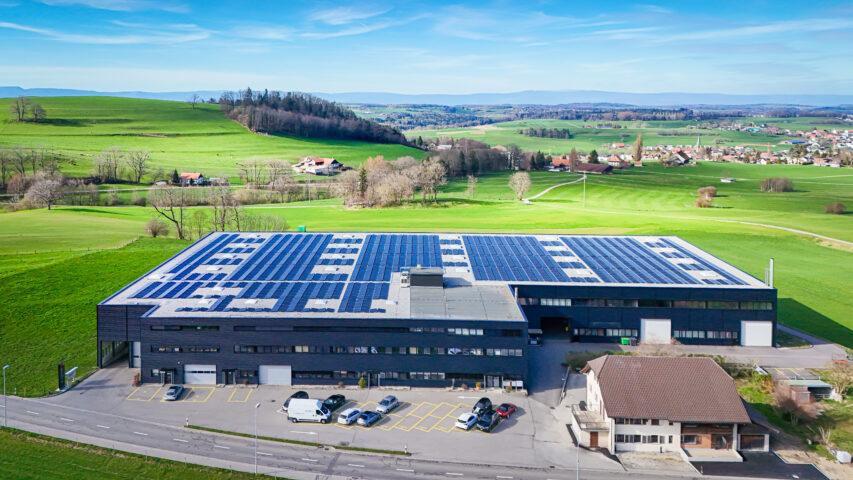
    The meat processing company Ernst Sutter AG from Gossau operates its Ticino logistics centre at the Bedano site without the use of fossil fuels. According to a press release, 45 per cent of the power supply for all necessary systems is covered by solar energy and the remainder by hydropower. The solar power is generated by a photovoltaic system on the roof of the centre, where the 271 square metre system produces 55,000 kilowatt hours of electricity per year.

    The heating system was switched from oil heating to an air-to-water heat pump system. The heat extracted from the cooling systems is used to produce hot water.

    With the company sites in Gossau and Bazenheid SG, Bedano is now the company’s third site to be supplied with fossil-free energy. “We are setting ourselves ambitious goals to continuously reduce our ecological footprint and thus contribute to a more sustainable future,” Reto Sutter, CEO, is quoted as saying in the press release. “The expansion of renewable energies at our sites plays a central role in this.”

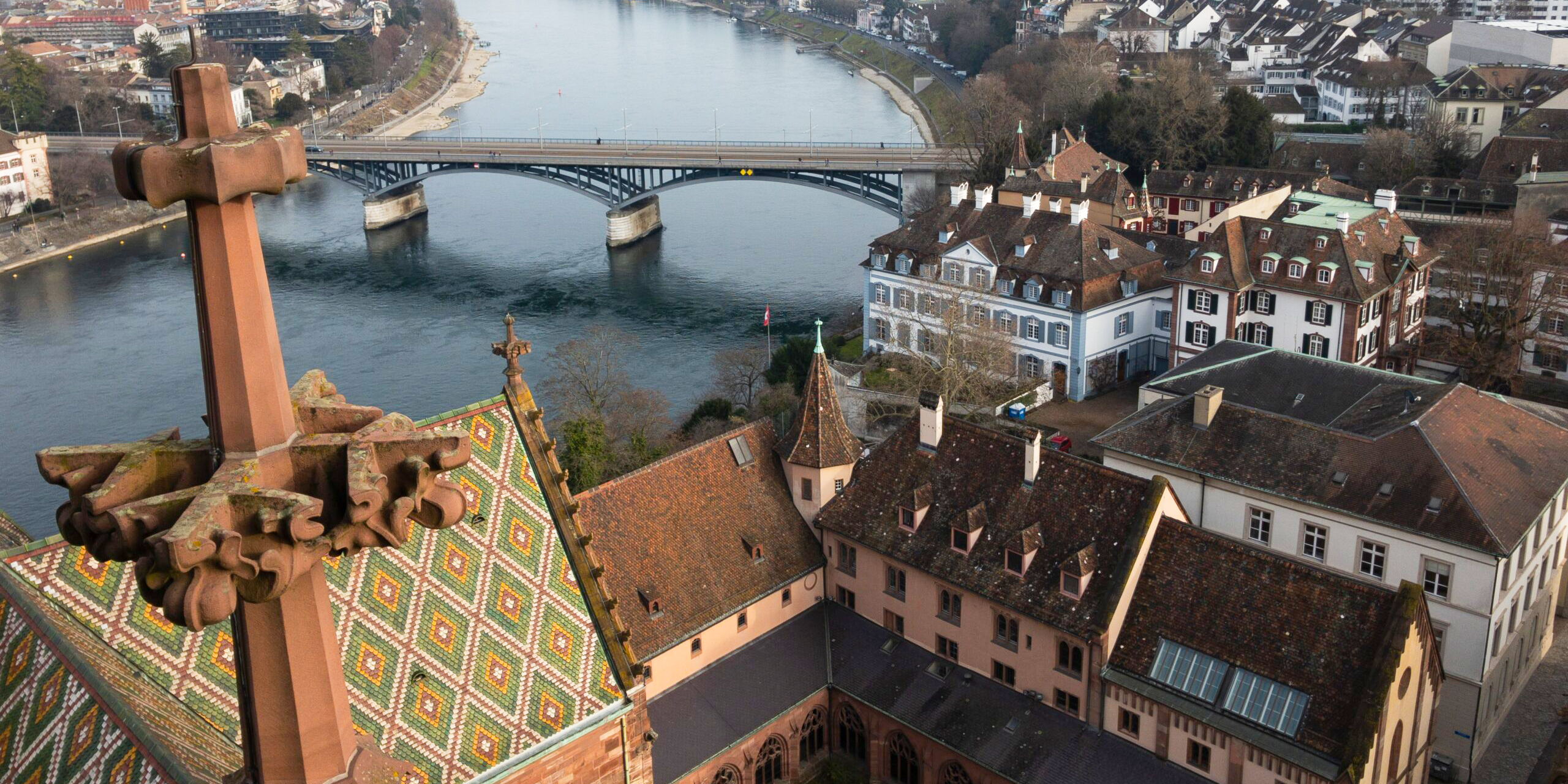
  • Basel area funding to continue until 2030

    Basel area funding to continue until 2030

    The Basel-Stadt energy package has proven to be an effective instrument for supporting energy-efficient renovations and the expansion of renewable energies. The current spending authorisation expires at the end of 2025. The cantonal government is therefore applying to the cantonal parliament for an extension of the programme for the years 2026 to 2030 with a funding volume of CHF 51.25 million.

    The future design of the funding measures is based on the 2022 energy planning report and includes new incentives in addition to the continuation of proven programmes. These include energy-related operational optimisation for residential buildings, subsidies for the 1:1 replacement of old heating systems, the regeneration of geothermal probes, bonuses for combined roof and façade renovations with photovoltaics and the promotion of charging infrastructure in multi-party buildings. Municipalities are also to be supported with certification as energy cities.

    Positive impetus for the economy and climate protection
    The energy package has seen high demand in recent years, particularly after the record year of 2022. The support measures provide economic impetus, from which small and medium-sized enterprises in particular benefit.

    An intercantonal comparison shows that the Basel-Stadt energy package has an above-average impact and makes a significant contribution to cantonal energy and climate policy. The cantonal government will report to the cantonal parliament on the utilisation of the funds and the CO₂ impact of the programme halfway through its term.

    With the planned extension, the Basel-Landschaft energy package remains a key instrument for climate protection and sustainable development in the canton of Basel-Landschaft.

  • New company strengthens local power supply in Buttisholz and the surrounding area

    New company strengthens local power supply in Buttisholz and the surrounding area

    (CONNECT) Dorfstrom AG, based in Buttisholz, commenced operations on 1 January 2025. According to a press release, the company was entered in the commercial register on 3 December 2024. The new company aims to provide impetus for the local energy supply in Buttisholz and other municipalities, according to the press release.

    A dedicated website, which was launched at the start of business operations, provides information about the project and the planned cooperation between local energy producers and a platform for collaboration. “The website is a central point of contact for informing people in Buttisholz and beyond about our goals and offers,” said Oscar Küng, Chairman of the Board of Directors of Dorfstrom AG.

    With the entry in the commercial register, Dorfstrom AG has reached an important milestone in rethinking the local electricity supply and actively driving forward the energy transition in Buttisholz, according to Dorfstrom AG. The company is focussing on the promotion of virtual mergers for self-consumption (vZEV) and the development of local electricity communities (LEGs). The aim is to utilise locally produced electricity directly in the respective municipality. This strengthens local value creation and reduces dependence on large energy suppliers.

    Dorfstrom AG organises local electricity trading to ensure efficient distribution and brings producers and consumers together. It wants to plan, build and operate renewable energy plants, from solar plants and biogas plants to local wind power projects. The electricity is also to be stored in order to compensate for fluctuations and ensure security of supply. Dorfstrom AG aims to support local energy projects through investments and partnerships.

  • Sette aziende creano un’agenzia comune per la fornitura di calore sostenibile nella Svizzera orientale

    Sette aziende creano un’agenzia comune per la fornitura di calore sostenibile nella Svizzera orientale

    Sette fornitori di servizi energetici della Svizzera orientale hanno fondato Wärme Netz Ostschweiz AG (WNO), secondo un comunicato stampa. I partecipanti sono EKT Holding AG, il Comune di Uzwil, il Comune di Wil, St.Gallisch-Appenzellische Kraftwerke AG, Schmid AG energy solutions, Technische Betriebe Flawil e Technische Betriebe Wil.

    L’obiettivo della nuova società è quello di sviluppare e gestire soluzioni di riscaldamento integrate innovative e rispettose del clima nei cantoni della Svizzera orientale di Thurgau, San Gallo, Appenzello Interno e Appenzello Esterno, nonché nelle regioni limitrofe. In qualità di fornitore di servizi energetici sovraregionali, WNO sostiene i Comuni e i clienti privati e aziendali nel passaggio a una fornitura di calore sostenibile, secondo il comunicato stampa. Le rispettive comunità locali e le aziende regionali sono coinvolte nello sviluppo e nel funzionamento delle reti di riscaldamento.

    “La fondazione di WNO è un passo decisivo verso una fornitura di calore rispettosa del clima nella Svizzera orientale. Insieme, stiamo portando avanti la transizione energetica, rafforzando la nostra regione e utilizzando tecnologie innovative”, ha dichiarato Marco Huwiler, membro del Consiglio di Amministrazione di WNO e Amministratore Delegato di Technische Betriebe Wil.

    Secondo il comunicato stampa, l’attenzione fino alla metà del 2025 si concentrerà sulla costituzione dell’azienda, ossia sulla creazione del personale, sullo sviluppo delle basi aziendali e delle soluzioni di finanziamento, nonché sui colloqui con i comuni e i potenziali azionisti. Lo sviluppo del primo progetto in un comune dovrebbe iniziare a metà del prossimo anno.

    Il settore del riscaldamento rappresenta circa il 50% del consumo energetico in Svizzera e causa oltre il 35% delle emissioni di gas serra, prosegue il comunicato stampa. WNO vuole sostituire i combustibili fossili con soluzioni di riscaldamento rinnovabili.

  • New technologies for geothermal utilisation developed in Switzerland

    New technologies for geothermal utilisation developed in Switzerland

    Researchers at ETH are fully utilising energy from underground to generate electricity and heat. Several research groups at the university are exploring the possibilities of geothermal energy, the ETH announced in a press release. According to the statement, Switzerland is better prepared for the utilisation of geothermal energy than it was a few years ago in terms of technology, regulations and public acceptance.

    A group led by Stefan Wiemer, Professor at the Department of Earth and Planetary Sciences at ETH and Director of the Swiss Seismological Service, is conducting research in the BedrettoLab on minimising earthquake risks in so-called enhanced geothermal systems. A sensor-supported system monitors the creation of the necessary artificial cracks in which water heats up. The knowledge gained in the BedrettoLab is being utilised in the planning of the geothermal pilot power plant in Haute-Sorne JU.

    The group led by Martin Saar, Professor of Geothermal Energy and Geofluids in the Department of Earth and Planetary Sciences at ETH, is exploring the possibilities of closed raw circuits in which CO2 circulates. These so-called deep closed-loop advanced geothermal systems could be “a climate-friendly alternative to CO₂-intensive reserve gas power plants”, Saar explains in the press release. The group has also already patented so-called CO2-Plume Geothermal Systems. These combine the permanent storage of CO2 in rock with its utilisation for the production of heat and electricity. The storage of process and summer heat from buildings in rock, which can be used for heating in winter, is also being investigated.

  • Hybrid small power plant promotes green energy in Graubünden

    Hybrid small power plant promotes green energy in Graubünden

    NewGreenTec AG has installed one of its hybrid wind-solar small power plants on the roof of the Plantahof. In future, it will contribute to the sustainable power supply of the agricultural training centre in the canton of Graubünden and eastern Switzerland. According to the start-up company, it will also enable pupils and teachers to experience the technology first-hand and expand their knowledge of renewable energies.

    “We are delighted to be promoting the sustainable development of agriculture in Graubünden with this project,” said Frido Stutz, Managing Director of NewGreenTec AG, in a company press release. “The combination of wind and solar energy is a pioneering step towards an environmentally friendly and stable power supply throughout the day and year.”

    NewGreenTec also recognises this as a symbol of the potential for a sustainable future: “With the power of wind and sun, the Rhine Valley is set to become another example of successful innovation in green energy supply.” The company’s first small power plant on an industrial building was put into operation in January 2023.

    The hybrid device combines solar panels, a small wind turbine and storage technology in a single unit and was developed in collaboration with Swiss universities of applied sciences. The wind turbines, which rotate around a vertical axis, are independent of the wind direction and virtually noiseless.

  • Switzerland on course for net zero

    Switzerland on course for net zero

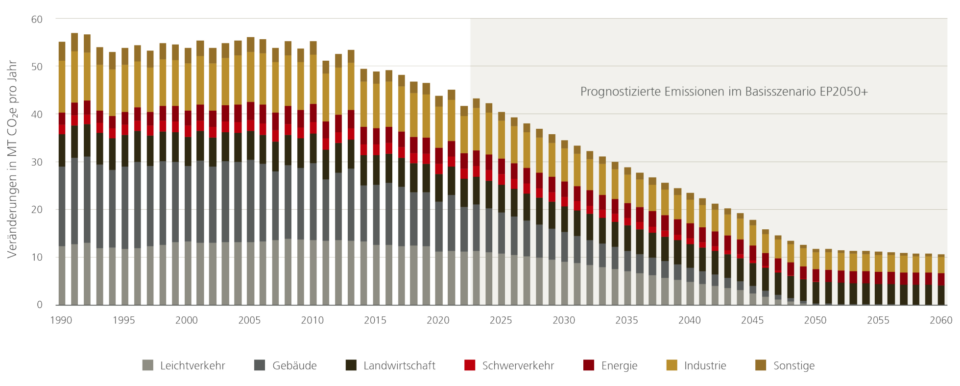
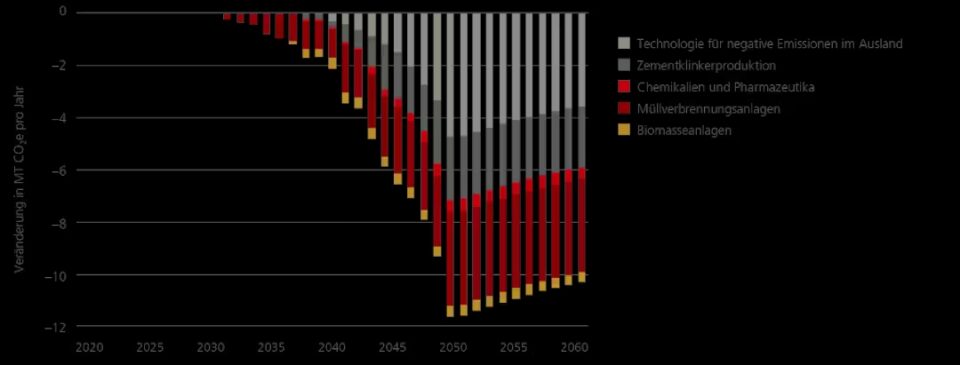
    Switzerland compares favourably with other countries. Its carbon intensity is the lowest of all OECD countries and electricity generation is already largely CO₂-free. Emissions were reduced by 24% between 1990 and 2022. This is a remarkable achievement while at the same time doubling its economic strength. This strong starting position offers Switzerland the opportunity to take a leading role in green technologies such as carbon capture or low-carbon cement.

    Renewable energies and energy storage are key
    In order to continue decarbonisation, electricity generation capacity must be increased from the current 27 gigawatts to over 60 GW by 2050. This is particularly challenging as the four remaining nuclear reactors will be shut down by 2034. A massive expansion of renewable energies and innovative solutions for the seasonality of supply and demand are required. Increasing energy storage capacities and efficient demand management will also play a key role.

    Michael Baldinger, Chief Sustainability Officer at UBS, explains: “For sectors that cannot completely eliminate their emissions, carbon capture technologies are crucial. This presents Switzerland with technological, logistical and financial challenges, but at the same time opens up opportunities in green markets.”

    Regulatory changes set the course
    The legal basis for the transition will be defined by significant regulatory changes in 2025. These include the Electricity Act, the CO₂ Act and the Climate and Innovation Act. Adapting to EU requirements will also increase the number of Swiss companies subject to reporting requirements from 300 to 3,500. These changes require targeted investments and close cooperation between the business, political and financial sectors.

    Financial sector as a key player
    According to estimates by the Swiss Bankers Association (SBA), CHF 13 billion is required annually to achieve net zero. The Swiss financial sector plays a decisive role here. It offers financing options such as bank loans, bonds and blended finance solutions that support the market entry of new technologies. It can also advise companies on the transformation and act as a link between investors and companies.

  • Start of construction for alpine solar plant in Klosters

    Start of construction for alpine solar plant in Klosters

    The Madrisa Solar alpine solar power plant can be built. According to a press release, Madrisa Solar AG, the client, has decided to go ahead with the construction. The plant will be built near the Klosters-Madrisa mountain railway at an altitude of 2,000 metres above sea level.

    The south-facing plant will have an output of 12 megawatts and is expected to generate 17 gigawatt hours per year, enough to supply 3500 households. The electricity will be purchased by EKZ, based in Dietikon ZH, and the Klosters-Madrisa mountain railway company. In addition to the cantonal energy supplier from Zurich, the Graubünden-based energy supplier Repower and the municipality of Klosters each hold a one-third stake in Madrisa Solar AG.

    “For us, Madrisa Solar is a further commitment to the energy transition,” said Paul Sidler, Head of Renewable Energies at EKZ, in the press release. “As a pioneering project, the Alpine solar plant will strengthen security of supply in winter in the future.”

    “The decisive factors for the positive decision were the ideal location, the great support of the municipality of Klosters, the partnership with EKZ and the good cooperation with the cantonal authorities and environmental protection organisations,” adds Repower CEO Roland Leuenberger.

    According to municipal president Hansueli Roth, Klosters is building on its previous commitment: “As an energy town, Klosters wants to make a contribution to the expansion of renewable energies with its participation in Madrisa Solar in addition to its existing use of hydropower (for over 100 years) and thus fulfil its shared responsibility as a tourist municipality with high winter energy consumption.”

  • The future of renewable fuels in Switzerland

    The future of renewable fuels in Switzerland

    Switzerland is lagging behind countries such as Germany in the use of renewable energies for the production of fuels. However, with its companies and research institutions working in this field, it is well positioned to catch up. This was the conclusion of the two Power-to-X Days at the JED in Schlieren, which were organized by the Swiss Power-to-X Collaborative Innovation Network(SPIN), Avenergy Suisse and Swissmem. Around 140 representatives from business, science and politics, including Federal Councillor Guy Parmelin and Zurich Government Councillor Carmen Walker Späh, spoke about the possibilities of scaling up Power-to-X production.

    The participants pointed out that the development of Power-to-X is dependent on cooperation between industry, the financial sector and research and requires the right framework conditions. “Industry can do its part, but the market launch of new technologies cannot happen without universities and the financial world on board,” said Patrik Meli, Co-President of SPIN, according to a blog post on the first day of the event.

    Markus Bareit, hydrogen project manager at the Swiss Federal Office of Energy, referred to the hydrogen strategy for Switzerland, which the Federal Council intends to adopt in the coming weeks. The canton of Zurich, for its part, is planning a competence center for sustainable aviation fuel (SAF). Synhelion co-founder Philipp Furler pointed out that the proportion of SAF is to be increased fifty-fold by 2035. Regional initiatives are also part of the transformation, such as the Association for the Decarbonization of Industry in Zug and the hydrogen bus that has been running in Brugg AG since March.

    According to a press release from SPIN, the results of the discussions will be prepared and published in the coming weeks.

  • Expansion of renewable energy plants in Italy

    Expansion of renewable energy plants in Italy

    The Repower Group is significantly expanding its portfolio in Italy. According to a company press release, it has acquired the 35 per cent of shares in Repower Renewable previously held by the London-based investment firm Omnes Capital since it was founded in 2018. The Poschiavo-based electricity producer, distribution system operator and energy trader has also held the remaining 65 per cent since then. This means that the Repower Group now controls 100 per cent of Repower Renewable.

    This means that Repower is now the sole owner of Repower Renewable’s Italian wind, solar and hydroelectric power plants. Their total output amounts to around 120 megawatts. According to the press release, there is also a “full pipeline” of already approved power plant projects with a total capacity of a further 150 megawatts.

    According to the statement, Repower’s strategy envisages the consistent expansion of its portfolio of renewable energy plants in Switzerland and Italy. The 30,000 customers in Italy to date are to be supplied entirely with certified renewable energy in the future.

  • District heating and sustainability for the Metro Shop

    District heating and sustainability for the Metro Shop

    According to a press release, the Metro Shop in Baden has been connected to the district heating and cooling network. With its high energy requirements and annual consumption of around 300,000 kilowatt hours, it is one of the largest consumers of Baden’s energy network. The connection will make it possible to reduce CO2 emissions by 50 tons per year, according to the city’s press release.

    The city of Baden is pursuing the goal of reducing its energy-related greenhouse gas emissions to net zero by 2050 at the latest. To this end, a consistent switch to renewable energies is planned. In cooperation with Regionalwerke AG Baden, the city is driving forward the rapid expansion of renewable district heating and cooling, the report continues. The expansion is progressing rapidly. Five properties in the administrative assets with an annual consumption of around 1,235,000 kilowatt hours and five properties in the financial assets with an annual consumption of around 320,000 kilowatt hours (kWh) are already connected.

    Sandro Valsecchi, project manager for heating systems at Regionalwerke AG Baden, is quoted as saying that the many interfaces were one of the biggest challenges in the Metro Shop project. “Laying the pipes on both floors of the train station parking garage was particularly challenging – and that during ongoing operations,” says Valsecchi.

    The connection of the Metro Shop marks the completion of a key sub-project in the expansion of the district heating and cooling network. In future, the project will reach further areas of the city in cooperation with Regionalwerke AG Baden.

  • Property funds and solar contracting: a response to the specific needs of property owners

    Property funds and solar contracting: a response to the specific needs of property owners

    How does solar contracting work?
    Solar contracting is based on a simple principle: we install our own photovoltaic panels at your company’s site. Within this framework, we take over the complete planning and project realisation, as well as the financing and management of the system.

    This offer not only enables you to upgrade your property, but also fulfils the legal requirements and the expectations of your investors and tenants. It also enables the creation of new rental space.

    Your unused space as a capital investment
    As a property owner, you probably have areas that are suitable for the installation of photovoltaic panels. At Romande Energie, we offer installation on the following surfaces:

    • On a roof
      Turn unused space into a power plant – from 500m2.
    • On a car park
      Use your car park to generate electricity with a solar carport – from 2,000m2.
    • On a greenfield site
      Set up a ground-mounted solar power system on an unused plot of land – from 2,000m2.

    Stoneweg: a concrete example

    The Stoneweg Group, which specialises in real estate investment, turned to Romande Energie to equip several buildings with solar panels.

    We have realised several projects with Romande Energie and have always greatly appreciated their reliability and their solutions to specific challenges.” Diana Oblak, Managing Director at Stoneweg

    Click here for the interview

    What are the advantages of contracting?
    Contracting makes it possible

    • the creation of new rental stock and therefore an increase in your returns.
    • guarantee the conformity of your properties.
    • increase the value of your property.
    • reduce theCO2 emissions of your property portfolio.
    • Providing your tenants with clean and locally generated electricity at a competitive price.
    • participate in reducing the risk of electricity shortages at a national level.
    • participate in the fight against climate change.

    To make an appointment or for further information, please contact us at

    www.romande-energie.ch/solar

    0800 233 825 | solar@romande-energie.ch

  • Solar power: first system of the second project in operation

    Solar power: first system of the second project in operation

    Zaugg Schlieren AG put the first third of its second solar plant in Schlieren into operation in mid-October. The corresponding building permit was only applied for at the end of February, the Schlieren-based packaging and logistics specialist reports in a post on LinkedIn. The installed capacity is stated as 98.28 kilowatts peak. This means that around 95 megawatt hours of solar power can be produced each year.

    By 2026, Zaugg Schlieren plans to have installed solar systems with a total output of 271.47 kilowatts peak. This means that around 263 megawatt hours of solar power can be generated each year. The company was founded in 1977 by Werner Zaugg on the site of the recently decommissioned gasworks in Schlieren. Since 2011 , Switzerland’s first professional transport packaging and crate manufacturer has also been represented with a site in China.

  • Strüby Unternehmungen receives first certificate for realised Minergie site

    Strüby Unternehmungen receives first certificate for realised Minergie site

    Energy efficiency, energy self-sufficiency and heat protection are currently major issues and will become even more important in the future. Since 2023, not just a single house, but an entire site can be certified by Minergie, meaning that the surrounding area can also be increasingly included in the planning of residential construction projects. On 2 September 2024, the “Fischermätteli” in Burgdorf BE received the first definitive site certificate from Minergie in Switzerland and thus reached a new level in sustainable construction.

    Label with high requirements
    The new, comprehensive Minergie site standard is supported by the Minergie Association, the cantons, the business community and the Swiss Federal Office of Energy. The Minergie site is characterised by very low energy consumption, minimised greenhouse gas emissions during construction and operation and maximum self-sufficiency with renewable energies. The buildings have above-average heat insulation and controlled air exchange. The design of the outdoor space increases climate resilience and the quality of stay, for example through suitable planting and shading. The Minergie site also incentivises climate-friendly mobility.

    Over 6600m3 of Swiss wood
    The Fischermätteli residential construction project was successfully completed by Strüby Unternehmungen in autumn 2023 after a construction period of around three and a half years. The ten apartment blocks with a total of 168 condominiums were built on a former commercial site in Burgdorf BE. Over 6600m3 of Swiss timber was used in the construction, making “Fischermätteli” the largest project in Switzerland to combine the Minergie-A-ECO standard and Swiss timber.

    Climate-friendly environmental design
    One hundred per cent of the energy for the entire site comes from renewable sources: the electricity from the photovoltaic systems on the building roofs, the heat for heating and hot water from a heating centre supplied with Swiss pellets. The finely meshed mobility concept focuses on electromobility, car sharing, bicycles and public transport. A co-working space promotes working from home and thus indirectly relieves traffic congestion. In addition, the climate-friendly environmental design based on the sponge city principle ensures natural and efficient cooling in summer and makes the “Fischermätteli” a hotspot of biodiversity thanks to the countless native plants.

    Success thanks to a climate-friendly overall concept
    Pius Kneubühler, Managing Director Real Estate Development & Construction at Strüby Unternehmungen, can confirm that the climate-friendly overall concept in line with the Minergie site standard pays off not only for the residents, but also for the investor. “The success has already manifested itself in the marketing of the condominiums. Demand was so pleasing that all flats were sold by the time construction was completed.”

  • Solar park project completed five months earlier than planned

    Solar park project completed five months earlier than planned

    Nexans Switzerland has commissioned its new solar park at the Cortaillod site five months ahead of schedule. It consists of ten individual systems, each of which was installed on a different roof. These independent units were then connected together to form a higher-level system. According to a statement from the cable manufacturer, this required adaptations to the specific architectural and structural features.

    This approach made it possible to completely avoid interfering with production activities at the site during the installation work. “The result: a 100 per cent successful commissioning, almost five months earlier than planned.”

    Since the summer of 2023, a team of Groupe E Greenwatt specialists from the Boudry NE site has installed over 4,000 solar modules, each with a capacity of 430 watts, “under demanding technical conditions”. The solar park has a total output of 1.7 megawatts. Together with a 700 kilowatt system previously installed by Groupe E, Nexans now achieves a self-consumption rate estimated at over 90 per cent.

    “This strategic partnership supports our goal of continuing to reduce our environmental footprint and develop our business sustainably, and strengthens our energy resilience,” Nexans Switzerland CEO Marco Spinelli is quoted as saying. “Even without these plants, Nexans only consumes electricity that comes 100 per cent from renewable sources, and has done so since the beginning of the year.”

  • Zug adopts sustainable energy targets

    Zug adopts sustainable energy targets

    Energy consumption in the canton of Zug amounts to almost 3,000 gigawatt hours per year, with buildings and mobility accounting for the largest share. The cantonal government’s new energy and climate strategy (EKS) aims to reduce energy consumption and rely more heavily on renewable energies. At the same time, the government wants to strengthen security of supply in the canton and reduce greenhouse gas emissions to net zero by 2050. With clear interim targets up to 2030, the government is concretising the path to these ambitious goals.

    Investments in solar power and energy storage
    A central component of the strategy is to increase the production of solar power in the canton. At the same time, investments in innovative energy storage technologies such as hydrogen are planned. “We want to shape the energy infrastructure of the future through close collaboration with industry and science,” explains Construction Director Florian Weber. Buildings in the canton should also increasingly serve as energy producers and thus become an energy hub.

    Sustainability in agriculture and negative emission technologies
    As part of the KERB sustainability project, the canton is focussing on measures in agriculture to reduce CO2 emissions. Forests and moors play a central role in CO2 sequestration. For unavoidable emissions, the canton is focussing on negative emission technologies that are intended to permanently remove CO2 from the atmosphere. A study is to determine the potential of these technologies in the canton.

    Adapting to climate change
    In addition to reducing emissions, the canton of Zug is also preparing for the effects of climate change. A cantonal natural hazard strategy aims to minimise climate-related risks such as heat and invasive pests. At the same time, investments are being made in climate-adapted road surfaces and sustainable forest management to ensure both protection and recreational areas.

  • New grid platform facilitates self-consumption of solar power and battery storage

    New grid platform facilitates self-consumption of solar power and battery storage

    According to a press release,Evaarist is launching a grid platform “for the democratisation of energy self-sufficiency”. The Sion-based start-up wants to enable more owners of existing solar installations to consume more of their solar production themselves. In addition to the autarcie.ch platform for controlling solar power from the roof, Evaarist also offers easy-to-install battery packs.

    “Energy self-sufficiency is something that is close to our hearts,” says Loïc Viret. He founded Evaarist 2023 with Julien Morard and Stéphane Curchod. The engineering firm specialises in renewable energies and energy self-sufficiency and launched the autarcie.ch platform as part of the Espace Innothèque at the Foire du Valais 2024, according to the press release.

    Evaarist’s considerations were based on the observation that almost 98 per cent of the 240,000 or so existing solar installations in Switzerland are not equipped with batteries. Evaarist offers universal battery systems for solar roofs. A battery pack is installed in parallel with the electricity grid, the solar modules and the existing inverters. “This will make it possible to store and work with additional energy. And above all, the degree of self-sufficiency can be increased to 65 to 85 per cent, compared to 20 to 30 per cent without batteries,” Viret is quoted as saying.

    Furthermore, Evaarist wants to bring the material directly from the manufacturer to the customer and the installation will largely be carried out as a “do it yourself” project. Thanks to an agreement with a German importer, autarcie.ch offers battery packs from CHF 5800 for 10 kilowatt hours.

    Autarcie.ch is not an anti-blackout system. “But our systems can be equipped to work if the grid fails,” Viret is quoted as saying.

  • Switzerland’s first low-pressure turbine commissioned in Martigny-Bourg

    Switzerland’s first low-pressure turbine commissioned in Martigny-Bourg

    The Forces Motrices de Martigny-Bourg (FMMB) have commissioned Switzerland’s first low-pressure turbine. As Alpiq writes in a press release, 850,000 kilowatt hours of electricity can now be generated per year in the underwater channel of the river power plant on the Dranse. The power plant’s current three production units generate 89 million kilowatt hours per year.

    Depending on the flow rate, the low-pressure turbine can turbine between 1.25 and 10.2 cubic metres of water per second. It is designed for a head of up to 2.5 metres. It has no additional impact on the environment and does not affect existing electricity production. “The installation of this new low-pressure turbine makes it possible to make the best possible use of the available water resources while at the same time being considerate of the environment,” said power plant manager Georges-Alain Zuber in the press release.

    Planning for the plant began in 2011. It is being subsidised with funds from the cost-covering feed-in remuneration.

    The power plant was built in 1908 as an electricity generator for Electro-Chimie de Paris. Today, the municipalities of Bovernier with 23.04 per cent, Sembrancher with 18.72 per cent, Martigny with 17.22 per cent, Martigny-Combe with 15.58 per cent and Vollèges with 1.64 per cent as well as Alpiq with 18 per cent and the Valais energy supplier FMV with 5.8 per cent have a stake in FMMB.

  • Progress and outlook for the cantonal climate strategy

    Progress and outlook for the cantonal climate strategy

    Successes include the introduction of a procurement guideline for CO2-free vehicles in the cantonal administration and the creation of a legal basis for financial support for flood protection measures. Two measures that have been finalised, while a further 47 are currently being implemented. New administration vehicles must now have a CO2-free drive system, which represents an important step towards a more climate-friendly administration. In addition, the Water Management Act has created the basis for promoting flood protection projects, which are essential for adapting to climate change.

    Public relations work as the key to raising awareness
    Another key aspect of the climate strategy is raising public awareness. Every year, a “climate walk” is organised on a climate-related topic to present projects to citizens. This year’s focus was on the energy-efficient refurbishment of an apartment block, which was upgraded from efficiency class G to class B. This shows how effective refurbishment measures can help to reduce energy consumption and CO2 emissions.

    Challenges in the area of fossil fuels and renewable energies
    The latest climate figures show that the proportion of oil heating systems in residential and service buildings has fallen by 5 per cent, while the proportion of heat pumps has risen by the same amount over the same period. Nevertheless, the proportion of natural gas heating systems remains unchanged, which contradicts the climate policy goals. In order to achieve the goal of a climate-friendly energy supply, the transition from fossil fuels to renewable energies must be accelerated.
    On a positive note, electricity production from photovoltaic systems in the canton has more than doubled since 2015. This shows that the use of renewable energies is progressing, even if considerable efforts are still required to achieve the climate targets that have been set.

    Potential for improvement in the cantonal administration
    The cantonal administration has set itself the goal of acting as a role model in climate protection. Despite initial progress, it is clear that energy consumption for heating and hot water in cantonal buildings has only been reduced by 2 per cent. More than half of the heating energy is still obtained from fossil fuels. CO2 emissions from the combustion of these fuels have remained virtually unchanged since 2016, indicating a need for additional action.

    Adjustments to energy requirements and future steps
    The Government Council has submitted measures that can be implemented quickly for consultation in order to increase the use of renewable energies. Among other things, these relate to the replacement of heating systems and the generation of self-generated electricity in new buildings. One example is the requirement that a renewable energy system should always be used in future when replacing heating systems in canton-owned buildings.
    Overall, it is clear that the canton of Schaffhausen is on the right track, but that targeted measures are still required to accelerate the transition to a climate-neutral future.

  • Focus on solar technology for agriculture

    Focus on solar technology for agriculture

    The international energy company Eaton and the agrivoltaics specialist Insolight, also based in Lausanne, have agreed on a strategic collaboration to optimise the use of solar power in agriculture. According to a press release, Eaton’s experience in intelligent energy management will be combined with Insolight’s solar technologies. In particular, it will be investigated whether Insolight’s photovoltaic systems can be coupled with Eaton’s battery storage systems (BESS) and charging infrastructure for electric vehicles. Insolight plans to install more than 100 projects with a capacity of 300 megawatt peak by 2026. For its part, Eaton intends to support the projects with technical expertise and product training.

    Both companies will also support the farmers involved in the integration, commissioning and ongoing maintenance of new sustainable energy systems. Insolight’s agrivoltaic systems not only generate electricity that can be used on the farms, but also protect plantations against wind, hail and heavy rain.

    “This collaboration with Eaton represents an important milestone in our endeavour to bring innovative agrivoltaic solutions to the market,” said Luiggino Torrigiani, Head of Marketing and Partnerships at Insolight, in the press release. “By partnering with Insolight, we can extend our capabilities to the agrivoltaic sector, where energy efficiency can have a real impact alongside agricultural productivity,” added Anne Lillywhite, Senior Vice President and General Manager for Energy Transition, Digital and Services at Eaton.

  • Renewable energies on the rise: Zurich city plans

    Renewable energies on the rise: Zurich city plans

    The voters of the city of Zurich have clearly approved the ewz framework credit with a clear majority of 82.0% and a yes majority in all city districts. This means that the city of Zurich’s energy supplier can continue to expand renewable energies as proposed by the city council. The framework credit of CHF 300 million is intended to finance the expansion of existing hydropower plants and the relicensing of hydropower plants, alpine photovoltaic plants and wind farms, among other things. It should also enable the city to invest in companies that plan, build or operate renewable energy plants.

    The funds are also to be used explicitly for investments by the city of Zurich’s energy supplier ewz in the expansion of renewable energies abroad. France, Germany, Norway and Sweden are currently the focus countries of ewz’s involvement abroad.

    This is the fourth framework credit for the expansion of renewable energies since 2008 and is intended to enable ewz to remain competitive. The framework credit was approved by the municipal council with a majority of 97 votes to 14. Only the SVP spoke out against it.

  • New wind turbine planned for Flumserberg

    New wind turbine planned for Flumserberg

    Axpo, headquartered in Baden, is starting initial investigations into a possible wind farm on the Flumserberg in the canton of St. Gallen. It could comprise up to six wind turbines. According to a press release, the energy company will install a wind measuring mast this week. This will be used to collect wind and bat data over the course of a year.

    The data collected will serve as the basis for the next project steps and detailed planning. The local community of Flums-Dorf and the Alpkorporation Mols have given their consent for the erection of the wind measuring mast. The 120 metre high mast will be erected on the Grappenchöpf site, a location that Axpo believes offers promising wind potential.

    The electricity produced from the wind farm would be equivalent to the consumption of over 10,000 households. According to the information provided, it could fill the winter gap, as two thirds of electricity production takes place in winter. As Axpo goes on to explain, a wind farm on the Flumserberg would not only help to reduce CO2 emissions and utilise a sustainable, renewable energy source, but would also provide an economic boost for the region.

  • Expansion of electromobility in Switzerland

    Expansion of electromobility in Switzerland

    According to a press release, Swiss Post and the fenaco cooperative are moving ahead with their joint plans for a nationwide electric fast-charging network. A total of 50 locations are planned by mid-2025. The capacity is then to be gradually expanded to 300 locations with 1,500 charging stations.

    Private drivers of electric vehicles and company fleets of electric vehicles will find these charging facilities at post offices, Agrola petrol stations and Landi shops, among others. All of them will use 100 per cent local electricity from renewable energy sources, which can be paid for using common payment methods such as Twint and credit cards or a customer card.

    The goal is to be achieved via the PowerUp joint venture. Both partners each have a 50 per cent share in this. The contracts have been signed and submitted to the competition authorities for approval, according to reports.

    PowerUp’s strength is its immediate proximity to workplaces, shops and leisure facilities. The combination with service offerings ensures a safe and well-maintained charging infrastructure with contact persons on site. PowerUp also offers simple pricing with no hidden costs. The partners see their joint commitment to electromobility as a contribution to the federal government’s electromobility roadmap.