According to a press release, the Basel-based energy supplier IWB is strengthening the most important hub of the Basel electricity grid in the Volta substation. One of the largest switchgears in a Swiss distribution grid is being replaced there, the press release continues. IWB will replace all electrical systems in the Volta substation by 2029 and also make the building earthquake-proof. The new switchgear will be operated with a climate-friendly insulating gas and the power grid will be reinforced with additional transformers. By investing in the renovation of the building and systems, IWB is making an important contribution to the high reliability of Basel’s electricity supply, the statement continues.
The Volta substation is the largest of IWB’s seven substations and is almost 100 years old. It was put into operation in 1932. Around a fifth of Basel’s electricity flows through the substation every day, an average of 600,000 kilowatt hours.
A new switchgear is currently being installed. It is replacing the switchgear for the 145-kilovolt grid, which dates back to 1976. It will consist of eleven switch panels and will be 16 metres long when completed. IWB will then also replace the switchgear for the 12-kilovolt grid. It will consist of 78 switch panels and be around 60 metres long. According to IWB, these will be the largest switchgears ever installed in a Swiss supply network. Both switchgears will also be equipped with climate-friendly insulating gas.
There are three transformers in the Volta substation that will be overhauled as part of the project. IWB will also install two additional transformers. The overall renovation of the substation will take place during ongoing operations.
The city of Winterthur is tackling one of the four individual projects in the development of the Obertor site. The buildings at Obertor 11, 13 and 17, which were previously used by the city police, are to be extensively renovated and converted into new office, commercial and residential space. The properties will remain in municipal ownership and will be subject to the cost rent, the city administrationannounced in a press release. The costs for the structural remodelling are estimated at CHF 16.2 million in total.
The two four-storey buildings at Obertor 11 and 13, which were built before 1850, will be returned to their original use. Commercial space will be created on the ground floor and a total of seven flats will be realised on the upper floors. In addition to an energy-efficient refurbishment and the renewal of all building services installations, a new staircase and lift core is planned in the buildings. In addition, “the façades will be adapted to the new use where necessary”, writes the city administration.
The property at Obertor 17 is a rococo villa dating back to 1764, which has served as a police station since its renovation in 1947. Now the original room layout is to be restored and the building shell repaired. Inside, “new office space will be created, which will allow the historic interior to be emphasised again”. The Haus zum Adler is also to undergo an energy-efficient refurbishment and the renewal of the building services installations. Fire protection and earthquake safety are also to be improved.
After 50 years of operation, the waste incineration plant in Turgi is to be renovated. According to a press release, the board of directors will propose a project credit of CHF 17 million at the next general meeting on 27 September. The total cost of the renovation is estimated at 325 million francs. According to the information, the necessity of a renewal is also reflected in increasing expenses for repairs and maintenance.
After a planning phase lasting several years, construction is not expected to begin until 2028. The new MWIP could then go into operation in 2033. The last renovation work on the plant was carried out in the 1990s.
In addition to the invitation to the general meeting, the MWIP has posteda collection of documents on its website, including the feasibility study for the projectand the detailed proposal by President Philippe Ramseier for the project planning loan.
According to these documents, the management and board of the MWIP have been working on the renewal of the outdated facilities since 2015. Cooperation with the neighbouring plants in Buchs AG and Dietikon ZH was examined. However, both rejected this. After the feasibility study of 2022, the MWIP board decided to locate the new plants on a neighbouring parcel of land belonging to the Abwasserverband Region Baden Wett ingen. This means that operations can continue during the renovation work.
The waste incineration plant in Turgi processes around 120,000 tonnes of waste per year. A moderate price increase is expected for the district heating generated from this waste because of the renovation costs.
According to a press release , the canton of Graubünden is building a new, state-of-the-art conference center on the Plantahof site. 24.5 million francs are available for the development of the area.
The ground-breaking ceremony heralded the start of construction for a building that is intended to create the spatial and energetic conditions for the future. The Plantahof agricultural training and advice center will receive a “future-oriented, flexible infrastructure” in several construction steps. The new building is said to be an asset for the future education and training of the young generation of farmers and for advising farmer families.
Investing in the future means environmentally conscious building in accordance with the Minergie-P-Eco standard. This energy-efficient and resource-saving construction meets all “legal requirements and regulations in terms of energy, environmental and safety technology as well as disability law”.
The new building is urgently needed after more than 40 years of operation and considerable need for repairs, especially in the dining room, kitchen and accommodation. Gradually, first the accommodation, then the kitchen and the hall will be modernized. The architecture should “disentangle” the building areas and “structure the exterior and interior spaces of the facility precisely and with high quality”.
Planning and implementation is carried out by a consortium consisting of the Nickisch Walder Architects based in Flims GR, the planning office Planalytik with headquarters in Flums SG and a specialist planning team.
The canton is investing CHF 24.5 million in the construction project. The Graubünden electorate had approved the referendum on February 9, 2020. Construction can take place during ongoing operations. Completion is scheduled for spring 2025. In the canton of Graubünden, the conference center founded in 1896 plays a central role in training and further education for agriculture.
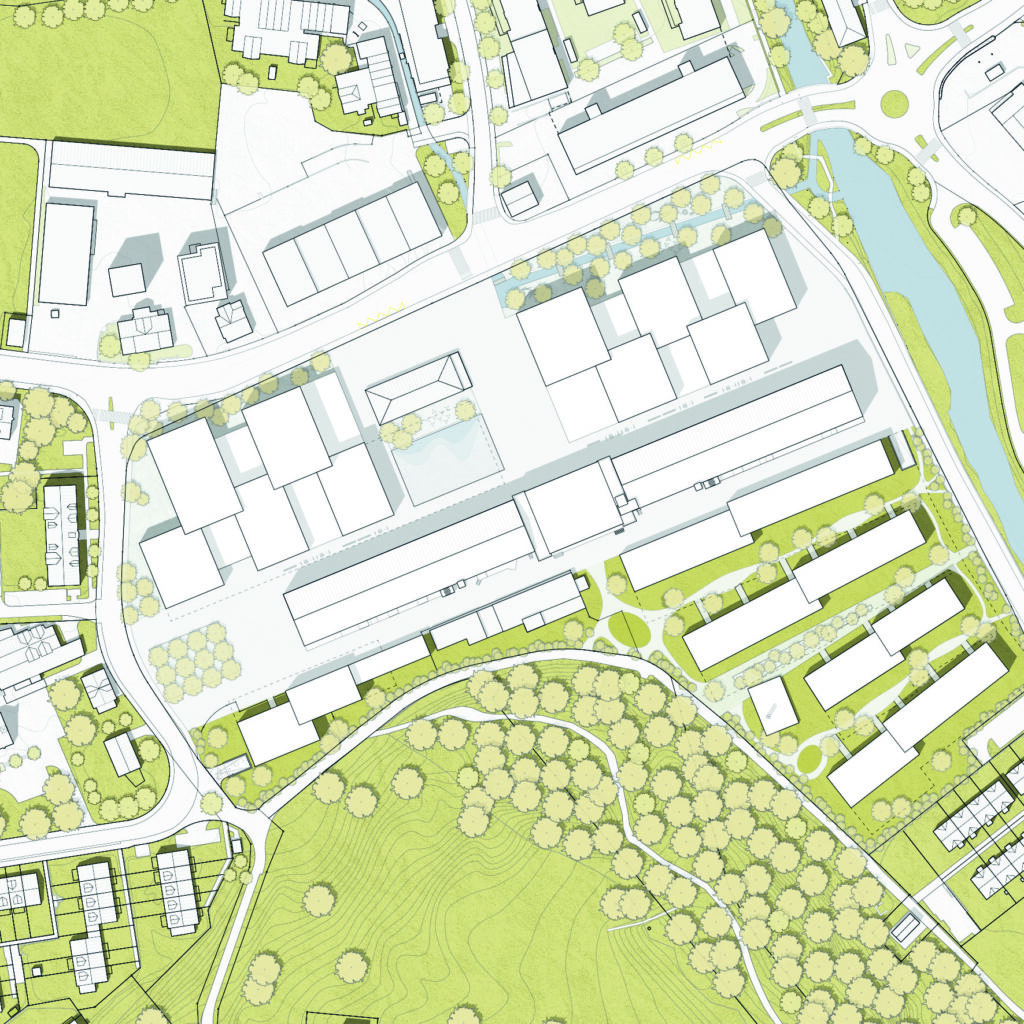
"The winning project was selected on the one hand because of the urban development strategy on the northern area, and on the other hand because of the respectful handling of the listed old buildings", says the lead architect Urs Oechslin from Zurich-based Lilin Architects. The two new building ensembles in the foreground of the spinning mill, which are intended for different uses, create a reference to the context through their urban planning anchored in place. The volumetric differentiation is derived from the existing settlement pattern of the urbanized village. The sub-volumes are staggered in terms of depth and height and allow different views of the spinning mill. The building typology thus mediates with great independence between the individual village buildings and the large-scale spinning mill building. In this way, the spinning mill area is given a new, urban face in which the various identities of the building history are superimposed.
Desired longevity Immediately after the study contract, the overall project was concretized, accompanied by the client, the building authorities, the preservation of monuments and representatives from the assessment committee and the neighborhood: "We are about to submit the draft of the development plan and the guideline project to a first round of official consultation" , so Oechslin. It is not easy to build a building park around the spinning mill that can keep up with the quality of the monument and whose beauty and benefits guarantee the desired longevity. In the immediate vicinity of such a monument, the demands on the architectural quality are very high. The cultural acceptance associated with aesthetics is more decisive for the value of the property than some technical innovations. What is no longer publicly pleasing will sooner or later be torn down. What, on the other hand, enjoys a social and cultural status, remains. The real meaning of a house ultimately lies in the contribution it makes to public life in the long term. Urs Oechslin: “If the population, the Baar community and the owners are successful in promising a place of great attraction, then the project will be approved by all authorities. It will have a political majority and will be supported by the broader population. "
Sustainable renewal For some time now, the «Spinni» has not served the purpose for which it was originally built. Since the end of production, a wide variety of uses have established themselves in the rooms. The clear and simple building structure of the spinning mill building is functionally sustainable because user extensions integrated in it can be easily adapted to changes. The high quality longevity of the basic structure achieved in this way is also aimed at for the new buildings. That is why it is being adapted for the new mixed-use buildings. As a result, the proposed building structure is not tied to a specific use and will survive future renovation processes.
A coherent whole The historically and structurally established strong identity of the area is a large fund from which any number of ideas can be realized. Time and again it is important to find suitable means to further develop, reinterpret and supplement this identity. In this way, the high level of social acceptance that the area enjoys today is to be further expanded. "Our motivation is to design a new, staggered part of the settlement with the intelligent combination of architectural, landscape-architectural and usage-specific interventions on the area of the old spinning mill on the Lorze", says Oechslin. And further: “This takes over the existing qualities and complements them adequately and respectfully. The demanding cultural, social, economic, ecological and building law requirements should be combined in a coherent whole in the interests of all those involved. "
The new use of «Spinni» needs to be carefully considered and planned.
Wir verwenden Cookies zur Unterstützung und Verbesserung unserer Dienste. Mit der Nutzung dieser Website erklären Sie sich mit der Verwendung von Cookies einverstanden. Weitere Informationen finden Sie in unserer Datenschutzerklärung.