Building Director Martin Neukom, Education Director Silvia Steiner and ZHAW Rector Jean-Marc Piveteau gave the go-ahead for the construction work to expand and modernise the School of Engineering at the ZHAW on 13 September. The ZHAW is one of the leading universities in Switzerland with over 14,000 students, according to a press release. However, some of the existing buildings on the site of the former technical centre in Winterthur no longer meet today’s requirements. In addition, the number of students continues to grow. Campus T will therefore be modernised and expanded in several stages over the next few years.
In the first construction phase, two new five-storey laboratory buildings will be built behind the historic technical centre. They will provide urgently needed space for teaching, research and development. Various test rooms as well as a publicly accessible canteen and cafeteria will be created there. The new buildings will be connected to the district heating network of the city of Winterthur and equipped with photovoltaic systems.
As part of the first construction phase, the Eulach will also be ecologically upgraded with a public, near-natural park and flood protection will be expanded, according to the press release. Two new bridges will connect the old town and Campus T with the Büelrain cantonal school and the surrounding residential neighbourhood.
The existing TB building will be dismantled by November. At the same time, the excavation pit for the smaller TT laboratory building will be dug. Work will then begin on the shell of the first new building, which is scheduled for completion in 2027. The second new building should be ready for occupancy in 2029.
Hofwil High School is being expanded with the construction of a new school building and a triple sports hall to accommodate the increasing number of pupils. Originally designed for ten classes and 200 pupils, the school currently accommodates 21 classes with around 460 pupils. Temporary buildings that were erected in 2013 and 2017 are to be replaced by the new buildings. The new school building will include classrooms and practical rooms, including two chemistry laboratories. An outdoor cafeteria extension is also planned. The new triple sports hall will be equipped with cloakrooms, sanitary facilities, a workroom for teachers and a theory room.
Move into the new buildings expected in summer 2026 Completion of the new school building and the triple sports hall is planned for summer 2026. After completion, the focus will be on the structural refurbishment of the existing listed buildings, which should be completed by autumn 2027. These renovations include necessary room changes and maintenance measures in order to meet current educational standards. At the same time, the existing temporary school rooms are to be demolished and used for other purposes.
Sustainable construction and energy concept Both new buildings will be constructed in accordance with the Minergie-P-ECO standard and equipped with photovoltaic systems to ensure sustainable and energy-efficient operation. This commitment to sustainability emphasises the future-oriented focus of Hofwil High School and sends out a strong signal of ecological responsibility in the education sector.
Financing and total costs The total costs for the extension and refurbishment of Hofwil High School amount to CHF 65.63 million. This investment will not only cover current space requirements, but will also provide future generations with a modern and well-equipped learning environment. The financing of these extensive building measures is a sign of the canton’s commitment to education and infrastructural development in Münchenbuchsee.
Historical significance and future prospects Hofwil High School, last renovated in the early 1980s, is an important part of the educational landscape in the region. The planned extensions and refurbishments are not only a response to current space requirements, but also an investment in the future. With the new infrastructure, the school will be able to cope with increasing pupil numbers and at the same time fulfil modern educational requirements.
The remodelling and extension plans for Hofwil High School are an important step towards ensuring high-quality education in the region. With modern teaching and sports facilities, the school will be optimally prepared to meet the needs of the pupils and offer them a comprehensive, contemporary education.
The successful completion of the preliminary project for the expansion and renovation of the Horw campus brings the vision of a modern educational centre a significant step closer. The purpose of the preliminary project phase was to gain detailed insights into the development and cost structure of the construction project. Despite the expected additional costs due to external factors such as construction costs and sustainability-orientated measures, the original project costs of CHF 365 million have been largely confirmed.
Cost development and influencing factors The analysis has shown that in addition to construction inflation, which accounts for around 18 per cent of the increase in costs, adjustments to VAT also have a significant impact. Further additional costs in the area of sustainability and project development as well as statutory sustainability certifications increase the financial framework. Total expenditure is now expected to amount to CHF 600 million, including reserves of around CHF 78 million. This sum is still in line with comparable projects of a similar scale in Switzerland.
Relevance for education and the economy Government Councillor and Finance Director Reto Wyss emphasise the continuous monitoring and review of cost developments by the responsible real estate department. The project remains continuously within the planned budget and the additional financial requirements are clearly explained by the review results. Project-related decisions and the dissemination of information are kept transparent in order to ensure public confidence.
The Canton of Lucerne has outsourced the realisation of this major construction project to a non-profit public limited company, “Immobilien Campus Luzern-Horw AG”. This enables efficient and targeted construction in compliance with the referendum and without affecting the special loans that have already been approved.
Outlook and significance for the region Director of Education Armin Hartmann emphasises the supra-regional significance of the project: “The Horw campus will have a lasting impact on the educational landscape and the business location. Its impact will reach far beyond the borders of Lucerne into the whole of Central Switzerland.” The realisation of this visionary project is therefore expressly welcomed and supported.
The successful completion of the preliminary project has paved the way for the next phase of the construction project. The project management team will promptly initiate the next steps, with the start of construction scheduled for 2026.
The planned expansion of the YOND Campus to include the YOND.02/03 buildings with a total usable area of around 31,000 m2 takes up the concept of YOND.01 and adapts it more specifically to the requirements of manufacturing companies. The focus is on providing robust and efficient buildings, flexibility through large, divisible areas and optimised logistics. These adaptations include efficient delivery, loading ramps, a logistics-friendly basement and advanced vertical access to the building. In addition, mezzanine floors made of wood enable flexible use of space that can be adapted to the individual needs of the companies.
At the same time, the historic laboratory and workshop building at 203 Albisriederstrasse is being converted into a centre for small and creative businesses. The planned renovation and extension of one floor are aimed at preserving the history of the site and creating a workspace for the creative industries. The transformation of the boiler house into a vertical garden and the establishment of a bistro on the ground floor emphasise the ambition to create a campus that harmoniously combines quality of life and the world of work.
The publicly accessible catering facilities along Albisriederstrasse and in the adjacent park will establish the site as an attractive location for businesses and visitors. The use of the ground floor will position the YOND Campus as a place for socialising and contribute to the activation of the space. This extension will create a forward-looking space that supports both the dynamic requirements of modern companies and the need for social interaction and creativity.
GammaRenax AG is moving under the umbrella of ISS Facility Services AG in Zurich. The Dübendorf-based company will operate under the ISS brand in future, the Swiss subsidiary of the globally active ISS Group for property management and facility management, headquartered in Copenhagen, announced in a press release. No details of the purchase price are provided in the press release.
“The acquisition of gammaRenax AG represents an important expansion of our competences and a strengthening of our market position”, André Nauer, CEO of ISS Switzerland, is quoted as saying in the press release. “Like ISS Switzerland, gammaRenax stands for quality, customer focus and professionalism.” The new acquisition is intended to expand ISS Facility Services AG’s range of services for hotels and hygiene management for spa and wellness areas, as well as training and further education.
Severin Gallo, former owner and Managing Director of gammaRenax AG, will join the Board of Directors of ISS Facility Services AG as part of the takeover. “Severin Gallo is a recognised expert within our industry and one of the leading figures who has shaped the facility services sector over the last 27 years,” explains Nauer. “By joining our Board of Directors, he will also be strategically committed to professional integration and will also provide strategic consulting services.”
The Chalberhau inert material landfill in Rümlang is facing a necessary expansion in order to extend its capacity limits and ensure the disposal of non-recyclable residues within the canton of Zurich. The landfill site has a strategically favourable location near Zurich, which enables short transport routes. The existing site will reach its capacity limit at the beginning of 2024, making it necessary to plan an expansion.
The draft of the cantonal design plan “Chalberhau landfill expansion” was developed in collaboration with owners, interest organisations, environmental associations, the municipal administration, the operator and cantonal authorities. In addition to the expansion of the landfill site, the plan also takes into account important environmental and landscape protection measures and defines the steps for reprocessing and final design.
The planning documents will be available for public inspection by all interested parties from 19 April to 21 June 2024. This period allows citizens to express their opinions and concerns, which are then analysed by the relevant specialist departments and recorded in an objection report. The design plan is officially approved by the building authorities once this process has been completed. The broad involvement of the public and the extensive consultations in advance aim to find a balanced solution that takes into account both operational needs and ecological and social requirements.
The presented project for the conversion and extension of the property at Gewerbestrasse 15 is characterised by its uniqueness and versatility. It includes various forms of utilisation as well as residential models, and combines existing structures with new buildings. A special feature of the project is that, once planning permission has been granted, it will be realised while the remaining tenants (Swisscom) continue to operate.
In the first phase of the project, the building will be stripped of its current façade and the existing attic and two floors below it will be removed. These are to be replaced by three residential floors and a new parapet in timber construction. The remaining five floors of the building, from the 2nd basement to the 2nd upper floor, will remain largely unchanged and will continue to be used for commercial, storage and technical purposes. A newly added terrace to the south of the building, together with a ramp on the east façade, will bridge the difference in height between the ground floor and the street without barriers.
The project also emphasises the differences between the existing building and the extension in the façades: the lower floors will have a rear-ventilated stone façade, while the extension will be clad in rear-ventilated ceramic cladding. Towards the west, the building volume gives way to the railway tracks in order to meet acoustic challenges and create a terrace that serves as an open space for both the residents and the commercial tenants. Access to the flats is via arcades, bridges and greenery, which characterise the building in the western quarter.
the Federal Council wants to invest 29.5 million francs in the expansion and renovation of the Agroscope research centre in Zurich-Reckenholz. The underground connecting level of the federal administration and laboratory buildings in Liebefeld (municipality of Köniz BE) is to be expanded at a cost of CHF 21.1 million.
For 27.5 million Swiss francs, the Federal Council wants to have a new building and a new office built for the Swiss representation in Cameroon’s capital. The two buildings are to be constructed on the grounds of the Swiss Embassy and replace rented buildings.
The Real Estate Dispatch also includes expenditure of CHF 140 million for projects not individually specified below an amount of ten million francs. The Council of States unanimously adopted the federal resolution on the real estate message on Monday. It still goes to the National Council.
At its meeting on 4 May, Dietikon ‘s parliament approved a construction loan of CHF 83,372,746 for the Wolfsmatt school building. This means that the renovation and expansion of the aging building can begin next year, according to a media release. The prerequisite is that the voters of Dietikon also approve the project in September.
The building was constructed in 1962 as a typical pavilion school of the 1950s and 1960s and is now in serious need of renovation. The listed building neither meets the legal requirements nor the demands of modern teaching or the increased number of pupils. Therefore, it is to be renovated and extended by two primary classes, group, after-school and multi-purpose rooms as well as a gymnasium. The existing buildings are to be ready for occupancy in 2028.
The corresponding plans were drawn up by a general planning team under the leadership of the Zurich architectural firm Bünzli Courvoisier. They won the city’s project competition four years ago from a total of 59 submissions. The winning project, called Im Grünen, “occupies a top position among the competition entries from both an economic and an ecological point of view,” according to a media release. The new buildings will be certified according to the Minergie-ECO standard. In terms of construction costs, it was among the most favourable.
Im Grünen retains the basic idea of a pavilion school. The cohesive overall architectural effect remains. Extension buildings complement the existing ensemble in a southerly direction. Parallel to the Vogelaustrasse, the new buildings will form a new second entrance to the school complex. The limited existing open space will be preserved.
The Zurich Opera House needs more space for its approximately 800 employees. The solid reinforced concrete extension built in 1984 is no longer sufficient. According to a statement by Opernhaus Zürich AG, there is an additional space requirement of 60 per cent. It refers to a study by the German theatre planner Kunkel Consulting.
The structural engineering office of the Canton of Zurich is examining whether the existing extension building can be raised. The study should be available in autumn. In any case, the new extension is to “attract international attention with its site-specific and visionary architecture as a model in terms of energy efficiency, sustainability and resource-saving construction methods”, according to the statement. An additional laboratory stage is also planned. Construction would take place in the first half of the 1930s at the earliest.
The opera house itself is also to be renovated. The seating and technical systems are to be renewed and barrier-free access created.
A temporary structure is to be erected on the roof of the extension building as early as summer 2024. The design comes from the Zurich architectural firm EM2N.
“One aim of the structural development is to remedy the fundamental deficiencies of the property so that the opera house can continue to fulfil its mission,” Markus Notter, Chairman of the Board of Directors Opernhaus AG, is quoted as saying in the statement. “In order to be able to maintain and expand this standard, the listed opera house and the adjacent extension building … must be renovated – in terms of energy and operations.”
The construction work for the extension of Basel SBB station is on track. On 14 December 2022, the federal government granted SBB the construction permit for the two projects. Construction work started on 2 January 2023. The CHF 210 million project package includes, on the one hand, the Basel SBB performance enhancement project with the additional 460-metre-long platform track 19/20 and capacity-increasing measures on the approach tracks towards Basel St. Johann and Münchenstein. On the other hand, the package includes a provisional 147-metre-long and approximately 10-metre-wide passerelle in the area between the existing passerelle and the Margarethen Bridge.
One of the prerequisites for future service extensions At a media conference in Basel, Wolfgang Stolle, SBB overall project manager, and Thomas Staffelbach, SBB overall coordinator Basel, provided information on the status of the work and the other extension projects in the region. Marco Galli, coordinator of the Basel rail hub at the canton of Basel Stadt, emphasised the importance of the project package for the canton. Because from the end of 2025, northwestern Switzerland is to receive significantly more trains. This was decided by the federal government, parliament and cantons. From then on, the S-Bahn trains between Basel and Liestal are to run every quarter of an hour and the long-distance trains on the Basel-Delémont-Biel/Bienne line every half an hour. Increased performance and a temporary passerelle will create the necessary capacity at Basel SBB station for more train stops and more passengers, especially during rush hour.
Drilling machine creates piles for 570-metre-long retaining wall The construction team is currently working on the future retaining wall along Meret Oppenheim-Strasse. The approximately 570-metre-long, four to seven-metre-high structure will close off the track field from the Gundeldinger district. The track field must be widened towards the south in order to create enough space for the extended platform and track system. Since the end of January, a drilling machine has been drilling the piles for the retaining wall. The machine will be in use between the Margarethen Bridge and the Peter Merian Bridge until probably June 2023. 119 of the total of 308 bored piles had been constructed by the end of March. The bored piles go to different depths in the ground; the longest are up to 14 metres long.
Demolition of the houses near the tracks between Passerelle and Hochstrasse In order to be able to build the retaining wall, the construction crews have been demolishing the nearby houses between Postpasserelle and Hauptpasserelle since January 2023. From April, the buildings on the track side of the upper Hochstrasse will follow. SBB had to close the southern access to the Postpasserelle for the same reason on 13 February 2023. The construction team will demolish the relevant section of the Postpasserelle from mid-May 2023. After that, the access will be rebuilt about 4.3 metres further south. In this way, it will extend over the wider track field in the future. The new access will go back into operation at the end of 2023.
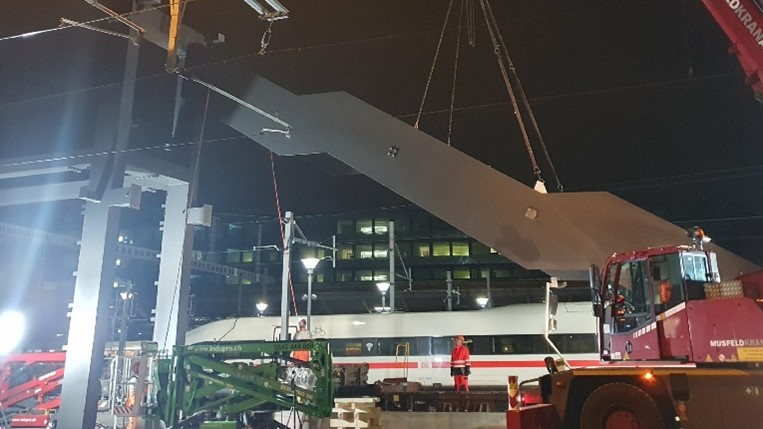
The first yoke for the new passerelle is in place The first work for the temporary passerelle is also underway. From mid-January to the beginning of April 2023, the construction team built the foundations and supports for the new passerelle at the western end of the platform 11/12. In the meantime, the yoke and the stairway to the passerelle have been built. At the beginning of April, the builders will then move to the western end of the platform 9/10 and do the same there. At the end of June, they will move to platform 7/8. During the work, the length of the platform in question will be restricted.
Extensive night work in the track area Since January, the construction teams have been working at night on the catenary, the tracks and the cable systems. These adjustments are necessary for the foundations of the passerelle and the new platforms. The construction teams are also erecting protective scaffolding. These are to ensure that no construction debris gets onto the operational track systems during the demolition work. For safety reasons, the construction teams can only carry out all this work with the track closed and the overhead line switched off. They must therefore be carried out at night, when there is less traffic. SBB is constantly examining how night-time noise can be reduced depending on the construction phase. However, it is aware that the work will still require a great deal of patience and understanding from residents.
Restrictions for bicycles and motorised traffic There have been and will be restrictions for bicycles and motorised traffic. For example, the number of bicycle parking spaces on the Gundeldinger side has been reduced from 700 to 530. SBB is therefore currently reviewing again with the canton how and where additional parking spaces are possible. The aim is to be able to put these additional spaces into operation in the spring. In the meantime, SBB is asking cyclists to use all the temporary parking spaces, including those at the Meret Oppenheim high-rise. In many cases, there are still spaces available there, especially on the upper floor of the double-storey parking facilities. in 2025, SBB will dismantle the temporary bicycle stands and re-install them on the redesigned south side of the station, along the tracks. The total number of bicycle stands will be increased to around 1100. For safety reasons, road traffic restrictions have been necessary on Meret-Oppenheim-Strasse since the beginning of January and on the upper Hochstrasse from 3 April to 30 June. SBB submits the restrictions to the cantonal police in advance in accordance with the applicable cantonal processes and guidelines and coordinates them with them.
Building worthy of protection: medical practice withresidential building in Littau The original building – a residential building with an integrated doctor’s practice – was built by the Lucerne architect Josef Gasser in 1959. He was inspired by the well-known American architect Frank Lloyd Wright: In particular, by the prairie style influenced by Wright, which refers to the broad, flat landscape in the American Midwest. Accordingly, the architecture is characterized by an open room design, a horizontal, two-dimensional orientation and the use of natural materials. In cooperation with the Monument Preservation of the Canton of Lucerne, a prudent way of dealing with the building worthy of protection was found.
Clinker brick building inspired by Frank Lloyd Wright is being gently renovated Little was changed during the renovation of the external appearance of the existing clinker building. Interventions in the external appearance of the house were only carried out in the direction of the garden, in which the foundation had the extension built. The room layout and use was adapted for the necessary communal, administration, practice and care rooms. Work rooms, guest rooms and a “room of silence” were created on the existing upper floor. The whole house is now accessible with a lift.
Pavilion-like wooden structure for inpatient hospice A single-storey wooden pavilion with 12 rooms was created in the inner courtyard. Each room has its own wet room and a view of the garden. The two buildings are connected by a corridor that surrounds the new inner courtyard. The pavilion has a basement and is connected to the existing building underground. For a harmonious appearance, the new building was realized with a clinker brick and wooden facade and a roof edge made of pre-patinated copper.
Renggli AG supported the Central Switzerland Hospice Foundation as general planner. As part of the planning team, she helped design the architecture and coordinated the demanding specialist areas and partners involved. Renggli AG also acted as general contractor in the project. ■
Wir verwenden Cookies zur Unterstützung und Verbesserung unserer Dienste. Mit der Nutzung dieser Website erklären Sie sich mit der Verwendung von Cookies einverstanden. Weitere Informationen finden Sie in unserer Datenschutzerklärung.