Tag: ewz

  • Zurich invests in large-scale battery storage for greater security of supply

    Zurich invests in large-scale battery storage for greater security of supply

    Zurich City Council has applied to the municipal council for a framework credit of CHF 20 million. According to a press release, the credit is to be used for the expansion of free-standing large-scale battery storage facilities operated by Elektrizitätswerk der Stadt Zürich(ewz).

    The independently operated systems are used to store large amounts of energy, such as that generated by renewable sources like solar or wind energy. In addition to the existing power plants, the large-scale storage facilities can feed energy into the grid at peak times and thus contribute to the stability of the energy system and security of supply. An important contribution can be made here, particularly in view of the requirements of increasing electrification, such as the switch to electric vehicles and heat pumps.

    According to the press release, the city council can approve ewz projects independently within this framework credit and thus significantly shorten decision-making processes. For ewz, this means that even larger projects in highly competitive business areas can be handled swiftly and remain competitive.

  • Zurich utilities expand smart meter network

    Zurich utilities expand smart meter network

    According to a press release, the electricity utility of the city of Zurich(ewz), Energie 360° and the Zurich water utility (WWZ) are expanding the use of smart meters. They are replacing analog meters that are still read by hand. This allows consumption data to be recorded and transmitted more quickly. By reading electricity, water and gas digitally, customers would have more transparency about their consumption. For the water supply, there are additional advantages in terms of troubleshooting. Any leaks and pipe damage can be detected more quickly using digital water meters.

    Ewz has been working on the supply of digital meters since August 2024. Gas supplier Energie 360° has been involved in the expansion of smart metering systems since April. Ewz plans to replace as many conventional meters as possible with digital meters by 2029. Around 300,000 smart meters are to be available in the city of Zurich and a further 4,000 in the ewz supply area in Graubünden. WVZ has announced the installation of 33,000 smart water meters by 2036.

    “With the installation of smart meters, we are taking an important next step towards the digitalization of the supply networks,” said City Councillor Michael Baumer, Head of the Department of Industrial Operations.

    Like their predecessors, the smart meters will continue to be installed primarily in basements.

  • Expansion of solar installations in Zurich

    Expansion of solar installations in Zurich

    ewz, the energy supplier to the city of Zurich, is pressing ahead with its expansion of solar installations. As detailed in a press release, the company has published 14 new locations on its website in which citizens can participate. For CHF 250 per square metre, you can acquire a stake in the additional 11,000 square metres. Participants receive 80 kilowatt hours of Zurich solar power per year on their ewz bill. With the areas now connected, ewz now has 55 solar installations in the city of Zurich. The newly added areas are expected to produce 1,246,000 kilowatt hours of electricity per year. This corresponds to the electricity consumption of 500 average households.

    “With the solar strategy, we in the city of Zurich have the ambitious goal of producing more solar power,” said City Councillor Michael Baumer, Head of Industrial Operations, in the press release. “I have therefore taken the opportunity to acquire a solar stake myself. Only together can we make Zurich a solar city – every square metre counts!”

    Ewz also offers homeowners solar solutions for their own roofs. For example, 950 solar modules will be installed on four residential buildings in Guggach by July. The system is expected to produce 423,000 kilowatt hours and supply the 197 households with solar power.

  • Net zero: towards climate-neutral transport

    Net zero: towards climate-neutral transport

    The real estate industry needs to reduce greenhouse gas emissions quickly and significantly. Getting close to net zero is already possible by combining various approaches and measures. A new white paper reveals the key areas of action for planners and building owners.

    The building sector is responsible for around 40% of global GHG emissions. The potential for reduction is accordingly great – and thus also the responsibility borne by those involved in the industry. To raise awareness of the urgency of rapidly reducing GHG emissions, it is important to know where and when a building emits GHGs throughout its life cycle and how these emissions can be reduced.

    The climate-friendliness of a construction project begins with the architectural concept. Optimised geometry, a material-efficient building structure, opting for durable materials and compact structures all contribute to reducing emissions.

    Today, very few construction materials are completely emission-free, but many are at least low-emission. These include building materials of biogenic origin such as wood, insulation materials made from renewable raw materials such as straw or cellulose, and climate-optimised concrete types. As concrete accounts for around 8% of global GHG emissions, it has a particularly large impact.

    Many properties in this country are still heated with fossil fuels such as oil or gas. Suitable alternatives for low-emission heating include heat pumps, thermal grids and wood-fired heating systems. It is also important for roof and façade areas to be used for photovoltaics.

    Exemples de projets réussis
    Various examples show that net-zero construction works not only on paper, but can also be implemented in practice. At the Hobelwerk site in Winterthur, for example, the focus is on measures such as replacing concrete with timber structures or reusing components. Similar methods are also being used at the Greencity sector B6 (Vergé) [GRL1] in Zurich. In addition to the choice of low-emission materials, the use of renewable energy from ewz also contributes towards reaching the net zero objective. A third example is the new headquarters of Sonova Communications in Murten. Thanks to high-quality insulation and a large thermal storage mass, the building requires no active heating or cooling, making it operationally carbon-neutral.

    Go to the white paper

  • Zurich Wind – Zurich cooperation for the use of Zurich wind energy

    Zurich Wind – Zurich cooperation for the use of Zurich wind energy

    With its Energy Strategy and Energy Planning 2022, the Zurich cantonal government has defined the direction of travel in the canton of Zurich: away from imported, fossil fuels towards renewable, domestic energy. EKZ, ewz and Stadtwerk Winterthur therefore intend to jointly implement wind projects at the sites defined by the Canton of Zurich and specified in the Cantonal Structure Plan. The governments of the cities of Zurich and Winterthur have approved a corresponding cooperation agreement. Michael Baumer, Zurich City Councillor: “With EKZ, ewz and Stadtwerk Winterthur, three strong partners have joined forces to further expand local energy production and supply the population in the city and canton of Zurich with even more renewable energy.” Winterthur city councillor Stefan Fritschi adds: “With wind projects in the canton of Zurich, we are jointly making a valuable contribution to renewable electricity production and to our climate and energy policy goals.” Zurich Wind, the Zurich cooperation for the use of Zurich wind energy, is intended to ensure the development, but also the financing, construction and operation of wind power plants in the canton of Zurich. Wind projects are not welcomed everywhere by the population. According to Urs Rengel, CEO EKZ, the partners are aware of this: “Zürich Wind relies on dialogue and will only realise wind projects with the support of the local population.” With Zürich Wind, the three partners want to send a clear signal for a renewable power supply in the canton of Zurich.

    On 7 October 2022, the canton of Zurich presented its plans for the evaluation of wind energy areas in the cantonal structure plan. Wind power plants are also to contribute to the future supply of electricity with renewable energies in the canton of Zurich. Security of supply is becoming increasingly important and solutions must be found in particular to meet the demand for electricity in winter. Wind turbines are particularly suitable for contributing to security of supply, as electricity production is mainly in winter due to wind conditions, when production from photovoltaic plants is low due to a lack of optimal solar radiation in the midlands.

    Wind potential in the Canton of Zurich
    On behalf of the federal government, the Canton of Zurich’s Department of Construction prepared a basic report on wind energy regarding the situation in the Canton of Zurich and published it last autumn. The report shows that it is also possible to use wind energy in the canton of Zurich. Around 50 areas are defined as potential areas. Whether the realisation of wind power plants is feasible in these areas and whether the wind yield is economical has to be clarified in specific projects. The canton’s goal is to complete the guideline planning with the determination of locations by the end of 2025.

    Source www.ewz.ch

  • ewz plans large-scale, high-alpine solar plants in Graubünden

    ewz plans large-scale, high-alpine solar plants in Graubünden

    ewz can plan further large-scale solar plants in the canton of Graubünden. With an annual production of around 93 gigawatt hours (GWh), it should be possible to supply up to 58,000 households with renewable energy in the future. In this way, ewz is making an important contribution to increasing security of supply and achieving the net-zero targets.

    These projects are also important for achieving the goals of the federal government’s Energy Strategy 2050. Thanks to the “Federal Act on Urgent Measures for the Short-Term Provision of a Secure Electricity Supply in Winter” (amendment to the Energy Act), the prerequisites for the rapid expansion of such PV ground-mounted systems with high winter production were first created.

    Municipality of Surses, Savognin site
    The city council has approved new one-off expenditure of CHF 1.7 million for a preliminary and construction project for a high-alpine photovoltaic (PV) plant in Val Nandro above Savognin. Ewz can now plan a large-scale PV plant on several areas adjacent to the Savognin ski area. The results of the preliminary and construction project will then serve as the basis for the investment decision on the part of ewz, which will probably be the responsibility of the town council.

    PV modules are also planned for areas west of Piz Curvér. Approval of the project planning costs for these areas is the responsibility of the head of the Department of Industrial Operations.

    In total, depending on the implementation variant, up to 80 GWh of solar electricity could be produced annually for around 50,000 households on the above-mentioned areas in the municipality of Surses. The construction projects will be submitted to the municipality of Surses and the landowners for approval. The municipality, the landowners and Savognin Bergbahnen support the projects.

    Municipality of Rheinwald, Splügen-Tambo site
    Independently of the plans in the municipality of Surses,ewz is continuing to push ahead with the expansion of high-alpine solar plants. On the Tanatzhöhi in the Splügen-Tambo winter sports area in the municipality of Rheinwald, ewz is also starting a preliminary and construction project for a high-alpine PV plant. Depending on the implementation variant, it could produce up to 13 GWh of solar power annually for around 8,000 households. Approval of the project costs is the responsibility of the head of the Department of Industrial Operations.

    Councillor Baumer: “Expand own productionin Switzerland”
    The large-scale solar plants in the municipalities of Surses and Rheinwald are planned in areas that are already developed in terms of infrastructure. The areas concerned are not located in any national or local protected areas. A dual use with alpine farming and electricity generation is envisaged.

    Michael Baumer, councillor and head of the Department of Industrial Operations, explains: “In order to increase energy security and at the same time achieve the net zero targets, the expansion of sustainable electricity production is central.” Alongside hydro and wind power, solar energy is an important pillar of sustainable electricity generation, he says. Councillor Baumer: “In terms of PV expansion, we are concentrating on properties on city territory, Switzerland-wide sites as well as high alpine sites. The projects in the municipalities of Surses and Rheinwald are important building blocks for expanding renewable energy production domestically and further increasing the security of supply in winter.”

    Pioneering high-alpine plants are already running at full speed
    ewz already has two large-scale high-alpine solar plants in operation. They produce solar electricity at the Albigna dam in Bergell and at the dam on Lago di Lei. Both plants meet expectations, especially in terms of high electricity production in winter. Around 50% of the electricity is produced in the winter half-year. In addition, it is confirmed that 25% more energy can be produced on an annual average at a high alpine location than in the Central Plateau.

  • New white paper on ‘Climate-conscious building’

    New white paper on ‘Climate-conscious building’

    Climate change is causing summer temperatures to rise in Switzerland. This is particularly apparent in densely built cities with extensive sealed surfaces. Buildings and their surroundings must be designed to offer a comfortable quality of life in the climate of the future. ewz’s new white paper on ‘Climate-conscious building’ offers an overview of this topic. The publication serves as a knowledge base and inspiration for construction in the context of climate change and is free to download here.

    Focus on cities
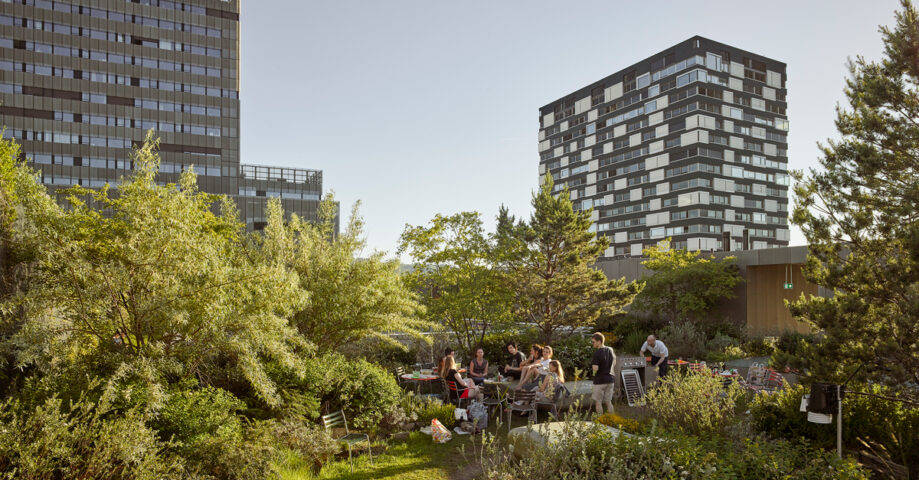
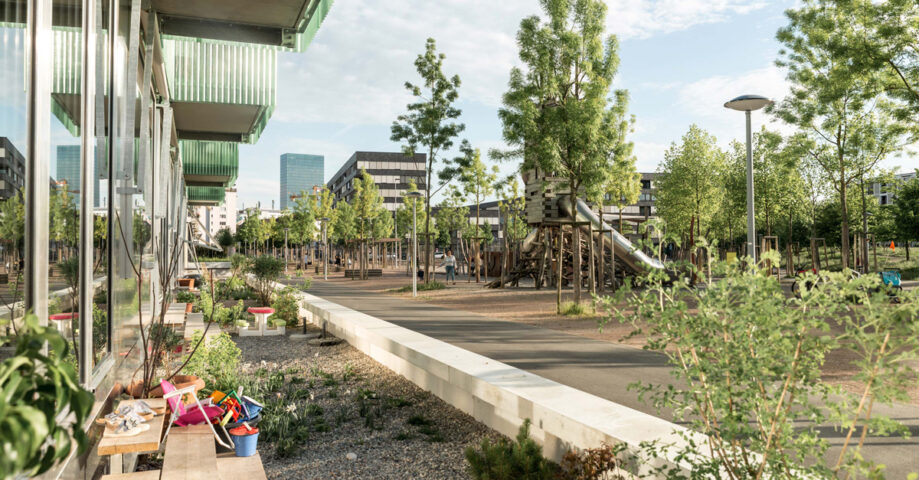
    Green spaces with shady trees and cold air corridors intended to bring cooling are often either entirely absent or inadequate, meaning heat islands form in urban areas – where temperatures can be up to ten degrees higher at night than in surrounding areas. A catalogue of measures tailored to each specific location is needed to counteract this heat island effect. Important principles for eco-friendly urban planning and building include building position and sizing, green areas, facades and roofs, and shading.

    Copyright Roland Bernath

    Moderate window proportions
    It’s not just exterior spaces that need to be planned and built in a climate-conscious way, but also the buildings themselves. To keep interiors as cool as possible when external temperatures rise, parameters such as building orientation, window surface areas and the building’s retention capacity are critical, starting at the design stage. Solid ceilings and floors, for example, store heat due to their mass and the room temperature rises more slowly. Windows also need special attention. Large-scale glazing is beneficial in that it lets abundant natural daylight into the interior and keeps solar heat input high in winter. In summer, however, this heat is undesirable. It is therefore recommended to avoid floor-to-ceiling windows as far as possible, and to strike a balance between aesthetics and comfortable temperatures. A window proportion of up to 30 per cent in residential buildings and up to 40 per cent in office buildings is a benchmark.

    Ventilation and cooling
    During long periods of hot weather, even a well-planned building heats up. It is extremely effective to dissipate the accumulated heat at night. This can be achieved by cross-ventilation, for example. Even better is to design a building that develops a chimney effect. Ventilation flaps in the façade – adjacent to the windows, for example – allow cool outside air to enter the interior and then discharge through an opening in the roof by way of the stairwell. Solutions like this entail no or minimal additional costs and work more efficiently than air conditioning units.

    Unlike residential buildings, today’s office buildings are often equipped with cooling systems. This is due to the high internal loads produced by users and IT infrastructure, not to mention the high proportion of glass in the façades. There are office buildings whose requirements for cooling and heating energy are now already identical. By 2100, office buildings could require up to ten times more energy for cooling than for heating, depending on climatic developments. This would presumably increase operating costs significantly and make it more difficult to operate buildings economically.

    An array of local energy sources
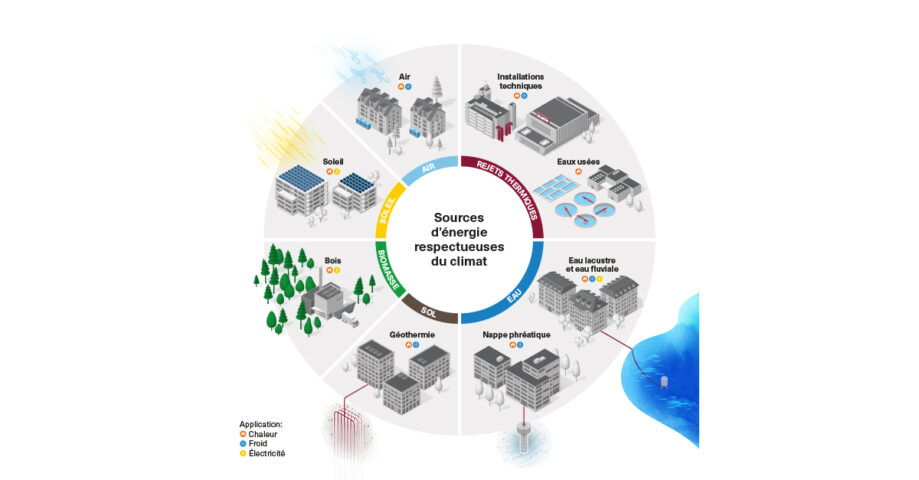
    Environmentally friendly passive cooling is ideal for meeting the basic cooling requirements of office and residential properties. Known as free cooling, there are various energy sources in Switzerland that are suitable for this.

    Geothermal heat accessed via probes is often used. In winter, thermal energy from the ground is used as a heat source, while in summer it serves also for cooling, because required temperatures are significantly below room temperatures. Lake water is another particularly suitable energy source, as the many Swiss lakes provide a valuable thermal storage mass. Because their shores are often densely populated, the lake water can be efficiently used to supply numerous buildings.

    Whether it comes from geothermal probes, lake water or other sources, it is crucial that cooling uses as little energy as possible. So it’s a good idea for building owners, investors and architectural specialists to discuss this issue with an energy service provider such as ewz as early as possible and see which options are feasible. This enables the construction of buildings that can offer high comfort levels even in the hot summers of the future, without placing an additional burden on the environment.

    Environmentally friendly heating remains important
    It is important to bear in mind that the cooling energy needed for residential buildings is relatively low compared to the heating required. Decarbonisation of heat supply must therefore remain a priority in order to achieve net zero. Sustainable heating is not a problem nowadays, with various technically mature and economically attractive renewable heating systems available.

    The ‘Climate-conscious building’ white paper provides in-depth information, detailed insights and a range of best-practice examples highlighting specific solutions for tackling this issue. The new white paper is free to download for all interested parties.

    https://www.ewz.ch/en/business-customers/real-estate.html

  • ewz builds second solar system on dam wall

    ewz builds second solar system on dam wall

    ewz is building its second large-scale solar system on the Valle di Lei dam at over 1,900 meters above sea level. The Graubünden municipality of Ferrera issued the building permit for this in November 2021. According to a press release , more than 1,000 modules will be installed on the Valle di Lei dam wall of the Hinterrhein power plant ( KHR ) over a length of 550 meters. Most of the construction and installation work is carried out by KHR employees.

    The system was developed and planned by Reech GmbH from Landquart GR. It will have an output of 343.2 kilowatt peak. Annual production will be around 380 megawatt hours. According to ewz, this corresponds to the annual electricity requirements of around 160 households in Zurich.

    High alpine photovoltaic systems are particularly efficient. According to the information, they deliver 25 percent more electricity on average over the year than systems in the Mittelland. They also produce around half of the annual electricity in winter. As a result, according to ewz, they contribute to security of supply in the winter months.

    Similar to the first photovoltaic system from ewz on the Albigna dam, ewz customers can also participate in Lago di Lei – Solar. 73 percent of the available space has already been sold.

  • ewz joins EVUlution

    ewz joins EVUlution

    EVUlotion has successfully completed a financing round. As reported by the service provider based in Landquart, the existing shareholders have participated. The previous shareholders include Arbon Energie , the Jona-Rapperswil electricity works, EWN Cantonal Electricity Works Nidwalden , LKW from Liechtenstein, Bündner Repower and SN Energie from St.Gallen.

    In addition, EVUlution was able to expand its shareholder base to include ewz . The city of Zurich’s energy supplier is also contributing smart grid solutions AG . The ewz subsidiary founded in 2016 has developed an innovative solution for network management. According to the Zurich-based company’s website, it is based on measuring and control devices distributed in the network that communicate with each other. It ensures the safe and economical operation of the network.

    Karl Thoma, Managing Director of EVUlution, sees the round of financing as a milestone in the development of his company. “With the commitment of the existing partners and ewz as a new co-shareholder, we have laid the basis for further growth and gained valuable know-how,” he is quoted as saying in his company’s announcement.

    Similarly, Roland Lüthy, Managing Director of smart grid solutions: “We are pleased to have found a strong partner in EVUlution for the further development of innovative grid management solutions.”

    EVUlution has already offered a software solution for system management, a certified overall smart metering system and a customer portal.

  • Photovoltaics: Economic and ecological benefits for real estate owners

    Photovoltaics: Economic and ecological benefits for real estate owners

    Enormous solar potential
    After a steady increase over the years, photovoltaics recorded a record increase in 2020. According to the “Solar energy statistics” of the Federal Office of Energy (SFOE), around 118,000 photovoltaic systems with an output of almost 3 gigawatts were installed at the end of 2020. The strong market growth continued in 2021, so that according to Swissolar, photovoltaics (PV) today covers more than 6 percent of Switzerland’s electricity requirements. Experts assume that this trend will continue, not least in view of the efforts towards much more energy independence.

    Ecological and economic advantages
    Photovoltaic systems bring a whole range of advantages for owners of real estate portfolios. On the one hand, they can protect themselves against rising electricity prices. On the other hand, they already meet possible future self-production specifications today. Also with regard to subsidies, new rules will make the production of solar power more attractive in the future. In addition, portfolio owners with their own solar systems benefit from a clear reputation advantage.

    In most cases, PV power from your own roof is cheaper than power from the grid. The fact that power consumption due to heat pumps and electromobility will continue to rise in the future contributes to the financial attractiveness of PV systems. Improving the ecological balance sheet is also becoming increasingly important, because sustainability aspects are part of the strategy of more and more companies. Furthermore, PV systems are also interesting because they increase the value of real estate. If the photovoltaic systems produce more electricity than can be consumed on site, it is possible to use the solar power in other properties.

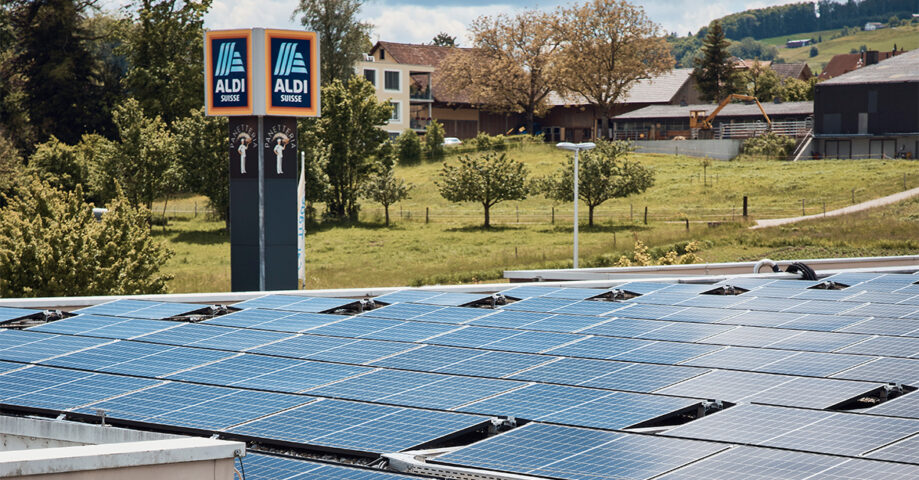
    In the ALDI SUISSE solar project , for example, sustainability and cost-effectiveness play a key role. In just over a year, ewz equipped 68 store roofs between Romanshorn and Geneva with photovoltaic systems. ALDI SUISSE uses most of the solar power itself for its own branch operations. Thanks to the large PV systems, the implemented solution enables a high solar yield with an average self-consumption of 55 to 60 percent.

    High self-consumption increases profitability
    There is already a heat pump in around 90 percent of new buildings, and new registrations of electric cars are continuing to rise sharply. However, heat pumps and electric vehicles are only really low in CO 2 if they use renewable electricity. The combination with a photovoltaic system therefore makes sense: Solar power reduces CO 2 emissions and high self-consumption increases the profitability of the PV system. This is because the production costs for solar power are lower than the electricity tariff for households and because the energy suppliers pay a low tariff for the solar power fed into the grid.

    A good way of using a large part of the solar power yourself is to organize several end users in a group for self-consumption (ZEV) . These are possible both in rental properties and among property owners. The degree of self-consumption of photovoltaic systems is on average 30 to 40 percent. This value can be significantly increased with self-consumption solutions.

    A large part of the electricity is used on site through the targeted control of consumers such as heat pumps or electric vehicles. The advantage for property owners and their tenants: the cost of solar power, at 8 to 16 centimes per kilowatt hour, is lower than the electricity tariff for households, which costs 15 to 25 centimes per kilowatt hour.

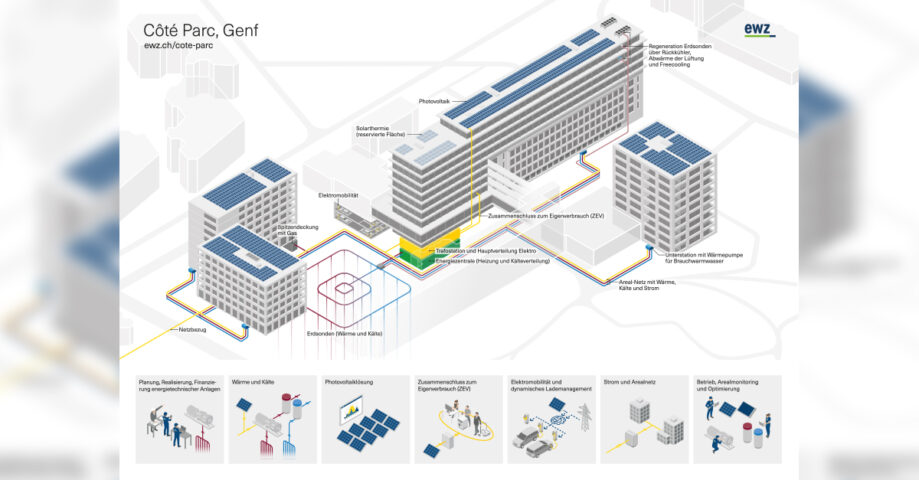
    An interesting practical example of this is the “ Côté Parc ” project in Geneva. 776 photovoltaic panels on the roofs of the area form the basis for an integrated solar solution with heat pumps, charging stations for electric cars and the area’s own power grid, including self-consumption for the users.

    For real estate owners with large roof areas (from approx. 700 m2), a contracting model is an option worth considering. The provider takes over all services – from planning to financing, implementation to operation over several decades. Including the integration of photovoltaic systems in a holistic energy solution with heat and cold supply, electromobility and self-consumption models.

    Business customers of ewz can rely on efficient and tailor-made solutions from competent teams with many years of experience. Investment, maintenance and repair costs are not incurred during the contract period. After the end of the contract period – usually 20 to 30 years – the photovoltaic system becomes the property of the customer.

    Further interesting information on the subject of photovoltaics and the white paper “Photovoltaics & ZEV” can be found here .

    ewz energy solutions
    Locations in Zurich, Sils (GR) and Rolle (VD)
    ewz.ch/energy-solutions


  • Villmergen is planning two heating networks

    Villmergen is planning two heating networks

    The municipality of Villmergen and AEW Energie AG are examining the realization of two independent heating networks. According to a media release from the energy supplier, the municipality is planning a heating center for renewable heat in the Perimeter Dorf together with the electricity company of the city of Zurich ( ewz ). Both want to invest around 7 million Swiss francs for this. A second network is to be created with AEW as an investor in the perimeter of industry. In an initial phase, AEW is providing around CHF 10 million for this.

    The prerequisite for the implementation of this plan is the approval of the voters at the municipal assembly on November 25, 2022. The first heat delivery is planned for the 2024/2025 heating period.

    According to AEW, the added value remains in the region: the Rietenberg forest area is to supply fuel for the village, and operation is ensured by the Villmergen municipal works. This could be used to heat 340 households in a CO2-neutral manner. That corresponds to a saving of 352,000 cubic meters of natural gas or 750 tons of CO2 emissions.

    The heat from the industrial heating network would be produced largely from regionally grown wood and waste wood, as well as oil to cover peak loads. This can heat 700 households in a CO2-neutral way. This saves around 640,000 cubic meters of natural gas annually, which would cause 2,900 tons of CO2 emissions.

  • Zurich is to become a solar city

    Zurich is to become a solar city

    ewz is expanding its citizen participation model ewz.solarzüri . As the energy supplier announced in a press release , around 3,300 additional solar systems on public buildings in the city of Zurich are now available to its customers. In this way, tenants can also contribute to the construction of additional solar areas. The price is 250 francs per square meter, the payment on the electricity bill is 80 kilowatt hours per year for a period of 20 years.

    The largest of the planned new solar systems are in Höngg: on the Lachenzelg Ost school building (1860 square meters) and on the waterfront school building (1170 square meters). 100 square meters are planned on the roof of the Dunkelhölzli residential building in Altstetten, and 165 square meters on the Altstetten train station. If 80 percent of an area is sold through this type of swarm financing, the respective system is realized by ewz.

    In this case, clean electricity will be generated by ewz.solarzüri from January 2023 on over 37,000 square meters. According to ewz, further locations are in the works.

    “With the solar strategy , we in the city of Zurich have the ambitious goal of producing more solar power,” City Councilor Michael Baumer, head of the industrial operations of the city of Zurich , to which ewz also belongs, is quoted in the statement. “Because only together can we make Zurich a solar city – every square meter counts!”

  • Holistic solar solution for ALDI SUISSE

    Holistic solar solution for ALDI SUISSE

    The project is about sustainability and profitability: Photovoltaic systems with a total output of around 15,000 kWp were installed on around 70 store roofs. If you add up the systems, you get one of the largest solar energy projects in Switzerland. It will produce around 14 million kilowatt hours of electricity per year, which corresponds to the consumption of around 5,300 households. In this way, the retailer makes a valuable contribution to the sustainable energy supply in Switzerland – and at the same time can significantly reduce its operating costs.

    The electricity from the systems is used by the shops themselves, which – like all retailers – consume a relatively large amount of energy because of the many refrigerated shelves, the oven, the heating and the lighting. In addition, where available, the solar power is used in the e-charging stations next to the branches and, if there is excess, fed into the grid.

    Time pressure as a challenge and opportunity
    At the end of 2019, ewz Energy Solutions was awarded the contract to build the systems. In close cooperation, ewz developed a pilot system with its subsidiary SunTechnics Fabrisolar and another partner. This procedure made it possible to use the know-how of all those involved and to clarify technical questions in advance. ALDI SUISSE’s extensive requirements for the construction process, safety requirements and functionality were also taken into account. ewz prepared the rollout during the pilot phase and continuously incorporated the findings from the construction of the first systems. The time pressure thus proved not only to be a major challenge, but also an opportunity. Because of the almost simultaneous construction of the 70 or so plants, many synergies could be used, which enabled efficient implementation.

    Elaborate static test
    Before the modules were installed, each roof had to be statically tested. This is particularly important for existing buildings, as the additional loads from modules, fastening systems and cast concrete blocks are high. For each store roof, the specialists used calculation software to create a ballast plan that specifies the number and positioning of the modules. The modules are usually set up in an east-west direction. A southern orientation would also be possible in principle due to the high direct solar radiation at midday, but over the course of the day the east-west orientation proves to be more profitable.

    Maximum solar yield
    “When planning, we didn’t look at the size of the house connection, but at the available roof area and the maximum number of modules we could place there,” says Roland Jucker, overall project manager at ewz. The goal of ewz was clearly to generate as much solar yield as possible. However, this fundamental decision presented the planners with a number of challenges. The biggest was to integrate the PV system into the existing power supply of the branches.

    The electricity produced by the PV system is primarily used directly in the ALDI branch to cover its own consumption. If the branch is using less electricity than the PV system is producing, the excess electricity is fed into the grid. The electrical house connection must therefore be matched to the maximum output of the PV system (e.g. sunny Sunday with maximum production and low self-consumption). However, because this situation occurs extremely rarely and only for a short time, strengthening the house connection would be disproportionately expensive.

    The solution is dynamic power control. It is constantly measured how much electricity the PV system is currently producing, what the consumers are drawing and how much electricity is being fed back into the grid. If the feedback current is above a certain limit, the control unit gives the command to the inverter to throttle the power. The house connection fuse cannot be overloaded and self-consumption is not restricted.

    Thanks to the large PV systems, the solution implemented for ALDI SUISSE enables a very high solar yield with an average self-consumption of around 60 percent.

    ALDI SUISSE has concluded a contracting agreement with ewz
    To put it simply: ALDI SUISSE provides the roofs and, as far as possible, obtains the solar power to cover the electricity consumption directly in the branch. The PV systems belong to ewz, which is also responsible for maintenance, billing and renewal. The “carefree package” also includes the overall coordination of the project, obtaining building permits, remote monitoring and the use of residual electricity.

    Roland Jucker, overall project manager at ewz says: “The idea of equipping as many roofs as possible with a standardized PV solution is visionary”. “In the end, around 45,000 modules were installed.” Jucker is particularly proud of the fact that the installation was able to take place during ongoing operations. “We had to be off the network for 30 minutes after closing time – that was the only interruption.”

    Christoph Deiss, Head of the Energy Solutions division at ewz, says: “I am not aware of a similar project in Switzerland. In this way, ALDI SUISSE is making a valuable contribution to climate protection together with us.» Christoph Deiss emphasizes the great experience: “We have been using photovoltaic technology for over 30 years – we have been a solar pioneer from the very beginning.” Thanks to its great know-how and many years of experience, ewz prevailed against around a dozen competitors in the tender. “ewz is a Swiss company with locations in Zurich, Graubünden and Vaud,” emphasizes Christoph Deiss. “Thanks to the regional operating teams, we guarantee the highest security of supply and short response times.”

    Further information at: ewz.ch/aldisuisse

  • Refurbishment of the large Webermühle development

    Refurbishment of the large Webermühle development

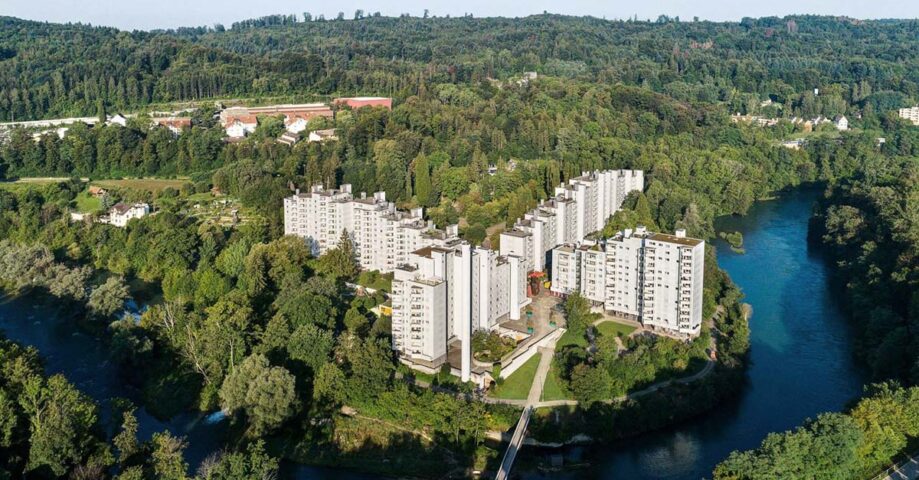
    The Webermühle development in Neuenhof houses 368 rental apartments. The settlement on a peninsula in a loop of the Limmat was built on the industrial site of a former weaving mill and was ready to move into in 1984 after ten years of construction. Planned by the architectural office Steiger Partner AG and built by Ernst Göhner AG, the Webermühle with its different volumes offers living space for up to 1,500 residents. Despite the very high density, the apartments with the four rows of high-rise buildings arranged in a cross shape are characterized by a surprising foresight. Since 2008, the buildings realized in the “Göhner 3” modular construction system have been owned by a real estate fund from Credit Suisse Asset Management.

    Ecologically and economically sustainable renovation
    A good 40 years after moving in, the apartments no longer met today’s standards – neither in terms of appearance nor in terms of comfort. With an analysis of the building structure, the client started planning an extensive partial renovation in 2009, which was implemented in stages between 2012 and 2014. The portfolio strategy of Credit Suisse Asset Management attaches great importance to ecologically and economically sustainable solutions. With the modernization of the Webermühle, one wanted to make the living and green space more attractive for the tenants and to maintain the value of the property. On the other hand, the building technology should be brought up to date and thus the energy consumption should be significantly reduced. Better connections to public transport were also an important goal: Since the construction of a new inclined lift in 2015, Wettingen train station can be reached within a few minutes on foot.

    Heat supply: switch to flow heat
    The core of the energetic renovation is the reorientation of the heat supply. To this end, the client defined a clear goal right from the start: in future, the heat supply in the Webermühle should be at least 70 % CO 2 -free. Due to the size of the facility, Credit Suisse Asset Management wanted to have the heating system replaced by a contractor instead of producing heat itself. The sustainability of the solution proposed by ewz with a river water heat pump convinced the client even after a detailed examination by specialists.

    More about the project

    White paper on the topic of energy-efficient refurbishment
    In addition to the practical example “Webermühle”, the white paper “Energy-related renovations as an opportunity for the real estate industry”, which was created in close cooperation between ewz and the research and consulting company intep, offers insights into the relevance of energy-related renovations.

    Knowing that the building sector is responsible for about a quarter of emissions, there is an urgent need to renovate the building stock. Because the few climate-friendly and energy-efficient new buildings will not have a major effect on the entire sector. At the moment we are in a renovation backlog. The current renovation rate of one percent must be doubled in order to achieve the climate targets.

    Practical experience shows that during renewal processes, too little attention is paid to energy-related refurbishment compared to replacement new buildings. The landowners often lack basic information that shows them the economic, ecological and social potential of energy-related renovations. The whitepaper is intended to make a contribution to precisely this. There is a basic overview of the urgency, legal framework, benefits, opportunities and possible strategies of energy-related renovations.

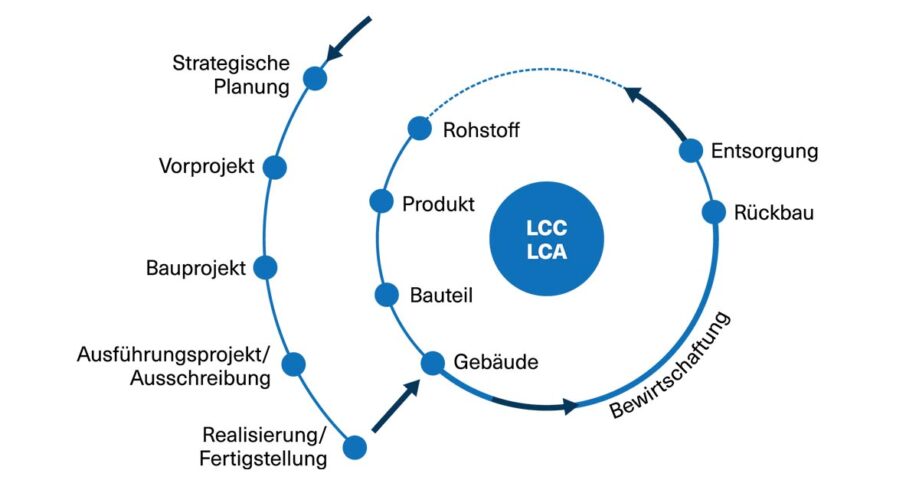
    The results of an ecological balance sheet (life cycle analysis, LCA) and an analysis of the life cycle costs (LCC), for example, form an excellent basis for decision-making. These quantitative assessment methods take into account the entire building life cycle.

    The life cycle analysis (LCA) to determine the environmental impact and the analysis of the life cycle costs (LCC) offer quantitative decision bases for energy renovation. (Source: Kellenberger (intep), 2021)

    To the white paper

  • Whitepaper: Energetic renovations as an opportunity

    Whitepaper: Energetic renovations as an opportunity

    Knowing that the building sector is responsible for around a quarter of emissions, there is an urgent need to renovate the building stock. Because the few climate-friendly and energy-efficient new buildings will not have a major effect on the entire sector. At the moment we are in a renovation backlog. The current renovation rate of one percent must be doubled in order to achieve the climate targets.

    Practical experience shows that during renewal processes, too little attention is paid to energy-related refurbishment compared to replacement new buildings. The landowners often lack basic information that shows them the economic, ecological and social potential of energy-related renovations. The whitepaper is intended to make a contribution to precisely this. There is a basic overview of the urgency, legal framework, benefits, opportunities and possible strategies of energy-related renovations.

    The results of an ecological balance sheet (life cycle analysis, LCA) and an analysis of the life cycle costs (LCC), for example, form an excellent basis for decision-making. These quantitative assessment methods take into account the entire building life cycle.

    To the white paper

    Comprehensive redevelopment of the Webermühle housing estate
    One example of a successful renovation is the large Webermühle development in Neuenhof. The former Göhner settlement, which was occupied in 1984 and has been owned by a real estate fund from Credit Suisse Asset Management since 2008, houses 368 rental apartments with around 1,500 residents.

    The core of the energetic renovation of the Webermühle is the reorientation of the heat supply. To this end, the client defined a clear goal right from the start: in the future, the heat supply should be at least 70% CO₂-free. Due to the size of the facility, Credit Suisse Asset Management wanted to have the heating system replaced by a contractor instead of producing heat itself. The sustainability of the solution proposed by ewz with a river water heat pump convinced the client.

    Find out more

  • Refurbishment of the large Webermühle development

    Refurbishment of the large Webermühle development

    The Webermühle development in Neuenhof houses 368 rental apartments. The settlement on a peninsula in a loop of the Limmat was built on the industrial site of a former weaving mill and was ready to move into in 1984 after ten years of construction. Planned by the architectural office Steiger Partner AG and built by Ernst Göhner AG, the Webermühle with its different volumes offers living space for up to 1,500 residents. Despite the very high density, the apartments with the four rows of high-rise buildings arranged in a cross shape are characterized by a surprising foresight. Since 2008, the buildings realized in the “Göhner 3” modular construction system have been owned by a real estate fund from Credit Suisse Asset Management.

    Ecologically and economically sustainable renovation
    A good 40 years after moving in, the apartments no longer met today’s standards – neither in terms of appearance nor in terms of comfort. With an analysis of the building structure, the client started planning an extensive partial renovation in 2009, which was implemented in stages between 2012 and 2014. Credit Suisse Asset Management’s portfolio strategy attaches great importance to ecologically and economically sustainable solutions. With the modernization of the Webermühle, one wanted to make the living and green space more attractive for the tenants and to maintain the value of the property. On the other hand, the building technology should be brought up to date and thus the energy consumption should be significantly reduced. Better connections to public transport were also an important goal: Since the construction of a new inclined lift in 2015, Wettingen train station can be reached within a few minutes on foot.

    Heat supply: switch to flow heat
    The core of the energetic renovation is the reorientation of the heat supply. To this end, the client defined a clear goal right from the start: in the future, the heat supply in the Webermühle should be at least 70% CO 2 -free. Due to the size of the facility, Credit Suisse Asset Management wanted to have the heating system replaced by a contractor instead of producing heat itself. The sustainability of the solution proposed by ewz with a river water heat pump convinced the client even after a detailed examination by specialists.

    More about the project

  • Zurich is investing CHF 573 million in district heating

    Zurich is investing CHF 573 million in district heating

    In a press release , the City of Zurich announced the approval of the “Thermal grids of the power plant” credit line in the amount of CHF 573 million. The amount is to flow into the switch from fossil to renewable heating and cooling in the city and financially secure the conversion of the heating supply required to achieve the climate target. Those entitled to vote should decide on the approval in 2022.

    The city set the course for the climate policy expansion plans “ Net Zero 2040 ” of the electricity company of the city of Zurich ( ewz ) in spring 2021 with the opening of the Zurich Heat Advice Center. The legal foundation was laid in November 2021 with the Heat Supply Ordinance.

    City Councilor Michael Baumer is quoted as saying that the municipal measure, which is divided into six sub-projects, makes an “important contribution to decarbonisation in the heating sector”. The financial buffer is “only a first step, the actual work is just beginning,” announces Baumer.

  • The Metropolitans: Over 180 parking spaces, electric car ready

    The Metropolitans: Over 180 parking spaces, electric car ready

    The two towers rise around 60 meters into the sky and thus shape the character of the Leutschenbach district in the north of the city of Zurich. However, “The Metropolitans” is not only visually impressive, it is also a showcase project when it comes to electromobility. The underground car park was equipped in such a way that a sustainable infrastructure for e-vehicles is available for the residents of the 212 apartments.

    Clear decision
    When the residential towers were completed in 2015/16, there was only one charging station in the underground car park. Little by little, other residents had their parking lot equipped. “There was a certain amount of wild growth,” explains Christian Steiger, who, as the delegate of the condominium owners, accompanied the expansion from the start. “When other owners expressed their interest in a charging station, we set up a project team to find a uniform solution”. The team obtained offers and recommended the charging solution from ewz after a thorough examination. “Working with ewz in the evaluation phase was very pleasant and productive,” explains Steiger. “We were also impressed by the price-performance ratio, the know-how and the complete solution.” The joint owners’ meeting followed the recommendation and decided, by far more, in favor of the ewz solution.

    Novel ceiling pillars
    After the award, ewz submitted a funding application to the City of Zurich, which covered up to 60 percent of the costs for the charging infrastructure as part of the 2000 watt contribution. The application was approved – implementation could begin in spring 2021. In a first phase, all 187 parking spaces in the underground car park were connected with a ribbon cable. This means that when you register, you only need to install and connect the charging station. Several dozen residents did this directly: in the summer of 2021, over 80 parking spaces were already equipped with a “easee” charging station.

    Depending on the location of a parking lot, the charging station is either mounted on the wall (wallbox) or suspended from the ceiling. Such ceiling pillars, each with up to four charging stations, are ideal for parking spaces in the middle of underground garages and impress with their high-quality design. According to Christian Steiger, the feedback on the new charging infrastructure is very positive. “The charging stations look good and work perfectly,” he sums up.

    Load management saves costs
    The charging infrastructure of “The Metropolitans” includes dynamic load management. It ensures that all connected e-cars receive sufficient electricity and are charged the next morning. At the same time, the system ensures that the need for charging is coordinated with the needs of the households. This automatic load balancing of the “easee” charging stations has the advantage that up to three times as many electric vehicles can be charged at the same time – 24 hours a day and thanks to a standard tariff at no additional cost. This prevents overloads or even power failures and ensures a reliable, stable power supply. In addition, thanks to the load management, an expensive expansion of the connected load of the two residential towers could be avoided.

    Simple billing
    While the basic expansion of the charging infrastructure was paid for jointly by all floor owners using a distribution key, the individual owner pays for the charging station himself. After that, only low costs are incurred in operation. The users receive a chip card (RFID card) so that they can identify themselves at their charging station and enable charging. The ewz package also includes an app that shows the electricity used and the costs at all times. You will be billed monthly via a credit card that is stored in the app. Users only pay ewz CHF 9.90 per month for these services.

    Advantages of the ewz charging solution
    Through the partnership, the residents benefit from a future-proof complete solution. The project team and the administration really appreciate having a single point of contact with ewz as the general contractor for the planning, implementation and operation of the charging infrastructure. This guarantees an efficient, practice-oriented solution with simple scalability. Ewz’s 24-7 customer service and its reputation as a city partner strengthen the customer’s feeling of security. You can also rest assured that your electric vehicles will only be charged with green electricity.

    Flexible, simple and sustainable: this is how the charging solution from ewz works. And you can find out more about Switzerland-wide energy solutions from ewz here.

  • ewz equips 70 Aldi roofs with solar modules

    ewz equips 70 Aldi roofs with solar modules

    Around 70 Aldi Suisse branches can use self-produced solar power either now or in the near future. According to a media release from Aldi, “one of the largest solar energy projects in Switzerland” is on the home straight. A total of 45,000 solar modules will then have been installed on the approximately 70 Aldi Suisse branch roofs. The photovoltaic systems are installed and operated by ewz .

    The electricity generated from around 14 million kilowatt hours corresponds roughly to the annual consumption of 5,000 households. Together with the "largest connected solar system in Switzerland" on the roof of the Aldi Suisse distribution center in Perlen ZH, a total of over 22 million kilowatt hours of electricity would then be produced. This could supply around 8,400 households for a year.

    Aldi Suisse uses the majority of this for lighting or cooling its own branches and for electric charging stations. So far, they have been built at 10 percent of the locations. Any surpluses would be fed into the grid by ewz. "We are proud", says Jérôme Meyer, Aldi Country Manager, "that with solar energy projects like this we are helping to further systematically reduce the company's own CO2 footprint".

  • Swiss Life Arena produces ice in a CO2-neutral way

    Swiss Life Arena produces ice in a CO2-neutral way

    The Swiss Life Arena should be “a showpiece in terms of energy efficiency”, writes the electricity company of the city of Zurich ( ewz ) in a press release . It created the energy concept for the ice rink in Zurich Altstetten. “We have incorporated our many years of experience in the planning, implementation and technical operation of arenas such as the Hallenstadion in Zurich, the Swisspor Arena in Lucerne or the Vaudoise Arena in Lausanne,” says Christoph Deiss, Head of Energy Solutions at ewz Communication cited.

    The heart of the concept is the arena’s energy center, which produces the cold for the ice surface and the energy for the indoor climate. The waste heat produced by the four refrigeration machines is used on the one hand to heat the rooms. On the other hand, the arena is to be connected to the Altstetten and Höngg energy network. In this way, the waste heat from the refrigeration machines will contribute to the heat supply of households connected to the energy network in the future. “We decided on an energy concept from ewz that guarantees ecological sustainability,” said Peter Zahner, CEO of the ZSC Lions , in the message. “We were particularly impressed by the innovative approach to utilize synergies – not least from an economic point of view.”

    In order for the Swiss Life Arena to meet the Minergie standard for ice arenas, a photovoltaic system with an output of 400 kilowatts peak will also be installed on the roof of the stadium. Heating and cooling as well as the electricity additionally supplied by ewz are produced “100 percent CO2-free”, writes ewz. A building automation system should control the systems in a demand-oriented and energy-efficient manner.

  • ewz involves citizens in further solar systems

    ewz involves citizens in further solar systems

    ewz offers people who want to actively participate in the energy transition the opportunity to acquire stakes in photovoltaic systems. This type of crowd financing enables the construction of new systems, for example on school roofs. According to a press release , ewz is offering a total of 4,000 square meters of new space for this purpose.

    Of this, 1,100 square meters of photovoltaic area are now available on the Falletsche municipal school building in Leimbach. The Rebhügel school buildings in Wiedikon, Kolbenacker in Seebach and Mattenhof in Schwamendingen will go online in the course of the year. A maximum of ten square meters of participation at CHF 250 per household can be purchased on the Internet. In return, customers receive 80 kilowatt hours of sustainably produced solar power from Zurich per square meter of participation credited to their electricity bills.

    The last square meters of participation are still available for the first large-scale high-alpine solar system in Switzerland, which has already been completed on the ewz dam in Graubünden's Bergell. Because the yield is more than twice as high as in the Unterland, both the participation price and the credit are higher there.

  • ewz implement 100 climate-neutral real estate projects

    ewz implement 100 climate-neutral real estate projects

    Ewz is aiming for an ambitious goal by 2030: "Individual projects are not enough to achieve the national climate targets," ewz director Benedikt Loepfe is quoted in a media release. Instead, ewz understands the flagship Fischermätteli quarter in Burgdorf BE, which is currently under construction, "as a starting point for an ambitious goal: 100 real estate projects – 100% climate-neutral".

    Because the construction and maintenance of buildings generate a good third of all pollutant emissions, energy-efficient buildings and a climate-neutral energy supply are among the most important levers for Switzerland's climate goals, the press release said. For example, the combination of heat pumps, solar power, storage and electromobility leads to the greatest possible self-sufficiency with low resource consumption. In doing so, local, renewable energy sources are consistently used.

    "With the comprehensive implementation of such climate-neutral real estate projects – both new buildings and renovations – ewz is making a significant contribution to environmental and climate protection and the energy transition," said Loepfe. "As one of the first energy supply companies, ewz is committed to a pioneering commitment to a CO2-free Switzerland."

  • Sensors save up to 90 percent electricity at bus stops

    Sensors save up to 90 percent electricity at bus stops

    Verkehrsbetriebe Zürich ( VBZ ) and the municipal energy supplier ewz tested the use of new LED lighting at several stops in the first half of 2020. These are built in with motion sensors with which the light can be weakened to a tenth of its strength when nobody is at the stop.

    The tests have shown that power consumption can be reduced significantly. "Viewed across all illuminated bus stops, the average energy saving for LED lights with motion sensors is around 90 percent, with the situation-specific regulation of brightness additionally reducing light emissions," Martin Suter, head of bus stops at VBZ, is quoted in a statement from his company. In addition, the service life should be able to be more than doubled by weakening the light to 25 to 30 years, according to the announcement.

    In the next five years, the previous fluorescent tubes at all bus stops are to be replaced by the new LED lighting.

  • ewz should produce more renewable electricity

    ewz should produce more renewable electricity

    According to a press release , the city council of Zurich has applied for a third credit line of 200 million francs for the ewz. These funds are to flow into energy production facilities that produce electricity from renewable sources. The voters of the City of Zurich will ultimately decide whether this application will be approved.

    As stated in the communication, since 2007 voters have approved three credit lines for investments in the production of wind energy and other renewable sources. In total, the amount was 420 million francs. With this, ewz acquired 18 wind farms in Germany, France, Sweden and Norway through the wholly-owned subsidiary of the city of Zurich, ewz (Deutschland) GmbH. This means that the ewz now has around one terawatt hour of electricity from wind. This corresponds to the current ewz share from the electricity production of the Gösgen nuclear power plant.

    With the 200 million francs that have now been applied for, the ewz wants to expand primarily wind turbines and hydropower plants in Switzerland and other European countries. The ewz is aiming again to invest a third of the credit line in systems in Switzerland.

    The ewz Germany group is responsible for all purchases and financing abroad. The city of Zurich describes it as one of its most important holdings. The city council therefore requests the municipal council to create a legal basis for ewz (Deutschland) GmbH in a separate submission.

  • Fischermätteli Burgdorf: Future-oriented area in the Minergie-A-Eco standard

    Fischermätteli Burgdorf: Future-oriented area in the Minergie-A-Eco standard

    In December 2019, the excavators drove into the former industrial site in Burgdorf and the new Fischermätteli district should soon come to life: the first apartments will be ready for occupancy in summer 2021. By 2024, ten apartment buildings with 169 inexpensive 2.5 to 5.5 room apartments and living spaces between 52 and 140 square meters are to be built in a total of three construction phases. Located in an idyllic location in the immediate vicinity of the forest, the buildings are grouped around a central meeting zone with five differently designed outdoor spaces.

    Largest Minergie-A-Eco quarter made with Swiss wood

    The Fischermätteli settlement will one day be the largest development in Switzerland that will not only be built with Swiss wood, but also meet the Minergie-A-Eco standard. This requires a positive energy balance and the expenditure for space and water heating, air renewal as well as for all electrical devices and lighting must be covered by renewable energies. The addition Eco focuses on the issues of health and building ecology and ensures a high level of living comfort. "Based on the positive experiences we have made so far, it was the only right decision for us in terms of ecology and sustainability to build the Fischermätteli in the Minergie-A-Eco standard," explains Bruno Kälin. He is Head of Marketing and a member of the management team at Strüby Konzept AG. The Strüby companies act both as builders and as full service providers (project development, architecture, engineering, production, implementation, customer service, customer service) and are also responsible for sales.

    For the Fischermätteli, the client relies on spruce and silver fir from Swiss forests: “There is no better building material than wood. It is available locally, is growing steadily, is CO 2 -neutral, creates jobs in the region and ensures a good and healthy indoor climate, ”explains Kälin. The wood required for construction is bought directly from the forest owners, sawn, glued and processed in the region. Long transport routes are eliminated, which means that the embodied energy is very low.

    Sophisticated energy concept

    The client had put out a tender for the energy concept, which ewz won. The energy service company is responsible for planning, financing, realizing and operating the energy supply. The contracts run until December 2044 and begin in stages according to construction stages. The ewz Energy Solutions division has developed an integral concept for the Fischermätteli district, which, in addition to a sophisticated heat and power supply, also includes ancillary costs accounting that covers all media.

    All buildings on the site are connected to an area heating network. The heart of the heat supply is the heating center with an output of 550 kW. Wood pellets from the region are used as energy sources. The quality management system of the working group QM wood heating plants ensures efficient heat production. The energy service provider finances and implements the heating center and the lines for heat distribution to the house. The client, on the other hand, builds the installations for the domestic hot water and for the fine distribution of heat in the houses. A heat pump instead of wood heating could not be considered due to the geological conditions at the site.

    100 percent renewable solar power

    In addition to the heat supply contracts, ewz agrees electricity supply contracts with the owners. These regulate the supply of electricity to a total of seven floor and site owners. Since the Minergie-A building standard requires 100 percent coverage with renewable electricity, a photovoltaic system is installed on every house roof. The ten plants in the final stage will have an output of 722 kWp. According to project manager Christian Rolli from ewz Energielösungen, the challenge was to achieve the required solar power yield and still have enough space on the roofs for maintenance and servicing of the photovoltaic modules. The solution was to choose monocrystalline high-performance modules with a higher degree of efficiency, which produce more yield in less space, but this is reflected in a higher price. Around 3200 m 2 of photovoltaic modules are installed on the site. If, for example, there is such a high overproduction during the summer holidays that not all of the electricity can be fed into the grid, production can be reduced.

    The overall concept worked out by ewz Energielösungen convinced the client: "Our specifications for an ecological and economical solution that can be implemented and maintained holistically by one partner were implemented very well by ewz," says Bruno Kälin.

  • The first high-alpine solar plant will be in production from September

    The first high-alpine solar plant will be in production from September

    From September the first high-alpine solar project in Bergell will deliver natural electricity. As the operator Elektrizitätswerke der Stadt Zürich ( ewz ) announced in a press release , most of the more than 1200 photovoltaic (PV) panels have now been installed on the Albigna dam.

    For the assembly work, a so-called bridge inspection device was transported to the dam wall with the Albigna cable car. Most of the construction work was carried out by ewz employees from Bergell.

    Citizens from Zurich and Graubünden have the opportunity to purchase half, one, three or five square meters of the PV area and thus make a contribution to environmental and climate protection. The public participation model ewz.solarzüri provides that ewz customers are credited 180 kilowatt hours of solar power per square meter per year on their electricity bill. The term is 20 years. The one-off costs per square meter are CHF 560.

    From August 14, interested parties can find out more and order panel space on the websites ewz.ch/solargrischun and ewz.ch/solar-für-alle . Until then, these links lead to the current page of ewz.solarzüri.