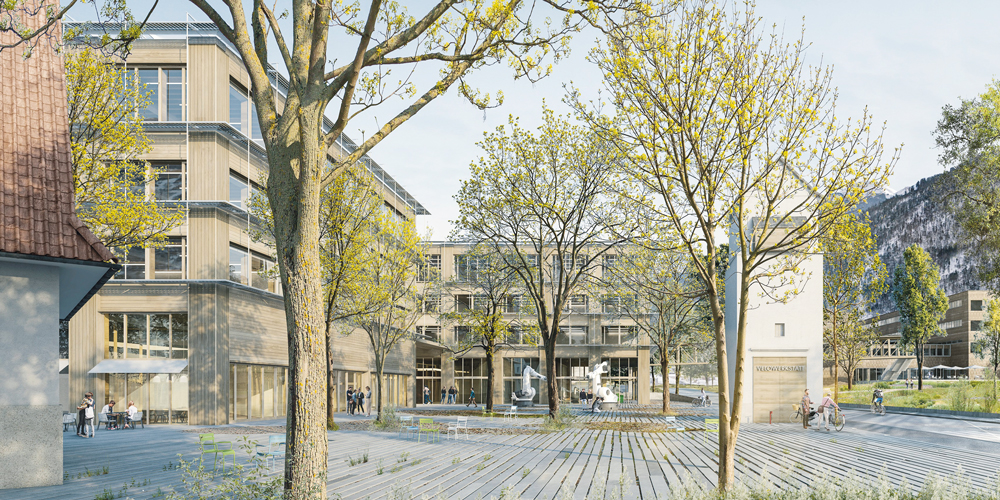
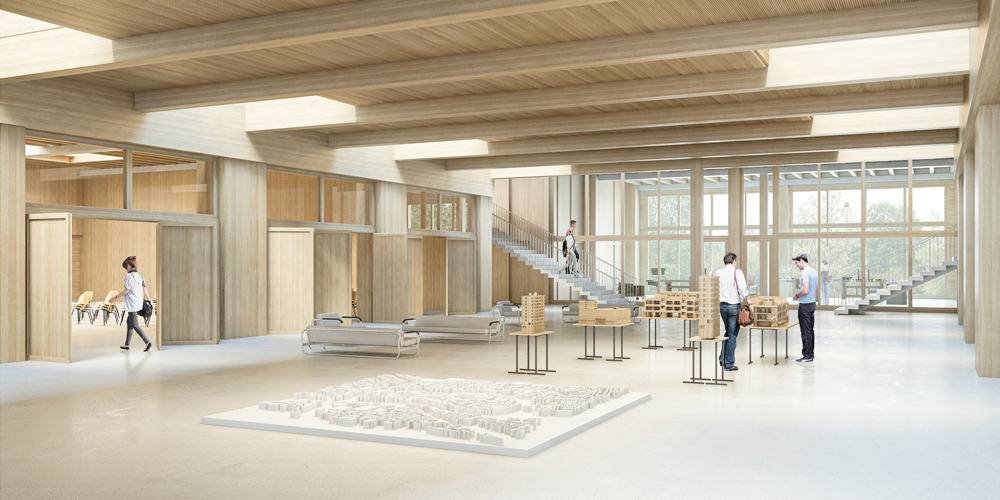
On 6 May, the foundation stone was laid for the new Biel/Bienne campus of Bern University of Applied Sciences on the former Feldschlösschen site near Biel railway station. An education and research centre for around 2,350 students and lecturers is to be built here by 2028, the Canton of Bern ‘s Department of Construction and Transport announced in a press release. Together with the federal government and a private partner, the Canton of Bern is raising around CHF 400 million for the construction of the new campus.
The Bern University of Applied Sciences will unite its Departments of Engineering and Information Technology as well as Architecture, Wood and Construction at the Biel/Bienne campus. According to the press release, the open architecture of the new site will promote interdisciplinary exchange and creative collaboration. The campus is designed as a cloverleaf of three building wings around a common centre.
“An inspiring environment is being created here that focuses on openness, interdisciplinarity and high standards of infrastructure and quality,” said Cantonal Councillor Christoph Neuhaus, Director of Construction and Transport of the Canton of Bern, in the press release. “The new campus is being built as a modern timber construction – a project that stands for sustainable, climate-friendly construction.” Glenda Gonzalez Bassi, Mayor of Biel/Bienne, sees the future campus “as a central location for the development of our region, for the education of our young generation and for attracting the talent that our economy needs now more than ever.”
The University of Applied Sciences Graubünden (UAS) and the Rotterdam University of Applied Sciences have signed a cooperation agreement. According to a media release, the cooperation was sealed during the Sketchcity study week with students from both institutions. The launch of the new cooperation brought together 200 students from the fields of urban planning and multimedia production from Chur, Bern and Rotterdam.
The cooperation arose from the Sketchcity project, which has been carried out by the UAS Graubünden in the Netherlands since 2016. The cooperation is intended to generate innovative ideas for the urban design of the future through interdisciplinary teaching and learning as well as research, according to a statement from the UAS. “We are connected by the Rhine, which is emblematic of this cooperation,” Professor Bruno Studer, head of the Department of Applied Future Technologies at the UAS Graubünden, is quoted as saying.
Based on existing contacts and positive experiences with the Sketchcity project, the two universities of applied sciences have decided to intensify their cooperation, according to the statement. The basis is the Swiss method Sketch&Draw, which is used as a visual development and innovation tool. The idea behind it is to enable co-creation, co-teaching and research also with visual means.
“We all need a visual tool to sketch the future. Sketching has always been the development tool in academic research,” Tanja Hess is quoted as saying, the initiator of the Sketch&Draw method. She is a professor of visualisation in the Multimedia Production bachelor’s degree programme at the UAS Graubünden and the Bern University of Applied Sciences.
The 19th Innovation Awards of the Foundation for the Promotion and Support of Technology-Oriented Entrepreneurship Rapperswil(Futur) go to two student projects of the University of Applied Sciences of Eastern Switzerland. Since the autumn semester 2008, the foundation has been offering an innovation prize among the students of the OST – University of Applied Sciences of Eastern Switzerland in Rapperswil. The prize is awarded and supports particularly innovative concepts that can later be marketed.
The main prize of 10,000 Swiss francs goes to the air-insulated power line called Hivoduct. It was developed by students led by Prof. Dr. Michael Schueller at the Institute of Energy Technology. “With it, we were able to develop a low-loss, invisibly laid and easily installed solution for the urgently needed expansion of power grids and for energy-intensive industries,” Schueller is quoted as saying in a media release from the University of Applied Sciences. According to the information, the Hivoduct cable is already in use in a pilot project in Zurich’s Seefeld and in a high-current facility in Germany. The SBB wants to use it in a transformer station.
The catalyst SelfCat, which regenerates itself, was awarded the recognition prize of 6000 Swiss francs. It was developed by the Advanced Materials and Processes group led by Prof. Dr. Andre Heel. According to project leader Heel, all that is needed to restore the catalytic converter to its original state is to aerate it briefly at high temperature. It can be adapted to numerous processes and therefore plays an important role in exhaust gas purification and in the production of sustainable synthetic energy sources.
With its clear volume, the new high-rise integrates itself as a matter of course into the urban structure of the new “Vision Mitte” quarter. It takes up the lines of the surrounding buildings and forms, so to speak, the last piece of the puzzle in the large cluster of buildings of the university of applied sciences and office and industrial buildings on this site. The building was not named after the number of flats, of course, but after the famous Roman excavation site in Windisch (Vindonissa).
The right type of wall for every use The 16 condominiums are located on the top four floors of the tower, the 116 rental flats on the 3rd to 10th floors. On the lowest three floors, the Centurion Towerhotel with 66 flats and rooms meets the needs of many regional businesses as well as the neighbouring technical college. These different uses are reflected not least in the materialisation and design within the building. The tower was raised as a skeleton structure and completely finished with non-load-bearing gypsum drywall systems.
The (almost) all-rounder Hydrophobised Rigips® Habito board plays a central role in the kitchens and wet rooms of the condominiums. It is probably one of the most versatile gypsum boards available and is suitable for residential, office and commercial construction, but also for hotels, hospitals and schools. During development, the focus was on an optimal room climate and easy processing. The revolutionary product was uncompromisingly optimised for these properties and equipped with the best performance data and a wide range of applications. The board is very robust, fire-resistant, sound-insulating, ecologically sustainable and efficient to work with.
A lot of planning and conversion freedom As soon as a brick wall is replaced with the Rigips® Habito system, the advantages multiply. There is no need to measure and install load-reinforcing wall inserts, because force loads such as furniture, pictures or TV screens can be screwed on directly without dowels. For the same reason, there is no need to determine the wall inserts at an early stage, which increases planning freedom. Habito is therefore as stable as a Roman legionnaire or as a conventional solid wall. With all these strengths in terms of building physics and con- struction, thanks to planning with gypsum drywall systems, there remains sufficient flexibility for later conversions if the utilisation requirements of individual rooms or even floors should change.
Gypsum drywall construction has also long been able to keep up at this level.
ABOUT RIGIPS Rigips is a pioneer of dry construction in Europe and part of the Saint-Gobain Group, one of the most traditional and innovative industrial groups in the world. In Switzerland, Rigips AG is the leading producer and supplier of gypsum drywall systems and a reliable supporter in the planning and execution of sophisticated interior design solutions. Plasterboard systems from Rigips AG are developed to successfully and sustainably realise the goals of customers and partners.
Flexible forms of accommodation, so-called flexlodges, could strengthen Graubünden tourism. However, the opportunities that the niche segment offers in addition to the classic accommodation in hotels and holiday apartments have so far hardly been used. According to a press release , scientists from the Institute for Tourism and Leisure at the University of Applied Sciences in Graubünden discovered this on behalf of the Office for Economy and Tourism in Graubünden .
The new forms of accommodation include safari tents and yurts, trailers and buses, as well as sleeping barrels, houseboats and tree houses. They are characterized by their closeness to nature. Compared to hotels and holiday apartments, they offer a better cost/income ratio due to lower investment costs. They also enable operators to react more flexibly to peaks in demand. In addition, Flexlodges appeal to a wide range of target groups. Furthermore, they often provide spectacular and thus particularly media-effective image material for communication and marketing measures.
However, the basic study also shows that the opportunities for innovative business ideas in this area have hardly been exploited to date. Reasons include a lack of orientation for providers and complicated legislation regarding spatial planning. In addition, due to the lack of uniform terms and platforms, the offers are often difficult to find or can only be found by chance. All in all, flexlodges are still not well known.
The scientists therefore recommend the "creation of framework conditions, the promotion of cooperation between the actors involved, the provision of information and the marketing of offers".
Die Fachhochschule Graubünden (FHGR) – die achte öffentlich-rechtliche Fachhochschule der Schweiz – ist heute auf fünf Standorte in neun Gebäuden innerhalb der Stadt Chur verteilt. Die Anzahl Studierender sowie das Forschungsvolumen der FHGR nehmen weiterhin zu. Die bestehenden Standorte bieten zu wenig Räumlichkeiten und Ausbaumöglichkeiten, um die Hochschule in Zukunft optimal aufzustellen. Bislang fehlt beispielsweise der Raum für den Austausch zwischen den Disziplinen sowie für die informelle Kommunikation zwischen den Studierenden und den Dozierenden. Darüber hinaus sind derzeit zu wenige studentische Arbeitsplätze vorhanden, die den heutigen Anforderungen genügen. Durch die Verteilung der Gebäude über die Stadt fehlt der Hochschule zudem die architektonische Visibilität.
Aus diesen Gründen hat der Kanton Graubünden entschieden, das Fachholschulzentrum am Standort Pulvermühle neu zu erstellen. Hier befindet sich seit 1993 der Hauptsitz der FHGR. Der Neubau soll ein zusammenhängendes Bildungs- und Forschungszentrum ermöglichen, das von der Diversität und interdisziplinären Zusammenarbeit aller Organisationseinheiten lebt. Die Projektleitung wurde dem Hochbauamt Graubünden übertragen. In einem Wettbewerbsverfahren wurde aus den 57 eingegangenen Bewerbungen ein Generalplanerteam selektioniert, welches die Vorgaben und Ziele der Regierung bezüglich Funktionalität, Ortsbau und Architektur überzeugend umsetzt und die Realisierung in der geforderten Qualität und Wirtschaftlichkeit sowie unter Einhaltung der Kosten- und Terminvorgaben garantieren kann.
Das Siegerprojekt überzeugt mit Nachhaltigkeit und Funktionalität Die Entscheidung fiel auf das Team rund um das Projekt «Partenaris». Den Lead übernimmt dabei das Zürcher Architekturbüro Giuliani Hönger Architekten. Überzeugt hat das Projekt die Jury durch die gleichmässige Berücksichtigung der Kriterien Architektur, Tragwerk, Nachhaltigkeit und Funktionalität. «Partenaris» sieht eine städtebauliche Positionierung des Neubaus vor – unter Einbezug der bestehenden Gebäude und durch die sorgfältige Gestaltung eines parkähnlichen Aussenraums. So wird ein attraktives Hochschulareal geschaffen. Die Planung berücksichtigt ausserdem die gewünschte Nutzungsflexibilität.
Die erste Etappe sieht einen viergeschossigen U-förmigen Baukörper mit einer zentralen, rund 1200 Quadratmeter umfassenden Eingangshalle vor. Dabei öffnen sich die drei Gebäudeflügel nach Süden zur Pulvermühlestrasse hin und interagieren mit den bestehenden Gebäuden. Der Neubau wird als Hybrid-Skelettbau ausgeführt.
Mittels Passerelle wird es mit dem Neubau verbunden. Die Obergeschosse sind für Nutzungen der Institute und Departemente vorgesehen, wobei der Öffentlichkeitsgrad und damit die Publikumsintensität mit jedem Stockwerk abnimmt. Das Raumprogramm wird mit vergleichsweise wenig Geschossfläche flächeneffizient umgesetzt. Dank der strukturierten Bauweise und ressourcenschonenden Materialisierung können die Werte bei der Grauen Energie auf einem guten Niveau gehalten werden. Im Westen entsteht zudem eine neue Terrasse. In der zweiten Etappe wird das bestehende Gebäude P57 in Richtung Westen erweitert.
Aus Sicht des Kantons Graubünden ist die Realisierung des Fachhochschulzentrums hinsichtlich Bildung, Forschung und auch innovationspolitisch von grosser Wichtigkeit. Denn der Mangel an Fachkräften, insbesondere in den technisch-naturwissenschaftlichen Disziplinen, hat Auswirkungen auf die Bündner Unternehmen: Diesen fehlen das nötige Wachstum und die gewünschte Entwicklung. Die neue Fachhochschule soll junge Leute ausbilden, fördern und damit die Wettbewerbsfähigkeit der Bündner Volkswirtschaft stärken.
Das Siegerprojekt wird in einem nächsten Schritt planerisch weiterbearbeitet. Danach muss es vom Grossen Rat genehmigt werden. Erhält «Partenaris» grünes Licht, soll Ende 2024 mit den Bauarbeiten begonnen werden. Im Jahr 2028 soll der Neubau bezugsbereit sein. Der Studienbetrieb läuft während den Umbauarbeiten weiter wie gewohnt.
Die Visualisierung zeigt den zukünftigen Campusplatz.So soll das Foyer des Neubaus dereinst aussehen.
The FHNWUniversity of Architecture, Building and Geomantics will be offering a certificate course in spatial data analytics at its location in Olten from January. This is intended to enable specialists from the fields of data science, transport, logistics, spatial planning as well as natural and environmental sciences to digitally plan the cities of the future and evaluate the data from infrastructures. The university is responding to a need in the construction and planning industry, according to its media release .
The Certificate of Advanced Studies (CAS) Spatial Data Analytics is intended to impart the knowledge required to model, process and interpret geodata in a targeted manner in 16 course days and in cooperation with experts from the field. For this purpose, “a balanced mix of lectures, case studies, group work and practical exercises” is planned, according to the FHNW. In addition, time blocks are planned for self-study.
“The question of where spatially measurable events take place is no longer sufficient,” says Prof. Dr. Pia Bereuter quoted in the communication. “In the future, we also need to understand why these happen. This requires well-founded analysis processes that are integrated into the digitization strategy of companies or organizations. “This expertise represents the basis for decisions with spatial reference” in almost every industry “.
A research group from the University of Life Sciences ( HLS ) of the University of Applied Sciences Northwestern Switzerland (FHNW) gives the all-clear: their tests show that the lead contained in the new perovskite solar cells is just as little washed out as all other functional metals, even if there is any weather damage. The cells were able to withstand rainwater and hail tests without the metal concentration in the rainwater increasing noticeably.
The prerequisite for a low environmental risk is that the solar cells are packed according to commercial standards. But "even with poor packaging, only 5 to 10 percent of the total lead content in rainwater was measured over several months," HLS doctoral student Felix Schmidt is quoted in a report by the FHNW. “We currently see little cause for concern with regard to the possible environmental impacts of lead.” However, this sensitive topic must be communicated transparently with regard to the social acceptance of this technology.
Permoskite solar cells are considered to be the future of photovoltaics. Tremendous advances in research have increased their efficiency from initially 3 to almost 30 percent in the past few years. It is thus just above that of traditional silicon cells.
Perovskite is the collective term for new materials, the crystal structure of which is similar to the natural mineral, also known as perovskite. Perovskites absorb light particularly efficiently and conduct the electricity generated well. They are both inexpensive and easy to manufacture and process. Among other things, two national research programs are running in Switzerland. They are designed to encourage the rapid adoption of this disruptive technology.
Now you have to think about “what will happen to the solar cells at the end of their lifespan”, continues Schmidt. "That is why we are currently developing ways to completely extract lead from old cells and use it again in new cells."
The University of Applied Sciences of Graubünden has examined how the added value of luxury residences that are often vacant can be improved. In this context, the Institute for Tourism and Leisure ( ITF ) investigated the question of how their owners can become convinced renters. In Graubünden they have been “neglected”, writes the FH in a press release . However, because the trend is moving from overnight stays in a hotel to one's own holiday home, this clientele should not be neglected.
However, the existing data is too thin for a needs analysis. Therefore, in their study, the researchers examined the willingness to rent similar prestige properties. In the global yacht charter market, they identified high administrative hurdles as well as psychological motives as an obstacle to renting out. These include encroachments on privacy and limited flexibility in personal use.
The most important finding from this needs analysis, however, is "that both the rental of superyachts and luxury residences are a matter of trust". So that the potential of the often vacant luxury properties in the high-priced Alpine destinations can be used, "all tasks that arise must be managed by a coordinator role". It is your job to guarantee that all service participants work together as smoothly as possible. “The rest then comes naturally, because satisfied landlords generate satisfied tenants,” says the message.
Wir verwenden Cookies zur Unterstützung und Verbesserung unserer Dienste. Mit der Nutzung dieser Website erklären Sie sich mit der Verwendung von Cookies einverstanden. Weitere Informationen finden Sie in unserer Datenschutzerklärung.