Tag: Fachkräftemangel

  • Swiss companies start the year on a more optimistic note

    Swiss companies start the year on a more optimistic note

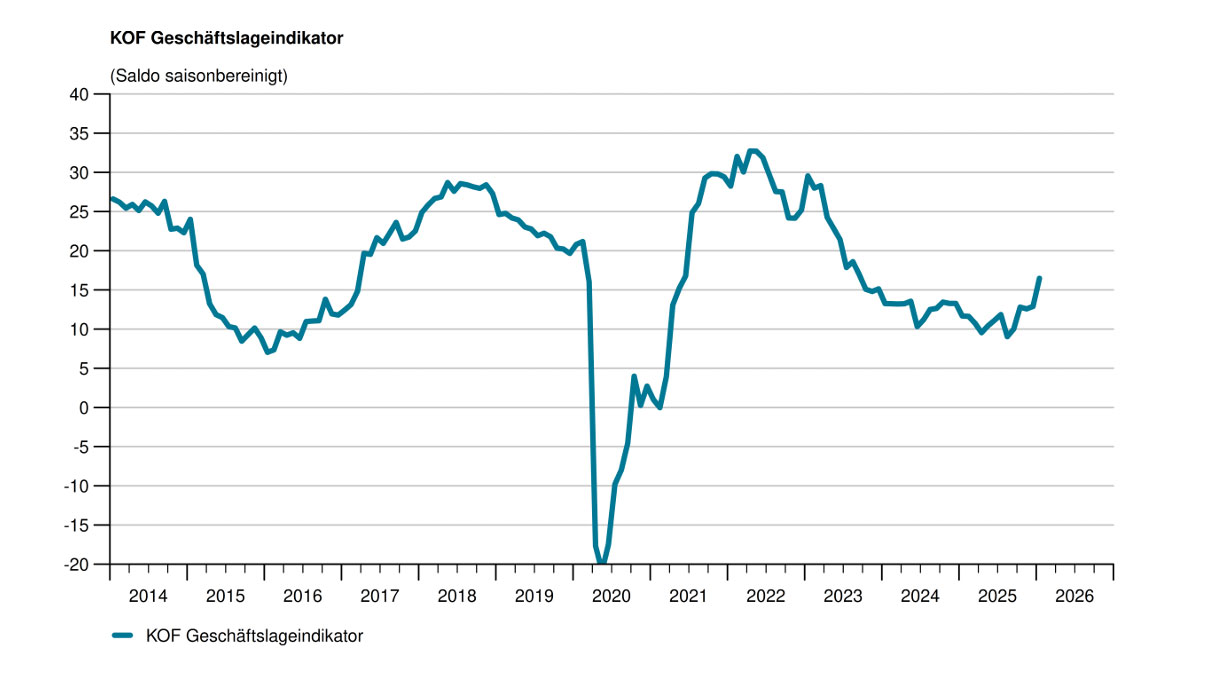
    The KOF Business Situation Indicator rose for the second month in a row in January, signalling a much more favourable starting position than a year ago. The business situation in the manufacturing industry in particular has brightened considerably, indicating a revival in demand and capacity utilisation.

    financial and insurance services, wholesale, catering and construction are also reporting rising business situation indicators, while the retail trade is at least slightly improving. The situation in other services remains largely stable, with only the project planning sector reporting a slight slowdown. Overall, this shows a broad-based improvement across the Swiss economy.

    industry as an anchor of sentiment
    Looking ahead to the next six months, optimism prevails in many sectors. The manufacturing industry in particular is anticipating a further improvement in business activity, confirming its role as an anchor of sentiment at the start of the year.

    expectations have also brightened in the retail trade, construction, financial and insurance services and project planning sectors. By contrast, the hospitality, wholesale and other services sectors are somewhat more cautious about the coming months, although the majority of them remain moderately positive.

    more recruitment
    Many companies are planning to take on additional staff. This is particularly evident in the hospitality industry, which is looking to expand its workforce but is finding it increasingly difficult to find suitable employees.

    the construction industry and the project planning sector are the most likely to report a shortage of skilled labour, which brings existing capacity bottlenecks into sharper focus. For managers and HR managers, this means that competition for qualified labour is continuing to increase in several key sectors.

    moderate momentum without new signs of inflation
    Despite the economic upturn, wage expectations remain stable. As in the October survey, companies expect gross wages to rise by 1.3% on average over the next twelve months, with above-average increases in the hospitality industry, the project planning sector and the construction industry.

    companies are also not expecting a turnaround in consumer prices. The expected inflation rate now stands at 0.9%, practically the same level as in the October survey (1.0%). The picture for monetary and wage policy is therefore one of moderate, well-anchored price and wage developments.

    broad base in the real economy
    The survey is based on around 4,500 companies from the manufacturing, construction and central services sectors, which corresponds to a response rate of around 56%.

    the KOF Business Situation Indicator thus provides a robust picture of the mood among managers. The Swiss private sector is starting 2026 with a broad base, cautious confidence and no discernible inflationary momentum, while at the same time increasing pressure on the labour market in key construction and service sectors.

  • SMEs fight for skilled workers and rely on flexibility

    SMEs fight for skilled workers and rely on flexibility

    Despite rising unemployment figures, the labor shortage remains the dominant concern for SMEs. According to the latest AXA labor market study, 44% of companies had great difficulty filling vacancies, while a further 40% struggled with recruitment problems at least to some extent. Highly specialized specialists and managers are particularly in demand and difficult to find. At the same time, increasing staff shortages are causing further stress.

    Competition from the state and corporations
    Two thirds of SMEs feel under pressure from large companies and state institutions in the competition for talent. While SMEs score points with values such as team spirit, closeness and appreciation, they remain at a disadvantage when it comes to wages, career opportunities and pensions.

    Team spirit beats specialist knowledge
    Insufficient specialist knowledge is considered the most common recruitment problem. Nevertheless, the study shows that soft factors are often decisive. Almost three quarters of companies prefer applicants with better teamwork skills to candidates with stronger but less compatible specialist knowledge. Reliability and honesty are among the most sought-after qualities.

    Diversity as a goal without clear implementation
    More than half of SMEs state that they consider diversity to be important. However, concrete measures remain the exception, with only 45 percent having introduced corresponding programs. Particularly in the area of recruitment, diversity often remains a non-binding goal without strategic anchoring.

    Employees with more power
    The study shows a clear shift in negotiating power in favor of employees. Two thirds of SMEs see their employees in a stronger position. Higher wage demands, demands for flexible working hours and changed behavior characterize the situation. Larger SMEs in particular are clearly observing this development.

    Flexibility as a response
    More than half of the companies surveyed are responding with flexible working time models and part-time options. Individual solutions for workloads, additional benefits and social services complement the strategies. Although salary increases play a role, they remain secondary to flexibilization.

    Outlook and succession issues
    Despite the challenges, 91% of SMEs are optimistic about the future. Economic uncertainties, changing customer requirements and the lack of young talent are a cause for concern. Succession planning in particular remains critical. 44% of companies rate the search for suitable solutions as difficult.

  • Zurich as a business location – fit for the future?

    Zurich as a business location – fit for the future?

    You head the Office of Economic Affairs of the Canton of Zurich. What are your responsibilities in this role and how can you influence economic development?
    The Canton of Zurich is a leading business location with international appeal. As the Office of Economic Affairs, we help to ensure that it remains competitive in the future, promotes innovation and generates sustainable added value.

    Thanks to a strong team with wide-ranging expertise in various areas and in-depth specialist knowledge, we strengthen the business location and support companies in various phases. We use our knowledge and experience in a targeted manner to analyze and develop the economic framework conditions and respond to new challenges. In close cooperation with the business and scientific communities, we analyze location factors and provide impetus to position Zurich as an attractive location for companies. At the same time, we take on central enforcement tasks: We ensure smooth approval procedures and thus create planning security for companies and employees. By ensuring compliance with working conditions and legal requirements, we contribute to an attractive and responsible labor market. Another focus is the promotion of affordable housing – a decisive factor for the attractiveness of a location. We therefore have numerous effective levers at our disposal to actively shape change.

    A pronounced service orientation is particularly important to me. A good understanding of our stakeholder groups and their needs forms the basis of our work. Because only if we know the challenges and concerns of companies can we provide targeted support and strengthen Zurich as a business location in the long term.

    In short: we create attractive framework conditions for an economic environment that benefits companies and the population alike.

    How do you assess the economic situation in the canton of Zurich?
    Overall, the canton of Zurich is in a very solid economic position and is one of the most innovative economic regions in Europe. Moderate economic growth of 1.1% is forecast for the current year. A high level of innovation, first-class universities and close cooperation between business and science make the location particularly attractive. Companies benefit from well-trained specialists, an excellent infrastructure and a strong international network.

    At the same time, we are facing important challenges: In the short and medium term, the latest geopolitical tensions could have an impact on Zurich as a business location. Closely linked to this is the question of how we position ourselves strategically vis-à-vis our European neighbors, particularly with regard to our relationship with the EU.

    In the long term, demographic change will play a key role. The ageing of society, rising retirement figures and the availability of skilled workers will be decisive for how competitive the business location remains. Measures must be taken in good time to secure the pool of skilled workers.

    However, thanks to its economic stability, innovative strength and quality of life, I believe that the canton of Zurich is well positioned to remain successful in the long term.

    In which areas does the canton of Zurich still have untapped economic potential?
    The canton of Zurich has a strong capacity for innovation. Nevertheless, there are areas with untapped potential: in the field of artificial intelligence, the canton of Zurich has taken an important step towards strengthening the dynamic AI ecosystem with the “Innovation Sandbox for Artificial Intelligence”. However, from a macroeconomic perspective, there are still great opportunities to anchor AI even more broadly in various sectors. SMEs in particular could increase their productivity and open up new business areas through the targeted use of AI. Practical support is needed here to provide SMEs with access to and knowledge of AI technology.

    There is further economic potential in the scaling of start-ups. Zurich offers an excellent environment for start-ups. However, many start-ups face the challenge of expanding their business beyond the initial phase. There is a need for additional financing options and targeted support structures to help start-ups grow and accompany them on their way to the international market.

    We are also not yet exploiting the existing potential in the area of digital health. Increasing cost pressure in the healthcare system, an ageing society and the growing shortage of specialists make a transformation more urgent than ever. Zurich as a business location has all the ingredients to be successful here: leading universities, strong players in the healthcare sector and innovative companies. With the “digital health center Bülach”, we have created an innovation hub that makes an important contribution by promoting innovation and building bridges between science and business.

    What economic policy framework conditions are crucial for the success of the Greater Zurich Area as a business location from the perspective of the Canton of Zurich?
    A key success factor is access to highly qualified specialists. The canton of Zurich has excellent universities and research institutes that attract talent from all over the world. To ensure that this remains the case in the future, the universities must also remain attractive to foreign students – both through first-class educational conditions and easier access to the job market after graduation.

    Tax conditions also play a decisive role. A competitive tax environment is essential if the canton of Zurich is to remain attractive. Currently, however, the tax environment is increasingly perceived by companies as a negative location factor. In a cantonal comparison, the canton of Zurich ranks second to last in terms of the tax burden on companies – a risk for long-term competitiveness.

    Our relationship with Europe is another key factor for economic success. Access to the European market is crucial for many companies, especially for export-oriented sectors. At the same time, companies in Zurich as a business location benefit from Switzerland’s lean and pragmatic regulations.

    How attractive is the Greater Zurich Area for investors in an international comparison with other European metropolitan regions?
    The Greater Zurich Area is one of the most attractive business locations in Europe and is asserting itself internationally as a leading location for companies and investors. It offers a unique combination of economic potential, innovative strength and business-friendly conditions. At the same time, the region offers a stable, transparent and reliable economic environment with attractive tax and regulatory conditions.

    Companies benefit from a first-class environment for research and development – characterized by close cooperation between universities, start-ups and globally active companies.

    Another key advantage for investors is the mix of industries in the region. Zurich is no longer just the most important financial center in Switzerland, but also a dynamic and diverse location for innovation. The strong presence of ICT, high-tech, space and robotics, life sciences, food and cleantech ensures a high density of innovation and minimizes the risk of dependencies. For investors, this means not only stability, but also attractive diversification opportunities.

    Switzerland is neither an EU member nor a cost-effective location. Why should an international company still choose the Greater Zurich Area?
    The Greater Zurich Area offers companies a unique overall package that goes far beyond cost factors. It combines a business-friendly and politically stable environment with first-class talent, leading research and a high quality of life – factors that are crucial for sustainable business success.

    Switzerland ranks first in the world when it comes to innovative strength as well as attracting and retaining talent. Thanks to an excellent education system, internationally recognized universities and a high quality of life, the country is able to attract specialists from all over the world. Companies benefit from a highly qualified labor market, which makes a decisive contribution to competitiveness.

    However, there is still untapped potential in one area: the availability of attractive and sustainable space for companies to successfully secure relocations and expansions.

    What strategic advantages does Switzerland offer as a hub for European or global business activities?
    As a business location, Switzerland offers a unique combination of stability, innovative strength and international networking. Thanks to its central location in the heart of Europe, it is an ideal starting point for companies with a global or European focus.

    One decisive advantage is its excellent accessibility: Zurich Airport offers direct connections to major economic centers worldwide and makes the Greater Zurich Area a strategic hub for international business activities.

    The fact that the canton of Zurich is already a sought-after location for globally active companies is demonstrated by the most recent relocations. International tech companies such as “OpenAI”, “Anthropic” and “Boston Dynamics” have opened offices in Zurich – proof of the attractiveness of the location and its potential as a hub for forward-looking industries. The high density of leading companies creates a dynamic ecosystem that also opens up new opportunities for local SMEs.

    How important are modern infrastructure and digital networking for internationally active companies?
    The Greater Zurich Area offers internationally active companies first-class infrastructure and seamless digital networking – key factors for competitiveness and sustainable growth.

    Thanks to Zurich Airport’s international reputation, a state-of-the-art rail and road network and direct connections to Europe’s most important economic centers, companies benefit from maximum mobility and accessibility. Switzerland is ranked first in the current IMD ranking for its infrastructure, which underlines the high quality and reliability of the location conditions.

    The region also impresses with its advanced digital infrastructure. High-performance networks and state-of-the-art technologies create optimal conditions for innovation, data-driven business models and the use of pioneering technologies such as artificial intelligence and cloud computing.

    With this combination of physical and digital excellence, the Greater Zurich Area offers companies the ideal framework conditions to successfully position themselves globally.
  • Digitalisation and AI as the answer to skills shortages and climate targets

    Digitalisation and AI as the answer to skills shortages and climate targets

    The construction industry needs both digitalisation and AI in response to increasing complexity and data density. According to a HSLU press release on the seminar organised by its Institute of Building Technology and Energy(IGE), both are also needed to increase efficiency in times of a shortage of skilled workers, declining productivity and an urgently needed reduction in greenhouse gases from buildings.

    This annual IGE event is aimed at specialists in energy, building and construction technology and architecture. This year’s event attracted 110 participants.

    Several speakers shed light on the latest developments in AI for the construction industry. For example, Bruno Michel from IBM Research spoke about “artificial stupidity” when generative AI generates incorrect information with poor training data from the internet. Jörn Plönnings from the University of Rostock also emphasised that a lack of training data is a major problem for the construction industry. However, AI is neither a curse nor a blessing, but simply a necessity in view of the increasing complexity and flood of data.

    Marcel Imfeld from Schindler Aufzüge and Roman Steffen from Trafiko spoke about intelligent mobility, which enables denser construction or fewer parking spaces in neighbourhoods, for example. The automated monitoring of buildings was also covered in various presentations.

    The HSLU presented its Lightscore project, which aims to launch an evidence-based integrative lighting assessment. It is also working on a new SIA standard for the energy efficiency of data centres. And finally, Roger Buser from HSLU reported on his journey through India with the emission-free solar vehicle Solar Butterfly made of ocean PET, where he encountered numerous innovative solutions to combat climate change.

  • Findings from the Canton of Zurich’s “Fokus Standort” programme

    Findings from the Canton of Zurich’s “Fokus Standort” programme

    In order to position the canton of Zurich as an attractive business location in the long term, the Department of Economic Affairs is focusing on dialogue and collaboration. Current trends and challenges, including digitalisation, skills shortages and regulatory developments, were analysed at the “Fokus Standort” event.

    The discussion was based on the “Canton of Zurich location trend analysis”, which identified four key influencing factors: artificial intelligence and automation, demographic change, increasing regulatory density and economic uncertainty in relation to the EU.

    Workshops on key location topics
    Challenges and solutions were discussed in depth in four topic-specific workshops.

    Skilled workers: How can the labour market situation be stabilised through a better work-life balance, technological innovations and longer working lives?

    Technology: What role does artificial intelligence play in companies and educational institutions, and how can digital skills be promoted in a targeted manner?

    Regulation: How can companies be relieved in order to ensure competitiveness despite increasing administrative requirements?

    Mobility: What concepts can reduce travelling distances and promote sustainable transport solutions?

    The measures developed are now to be further developed in working groups and translated into concrete recommendations for action.

    Demographic change and labour shortage
    Government Councillor Carmen Walker Späh opened the discussion on demographic change. She emphasised that the rising number of retirees and the low number of new recruits represent a major challenge for the labour market. In addition to a better work-life balance, technological efficiency improvements and longer working lives are key solutions.

    In the concluding panel discussion with leading business and industry representatives, further strategies to combat the labour shortage were discussed. The Canton of Zurich is thus focussing on a constructive exchange in order to make the business location fit for the future.

  • Swiss construction industry 2025

    Swiss construction industry 2025

    By 2025, sustainability will no longer be a trend, but a matter of course. Building certificates such as Minergie or SNBS and circular construction will take centre stage. Companies that reuse building materials and offer innovative solutions will secure decisive competitive advantages.

    Digitalisation enters the next round
    The digital transformation is reaching new dimensions. Technologies such as IoT, AI-based planning software and digital construction site management tools are being used more widely. At the same time, promoting digital skills among employees is essential in order to actively shape digital progress.

    Skills shortage remains a challenge
    The industry continues to be characterised by a shortage of qualified workers. Companies are increasingly investing in training and further education programmes, focusing on international recruitment and pushing ahead with automation. Modern working conditions and attractive corporate values are becoming increasingly important.

    Focus on urban development and densification
    Urbanisation calls for innovative concepts such as car-free zones, mixed-use districts and urban greening. At the same time, affordable housing remains one of the key challenges. Creative solutions are needed to meet the needs of the population.

    Energy and raw material prices
    The energy crisis and the cost of building materials remain a dominant issue. Local and sustainable building materials are gaining in importance, while legal requirements are driving the expansion of renewable energies. Solar installations and innovative heating systems are setting new standards here.

    Collaboration as the key to success
    The increasing complexity of construction projects requires closer cooperation between architects, engineers and technology providers. Companies that focus on partnerships benefit from synergies and can realise projects more efficiently.

  • Working together for attractive management

    Working together for attractive management

    Malicious tongues (and long-standing market observers) claim that the property business in Switzerland runs smoothly, in good times and bad, and without much help from the property sector. However, the example of property management shows that not everything always goes well. The favourite scapegoat of tenants and the media has to take the rap when the reference interest rate rises and interest-related rent reductions are reversed. Or when service charges rise because energy costs explode. Or when arguments between neighbours escalate because the barbecue season has started. Or when rents rise because supply cannot keep up with demand.

    Property managers – or more precisely, the majority of them – have an exciting and demanding task: they have to satisfy two very different categories of customers: their clients, usually private owners and asset managers, for whom they are responsible for maintaining property portfolios and optimising property income, and their tenants, who expect their concerns to be met unbureaucratically, defects and damage to be rectified quickly, annoying neighbours to be dealt with and service charges to be minimised.

    This challenging task becomes a burden when clients demand more and more services for less and less money in order to support their returns, and when tenants make ever higher demands because they assume that rising housing costs go hand in hand with a higher level of service and that “no” is not an answer.

    The burden has consequences. On behalf of SVIT Zurich, we conducted an online survey of active and former property managers between October 2023 and January 2024 to find out how active managers view the profession, where former managers have moved to and under what conditions they would return to property management.

    The answers are sobering. Although 80% of active farmers identify with their work, a majority are considering changing jobs (Figure 1). It is particularly worrying that two thirds of the “seniors” are considering whether they should turn their backs on farming, and that one in nine team leaders has applied for a job outside of farming in the past six months. The sector risks losing its most experienced top performers.

    We do not believe that the property industry can afford to lose experienced managers. Owners and asset managers are already complaining that knowledge is lost with every turnover and tasks are left undone. The attempt to ensure continuity in property management with asset managers who have previously worked in property management themselves is understandable – but counterproductive. A blurred division of roles and responsibilities almost always leads to friction, and micromanagement contributes to managers looking for other areas of responsibility.

    Tenants also have a lot to lose. It is already being criticised that it is becoming increasingly difficult to find personal contacts behind apps and web forms, and that staff changes are causing concerns to fizzle out. Even the tenants’ association, which likes to portray landlords as “rip-off artists” and urges tenants to challenge rent increases and service charge bills “rather once too often”, should actually know that Switzerland as a tenant country cannot function without knowledgeable landlords.

    As difficult as it may sometimes seem, it is possible to make property management more attractive again. We believe that property management companies, clients and industry associations can achieve a great deal with a concerted effort.

    Property management companies can do more to relieve the burden on property managers in their day-to-day business and in dealing with large portfolios. In many administrations, work processes could be formalised, simplified, standardised and properly digitalised. Digitalisation zombies could be disposed of more quickly and management deficits could be addressed more actively. Services offered could often be defined more clearly in order to manage expectations and avoid conflicts; if conflicts escalate, managers could often be better protected from hostility.

    Clients could become more aware that quality has a price and that property management companies do not have a patent remedy for reducing operating costs with the often elusive – and sometimes deceptive – digitalisation dividends. The fact is that property management has become more demanding and complex, and that maintaining and renewing the building stock requires more people and expertise. Control is undoubtedly necessary in this context, but constructive cooperation is also required. Investing in asset micro-managers is of little use if it creates additional work for the management and takes away necessary resources.

    Finally, service providers and industry associations can expand the training and further education programmes on offer to better prepare managers for changing tasks and working methods.

    The traditional training path from clerk to property manager assumes that property managers can do everything that could contribute to maintaining the value and optimising the income of the building stock, from handing over rental properties and property accounting to developing maintenance strategies and supporting tenant improvements and renovations, and that three years of professional experience and a specialist certificate are enough to lead a management team.

    In addition to traditional all-rounders, the real estate industry also needs specialists who know how the energy and emission intensity of existing properties can be reduced at a reasonable cost, how redensification projects can be implemented without a lot of background noise or how shopping centres can be revitalised. This requires training and further education paths that give lateral entrants and newcomers the opportunity to play to their strengths without having to internalise all of their management knowledge. And there needs to be an awareness that value creation in the portfolio increasingly requires a team effort, in which other experts make a significant contribution alongside traditional property managers.

    It is up to the players in the property industry to reward this contribution appropriately.

  • 102. immoTable Schaffhausen on the road to the future

    102. immoTable Schaffhausen on the road to the future

    [smartslider3 slider=”24″]

    Councillor Daniel Preisig gave an overview of Schaffhausen’s economic development in recent decades. After the industrial crisis and stagnation in the 1990s, Schaffhausen has recovered thanks to targeted economic development. in 2023, the population record of 1969 was reached again for the first time. Preisig emphasised how projects such as the conversion of the old steel foundry and the relocation of roads to create traffic-free promenades along the banks of the Rhine contributed to the city’s attractiveness. Schaffhausen is continuously investing in smart, future-orientated urban development and digital administration.

    Dino Tamagni highlighted the impressive economic development of the canton of Schaffhausen. The region’s industrial success story began with the construction of the Moser Dam in the 19th century. The hydroelectric power plant, once the largest of its kind in Switzerland, laid the foundations for the establishment of important industrial pioneers such as Georg Fischer, SIG and IWC, which turned Schaffhausen into a central industrial centre.
    In the 1990s, globalisation led to plant closures, job losses and emigration, resulting in the loss of 11% of jobs. However, targeted economic measures, such as the creation of an economic development agency, enabled Schaffhausen to overcome the challenges and regain its competitiveness.
    Today, the canton has one of the strongest economies in Switzerland, with the highest GDP per capita. Thanks to the promotion of innovation projects and the continuous expansion of the infrastructure, Schaffhausen remains an attractive and future-orientated business location.

    Andreas Campi, Head of Development, Halter AG, presented the “Im Pantli” residential project in the Waldquartier Schaffhausen. A modern residential neighbourhood is being built on the site, which was once used as a workers’ housing estate by Georg Fischer AG. The buildings are arranged around a neighbourhood centre to create urban alleyways and meeting spaces. The car-free development offers spacious, family-friendly flats with private outdoor areas. Childcare facilities and a dedicated bus stop enhance the quality of the location. The project not only promotes modern living, but also a lively community life.

    Pascal Stutz, CEO of SVIT Zurich, Joëlle Zimmerli, Managing Director of Zimraum GmbH and Christian Brütsch, Owner and Managing Director of Stratcraft GmbH, presented solutions to the shortage of skilled labour. A key challenge facing the property sector is the shortage of skilled workers and dissatisfaction among experienced professionals. Around 60 % of the senior professionals surveyed feel that their workload is too high, and over 50 % see large portfolios as problematic. The study presented highlighted the need for action and suggested solutions such as the standardisation of processes, intelligent digitalisation and the promotion of leadership skills in order to better overcome the challenges.

    Tindaro Milone presented a comparison of energy sources for heat pumps at the immoTable. EKZ operates over 1,200 energy systems across Switzerland and favours sustainable solutions. Air is cost-effective, but less powerful. Geothermal energy offers stable energy, but is expensive and location-dependent. Groundwater is efficient, but requires strict authorisations. Waste water provides a lot of energy, but is irregularly available. Seawater is particularly efficient, but expensive and tied to bodies of water. The choice of energy source depends on the project requirements, with EKZ offering customised solutions. We look forward to welcoming you to the next immoTable in Zug, where the focus will once again be on exciting topics and pioneering developments in the property sector. Join us as experts discuss the future of Zug as a property location and the latest innovations in the sector.

    Further information on the event and future dates can be found at www.immotable.ch

  • Zurich power generators jointly train grid electricians

    Zurich power generators jointly train grid electricians

    According to a press release, Zurich’s two electricity suppliers are launching a joint training and communication campaign. Together, they want to train more grid electricians. The focus is on lateral entrants, according to a joint press release from EKZ and ewz.

    Instead of poaching skilled workers from each other, the electricity suppliers have now developed a joint training concept that is specifically tailored to lateral entrants. The programme is aimed at professionals who have already completed training in electrical engineering or another trade. The two energy companies are organising an information evening on this topic on 13 November.

    The programme is being run jointly by the two companies. During the internal training period, employees already receive a full salary. They are employed by either EKZ or ewz and receive their practical training on the job, supplemented by courses at the ewz training centre in Zurich-Schwamendingen. After around a year of further training, graduates receive an internal training certificate.

    In order to reach candidates for the lateral entry programme, the electricity suppliers are launching the Komm ins Team Power campaign. It addresses the target group with short videos on various online channels and directs them to a special website. Advertising campaigns at sporting events, activation via employees of the two energy companies and cooperation with the netzelektriker-forum association are also planned.

  • Skilled labour shortage – an industry analysis by SVIT Zurich

    Skilled labour shortage – an industry analysis by SVIT Zurich

    [smartslider3 slider=”19″]

    Examining the distribution of roles in property management and developing specialised profiles could reduce the frustration of managing large portfolios. Overall, the shortage of skilled labour in the property sector calls for far-reaching structural adjustments to improve working conditions and the satisfaction of professionals. It remains to be seen whether the sector will successfully implement these strategies.

    Structural problems and proposed solutions
    Experts agree that there are structural challenges that are difficult to change. Nevertheless, there are numerous opportunities for improvement, such as the simplification and standardisation of processes, efficient systems and intelligent digitalisation. In addition, the promotion of leadership skills could better overcome organisational challenges. Improved conflict management and the proactive promotion of talent and career changers are further possible steps to overcome the shortage of skilled labour.

    Shining a light on the distribution of roles in management
    The areas of responsibility of “Bewis” (managers) include activities that require specific skills and competences. The allocation of these tasks within a company is largely determined by the management business model. In order to reduce frustration when dealing with large portfolios, four different “Bewi” profiles were identified and corresponding solutions developed. All-rounders are supported by juniors and administrators. A more efficient support system could help to reduce the frustration of managing large portfolios.

    Digital management promotes clear processes, integrated systems and the use of artificial intelligence (AI). An advanced IT infrastructure is essential here. Specialists and integrated “Bewis” work in teams with other specialised experts. Attractive career paths and complementary skills are key success factors here. A narrowly defined area of responsibility could also help to minimise job frustration.

    Key to solving the skills shortage
    The skills shortage in the real estate sector is a multifaceted and complex problem that requires far-reaching structural and organisational adjustments. Some of the existing challenges can be tackled through clever conflict management, targeted promotion of talent and the adaptation of roles within property management.

    It remains to be seen how the sector will implement these strategic proposals to improve the working conditions and satisfaction of its professionals.

  • Successes, prospects and highlights of the 100th immoTable in Zurich

    Successes, prospects and highlights of the 100th immoTable in Zurich

    As part of the 100th immoTable at Ambassador House, one of the top events for the real estate industry, not only was progress celebrated, but topics such as sustainable urban development and the shortage of skilled workers were also addressed. Sabine Billeter briefly summarized the developments of the last five years. Arun Banovi then presented the new industry-specific job platform, which is an important resource for skilled workers. ImmoMedia is responsible for several media vehicles, such as the immoNewsletter, www.immo-invest.ch, immobilienJobs.ch, immoTermine.ch, the magazine immo!nvest a platform for locations and real estate.

    The focus of the event was the discussion on Zurich’s development strategies, which were presented by Fabian Streiff, Head of the Canton of Zurich’s Department of Economic Affairs. He emphasized Zurich’s strong position compared to other European cities and outlined innovative projects such as the research being carried out by universities, colleges and ETH on topics such as drone infrastructure, regulating the last mile and connecting with co-working and meeting zones for pedestrians and cyclists as well as the public transport network. The increasing shortage of skilled workers and demographic challenges were also the focus of the discussion.

    Martin Schneider, Deputy Director of the City of Zurich’s Office for Urban Development, highlighted the need to create living space for the city’s predicted growth. He referred to the importance of flexible housing concepts and the need to adapt land use to noise protection and climate targets. He also spoke about urban expansion and densification in the context of ISOS, which illustrates the complexity of urban development.

    Sustainable construction was also discussed, represented by Jura Cement-Fabriken AG, which has set itself the goal of building sustainably with concrete by 2030. Reducing CO2 emissions by changing material compositions was highlighted as an important factor in future construction practice. EWZ has also set itself the goal of 100% climate-neutral heating and cooling. The approach was illustrated to the participants using the Guggach and Greencity projects.

    Finally, Stefan Fahrländer, owner of Fahrländer Partner Raumentwicklung, emphasized the need for political measures to speed up the construction process and thus improve responsiveness to market needs. His comments underlined the need for faster and more efficient implementation of construction projects in Switzerland.

    The event was rounded off with a performance by rapper and beatboxer Knackeboul, who summarized the content of the event in a dynamic rap. In this way, the combination of specialist knowledge and cultural integration was illustrated in an entertaining way.

  • Zurich as an economic magnet

    Zurich as an economic magnet

    A study recently published by the cantonal Office of Economic Affairs (AWI) on Zurich’s attractiveness as a business location compared the canton with international business centres such as Munich and London. The “Location Day” provided a platform to discuss these results and develop further strategies. According to AWI Director Fabian Streiff, although Zurich is in a good position, it faces challenges in the cost environment and a shortage of skilled labour.

    An international comparison showed that Zurich performs better than Munich when it comes to recruiting skilled labour, although the shortage of skilled workers is also noticeable here. Discussions revealed that more efficient processing of work permits and better utilisation of domestic potential are necessary to maintain competitiveness.

    Another topic was support for start-ups. While some called for more government support, others warned of the consequences of too much regulation through state intervention.

    The digitalisation of the healthcare system and the use of artificial intelligence were identified as key areas for the future. A more efficient exchange of data and the implementation of digital processes could not only reduce the workload of medical staff, but also increase the attractiveness of the location for specialists from abroad.

    Technology, skilled labour, entrepreneurship, mobility and sustainability were the key topics discussed in workshops. The discussions showed that Zurich has great potential that needs to be exploited, particularly in the areas of sustainability and digitalisation.

    The “Location Day” ended with an appeal from Government Councillor Carmen Walker Späh to fully utilise the existing potential and set the right course for the future. The results of the day should serve as a basis for concrete measures to further strengthen Zurich as an attractive business location.

  • Frischknecht Holzbau-Team AG wins the Innovation Award Zürcher Unterland 2023

    Frischknecht Holzbau-Team AG wins the Innovation Award Zürcher Unterland 2023

    This year’s Innovation Award Zürcher Unterland has gone to Frischknecht Holzbau-Team AG. The company from Kloten “has shown a lot of courage with the introduction of a four-day week to combat the shortage of skilled workers and has gained new and valuable experience for the construction industry”, writes the association Standort Zürcher Unterland in a statement. It has organised the competition to honour innovations from the Unterland region every year since 2021.

    Comtag AG from Wil ZH came in second with its innovative cleaning process for coffee grinders. Third place went to Green Datacenter AG from Lupfig AG. It was awarded for its Metro Campus Dielsdorf. The waste heat from the data centre in Unterland can be used by households and businesses in the surrounding area.

    The prize money of 5000 Swiss francs for the first-placed company and 2500 Swiss francs each for the second and third-placed companies was donated by the sponsors Zürcher Kantonalbank and Vetropack. The award ceremony took place on 14 September as part of the innovation event at Vivi Kola in the premises of the former mineral springs in Eglisau. The 50 or so participants were also offered a programme of presentations and seminars as well as a tour of Vivi Kola’s factory facilities.

    This year’s Innovation Award Zürcher Unterland went to Frischknecht Holzbau-Team AG. The company from Kloten “has shown a lot of courage with the introduction of a four-day week to combat the shortage of skilled workers and has gained new and valuable experience for the construction industry”, writes the association Standort Zürcher Unterland in a statement. It has organised the competition to honour innovations from the Unterland region every year since 2021.

    Comtag AG from Wil ZH came in second with its innovative cleaning process for coffee grinders. Third place went to Green Datacenter AG from Lupfig AG. It was awarded for its Metro Campus Dielsdorf. The waste heat from the data centre in Unterland can be used by households and businesses in the surrounding area.

    The prize money of 5000 Swiss francs for the first-placed company and 2500 Swiss francs each for the second and third-placed companies was donated by the sponsors Zürcher Kantonalbank and Vetropack. The award ceremony took place on 14 September as part of the innovation event at Vivi Kola in the premises of the former mineral springs in Eglisau. The 50 or so participants were also offered a programme of presentations and seminars as well as a tour of Vivi Kola’s factory facilities.

  • Schweizer Konjunktur harzt – Verarbeitendes Gewerbe im Abschwung

    Schweizer Konjunktur harzt – Verarbeitendes Gewerbe im Abschwung

    In der Mehrzahl der befragten Wirtschaftsbereiche trübt sich die Geschäftslage im Juli ein – im Verarbeitenden Gewerbe bereits den sechsten Monat nacheinander. Dieser Wirtschaftsbereich befindet sich im Abschwung. Zum ersten Mal seit Januar 2021 kommt der Indikator für die Geschäftslage dieser Branche wieder im negativen Bereich zu liegen. Besonders deutlich ist die Abwärtstendenz bei den exportorientierten Firmen.

    Einen Dämpfer erhält auch der Dienstleistungssektor. Überdies geht der Geschäftslageindikator in den Branchen Finanz-​ und Versicherungsdienstleistungen, Baugewerbe und Projektierung etwas zurück. Eine positive Entwicklung nehmen im Juli dagegen die Konsumbereiche Detailhandel und Gastgewerbe.

    Inflationserwartungen geben nach – Bauhauptgewerbe rechnet mit sinkenden Preisen
    Der Preisauftrieb nimmt in nahezu allen Wirtschaftsbereichen weiter ab. Vergleichsweise häufig sind Preisanhebungen im Gastgewerbe und bei den wirtschaftlichen Dienstleistungen geplant. In den anderen Wirtschaftsbereichen dürfte die Dynamik bei den Preisen in der nächsten Zeit gering sein. Das Bauhauptgewerbe rechnet sogar mit eher sinkenden Preisen für seine Leistungen. Die Erwartungen der Unternehmen über die eigene Preissetzung hinaus für die Entwicklung des Konsumentenpreisindex sind geringfügig weniger hoch als bisher. Die Unternehmen erwarten nun einen Anstieg der Konsumentenpreise in den nächsten zwölf Monaten um 2.5%. Im April gingen sie von 2.6% aus. Für die Inflation in fünf Jahren liegen die Erwartungen momentan bei 2.3% nach 2.5% im April.

    Arbeitskräftemangel bleibt ein Problem, verliert aber an Schärfe
    Die Unternehmen in der Schweiz suchen zwar insgesamt weiterhin zusätzliches Personal, allerdings sind die Einstellungspläne nicht mehr ganz so expansiv wie bislang. Dementsprechend ist der Arbeitskräftemangel in den Augen der Unternehmen weiterhin ein sehr dringendes Problem, es verliert aber im Verarbeitenden Gewerbe, im Baugewerbe und im Grosshandel im Vergleich zu bisher an Schärfe. Im Verarbeitenden Gewerbe und im Grosshandel sind die Sorgen über eine schwache Nachfrage derzeit drängender als die über fehlendes Personal.

  • Master builders want to respond to the study on the shortage of skilled workers

    Master builders want to respond to the study on the shortage of skilled workers

    “Our industry is doing well after three years of permanent crisis,” said Central President Gian-Luca Lardi, welcoming the more than 550 guests to the Construction Industry Day at the LAC Lugano Arte e Cultura cultural centre. “The master builders have learned to deal with the effects of the Ukraine war, just as they did before with the price increases and supply bottlenecks in the wake of the Corona pandemic.” And the future outlook is also quite positive in the medium to long term, according to Lardi. Construction activity should continue to grow, “albeit at a somewhat slower pace”. While strong growth is forecast for residential construction until 2040, mild growth to stagnation is expected in commercial construction, public building construction and public civil engineering. At the same time, builders can look forward to prices for building materials gradually falling again.

    SBC study shows: Shortage of skilled workers endangers jobs
    The focus of this year’s networking event was on the shortage of skilled workers and what mix of measures can be used to combat it. Today, the search for suitable employees at all levels is a major challenge for many tradespeople, including master builders. And it can be assumed that the situation will get even worse. With far-reaching consequences. “Without enough qualified craftsmen, important construction projects in our country can no longer be realised,” Lardi explained. To prevent such a scenario, the Swiss Association of Master Builders commissioned the Demographics Competence Centre to conduct a “Study on the Long-Term Development of the Economy and Skilled Workers in the Main Construction Industry”. Now the results of the study are public: while the demand for skilled workers in the main construction sector continues to rise, the supply is falling. By 2040, the shortage of skilled workers in the most important professions in the main construction industry – measured in terms of construction volume – is expected to reach 16 percent. Without countermeasures, there would be a shortage of about 30 percent of the required employees, i.e. about 2,500 skilled workers, among bricklayers and masons alone. This has an impact on turnover: If no measures were taken, the construction industry would lose up to 800 million Swiss francs annually due to the lack of skilled workers, or 13 billion Swiss francs in total over the next 20 years, adjusted for prices.

    Digitalisation and personnel recruitment as hopefuls
    The study points to several solutions against the shortage of skilled workers. “If we increase turnover per capita by 0.5 per cent annually, we can make up for 50 per cent of the shortage of skilled workers,” Gian-Luca Lardi reassured, however. This increase in productivity is to be achieved mainly with the help of digitalisation and through innovations. At the same time, the industry must do everything it can to “train more apprentices, keep skilled workers in the profession longer and ultimately recruit more lateral entrants”. In this way, the other half of the skills gap could be closed. The study points out several levers that can be tightened. For foremen and forewomen, where the shortage will develop less precariously than in other construction professions, lateral entrants already play an important role today. With targeted career and junior staff planning and support, the number of people in management positions can be increased. In apprenticeship training, it is very important to motivate young people to successfully complete their bricklaying apprenticeship and also to stay in the main construction trade in the long term. The decisive factor is not only the management and company culture, but above all the many great, “cool” construction projects that the young people can actively shape. Then they see that their work offers meaning and creates sustainable values.

    Lardi ended his speech with an appeal to all project participants, i.e. builders, planners, specialists, construction companies and political decision-makers alike: “We will only be able to realise our future building park and infrastructures if we work together in true partnership and at eye level.”

    Source: https://baumeister.swiss/

  • Master Builders’ Association counters shortage of skilled workers

    Master Builders’ Association counters shortage of skilled workers

    The Swiss Association of Master Builders(SBA) expects a growing shortage of skilled workers in the construction industry. It has therefore commissioned a “Study on the Long-Term Development of the Economy and Skilled Workers in the Main Construction Industry” from the Competence Centre for Demographics, the association informs in a press release. According to the study, which was presented at the end of June at the Construction Industry Day in Lugano, the shortage of skilled workers, measured in terms of construction volume, could reach about 16 percent by 2040. This would cause annual turnover losses of up to CHF 800 million and thus endanger jobs in the construction industry.

    In Lugano, however, SBC Central President Gian-Luca Lardi also pointed out possible solutions. “If we increase turnover per capita by 0.5 per cent annually, we can make up for 50 per cent of the shortage of skilled workers,” Lardi is quoted as saying in the press release from his address at the industry’s traditional networking event. According to the association, this increase in productivity should mainly be achieved through digitalisation and innovation. At the same time, Lardi suggested “training more apprentices, keeping skilled workers in the profession longer and ultimately recruiting more lateral entrants”. In this way, the other half of the gap could be closed, according to the Central President.

  • Daiwa House Modular Europe names four trends that will be essential for the real estate industry in 2022

    Daiwa House Modular Europe names four trends that will be essential for the real estate industry in 2022

    Global scarcity of resources
    The prices of many building materials are currently skyrocketing. This will not change this year either – insulating materials, steel, everything will become more expensive and scarce. Construction prices are rising accordingly and threaten to make many projects unprofitable. In addition, the emerging countries in particular are currently asking for a lot of material and are buying the market empty. So the situation will continue to worsen. In the long term, only improved project planning with a greater focus on reusability can help, because circular economy and resource protection already begin in the planning phase. If entire buildings, parts of buildings and building materials can be recycled or found a subsequent use, this not only reduces the material requirement, but also contributes to greater sustainability at the same time. It is important to think big about Cradle to Cradle in the future.

    Sustainability not only through energy savings in the usage phase
    The German construction industry in particular has an urgent need to catch up when it comes to sustainability. In the Netherlands there is already a CO 2 cap per square meter of new construction. With the new government with green participation, it is quite conceivable that such a cap will also become the new guideline in Germany. In addition, disposal costs will remain a major issue and will increase proportionately. Due to the still immature framework conditions for recycling processes and the low landfill capacities, waste is becoming a further driver of construction costs. This shows how important it will be in the future to use building materials and building parts for a long time and to reuse them later – as is already possible in modular construction by refurbishing reused modules. The circular economy should therefore be the focus of the project early on in the planning.

    Digitization and AI also in construction
    In order to increase sustainability across the entire industry and to counteract the scarcity of resources, both planning and production must be optimized. Both must become more intelligent overall and network. The use of “artificial intelligence” is ideal for this. It supports construction projects, for example, through generative design, proactive problem detection and the avoidance of delays and cost overruns. But it also has to be used in production. An example: Digitizing the cut leads to less offcuts and waste. Thanks to good advance planning and the use of an AI, the remaining material from a cut can be used for further use in other future projects. This not only saves material, but also additional work steps and thus increases the efficiency of the entire production process. After all, residual materials are also resources.

    Industrialized manufacturing as in the automotive industry
    The advance of digitization within the construction industry also enables the use of semi- or fully automated processes. They reduce sources of error and make production more efficient. Affordable living space can be optimally realized with robot-supported construction processes in connection with the necessary digital management of the construction data – from planning to construction site. In view of the acute shortage of skilled workers, which will not be solved in the next few years, this development is the logical consequence. Daiwa House Modular Europe will also rely on automated processes in the already planned German gigafactory.

    These four trends should encourage the construction industry to rethink. In addition, there are a number of other changes such as a generational change in the ranks of managers as well as political and social change. Builders are now open to standardized building solutions. Modularly planned and built buildings offer a short construction time and high quality thanks to around 90 percent prefabrication in the factory. In the residential, care, hotel and education segments in particular, there are similar needs despite the different locations – so not every building has to be a prototype.