Tag: Fassade

  • Building envelope as a living CO₂ filter

    Building envelope as a living CO₂ filter

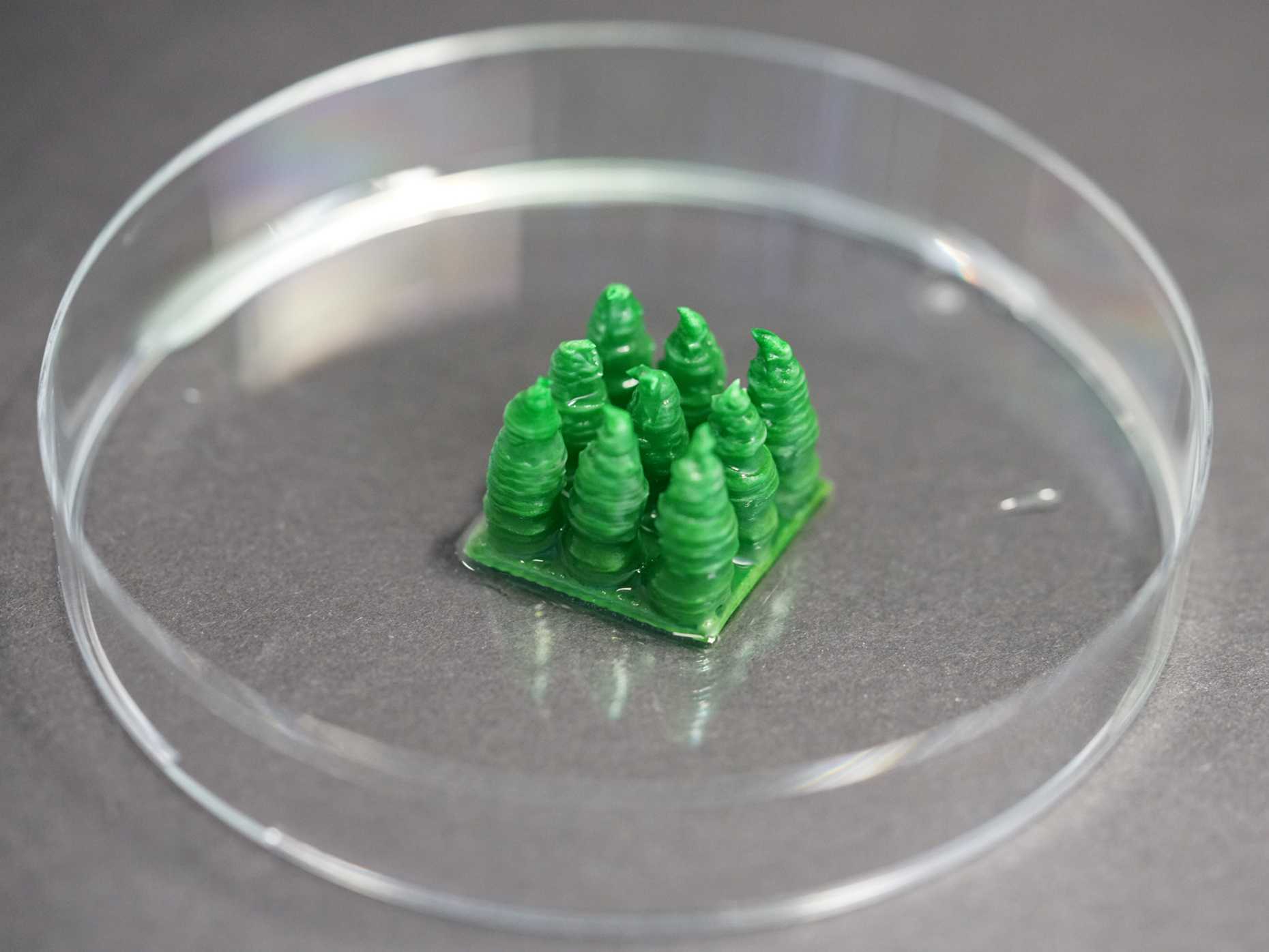
    The construction sector is considered one of the biggest sources of CO₂ emissions worldwide. Researchers at ETH Zurich are now pursuing a radically different approach. They have developed a living, organic building material that actively binds carbon dioxide from the atmosphere during its lifetime. Inside this material live cyanobacteria, also known as blue-green algae, which produce biomass via photosynthesis and also form carbon-containing minerals.

    The innovation combines biology, material science and 3D printing to create a promising concept for climate-neutral construction. The material is not only functional, but also structurally customisable. It can be moulded into freely selectable shapes, is lightweight and only requires sunlight, CO₂ and artificial seawater to grow.

    3D printing with photosynthesis in the system
    The project is led by Mark Tibbitt, Professor of Macromolecular Engineering at ETH. Together with his interdisciplinary team, he has succeeded in developing a hydrogel that stably coats the sensitive cyanobacteria and makes them printable at the same time. The result is a biologically active system that is architecturally mouldable and at the same time continuously binds CO₂.

    The double binding effect is remarkable. The material stores carbon both in the growing biomass of the bacteria and in the form of stable minerals. This creates a permanent carbon store that can potentially significantly reduce the carbon footprint of buildings.

    From the laboratory to the built environment
    The researchers see the primary area of application in the future in the building sector, for example as a façade coating. In contrast to conventional building materials, which cause emissions, this material could absorb CO₂ throughout its entire life cycle.

    Its implementation in architectural formats has already been tested at renowned platforms such as the Venice Biennale and the Triennale in Milan. The experience gained there shows that the concept can prove itself not only in the laboratory, but also in an architectural context.

    Potential for urban cycles
    The material is more than just an ecological experiment. It could become part of future urban material cycles. By not only housing users, but also serving as biological CO₂ sinks, buildings open up a new chapter in climate-conscious architecture.

    The ETH researchers’ findings have been published in the journal Nature Communications. An indication of the scientific relevance and level of innovation of the development. Now it is time to take the next steps towards scalability and long-term stability.
  • Solar facade combines energy generation with architecture

    Solar facade combines energy generation with architecture

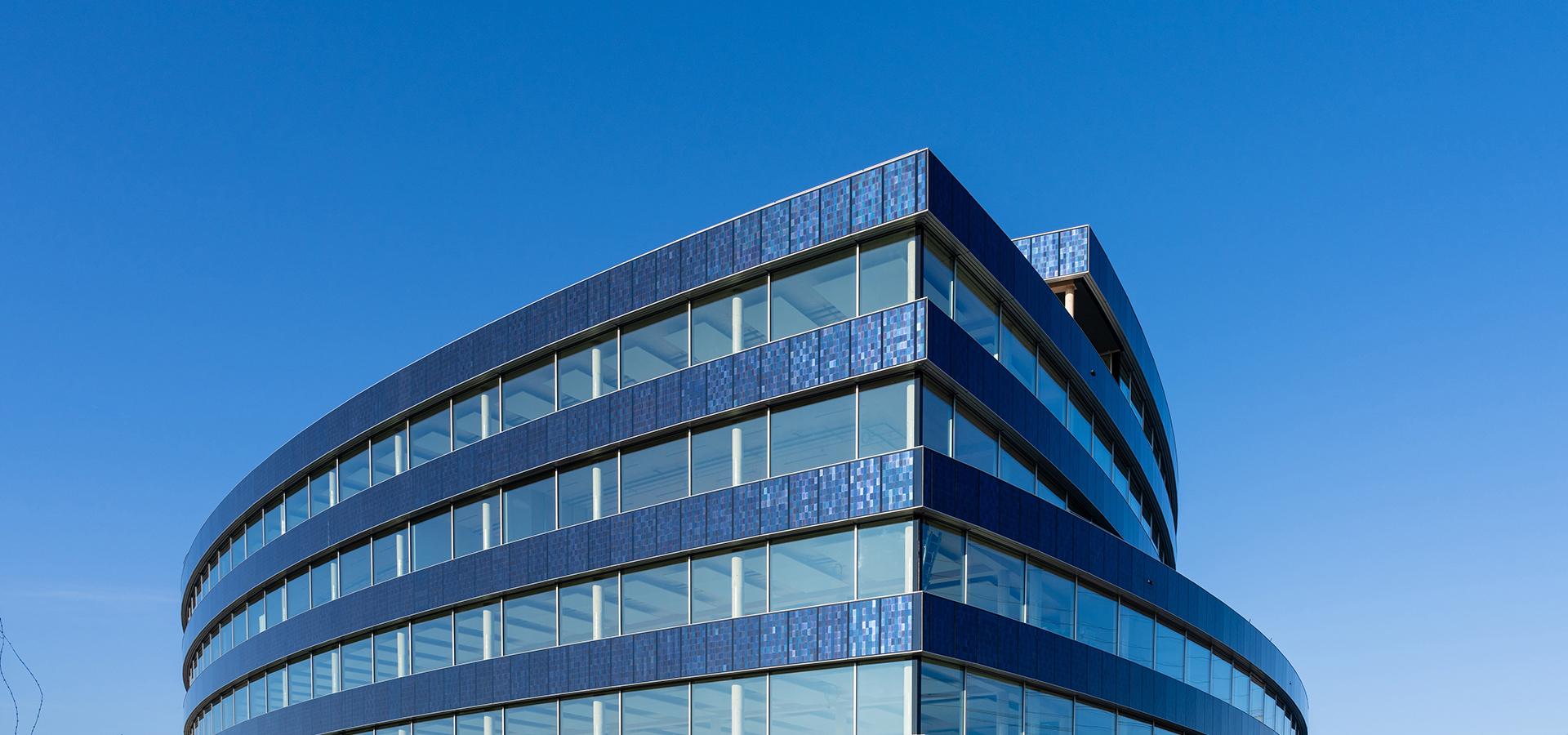
    Megasol Energie has developed the photovoltaic solution for the Bern 131 project, according to a press release . The 1605 customised modules shimmer blue thanks to the coloured rear glass, which is aligned with the sun. The front glass is transparent. Megasol developed the modules in collaboration with the Bern-based architecture firm Atelier 5, which designed the building.

    Megasol also supplied 468 standardised M450 modules for the roof area. The entire system has an output of 504 kilowatt peak. This will generate around 341,238 kilowatt hours of electricity per year. This corresponds to 88 per cent self-sufficiency for the building.

    Bern 131 at Stauffacherstrasse 131 was built by Atelier 5 as a hybrid of steel and wood. The wood comes 98 per cent from the canton of Bern. The building is SNBS Gold-certified.

    Florian Lünstedt, architect and partner at Atelier 5, praises the collaboration with Megasol. “The façade is not only an important architectural element that characterises the building, but also a functional component for energy generation,” he is quoted as saying in the press release. “The joint development of the PV modules with Megasol has made it possible to combine both aspects at a high level.”

  • Parlament einigt sich bei Solarpflicht für Gebäude

    Parlament einigt sich bei Solarpflicht für Gebäude

    Der Nationalrat entschied am Montag wie der Ständerat, auf Antrag einer Minderheit bei der Bereinigung des Energie-Mantelerlasses. Die Mehrheit der Kommission für Umwelt, Raumplanung und Energie (Urek-N) hatte indes auf der generellen Solarpflicht für Dächer und Fassaden bestanden, unterlag aber knapp.

    Energieminister Albert Rösti hatte vor dieser Formulierung gewarnt und gemahnt, die Vorlage mehrheitsfähig zu halten. Noch nicht einig sind sich die Räte bei der Solarpflicht für Parkplätze. Der Nationalrat will sie für grosse Flächen, der Ständerat nicht. Er hat nun wieder das Wort zur Vorlage.

  • Catalog recommends materials against urban heat islands

    Catalog recommends materials against urban heat islands

    The federal government has presented a reference work for new buildings and buildings to be renovated that shows the effect of building materials on the heat in urban and densely populated areas. It was created by the University of Applied Sciences Northwestern Switzerland on behalf of the Federal Office for Housing ( BWO ).

    According to a media release by the BWO, the catalog compares materials for outdoor use such as floor coverings and facades and explains their effect on the outside temperature. It also takes into account other properties of the materials, such as how they reflect sunlight or how much water floor coverings allow to seep away.

    The BWO calls on planners, developers and house owners to consult this material catalog when choosing suitable materials. In addition, the Office invites the scientific community to further develop and research the topic. Because according to the latest climate scenarios, the average temperatures in Switzerland will be 2.5 to 4.5 degrees higher by 2060 than in the period from 1981 to 2010. This means that the buildings that are being built or renovated today will be the microclimate of tomorrow shape.

  • New ecological design options with Stoneface natural stone brick look

    New ecological design options with Stoneface natural stone brick look

    With our bonded and patented compact facade system STONE-FACE (www.stoneface.ch), we not only have great references, but also a wonderful wealth of experience with many satisfied builders.

    It has been shown in the past that facades with a stone look (i.e. so-called brick slips) with naturally split surfaces are very popular. We have many beautiful references in the Swiss gneisses Onsernone (www.onsernone.com) Valser or San Bernardino (www.schweizernatursteine.ch) and of course also in our own Rooterberger sandstone (www.rooterberger.ch), which is right on our doorstep in Root is removed. But also the mud-colored Pietra Piasentina from the Julian Pre-Alps in the Friuli (IT) region makes hearts beat faster. The gneiss Montaigut from neighboring France shines with its warm color and natural elegance.

    Since the ecological aspect is becoming more and more important in today’s construction, the above Swiss rocks in particular fulfill this advantage in a perfect manner, because the material used is only between 12 and 20 mm thick and the transport distances are negligible. In addition, the naturally hand-split surface has the least amount of embodied energy, which a special study on the occasion of the 2000-watt society as an energy and climate policy concept for the city of Zurich has shown.

    In order to further increase the design options for architects, planners and builders, we have included additional specially thin-cut bricks from the border region with Italy in our delivery program under the “SASSOMANIA” label. These are not only perfectly suited as a STONEFACE facade, but can also be used as decoration in the interior, in wine cellar construction and, of course, in the garden area for cladding. A first new building in Buochs NW has already been successfully embellished with our Stoneface compact façade system.

    Façade renovation with stoneface: from run-of-the-mill property to beautiful rock resort, Widen.
    Before and after comparison with a stoneface renovation with Vals quartzite, Lucerne.
  • The renovation of the Baden district building is about to be completed

    The renovation of the Baden district building is about to be completed

    The district building in Baden has been refurbished since March with ongoing operations. According to the media release, all natural stone and artificial stone components are being restored and the facade base plaster partially replaced. The construction work will be completed in October 2021. Under the project management of the real estate department of the city of Baden as the client, the work is strictly based on the historical model. The construction project is being accompanied by Heiko Dobler, building consultant for the cantonal monument preservation department.

    The model for the renovation of the former schoolhouse, which was built in 1856/57, is the facade of the renovated Ochsen branch in the spa district. In the course of the renovation work, the existing plastic-contaminated plaster was completely milled off and a new lime plaster was applied based on the historical model. The facade was then given a new coat of paint and all 108 wooden windows were replaced. Both the planned construction time and the budget can presumably be adhered to, according to the statement from the city of Baden.

    During the renovation work, two special factors had to be taken into account. On the one hand, there are nesting sites for the protected swifts and alpine swifts. The upper part of the scaffolding was designed accordingly by mid-April. "This meant that suitable nesting sites were available to the birds returning from the south in good time," the city councilor in charge Philippe Ramseier is quoted as saying.

    Furthermore, special security requirements of the canton police and the district prison as tenants of the district building had to be met. For example, a three-meter-high board wall and a barbed wire at the end were installed.