Tag: Fassaden

  • World’s first non-combustible vapour barrier presented

    World’s first non-combustible vapour barrier presented

    Ampack AG, which claims to be the leading provider of sealing solutions for building envelopes in Central Europe, is presenting its new range of non-combustible roof and façade membranes, adhesive tapes and vapour barriers. According to a company statement, the vapour barrier is the first of its kind in the world. The products do not contribute to the fire load and are therefore a fire-safe alternative to conventional class B or E building membranes, which release toxic smoke in the event of a fire.

    The range includes the high-performance Ampatex A primo plus membrane, “the first non-combustible, genuine vapour barrier with an sd value of 50 m” worldwide. According to Ampack AG, the membrane reflects heat, holds insulation securely in the cavity and offers physical moisture protection for the first time.

    With Ampatop A silver plus and Ampatop A black, Ampack is also presenting two roof and façade membranes. According to the company, the silver plus is ideal for rear-ventilated façades and use under photovoltaic systems, while the Ampatop A black is a particularly “stylish” solution for rear-ventilated structures and buildings with energy generation systems. The system-compatible adhesive tapes Ampacoll A Tape silver and Ampacoll A Tape black round off the fire protection products as permanently sealed connections and surface bonding.

    In future, the product range will set new fire protection standards in high-rise buildings, special buildings and ventilated façades, offer planning security for construction stakeholders and send a clear signal for safety in the construction industry.
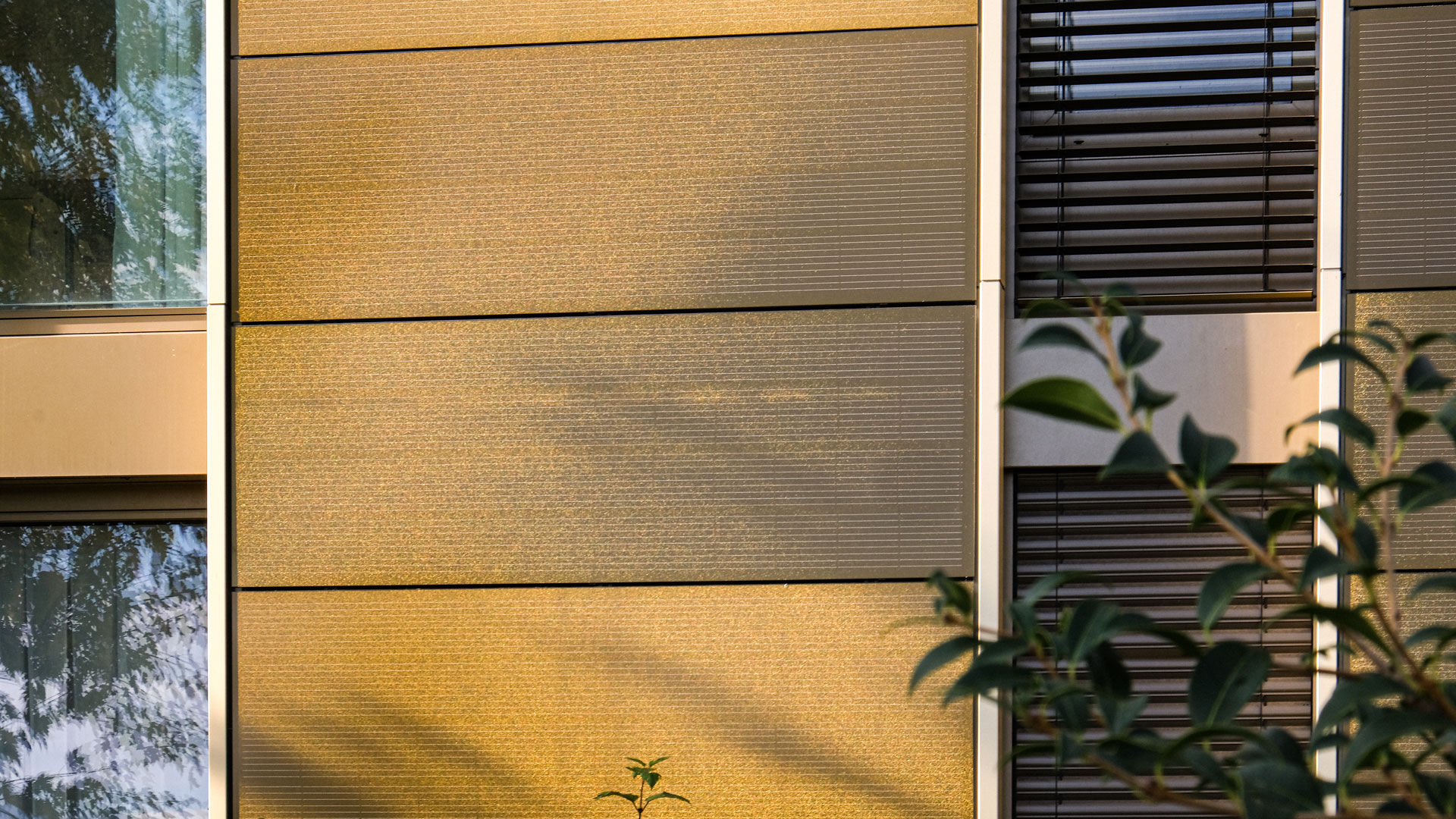
  • Gold-coloured façade modules in Schlieren set new solar standards

    Gold-coloured façade modules in Schlieren set new solar standards

    Megasol Energie AG, based in Deitingen, has launched a new coloured solar module on the market. According to a press release, the modules with their new colour design achieve around 94 percent of the efficiency of conventional black photovoltaic modules.

    The panels under the name SOLARCOLOR Morpho are manufactured for installation as façade elements. For example, they have been installed on two new buildings in the Lacheren area of Schlieren. Depending on the incidence of light, the gold-coloured modules create a lively play of colours, according to the press release.

    The two buildings in Lacheren comprise 36 flats. The roof is also covered with photovoltaic modules and generates peak values of 68 kilowatts with an annual yield of 59,900 kilowatt hours. The façade elements generate peaks of 17 kilowatts and an annual yield of around 16,200 kilowatt hours.

    Megasol Energie AG is one of the five nominated finalists for the Prix SVC Espace Mittelland 2025 sponsored by the Swiss Venture Club (SVC), which will be awarded in Bern on 12 March 2025.

  • Energy generation and cooling: façades at the centre of research

    Energy generation and cooling: façades at the centre of research

    HSLU researchers have explored the potential for greenery and solar panels on building façades in the GreenPV project. “While the benefits of PV systems and greenery are already being increasingly utilised on roofs, they have largely not been used on façades to date,” HSLU researcher Silvia Domingo is quoted as saying in a press release issued by the university about the project. However, they could contribute to closing the gap in winter electricity, among other things. This is because “the energy yield of a PV system is higher on a south-facing façade in the winter months than on a roof due to the low angle of inclination of the sun caused by the season”, explains Domingo.

    In addition to their cooling effect, green façades also contribute to biodiversity and the reduction of sound propagation. Air quality is also improved through the binding of pollutants and the production of oxygen. According to the HSLU researchers, greenery and photovoltaics (PV) can be combined well on façades. “PV comes into its own where a high level of energy generation is possible, i.e. on an unshaded façade on the upper floors,” says Domingo. Greenery, on the other hand, should be installed on the lower storeys and in inner courtyards.

    The authors have identified financing and a lack of guidelines and experience as obstacles for building owners. The appearance of a façade completely clad in black solar panels is also not to everyone’s taste. For this reason, the HSLU has already tested alternative colours and textures in another project.

  • Integration of photovoltaics in building façades

    Integration of photovoltaics in building façades

    The German government has set itself the goal of drastically increasing the share of solar energy in energy consumption by 2030, which is only possible by utilising innovative technologies and tapping into new PV potential. A key element of this strategy is the effective utilisation of building façades for photovoltaics. Despite the obvious benefits, the potential of façade PV has so far remained largely untapped, mainly due to the challenges of cost, complexity and aesthetics.

    To overcome these hurdles, the Center project, funded by the German Federal Ministry for Economic Affairs and Climate Protection and coordinated by the Fraunhofer Institute for Solar Energy Systems ISE, brings together the expertise of leading industrial companies and research centres. The aim is to develop practicable and cost-efficient standard solutions for the integration of photovoltaic systems into building envelopes. This initiative promises to remove the technical and economic barriers that stand in the way of the widespread use of façade PV.

    Successful examples of the integration of PV into building façades, such as the town hall in Freiburg and the OWP 12 office building in Stuttgart, already demonstrate the potential of this technology. These projects demonstrate that PV elements not only contribute to electricity generation, but can also offer other benefits such as sound insulation, weather protection and climate regulation within the buildings.

    The centre aims to deliver ground-breaking results within the next two years and plans to publish its findings in the form of a VDI guideline. This should promote the use of building-integrated photovoltaics and make a significant contribution to achieving the German government’s climate targets. The participation of experts from all areas of the solar industry and the construction sector underlines the holistic approach of the project, which aims to accelerate the solarisation of the building envelope and thus take a decisive step towards a more sustainable future.

  • Geilinger acquisisce la divisione facciate da Ernst Schweizer

    Geilinger acquisisce la divisione facciate da Ernst Schweizer

    Ernst Schweizer AG, con sede a Hedingen, sta vendendo la sua divisione facciate a Geilinger AG con effetto dal 1° gennaio 2024. Secondo l’azienda, Geilinger continuerà a gestire i reparti di vendita, tecnologia, installazione e assistenza come filiale nell’attuale sede di Hedingen. In cambio, assumerà 40 dipendenti di Ernst Schweizer. In futuro, le facciate stesse saranno prodotte presso la sede di Geilinger a Winterthur. “Il core business di Geilinger sono i progetti di facciate”, afferma Harry Bienz, amministratore delegato di Geilinger AG, nella dichiarazione. “Soprattutto nel settore delle facciate solari, Geilinger vuole partecipare alla comprovata esperienza di Ernst Schweizer AG”

    Ernst Schweizer parteciperà quindi a Geilinger come azionista di minoranza in futuro. Samuel Schweizer vede la vendita della business unit come un passo importante per la sua azienda. “L’attività di progetto, estremamente complessa in termini di processi e procedure, troverà una nuova casa in Geilinger, garantendo così la continuità per i clienti e i dipendenti”, ha dichiarato il CEO di Ernst Schweizer AG.

    In futuro, Ernst Schweizer si concentrerà sul business dei prodotti e dei fornitori, in forte crescita. Questo è composto da quattro unità di business. Ernst Schweizer continuerà ad operare come fornitore di sistemi per finestre in legno/metallo e pareti pieghevoli e scorrevoli, come fornitore di cassette per le lettere e per i pacchi e come fornitore di sistemi solari in Europa. L’azienda continuerà a dare lavoro a più di 450 persone.

  • Energy Cluster invites to one-day course on photovoltaic façades

    Energy Cluster invites to one-day course on photovoltaic façades

    The Energy Cluster network based in Bern invites interested parties to a day course on photovoltaic facades (PV facades) at the Lucerne University of Applied Sciences and Arts(HSLU) on 12 September. From 8.30 a.m. to 5 p.m., speakers will shed light on various aspects of house facades for the production of solar energy, according to a media release.

    Accordingly, David Stickelberger, Head of Market and Policy at Swissolar, will discuss the political framework conditions for PV façades from 9 a.m. onwards. From 9.30 a.m., Christoph Wangler, Product Owner PV Systems at 3S Swiss Solar Solutions, will address the question of how sustainable solar modules are.

    From 10.40 a.m., Roger Buser, lecturer in building technology and energy at the HSLU, will discuss the process steps from a rough estimate to the construction project. Pierre-Olivier Cuche, Managing Director at Solarwall, will then talk about the architecture and design of PV façades. From 11.40 a.m. Andreas Haller, Head of Innovation Solar Systems at Ernst Schweizer AG, will talk about implementation planning and installation.

    After the lunch break, the talk will continue with the topic of fire protection in a presentation by Christian Renken, Managing Director of CREnergie GmbH. From 2 p.m. Renken will be devoting himself to the topic of performance and economic efficiency.

    He will be followed by Stefan Gränicher, Project Manager Real Estate Development at Frutiger AG, with his impulse on profitability from the perspective of a real estate developer. Robin Bergamin, Consulting & Sales at Invisia AG, will then talk about energy management and the best possible use of electricity.

    The last lecture of the day is by Sina Büttner, research associate at the Institute for Building Technology and Energy at the Lucerne University of Applied Sciences and Arts, on optimal façade design with solar systems and greening in view of climate change.

  • Switzerland-wide premiere: Fire tests on wall-bound green façade

    Switzerland-wide premiere: Fire tests on wall-bound green façade

    Green facades can contribute to improving the microclimate in the city, support heat regulation in the building and promote biodiversity. However, there is still a large knowledge gap with regard to fire behaviour. In order to close this gap, researchers from the Institute of Timber Construction, Structures and Architecture IHTA at the Bern University of Applied Sciences BFH have carried out two fire tests on wall-mounted green facades.

    The test arrangement consisted of a multi-storey external wall element with two full and two only partially formed storeys. In the lower part of the wall element, the researchers placed a fire chamber that was open to the front. This allowed them to simulate the escape of flames from a window as it occurs after the so-called flash-over – the sudden development of a small fire into a large fire. The tests were carried out on the premises of the Dynamic Test Center of the BFH-TI in Vauffelin as closely as possible to the test specifications for exterior wall cladding systems of the Association of Cantonal Fire Insurers VKF (2016).

    Based on the results, it is possible to evaluate the fire behaviour of wall-bound green façades for buildings of medium height and to optimise the construction of external wall cladding systems for approval. The tests were part of a multi-year research project.

  • Catalog recommends materials against urban heat islands

    Catalog recommends materials against urban heat islands

    The federal government has presented a reference work for new buildings and buildings to be renovated that shows the effect of building materials on the heat in urban and densely populated areas. It was created by the University of Applied Sciences Northwestern Switzerland on behalf of the Federal Office for Housing ( BWO ).

    According to a media release by the BWO, the catalog compares materials for outdoor use such as floor coverings and facades and explains their effect on the outside temperature. It also takes into account other properties of the materials, such as how they reflect sunlight or how much water floor coverings allow to seep away.

    The BWO calls on planners, developers and house owners to consult this material catalog when choosing suitable materials. In addition, the Office invites the scientific community to further develop and research the topic. Because according to the latest climate scenarios, the average temperatures in Switzerland will be 2.5 to 4.5 degrees higher by 2060 than in the period from 1981 to 2010. This means that the buildings that are being built or renovated today will be the microclimate of tomorrow shape.

  • Conflicting goals slow down the expansion of solar energy

    Conflicting goals slow down the expansion of solar energy

    The expansion of domestic solar energy on roofs and facades is currently not progressing fast enough to achieve Switzerland's climate and energy policy goals. Because there is little space in Switzerland for large photovoltaic systems in open spaces, solar energy must also be harvested outside of settlements, write the Swiss Association for Solar Energy, Swissolar , and the Swiss Energy Foundation ( SES ) in a media release of the same name.

    "The greatest potential lies in buildings", David Stickelberger, managing director of Swissolar, is quoted there. "According to sonnendach.ch, 10 percent more electricity per year could be produced on suitable roofs and facades than Switzerland currently consumes." However, in view of the urgent need for action, it is difficult to tap this potential in good time.

    That is why the two organizations, in cooperation with the Zurich University of Applied Sciences ( ZHAW ), shed light on three areas outside of settlements where photovoltaic installations would be possible, but often cannot be implemented due to spatial planning obstacles: on noise barriers, in the agricultural zone and in the alpine area.

    These obstacles have to be removed, warns Felix Nipkow from the SES. That is why his foundation and Swissolar have commissioned the ZHAW to clarify conflicting goals with legal experts with regard to these three installation rooms and to identify solutions. All three reports were published by Dike Verlag . They can be downloaded from SES or ordered in printed form.