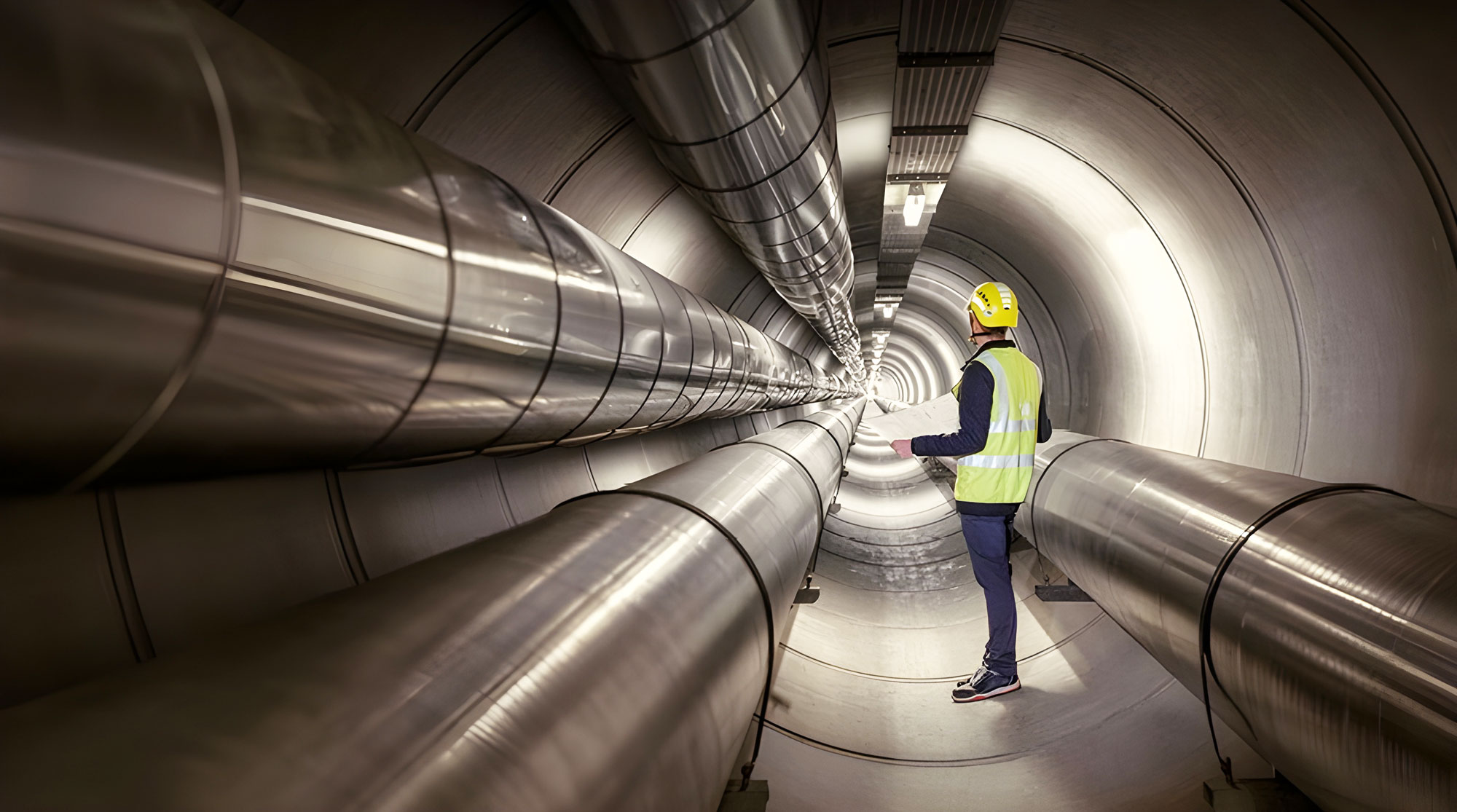
District heating is an important part of Basel’s climate strategy. Over 6,500 households and businesses are now supplied with environmentally friendly heat via 130 kilometers of district heating pipes. This is largely generated by using waste heat from the waste incineration plant and wood-fired power stations, which significantly reduces CO² emissions. By 2037, the network will grow to 180 kilometers and supply a large part of the city. The cycle works efficiently by heating hot water centrally, transporting it to customers, collecting it there and feeding it back into the plants.
Innovative production
A master plan forms the basis for ensuring that only renewable sources and waste heat are used to generate heat from 2035 onwards. IWB is relying on a large heat pump, which will use and label waste heat from wastewater treatment, to meet the increase in heat sales resulting from customer growth.
Decarbonization and coordinated expansion
The political mandate is clear. The canton of Basel-Stadt must become climate-neutral by 2037. IWB is investing over 450 million Swiss francs in the expansion of the district heating network and the associated infrastructure. At the same time, the gas network will be decommissioned in stages. For gas-heated properties, the transition will be planned early and transparently. The owners are informed at least three to four years before the shutdown and can apply for subsidies to replace the heating system. An interim solution can also be used to bridge the gap until district heating is connected.
Planning the network expansion is a logistical and organizational feat. The expansion of district heating is coordinated with road renovations, greening, the renewal of electricity and water pipes and traffic planning measures. In densely populated districts, optimized construction times and efficient work processes are crucial. From planning to implementation, the Department of Construction and Transport, IWB and Basler Verkehrs-Betriebe work in partnership and in close coordination.
Attractive connection solutions for owners
Whether individual, multiple or shared connections, district heating can be obtained according to customer requirements. Cooperative connection models are becoming increasingly important, particularly in Basel’s city center, but also in densely populated districts. In the case of multiple connections, neighboring buildings are connected via house-to-house lines; in the case of community connections, several properties share a central heating station, which saves space and costs. Each property remains technically independent, but benefits from attractive conditions and efficient operation.
Basel as a role model for the urban heat transition
With the ambitious expansion of district heating and the gradual phasing out of fossil fuels, Basel-Stadt is focusing on a climate-friendly heat supply in the urban environment. The combination of renewable production, intelligent grids, coordinated expansion and cooperative connection models makes the transformation a successful example of a sustainable energy policy. For Basel, the region and Switzerland.