Tag: finanzen

  • Zurich Airport has exceeded the canton’s requirements

    Zurich Airport has exceeded the canton’s requirements

    The Zurich cantonal government presented its airport report on 7 December. According to the report, Zurich Airport met the economic and transport requirements in 2022. At CHF 1,024 million, total revenue exceeded CHF 1 billion for the first time since coronavirus, an increase of 50.5 per cent. Costs rose by only 22.9 per cent to CHF 468 million. Profit amounted to 138 million francs, an increase of 149.3 per cent.

    Passenger numbers continued to recover to 23 million, with the government expecting 28 million travellers by 2023. The airport is also doing well in terms of quality: it is ranked 7th globally in terms of accessibility and 8th in terms of quality. According to the presentation by the cantonal government, the number of people affected by aircraft noise fell below the target value of 47,000 at around 43,400. The airport also remained well below 320,000 aircraft movements with 216,000 – 10,000 of which were at night.

    However, the complexity of flight operations remains high, emphasises the government council. Extending the runways, which will be put to the vote in the spring, will reduce the number of intersections in the air and on the ground. This will increase the safety margin, according to a press release on the airport report.

    The cantonal government emphasises the importance of the airport for the location. It is crucial for Switzerland’s international accessibility, an important employer and an economic driver for the canton and Switzerland as a whole.

  • Adaptation strategies for property professionals in a changing world

    Adaptation strategies for property professionals in a changing world

    The effects of the global pandemic are still being felt years later and have led us into a new reality. This requires property investors to re-evaluate their strategies in order to position themselves in a balanced way while remaining disciplined and flexible in responding to changing market conditions.

    The pandemic led to unprecedented, globally synchronised economic shutdowns, followed by a rapid restart. This resulted in a return of inflation, labour market bottlenecks and rising interest rates. At the same time, geopolitical upheavals, including conflicts in oil regions and the emergence of national industrial and environmental policies, are reshaping the global landscape.

    Against this backdrop, property investors should expect subdued growth in the USA, moderate growth in Europe and an adjustment to a new economic normal in China in 2024. These developments favour a focus on quality stocks, including in the technology sector, and a cautious stance towards government bonds as central banks are expected to start cutting interest rates.

    Political developments will also play an important role and could harbour both opportunities and risks for the global markets. Investors should therefore be prepared to adjust their market strategies accordingly and consider capital protection strategies.

    The next decade will be characterised by the ongoing development of artificial intelligence, a changing Chinese economy, the energy transition and persistently high levels of debt. These factors will have a far-reaching impact and offer investors new opportunities, particularly in sectors that benefit from technological innovation.

    In this new world, it is more important than ever for investors to have a clear plan, invest in a balanced way and remain flexible. Lessons from the past emphasise the value of diversification and the importance of patience and adaptability in an ever-changing environment.

  • Zurich is a stronghold of long-term tenants

    Zurich is a stronghold of long-term tenants

    Regulations on the rental property market protect tenants from rent increases. In contrast to the almost 25 per cent increase in asking rents, existing rents have remained relatively unchanged since 2008, explains Zürcher Kantonalbank(ZKB) in a press release. According to the ZHK’s surveys, the city of Zurich is a stronghold of long-term tenants. On average, tenants here have been living in their flat for ten years, with 15 per cent even staying for 20 years.

    “Strict rent regulations make the situation easier for existing tenants, but they also create financial disincentives,” Ursina Kubli, Head of Property Research at ZKB, is quoted as saying. “Tenants stay in their flats even though they are too small, too big or no longer suitable for other reasons.” Kubli proposes better framework conditions for residential construction as a solution: “A growing supply would dampen the increase in asking rents and thus also slow down the further drifting apart of asking and existing rents.” For this year, the experts at ZKB expect asking rents to grow by 3.5 per cent across Switzerland.

    The ZKB experts expect prices for owner-occupied homes to ease slightly. Across Switzerland, price growth should still be 1 per cent this year and 0.5 per cent next year. In the canton of Zurich, growth of 2 per cent is forecast for this year and 1 per cent for next year. “Excessive prices, as we saw during the pandemic, are no longer being paid,” explains Kubli. “The price-performance ratio has to make sense – this applies to both good and bad locations.”

  • Hamilton Bonaduz AG is making targeted investments in its future development

    Hamilton Bonaduz AG is making targeted investments in its future development

    The renowned Domenig Architekten have once again been commissioned to design and realise the project. Construction work is in full swing along the A13 motorway and in the immediate vicinity of the “1.0” building, which went into operation in 2018. The nine-storey building will be connected to the existing complex by a four-storey intermediate wing. The outstanding component of this new building is the 40 metre high-bay warehouse, which offers space for a total of 12,000 Euro pallets. The existing fully automated, rail-guided transport system will be expanded and the intralogistics will be seamlessly linked to the existing systems of building “1.0”.

    The modern appearance of this high-tech building is characterised by intelligent glass with an electrochromic coating. This glass, together with metal and photovoltaic panels, emphasises the vision of the Hamilton brand. The innovative glass façade darkens independently when exposed to direct or indirect sunlight and only allows 1% of the light energy to pass through when completely darkened. In order to generate and utilise electricity independently, a total of 5,400 m² of photovoltaic panels are installed on the roof and façade. In addition, heat energy and moisture from the ventilation system are recovered by a heat exchanger. The modern energy concept is rounded off by the use of a groundwater heat pump, which is operated by a heating network in Domat/Ems. The building will receive the coveted Minergie A certification.

    In keeping with the “Hamilton 1.0” project, the new building is being planned in detail from start to finish with the help of Building Information Modelling (BIM). BIM is a holistic working method for the integrated planning, construction and management of buildings. All relevant data is modelled digitally and all parties involved work synchronously with the same information.

    With “Hamilton 2.0 “, the BIM process is even continued consistently in the implementation phase: For the first time, the digital 3D BIM model is used exclusively, making conventional paper plans on the construction site obsolete.

  • Asking rents on the rise throughout Switzerland

    Asking rents on the rise throughout Switzerland

    The monthly rental index compiled by the digital property marketplace Homegate in collaboration with Zürcher Kantonalbank closed at 123.8 points in October. Compared to the previous month, the index rose by 0.4 per cent overall, Homegate reported in a press release. A year-on-year increase of 4 per cent was observed across Switzerland.

    In a year-on-year comparison, rents rose in all cantons, Homegate reports. At 7.5 per cent, they rose the most in Glarus. This was followed by Valais, the two (combined) cantons of Appenzell, Zurich, Schaffhausen and Schwyz with increases of between 6.9 and 5.3 per cent. The eight Swiss cities included in the index also recorded year-on-year increases in asking rents.

    Compared to September, rents rose in most of the cantons and six of the eight cities included in the index. The experts from Immobilienmarktplatz and Kantonalbank only observed a slight decline in asking rents in the cantons of Obwalden, Nidwalden and Schwyz as well as in the cities of Geneva and St.Gallen. Within the cantons, rents rose the most in Glarus, Schaffhausen and Uri. In the cities, the highest increases were observed in Zurich, Geneva, Bern and Lugano.

    Homegate is a division of SMG Swiss Marketplace Group AG. This combines the digital marketplaces of TX Group, Ringier and Mobiliar.

  • Erfolgreiche Bilanz trotz herausforderndem Markt

    Erfolgreiche Bilanz trotz herausforderndem Markt

    In den ersten neun Monaten des Jahres 2023 verzeichnete die Unternehmensgruppe einen Umsatzrückgang von 12,3% auf CHF 2’390 Mio. Der Rückgang ist teilweise auf negative Währungseffekte in Höhe von CHF 119 Mio. zurückzuführen, die durch den erstarkten Schweizer Franken verursacht wurden. In lokalen Währungen betrug der Rückgang 7,9%. Trotz dieser Herausforderungen gelang es, die EBITDA-Marge um 320 Basispunkte auf 31,3% zu steigern und das Gewinnwachstum pro Aktie in lokalen Währungen um 5,2% zu erhöhen.

    Der Nettoumsatz im dritten Quartal belief sich auf CHF 728 Mio., was einem Rückgang von 7,9% im Vergleich zum Vorjahresquartal entspricht. Währungsbereinigt ergab sich eine Abnahme von 4,8%, getrieben durch Volumenrückgänge und einen positiven Preiseffekt von etwa 6%.

    Die europäischen Märkte waren besonders von den schwierigen Bedingungen betroffen, mit einem währungsbereinigten Umsatzrückgang von 9,2% nach neun Monaten. Insbesondere Österreich, Deutschland und Osteuropa verzeichneten zweistellige Rückgänge, während die Region Nahost/Afrika ein Wachstum von 11,5% erzielte.

    Der währungsbereinigte Nettoumsatz sank bei Rohrleitungssystemen um 5,4%, bei Badezimmersystemen um 7,9% und bei Installations- und Spülsystemen um 10,1%.

    Trotz des herausfordernden Marktumfelds gibt es positive Aspekte wie den Bedarf an Renovierungen, den Trend zu höherwertigen Sanitärstandards und das günstige Marktumfeld in Ländern wie Indien und der Golfregion. Die Unternehmensgruppe hat sich für 2023 auf strategische Stabilität und operative Flexibilität fokussiert, um die Herausforderungen zu meistern und das mittelfristige Potenzial nicht zu beeinträchtigen.

    Für das Gesamtjahr 2023 erwartet die Unternehmensleitung einen Rückgang des Nettoumsatzwachstums in lokalen Währungen im mittleren einstelligen Bereich und eine EBITDA-Marge von 29 bis 30%. Die Unternehmensleitung ist überzeugt, dass das Unternehmen aus der aktuellen Marktsituation gestärkt hervorgehen wird. Diese Überzeugung stützt sich auf die stabile Strategie, starke Kundenbeziehungen und die finanzielle Stabilität des Unternehmens.

  • PriceHubble acquires WhenFresh

    PriceHubble acquires WhenFresh

    PriceHubble, according to its own information the European market leader for performance data solutions in the field of real estate and finance, has acquired London-based WhenFresh ltd. Acquired. According to a media release, the wholly owned merger of WhenFresh into PriceHubble’s portfolio will lead to the expansion of its leading market position.

    WhenFresh previously provided data and decision systems to banks, insurers, the public sector and other Big Data users and is a leading specialist in residential property data in the UK. The company provides access to over 200 proprietary, private and public datasets. WhenFresh’s solutions and expertise now enable PriceHubble’s clientele to make faster, more informed and more cost-effective decisions around property risk.

    “PriceHubble has quickly established itself as the leading B2B SaaS provider of real estate performance data solutions for banks, insurance companies and asset managers globally,” Dr Stefan Heitmann, founder and executive chairman of PriceHubble, was quoted as saying in the statement. “Seeing our sixth acquisition successfully completed and our unique capabilities extended into the largest banking and real estate market in Europe and beyond fills us with respect and joy in equal measure. We are exceptionally pleased to welcome the WhenFresh team.”

    WhenFresh Ltd will become a wholly owned subsidiary of PriceHubble UK, led by Mark Cunningham, co-founder and director of WhenFresh. Alan Dean, Co-Founder and Technical Director of WhenFresh, will become Group Innovation Director of PriceHubble.

  • Neue Immobilienfonds-Initiative in der Schweiz

    Neue Immobilienfonds-Initiative in der Schweiz

    Die Avobis Invest AG hat kürzlich den Start ihrer ersten eigenen Immobilienfonds-Initiative, den Avobis Real Estate Funds SICAV, angekündigt. Der Fokus dieses Fonds liegt auf dem Erwerb von hochwertigen Wohnimmobilien in der Schweiz, die für langfristig stabile Erträge sorgen. Ein besonderes Augenmerk wird auf neuwertige Immobilien gelegt, die sowohl modernen Bau- als auch Umweltschutzgesetzen entsprechen. Durch diese strenge Auswahl wird gewährleistet, dass in den nächsten 5 bis 10 Jahren keine zusätzlichen Investitionen für die Immobilien anfallen.

    Das Hauptziel des Avobis Swiss Residential Fund besteht darin, Immobilien zu erwerben, die jünger als acht Jahre sind oder kürzlich renoviert wurden. Diese Immobilien liegen in wirtschaftlich starken Regionen der Schweiz mit solidem Bevölkerungswachstum und guter Anbindung an den öffentlichen Verkehr. Der Hauptinvestitionsfokus liegt auf Wohngebäuden in den wirtschaftlichen Zentren der Schweiz, ausgenommen Tessin und Genf.

    In Bezug auf das Finanzziel plant der Fonds, innerhalb von fünf Jahren ein Volumen von rund CHF 500 Millionen zu erreichen. Mit der starken Unterstützung der Avobis Group AG, die über ein umfangreiches Netzwerk und ein erfahrenes Management-Team verfügt, sind die Chancen hoch, dieses Ziel zu erreichen.

    Interessenten sollten beachten, dass die Zeichnungsfrist für den Fonds vom 30. Oktober 2023 bis zum 24. November 2023 läuft. Dabei wird ein Emissionsvolumen von CHF 50 Millionen angestrebt, wobei die Ausschüttungen voraussichtlich mehr als 3% betragen werden. Die Fondsführung obliegt der PvB Pernet von Ballmoos AG, während die Avobis Invest AG das Asset Management und den Vertrieb übernimmt. Als Depotbank wurde die Banque Cantonale Vaudoise ausgewählt.

    Es ist zu betonen, dass der Avobis Swiss Residential Fund sich speziell an qualifizierte Anleger in der Schweiz richtet und keine Börsennotierung des Anlagevehikels vorgesehen ist.

  • Study on the role of spatial planning in rising housing costs

    Study on the role of spatial planning in rising housing costs

    The study “Causes of rising housing costs in Switzerland with a focus on spatial planning” makes it clear that spatial planning plays a moderating role in the real estate market: it has an impact on construction activity and thus influences housing costs. The increase in demand for housing, on the other hand, is a driving factor in rising housing costs. Among other things, the downsizing of households, population growth and rising individual housing consumption play a role here.

    Spatial planning can have an influence here. It limits the availability of building land and zoning capacities. In this way, it controls how flexibly the supply of housing can adapt to changing demand. If spatial planning is too strict, the supply can react less flexibly to the strong increase in demand. This can lead to higher housing costs in the long run.

    Internal development as a solution

    However, one of the tasks of spatial planning is to limit urban sprawl and protect the landscape. The study identifies inner development as an instrument that allows both the protection of the landscape and an increase in the supply of housing. The study also shows that rezonings have a price-dampening effect in areas where the utilisation of building zones is already high. Upzoning is defined as the expansion of possible uses within a building zone. This is therefore an effective means and, if used in a targeted manner, can have an optimal effect. The study results also suggest a connection between high housing costs and high planning and process costs. Lengthy approval and objection procedures also contribute to increased costs.

    Conference on housing and spatial development

    As part of the Swiss Housing Days 2023, which will take place from 3 to 7 November 2023 in Biel, a panel of experts will discuss on 6 November how internal development can be shaped so that more affordable housing is created in the process. More details and registration at www.bwo.admin.ch.

  • Admicasa establishes fund management company and launches its own real estate fund

    Admicasa establishes fund management company and launches its own real estate fund

    The management plans to launch another real estate fund by the beginning of 2024. This is aimed at municipalities that are involved in the construction of public facilities such as schools, hospitals and homes and aim to build affordable housing.

    With this step, the Admicasa Group is broadening its horizons: Admicasa develops, realises and manages real estate, with the management segment targeting institutional investors in particular. With the fund management segment, Admicasa is now also targeting a wider circle of investors.

    Beat Langenbach will take over as Chairman of the Board of Directors of Admicasa Fondsleitung AG. The accomplished entrepreneur is the founder of a successful brokerage company and former Chairman of the Admicasa Group.

    Beat Langenbach will be assisted by three high-calibre members of the Board of Directors: Professor Michael Trübestein is head of the Real Estate Management course at the University of Lucerne and holds various directorships in the real estate industry. Thomas Bergmann has many years of experience as an entrepreneur in the real estate industry

    In the real estate industry. And Walter Keller brings two decades of experience in the fund industry, including as Head of Custodian Bank at BNP Paribas.

    With Peter Csoport, Admicasa was able to gain a proven investment and real estate specialist who will lead the operational business of the fund management as CEO.

    The Swiss financial centre now has 53 licensed fund management companies. A majority of these are large banks and insurance companies. The new Admicasa Fondsleitung AG belongs to the exclusive group of medium-sized and independent fund management companies. “Now a broad range of investors can participate in the added value we create in the real estate industry with creative solutions,” says Serge Aerne, Chairman of the Board of Directors of the Admicasa Group. “We want to shake up the market.”

  • CFO change at SF Urban Properties AG

    CFO change at SF Urban Properties AG

    In his role as CFO of the fund management company, Reto Schnabel will in future concentrate fully on the financial management of Swiss Finance & Property Funds AG and its products and mandates.

    Alexander Vögele, Chairman of the Board of Directors of SF Urban Properties AG: “I would like to thank Reto for his valued and conscientious cooperation. With the help of his financial leadership, we were able to further expand a profitable portfolio. With Sascha Küng, we can fill the position ideally and with foresight.”

    Sascha Küng (38) joined Swiss Finance & Property Funds AG as Finance Manager in March 2021. He is a qualified auditor, holds an MSc in business informatics and a CAS in real estate valuation

  • Waste incineration plant in Turgi to be renovated at a cost of 325 million Swiss francs

    Waste incineration plant in Turgi to be renovated at a cost of 325 million Swiss francs

    After 50 years of operation, the waste incineration plant in Turgi is to be renovated. According to a press release, the board of directors will propose a project credit of CHF 17 million at the next general meeting on 27 September. The total cost of the renovation is estimated at 325 million francs. According to the information, the necessity of a renewal is also reflected in increasing expenses for repairs and maintenance.

    After a planning phase lasting several years, construction is not expected to begin until 2028. The new MWIP could then go into operation in 2033. The last renovation work on the plant was carried out in the 1990s.

    In addition to the invitation to the general meeting, the MWIP has posteda collection of documents on its website, including the feasibility study for the projectand the detailed proposal by President Philippe Ramseier for the project planning loan.

    According to these documents, the management and board of the MWIP have been working on the renewal of the outdated facilities since 2015. Cooperation with the neighbouring plants in Buchs AG and Dietikon ZH was examined. However, both rejected this. After the feasibility study of 2022, the MWIP board decided to locate the new plants on a neighbouring parcel of land belonging to the Abwasserverband Region Baden Wett ingen. This means that operations can continue during the renovation work.

    The waste incineration plant in Turgi processes around 120,000 tonnes of waste per year. A moderate price increase is expected for the district heating generated from this waste because of the renovation costs.

  • Mobiliar invests in heat reduction in Bern neighbourhood

    Mobiliar invests in heat reduction in Bern neighbourhood

    Mobiliar is contributing CHF 450,000 to a climate adaptation and upgrading project in the Breitenrain district of Bern. According to climate measurements by the University of Bern, this neighbourhood is hotter than average. According to a statement by the insurance company, the municipal council has approved a loan of 1.3 million francs for a corresponding redesign of Optingenstrasse. “With Mobiliar’s financial contribution, we can do more on Optingenstrasse than if the city had to finance the project alone,” municipal councillor Marieke Kruit is quoted as saying.

    The plan is to plant 20 trees to combat heat accumulation and to unseal street and parking areas so that rainwater can seep away and cool the air through evaporation. To further enhance the neighbourhood, green or marl areas are to be created with bicycle stands or seating. The city is carrying out these climate adaptations as part of the renovation work of the energy supplier Energie Wasser Bern, which is planned for 2024 anyway.

    “Our approach to natural hazards is not limited to paying for damage – we are also increasingly involved in prevention,” Thomas Trachsler of Mobiliar is quoted as saying. Belinda Walther Weger, Head of Public Affairs & Sustainability at the insurance company, emphasises that sponge city projects go beyond mere hazard prevention: “They help to ensure that the quality of life in densely populated areas remains high.” For this reason, Mobiliar from the cooperative will participate in further sponge city projects in Swiss cities as part of its support for climate protection projects. “With our commitment, we want to make an important contribution to a sustainable and positive future.”

  • Venture Kick supports Borobotics with 150,000 Swiss francs

    Venture Kick supports Borobotics with 150,000 Swiss francs

    Borobotics from Winterthur has received 150,000 Swiss francs from Venture Kick for the further development of its innovative drilling robot after reaching the third stage of the programme. In response to the problem of the previously energy-intensive and expensive drilling of holes for geothermal probes, Borobotics is revolutionising geothermal heating processes with a drilling robot that can work in up to 90 per cent less space and at significantly lower cost, according to a media release.

    In addition to the high costs and large space requirements, previous methods bring disadvantages such as energy intensity, inaccuracy, noise pollution and landscape destruction, according to the release. Borobotics describes its development as “an earthworm-like robot that moves vertically into the earth” without a rig or drill pipe. It is intended to enable a much wider spread of geothermal heating.

    Borobotics emerged from a research project at the Zurich University of Applied Sciences, according to the release. The start-up wants to invest the 150,000 Swiss francs in several drilling tests of its robot in order to be able to present a functioning prototype at the geothermal energy trade fair GeoTHERM 2024 in Offenburg during demonstration drillings on 29 February and 1 March 2024.

  • Einschätzung des Zinsmarktes durch Avobis

    Einschätzung des Zinsmarktes durch Avobis

    Die aktuellen Daten zur Inflation zeigen eine Kerninflation von 1,50%, was als positives Zeichen gesehen wird. Miet- und Energiekosten tragen wesentlich zu den jüngsten monatlichen Anstiegen bei, wobei Mieten sowohl im Quartals- als auch im Jahresvergleich gestiegen sind. Zukünftige Auswirkungen von Mietpreisanpassungen, die durch den im Juni 2023 aktualisierten hypothekarischen Referenzzinssatz verursacht wurden, werden ab November sichtbar sein.

    Das Bundesamt für Wohnungswesen hat bestätigt, dass der Referenzzinssatz im September bei 1,50% bleibt. Dennoch könnte eine Erhöhung des Durchschnittszinssatzes auf über 1,625% im Dezember zu weiteren Mietpreisanstiegen und damit zu Inflationsspitzen im kommenden Jahr führen.

    Die verzögerten Auswirkungen der Geldpolitik werden zunehmend spürbar, insbesondere auf dem Arbeitsmarkt der Schweiz, wo die Arbeitslosigkeit allmählich ansteigt und die Zahl der offenen Stellen abnimmt.

    Die Quartalsdaten für das zweite Quartal zeigen im Vergleich zum starken ersten Quartal (+0,90%) nur ein geringes Wachstum von 0,02%. Die SECO erwartet dennoch ein positives Wirtschaftswachstum für das Jahr 2023 und einen kontinuierlichen Rückgang der Inflation. Diese Trends untermauern die Erwartung, dass keine weiteren Zinsanpassungen durch die SNB erforderlich sind.

    Die Swapkurve hat sich im Vergleich zum letzten Monat abgeflacht und zeigt weiterhin eine gewölbte Struktur. Die kurzfristigen Swapsätze deuten auf eine geringe Chance für eine Zinserhöhung im September hin.

    Prognose von Avobis
    Es erscheint sehr wahrscheinlich, dass die SNB den Leitzins in der kommenden Sitzung am 21. September unverändert lassen wird. Der Einfluss von Mietpreissteigerungen auf die Inflation bleibt eine Variable, die genau beobachtet werden sollte. Falls bis zum Jahresende keine besorgniserregenden Inflationsanstiege festgestellt werden, könnte die Zinskurve eine inverse Struktur annehmen.

  • ZKB modernises network of locations

    ZKB modernises network of locations

    ZKB plans to invest a three-digit million amount in the modernisation of its network of locations over the next few years. “The physical presence on site and the proximity to our clientele is part of our DNA,” Steve Zurschmitten, Project Manager Sales and Market Area Manager Winterthur in Private Banking at ZKB, is quoted as saying in a statement from the bank. “That’s why we are also relying on the densest location network in the canton in the long term and are redesigning all of our 51 branches along a newly developed location concept.”

    At the centre of the new concept is personal advice for private individuals and companies on important events. For everyday business, the branches offer digital self-service support. At some locations, the establishment of a so-called event zone is planned for events on topics such as owning a home or starting a business. Seminars on how to use the Twint payment solution, eBanking or mobile banking are intended to make it easier to get started with the digital implementation of banking transactions. Starting next year, all branches are to be converted by 2030.

    The ZKB informs that the findings from the two pilot branches in Stettbach and Winterthur have been incorporated into the development of the location concept. Here, the cantonal bank evaluated which services will continue to be in demand in branches in the future and which will be shifted to the digital world. “By creating a new, contemporary offering with inviting meeting and advisory opportunities on site, we want to remain locally anchored and close to our customers and the population,” explains Zurschmitten.

  • Supply rents rise

    Supply rents rise

    The monthly rental index compiled by the digital real estate marketplace Homegate in cooperation with Zürcher Kantonalbank closed at 122.4 points in July. Compared to the previous month, the index increased by 0.6 points or 0.5 percent, SMG Swiss Marketplace Group AG informed in a press release. Compared to the previous year, asking rents rose by 4 per cent across Switzerland. There is a pause in the increase in the canton and city of Zurich. However, both show increases compared to the previous year.

    In July, asking rents rose the most in the cantons of Basel-Stadt, St.Gallen and Vaud, by 0.8 per cent each. There was no increase of more than 1 per cent in any canton. Asking rents in the canton of Zurich were below the national figure with an increase of 0.2 per cent.

    Only six cantons showed a decrease in asking rents, led by the cantons of Schwyz (1.9 per cent) and Graubünden (1.3 per cent). Compared to the previous year, however, asking rents have risen across the board, including in Zurich by 6.1 per cent. And the canton of Schwyz also shows a clear increase over the last year (6.4 per cent).

    The Swiss cities surveyed show that asking rents for the city of Zurich did not change in July. Nevertheless, they have risen significantly by 10.1 per cent compared to the previous year. The other cities also show increases in asking rents of between 2.2 per cent in Lucerne and 7.8 per cent in Lugano compared to July 2022. In July, asking rents rose everywhere except in the city of Zurich, with the largest increases in Lucerne (1.7 per cent) and St.Gallen (1.2 per cent).

    The next Homegate rent index is expected to be published on 14 September.

  • Energiedienst Group grows profitably

    Energiedienst Group grows profitably

    Energiedienst Holding AG generated operating income of CHF 973 million in the first half of 2023. In a year-on-year comparison, this corresponds to growth of around 30 per cent, the Swiss-German public limited company informs in a statement. Positive sales development and increased electricity prices are cited there as the background for the positive development.

    At 81.6 million euros, the operating result at EBIT level was close to the previous year’s figure. In the first half of 2022, the company had recorded a positive valuation effect from the personnel provision in the amount of 48 million euros here. Adjusted for this effect, an increase of 34.3 million euros to 77.3 million euros was realised, writes the Energiedienst Group. The net profit of 68.7 million euros was 16.8 million euros lower than in the previous year. For the year as a whole, the company expects an adjusted EBIT of around 100 million euros.

    All of the Group’s business areas contributed to the increase in turnover and adjusted operating profit. In the Customer-Oriented Energy Solutions segment, the contribution to EBIT was 1.4 million euros higher than in the previous year at 3.4 million. The end customer business of photovoltaics in Switzerland proved to be the main growth driver here.

    In the largest business division, Renewable Generation Infrastructure, the contribution to EBIT increased from CHF 21.4 million to CHF 65.4 million. Here, the Group attributes the good development to an overall improvement in electricity production from hydropower and the increased marketing level of generation.

  • Holcim looks back on an excellent half year

    Holcim looks back on an excellent half year

    Holcim generated sales of CHF 13.07 billion in the first half of 2023, the globally active Zug-based building materials group informed in a statement. This corresponds to a year-on-year decline of 11.0 percent. On an organic basis, growth of 7.4 percent was achieved, Holcim writes.

    Holcim reported a recurring operating result at EBIT level of CHF 2.04 billion for the reporting period. In the same period of the previous year, the figure was CHF 2.17 billion. The organic growth is put at 13.4 percent in the statement. The margin on operating profit increased by 0.8 percentage points year-on-year to 15.6 per cent. In the second quarter of 2023, a margin of 21.1 per cent was realised. Earnings per share increased by 15.3 per cent year-on-year to a record 2.19 Swiss francs. The company describes the first-half results as “outstanding”.

    “We are on track to achieve industry-leading margins in the 2023 financial year,” Jan Jenisch, Holcim’s chairman and CEO, was quoted as saying in the statement. “This confirms Holcim’s strong position in all markets where our leading sustainable construction solutions and brands deliver above-average profitability and growth.”

    In the half year under review, Holcim invested CHF 1.8 billion in 18 acquisitions. In addition, the company continued its expansion in the North American market, the statement said. According to it, Holcim has already been awarded more than 70 infrastructure projects in the US for the period 2023 to 2026.

  • Pension funds: Out of bounds with real estate

    Pension funds: Out of bounds with real estate

    Everything is relative: for pension fund managers, the quote attributed to Nobel Prize winner Albert Einstein may have a special ring at the moment. Their investments in shares and bonds have lost a lot of value in the past year. Positions in real estate, on the other hand, suffered less. As a result, these have – relatively speaking – often gained significantly in weight in the investment portfolio of the pension funds. This has not only theoretical but also tangible consequences.

    At the end of last year, market observers warned that a quarter of the pension funds in Switzerland would have to sell or devalue real estate investments because their weight exceeded the requirements of the Ordinance on Retirement, Survivors’ and Disability Pension Plans (BVV2). The ordinances prescribe a fixed quota for real estate investments that may not exceed 30 per cent.

    “A few pension funds had bandwidth violations
    Heinz Rothacher, CEO of the well-known St.Gallen pension fund consulting firm Complementa, now tells finews.ch that the quota violations at the end of 2022 turned out to be even more extensive than feared. “More than a third of the pension funds have reported a real estate quota of over 30 percent,” says the market expert (see chart below). And he notes, “There are a few pension funds that had a bandwidth violation due to the increase in ratios.”

    In fact, the OOB2 ordinance allows certain bandwidths in the portfolio shares according to which the pension funds can design their investment strategy. But even this leeway has limits. When the edge of the bands is touched, there are therefore two tactics: Sit it out or correct it.

    Maintain quota for now
    The pension funds have apparently opted for the former as a first step. “Since it is a passive violation of the bands, they tolerated it and decided to maintain the existing quota,” Rothacher reports. The same applies to violations of the BVV2 limit of 30 percent, he adds.

    Complementa has asked a good 150 decision-makers in occupational pension schemes specifically about the problem; the CEO therefore knows pretty well in which direction the industry is heading. As of the end of 2022, the real estate ratio averaged 24.1 percent, 3 percentage points higher than the previous year.

    The wait-and-see approach has not worked badly for the pension funds so far. The real estate quota has been reduced again this year due to the positive performance of the stock markets, Rothacher reports. As a result, “the breach of the bandwidths has been partially remedied.”

    Current surveys by Credit Suisse show that the Swiss pension funds generated an average investment return of 3.86 percent by the end of last June; the major bank UBS comes to an average performance after deduction of fees of 3.51 percent in its measurements. This means that the funds have already exceeded the statutory minimum distribution of 1 per cent per year.

    The crux with illiquidity
    Nevertheless, the problem has not disappeared, and the pension funds must be concerned about keeping within the defined bandwidths in the medium term due to their investment strategy. Another sticking point arises: Due to the illiquidity of the asset class – for example, directly held properties or investment foundations – it is difficult to adjust the ratio in the short term.

    Accordingly, the funds have to tackle where liquidity is most likely to be available: in listed real estate investments. As Rothacher from Complementa reports, there is now movement to be seen there. “37 percent of the funds that participated in the survey are planning to reduce listed real estate funds,” explains the financial professional. As many as 11 per cent of the respondents are also thinking about reducing non-listed vessels.

    Redemption fees increased
    As it turns out, the prices of Swiss real estate funds have already fallen sharply in 2022. The relevant SIX Real Estate Funds Broad Index (SWIIT) lost more than 15 percent of its value last year. This year, the counter stagnated. Meanwhile, a lower demand for additional investments is noticeable among the non-listed investment groups, explains Rothacher.

    Various real estate funds have also received significantly fewer commitments than planned for capital increases. “Not long ago, oversubscriptions were the norm,” he recalls.

    The Complementa CEO does not expect major sales of such vehicles. On the other hand, he knows of individual investment groups that have already increased redemption fees this year – also with the reference to wanting to protect existing investors. This can have a deterrent effect on sellers. “The redemption fees for the various investment vehicles vary greatly and can sometimes account for a large part of an annual performance,” Rothacher knows.

    When do appraisers resort to red pencils?
    But even those who stubbornly hold on to their real estate positions may have to let down their guard. This is the case if there are valuation corrections because the real estate appraisers would be forced to raise the discount rates due to further interest rate steps.

    At least on the Swiss market, the current low level of construction activity, immigration and rising rents make such measures appear premature. However, further interest rate hikes by the Swiss National Bank could still lead the appraisers to apply the red pencil.

    Local pension funds often have a pronounced “home bias” in their real estate investments and would probably be sensitive to a decline in valuations.

  • SBV erwartet das Zinserhöhung ein Prozent Umsatz jährlich kostet

    SBV erwartet das Zinserhöhung ein Prozent Umsatz jährlich kostet

    Am 22. Juni 2023 hat die Schweizerische Nationalbank (SNB) den Leitzins auf 1.75 Prozent erhöht. Damit nicht genug, die SNB dürfte den Zins im Laufe des Jahres weiter erhöhen, weil sich die Inflation hartnäckiger hält als bisher angenommen. Die Inflation wird in der nächsten Zeit etwa von den steigenden Wohnungsmietpreisen und höheren Stromkosten getrieben. Sowohl im 2023, aber auch in den nächsten beiden Jahren dürfte die Inflation gemäss der SNB-​eigenen Prognose bei etwas über 2 Prozent liegen, was über dem Zielkorridor der SNB liegt.

    Mittels fünf Schritten sind die Zinsen von -0.75 auf nun 1.75 Prozent gestiegen. Weitere Erhöhungen bis Jahresende sind absehbar. Da sich die Schweizer Konjunktur dieses Jahr abkühlt und die Wirtschaft nur noch schwach wächst, darf die SNB jedoch nicht über das eigentliche Ziel hinausschiessen. Daher sei an dieser Stelle davon ausgegangen, dass der Zins bis zum Jahresende noch zwei Mal um jeweils 0.25 Prozentpunkte angehoben wird. Es wird ausserdem angenommen, dass ab 2024 keine weiteren Schritte folgen, der Zins also mittelfristig bei 2.25 Prozent stabil bleibt.

    Bis zu 1.4% tieferes Umsatzwachstum im Jahr
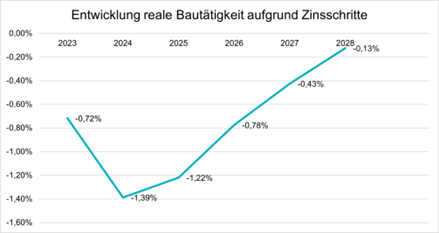
    Ein Rechenmodell des Schweizerischen Baumeisterverbands SBV zeigt, wie stark ein Zinsanstieg die Bautätigkeit negativ beeinflusst. Die Beeinträchtigung dehnt sich langsam und über die Zeit aus. In den ersten beiden Jahren wird das Umsatzwachstum am stärksten beeinträchtigt, aber selbst im fünften Jahr nach den Zinserhöhungen sind noch leichte, negative Auswirkungen spürbar. Die Aussagen beschreiben, wie sich der Umsatz entwickelt im Vergleich zu einer Welt, wenn die Zinsen nicht gestiegen wären.

    In den nächsten fünf Jahren dürfte der Umsatz im Bauhauptgewerbe deswegen kumuliert um 4.65% langsamer wachsen als wenn die Zinsen nicht gestiegen wären. Die grössten realen Umsatzeinbussen sind in den Jahren 2024 (-1.39%) und 2025 (-1.22%) zu erwarten.

    Positive Gegenkräfte könnten Umsatz wachsen lassen
    Die anhaltend starke Zuwanderung, der Nachholbedarf im Tiefbau sowie die Unterstützungsgelder für klimafreundliche Umbauten sind Faktoren, welche den Einbussen durch die Zinsen entgegenstehen und zumindest mittelfristig den Umsatz doch noch positiv wachsen lassen könnten.

    Insgesamt lässt sich also festhalten, dass sich die Leitzinserhöhungen auf den Geschäftsgang der Baufirmen auswirken, auch wenn die Auswirkungen insgesamt begrenzt sind. Das Bauhauptgewerbe bleibt unabhängig vom Zinsniveau eine wichtige Stütze der Schweizer Wirtschaft.

  • Holder wants to combat housing shortage

    Holder wants to combat housing shortage

    Halter AG wants to tackle an emerging housing shortage. The Schlier-based construction and real estate company is committed to sustainable and viable solutions, Halter explains in a press release. To this end, the company has prepared a position paper. Halter also presented the solutions proposed in this paper for discussion at the round table with Federal Councillor Guy Parmelin in May.

    In the position paper, Halter makes a number of demands. For example, additional use in residential zones and residential use in pure workplace zones should be permitted. Half of the additional living space created here must be realised as living space at cost rent. Halter also wants the potential of the cost rent financing model to be better exploited.

    The politicians are called upon to simplify the quality assurance procedure and to limit the digital building permit to use and architecture. Halter expects his own industry to reduce construction costs by increasing productivity.

    “The provision of affordable housing represents a similarly significant social challenge as climate-friendly conversion and new construction,” explains Halter CEO Markus Mettler in the statement. He says his company is ready to make innovative contributions to solving both tasks. “This goes hand in hand with the introduction of sustainable framework conditions for the construction and real estate industry that strengthen entrepreneurship and competitiveness in the sector and counteract the trend towards inefficient and costly regulation and nationalisation.”

  • Real estate fund from Swiss Life Asset Managers generates stable income

    Real estate fund from Swiss Life Asset Managers generates stable income

    The Swiss Life REF (CH) ESG Swiss Properties real estate fund closed the first half of the 2022/23 financial year “with low vacancy rates and stable income”, Swiss Life Asset Managers announced in a statement. Specifically, income of CHF 20.26 million was realised. In addition, there was a capital gain of CHF 3.81 million from the sale of a residential portfolio consisting of five smaller apartment buildings. The rent default rate was reduced from 2.97 to 1.76 per cent compared to the end of March 2022.

    The net asset value rose year-on-year from 112.01 francs to 114.34 francs. The fund currently holds 161 properties with a total value of 2.562 billion francs. At the end of 2022, Swiss Life Asset Managers had acquired 15 properties with a total market value of CHF 242 million.

    Since the fund’s launch in November 2015, Swiss Life REF (CH) ESG Swiss Properties has posted an annualised performance of 6.04%. This means that the price performance and distributions are 2.01 percentage points above the SXI Real Estate Funds TR benchmark index, explains the asset manager, which is part of the Swiss Life Group.

  • “Buy-to-let” A model calculation from the perspective of private investors

    “Buy-to-let” A model calculation from the perspective of private investors

    “Buy-to-let provides Swiss private investors with a way to participate in the real estate market and has enjoyed growing popularity in the wake of the low interest rate environment. The share of rented condominiums and single-family houses accounted for 17.0% of all newly concluded residential property financing in 2019 on a volume-weighted basis. This means that almost every sixth property was purchased with the intention of subsequently renting it out. In most cases, investments are made in condominiums and thus in smaller lot sizes due to the financial assets available.

    The aim of the final thesis was to show private investors the main risks associated with a buy-to-let investment and to establish a relative comparison with alternative capital market investments. To this end, an investment analysis model was developed that looked at the profitability of a 3.5-bedroom condominium from its purchase in 2000 to its sale in 2020. Based on studies in various markets in the Bern area and by means of different sensitivities regarding the use of debt capital, their effects on the profitability ratios were illustrated.

    Result
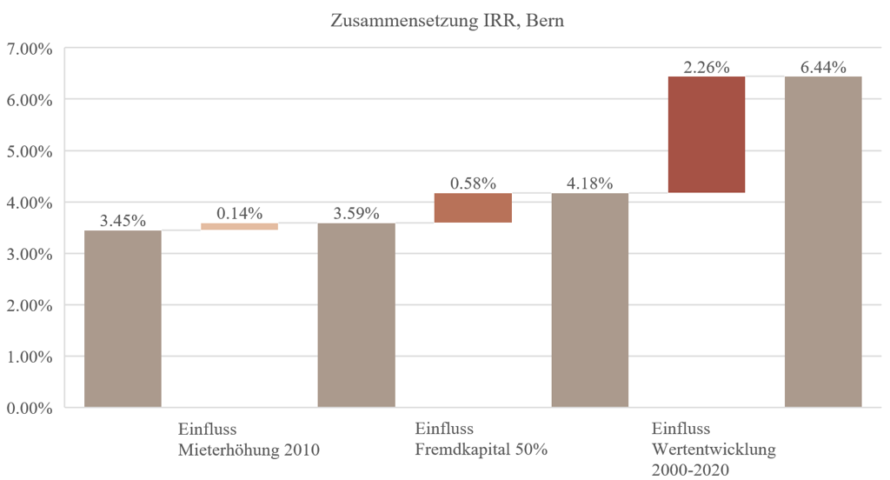
    Risky investment strategy: With regard to the holding phase, it became clear that in particular the choice of the degree of debt financing and the prevailing interest rate level determines the achievable return on equity and at the same time also forms the highest expenditure item. In the first years of the holding period, a high leverage ratio of 75% and an average interest rate of 3.70% resulted in exclusively negative net returns. With regard to the sale of the property, it became apparent that the value development was the most significant determinant for the success of the buy-to-let investment (see Fig. 1). The potentially realisable market value is subject to cyclical fluctuations. Combined with an increased leverage ratio and the associated debt risk in terms of rising interest rates and possible losses in value, these factors constitute the main risk of the buy-to-let investment. If, in addition, a large proportion of the assets is tied up in a single property, this creates a considerable cluster risk, which is further increased by the effect of rising interest rates and losses in value. It is important to note that passing on rising interest rates to the tenant is only possible to a limited extent due to legal restrictions and the sluggishly reacting reference interest rate. In addition, higher interest rates are usually accompanied by rising inflation rates. Since residential rents are usually not fully linked to the consumer price index, inflation leads to a partly real reduction in rental income.

    Fig. 1: Composition of IRR, using the example of the city of Bern.

    The consideration of the different markets – depending on the location of the property – also made it clear that the regional disparities can lead to large differences in the profitability and investment risk of the private investor and represent a further risk for the buy-to-let investment. With regard to the value retention of the property, the private investor should therefore primarily assess the location quality and the property.

    Comparison of capital market investments
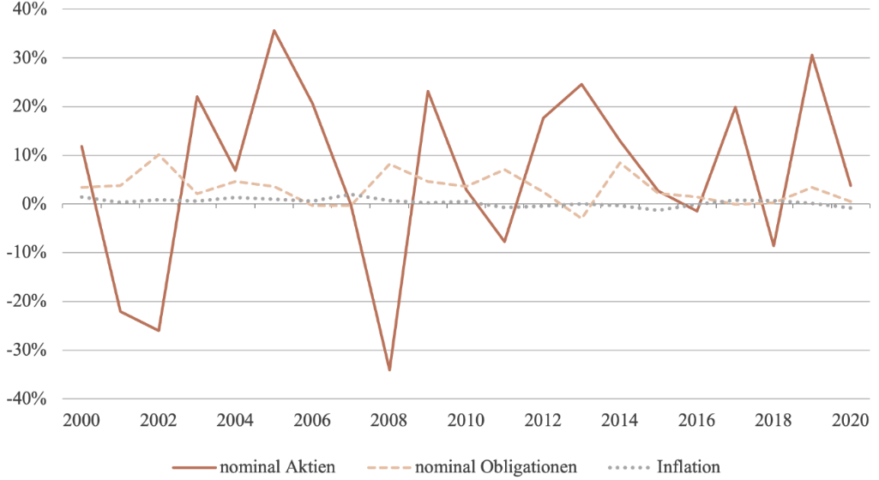
    The comparison with the two asset classes Swiss equities and Swiss government bonds showed that the buy-to-let strategy could certainly represent an attractive alternative (cf. fig. 2+3). It was possible to further improve the return on the property over the period under consideration by using debt capital, but this was accompanied by a significantly higher risk (see Fig. 3). It should also be noted that the risk-return characteristics must be extended to include the variable of liquidity: In a weak economic environment, the sale of a property is only possible under timely circumstances and is usually associated with financial losses.

    Fig. 2: Annual returns on equities and bonds, observation period 2000-2020.

    Conclusion
    The decision for a buy-to-let investment should not be made lightly. A property purchase financed out of a lack of alternative asset classes and low financing costs often does not take into account the risks assumed at the same time. The property must remain effectively affordable in a higher interest rate environment and further capital gains should not be relied upon as an investment strategy. It can be concluded that rental income in particular determines the success or failure of the buy-to-let investment.

    Personal details
    Anissa Kühni, born 1991. Studied architecture at the Bern University of Applied Sciences, graduating in 2016. Master of Advanced Studies UZH in Real Estate, graduating in 2021. From 2016, active at Frutiger AG in project development for various site developments with a focus on “residential” as well as acquisitions. Since 2023 employed as project manager for real estate developments at Swiss Prime Site Solutions AG for the real estate fund “Akara Swiss Diversity Property Fund PK”.

  • Schindler grows in the first quarter

    Schindler grows in the first quarter

    Schindler generated global sales totaling CHF 2.80 billion in the first quarter of 2023. This corresponds to year-on-year growth of 6.2 percent, the Lucerne-based lift manufacturer said in a statement. At 2.89 billion Swiss francs, however, incoming orders were 8.7 per cent lower than in the first quarter of 2022.

    “Delays at construction sites and the uncertainty on the international capital markets are having an increasingly negative impact on the real estate sector, despite strong demand in the residential construction sector,” Silvio Napoli, Chairman of the Board of Directors and CEO of Schindler, is quoted as saying in the release. “Even in this challenging environment, Schindler achieved sales growth in all regions and product lines.”
    The operating result at EBIT level increased year-on-year from CHF 211 million to CHF 282 million. Adjusted for the sale of the former factory site in Suzhou, net profit of CHF 186 million was 29.2% higher than in the same quarter of the previous year.

    In the same press release, Schindler also announced a change in the Group Executive Committee. The newly appointed Chief Technology Officer Donato Carparelli will replace Karl-Heinz Bauer, who is retiring.

    At the end of March, Schindler also won a lawsuit that had been ongoing for almost ten years. The background to the case is the capital increases at Hyundai Elevator, which were carried out against the wishes of shareholder Schindler. The Supreme Court of the Republic of Korea ruled in favour of Schindler in the liability suit against various members of the Board of Directors of Hyundai Elevator, according to the statement.

  • Merger of Credit Suisse and UBS

    Merger of Credit Suisse and UBS

    Credit Suisse and UBS entered into a merger agreement on Sunday under which UBS will be the continuing entity. Following the negotiations that took place over the weekend and led to the signing of the merger agreement, UBS and Credit Suisse have concluded that a merger is in the best interests of their shareholders and stakeholders. The Federal Department of Finance, the Swiss National Bank and FINMA had previously required the two companies to complete this transaction in order to restore the necessary confidence in the stability of the Swiss economy and the Swiss financial centre.

    The merger is subject to the following material conditions:

    • All Credit Suisse shareholders will receive 1 UBS share for 22.48 Credit Suisse shares in exchange for the merger. This exchange ratio corresponds to an acquisition price of CHF 3 billion for all Credit Suisse shares.
    • The merger is subject to customary closing conditions. Both parties are confident that all conditions can be fulfilled. The merger is expected to be completed, if possible, by the end of 2023.
    • The Swiss National Bank will provide Credit Suisse with access to facilities through which it will receive substantial additional liquidity.
    • It is expected that, in order to ensure a smooth integration of Credit Suisse into UBS, UBS will appoint employees to key positions at Credit Suisse as soon as legally possible.
    • Credit Suisse will continue its business as usual and implement its restructuring measures in cooperation with UBS.
    • UBS has expressed confidence that Credit Suisse employees can continue to be employed.

    Credit Suisse was informed on Sunday by FINMA of its decision that Credit Suisse’s Additional Tier 1 capital (arising from the issuance of Tier 1 capital notes) in the aggregate principal amount of approximately CHF 16 billion will be written down to zero.

    Taking into account the special circumstances affecting the Swiss economy as a whole, the Federal Council issues an emergency ordinance tailored to this specific transaction. It should be noted that the merger is being carried out without the otherwise required approval of the shareholders of UBS and Credit Suisse in order to increase transaction security.

    Axel P. Lehmann, Chairman of the Board of Directors of Credit Suisse, said: “The announced merger represents the best possible outcome given the extraordinary and unprecedented circumstances. Credit Suisse has been through an extremely difficult period. Although the team has worked tirelessly to clean up many significant legacy issues and implement the new strategy, today we are forced to adopt a solution that will deliver a sustainable outcome.”

  • Voters approve credit for district heating in Chur

    Voters approve credit for district heating in Chur

    Chur’s energy supplier Energie Wasser Chur(IBC) can massively expand its district heating network. The electorate approved a corresponding municipal proposal by 60.85 per cent. It states that the city will contribute 80 million Swiss francs to the total costs for the expansion of the heating network over a period of twelve years. These costs amount to 314 million francs.

    According to its message to the polls on 12 March, the municipal council supported the proposal with 17 votes in favour and 4 against. Now Chur is supporting the generation project of the IBC, which is an independent institution under public law in the sole ownership of the city, with 60 million francs to increase the endowment capital and in the form of a loan. The city is holding a further CHF 20 million in reserve for any guarantee that may be required.

    In the view of the municipal council, the investment is necessary to ensure the conversion to a renewable heat supply within the city. “At the same time, the loss of the previous added value from the sale of gas can be absorbed and the revenues increased elsewhere,” the message continues. “The money that flows out today for the purchase of oil and gas will remain in the region in the future.”

    According to the information, IBC wants to borrow a total of 160 million Swiss francs from financial institutions. In addition, a contribution of 56 million francs from the federal government and the canton is expected. The company intends to invest 38 million francs of its own funds.

  • Credit Suisse lowers distribution for real estate funds

    Credit Suisse lowers distribution for real estate funds

    Credit Suisse Funds AG expects a reduction in the net asset value of its Credit Suisse Real Estate Fund International (CS REF International). The background to this is developments in the global target markets on which the real estate fund is based, Credit Suisse informs in a statement. Here, rising interest rates in the key markets of the US, UK and Germany have impacted valuations.

    In concrete terms, the fund’s net asset value will fall to between CHF 960 and CHF 970 as of the reporting date at the end of 2022. As at year-end 2021, a net asset value of 1070.72 was recorded. By year-end 2022, Credit Suisse Funds AG has accepted redemption requests amounting to 13.3 percent of the units issued.

    As a result of the expected reduction in the net asset value of 9.5 to 10.5 percent, the major Zurich bank is adjusting the distribution on CS REF International. For 2022, the distribution is to be 35 to 38 francs per unit. In the previous year, 40 francs per unit were distributed.

  • Privately used residential property is becoming more expensive

    Privately used residential property is becoming more expensive

    According to a media release from Raiffeisen Switzerland on the quarterly transaction price index, owner-occupied homes have to dig deeper into their pockets than in the first quarter and also compared to the previous year. Accordingly, the purchase of a condominium increased in price by 3.5 percent in the second quarter. Compared to the same period last year, there was a price increase of 7.7 percent. A single-family house costs 1.3 percent more than in the previous quarter. Year-on-year, prices for this type of property have risen by 8.7 percent.

    According to the Raiffeisen chief economist Martin Neff, who was quoted in the media release, the price dynamic is due to the shortage of supply in the home ownership market. Neither the interest rate hike nor the heightened uncertainties in the reporting period would have changed that.

    In the case of condominiums, the highest increase in prices compared to the previous year was in the Zurich region, where prices rose by 11 percent. In contrast, the Bern region has the lowest rate compared to 2021 at 3.5 percent. 10.6 percent more has to be paid for a condominium in tourist areas.

    The price spiral is also driving up the costs for single-family homes. In the Western Switzerland region, the segment has increased in price by 12.8 percent, in the Northwestern Switzerland region the value is 10.4 percent.

    Broken down by place of residence, there is a pronounced desire for private home ownership in the countryside, where the prices for a single-family house have soared by 12 percent. In city centers, house prices are 8.7 percent higher than last year.

  • Cowa receives 1 million francs from investors

    Cowa receives 1 million francs from investors

    In a first round of financing, Cowa Thermal Solutions AG has received over CHF 1 million from private investors and its own founders Remo Waser and Simon Maranda. According to an article on the startupticker.ch portal, the young company based in Lucerne’s Technopark wants to use the fresh capital to market its heating storage system for heat pumps on a larger scale.

    The cleantech start-up is developing a heating storage system with capsules that contain environmentally friendly salts as a phase change material. A tank filled with the capsules can absorb three times more energy than a conventional water tank for heat pumps. According to the information, this makes a heating system less dependent on mains electricity. In addition, unlike batteries or rechargeable batteries, it does not use lithium.

    The storage tank filled with Cowa capsules has been available from the building technology company Meier Tobler since April of this year. According to startupticker.ch, the additional costs for the Cowa product compared to conventional storage systems are quickly balanced out due to the energy density and longevity of 20 years.

    In addition to further scaling on the domestic market, the company would like to expand to Germany soon. Initial talks with potential sales partners have already taken place.