Tag: Firmen

  • Leading global industry clusters

    Leading global industry clusters

    Over the years, more and more companies from the same industries have settled here, resulting in the formation of various industry clusters, as they are known. This also includes education, research and various platforms such as the Innovation Park or associations, in which a lively exchange takes place. The large number of companies, service providers, suppliers and private institutions provide mutual support and promote a service-orientated and efficient administration. The local companies also benefit from the high educational standards and excellent infrastructure.

    Blockchain, fintech and IT
    Zug has developed into a global hotspot for blockchain, fintech and IT. Here, innovations unfold in a symbiotic ecosystem where pioneering technologies meet and create a wealth of limitless opportunities. Zug has earned recognition for its transparent regulations, crypto-friendly banks and administrations, a dynamic labour market for cryptocurrencies and a varied calendar of events. Due to its proximity to the Zurich region, Zug is developing an attractive ecosystem for around 600 crypto companies in the “Crypto Valley” and is the birthplace of Ethereum. This environment is favoured by a positive regulatory framework, attractive taxes, incubators such as CV VC and a large number of fintech companies. The Canton of Zug supports research in this area financially by contributing almost CHF 40 million to the blockchain research initiative of the University of Applied Sciences and Arts Lucerne and the University of Lucerne.

    Zug’s “Fintech Cluster” embodies a centre of innovation in the field of financial technology. Within the “Crypto Valley”, this cluster acts as a dynamic meeting place for fintech companies, start-ups and financial institutions. Zug is also home to the National Test Centre for Cybersecurity (NTC) as well as various labs and research centres in the fields of blockchain, AI, ML and robotics at HSLU, located in Rotkreuz.

    Life sciences (pharma/biotech and medtech)
    The canton of Zug is a leading location for life sciences with around 300 companies and 9,000 employees. In addition to the strong focus on commercial functions, the medical and clinical areas are also growing. The regional innovative strength is reinforced by other leading clusters in deep tech, AI and ICT, which creates innovative synergies.

    Pharma/biotech
    Zug attracts numerous international pharmaceutical and biotech companies, including Biogen, Amgen, Astra Zeneca and Johnson & Johnson. In addition, around 60 US biotech companies have chosen Zug as their European headquarters in recent years. The high density of pharmaceutical and biotech companies in the canton of Zug and the large number of service providers specialising in life sciences create an advantageous business environment.

    Medtech
    In the medical technology sector, more than 100 companies specialising in diagnostics and medical production are represented with production sites and global headquarters. Representative examples of global headquarters are Roche Diagnostics, Medela, SHL Medical, Schiller and Johnson & Johnson Medtech with important global functions at their international campus in Zug.

    Zug also offers up-and-coming medtech start-ups such as Deep Breath Intelligence, Heart Force and Sedimentum optimal conditions for growth and innovation.

    New SHL Medical AG building
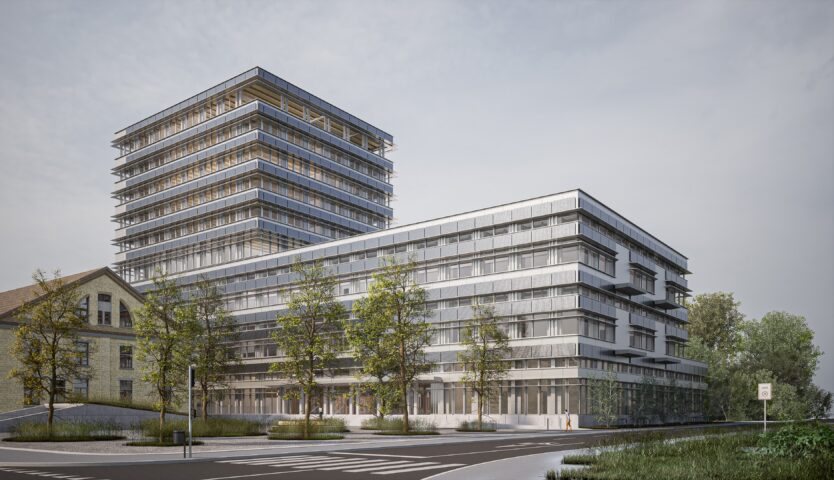
    The 5,000 m² office and 10,500 m² production building for the tenant SHL Medical AG is being built on the Tech Cluster Zug site. The compact design, the reduction in materials and the innovative hybrid construction of wood, steel and concrete promote resource-saving, efficient construction. Visible wood on the inside and a protective aluminium layer on the outside reflect the high quality standards. A 20% reduction in CO2 emissions is made possible by on-site concrete production using Jura Eco cement.

    SHL’s energy supply is designed as part of the site-wide multi-energy hub. The energy supply is supplemented by lake water cooling and large-scale PV systems on roofs and façades. The surplus heat and energy is recovered for further use in the hub.

    New Roche production building

    Roche is investing 215 million in a new 29,000 m² diagnostics production building in Rotkreuz, which will be completed by 2027. The flexible design will allow the building to be adapted to future production needs, thereby increasing long-term efficiency. Sustainability is a top priority: a fossil-free energy supply, water circulation systems and resource-saving construction methods are planned. The surrounding area will be designed to be close to nature, with wet meadows, a fen and a roof garden at a height of 23 metres to promote biodiversity.

    Tech industry
    The tech industry is one of the largest employment sectors in Switzerland. With around 14,000 employees and 750 companies, this sector is also important for the canton of Zug. The focus of the high-tech cluster in Zug is on the development, design and manufacture of electronic products and services. Digitalisation, the Internet of Things (IoT), robotics and artificial intelligence (AI) also play important roles.

    Zug stands out as one of the most dynamically expanding technology centres in Europe. The canton of Zug is home to numerous notable SMEs and start-ups specialising in cutting-edge and pioneering technologies. Their influence extends across various industries as they develop ground-breaking solutions based on emerging technologies. Access to various research and networking institutions such as the University of Applied Sciences (HSLU), the Innovation Park Central Switzerland and the Technology Forum Zug create the ideal framework for innovative, technology-driven companies.

    Siemens Campus
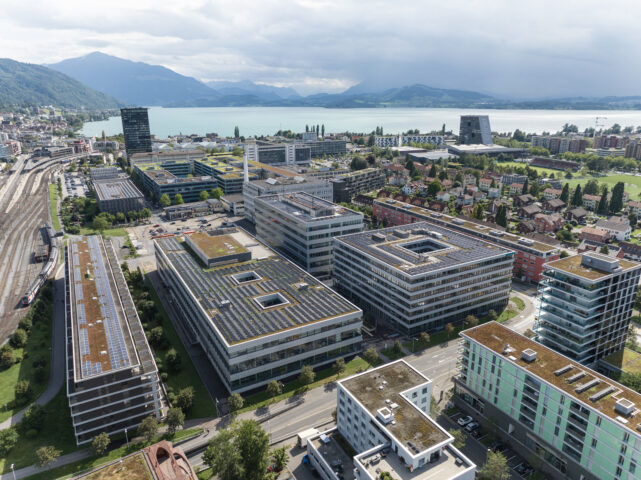
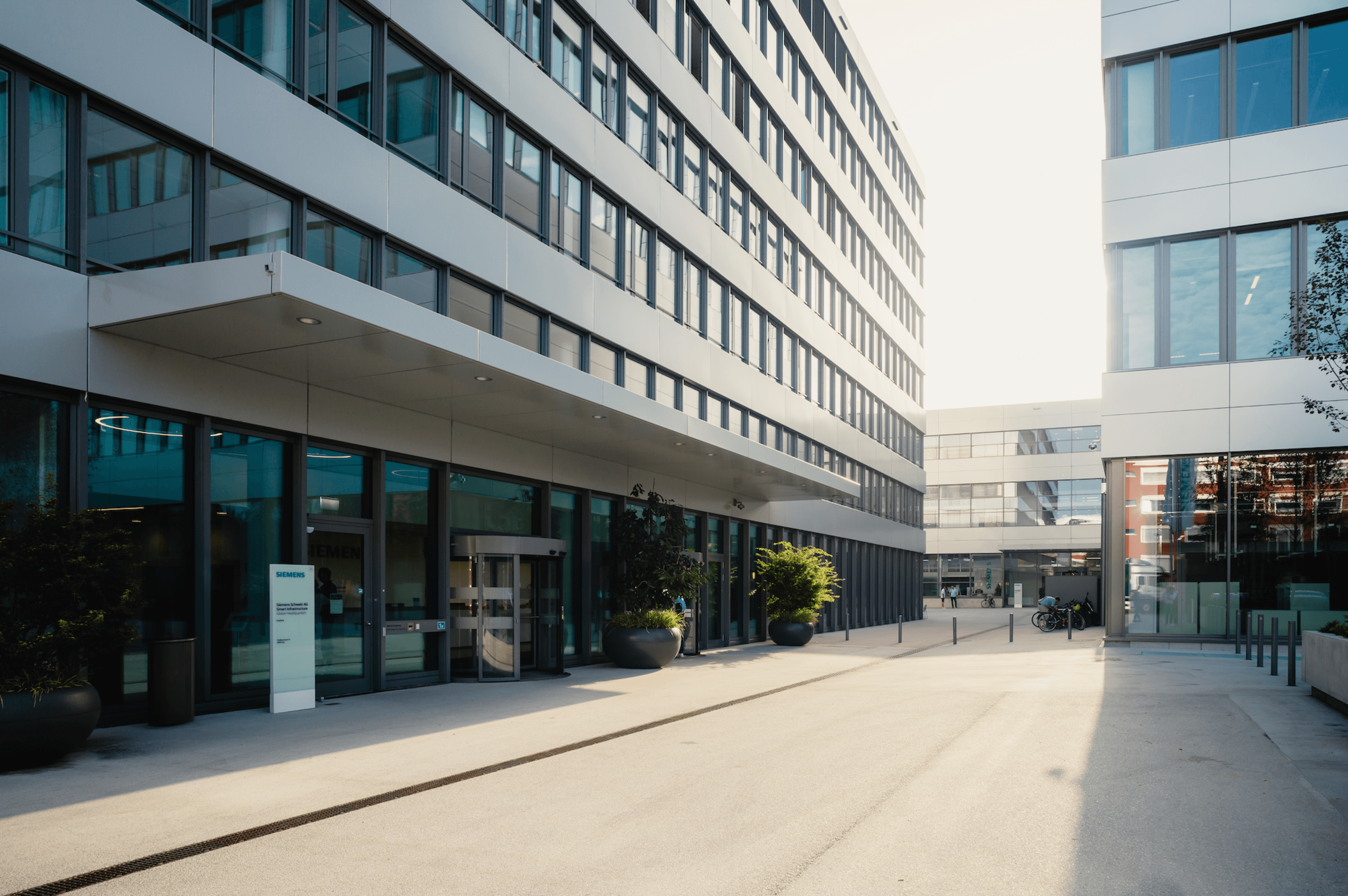
    The 81,000 m2 Siemens Campus Zug is a showcase project for digitalisation and sustainability and demonstrates how modern products and solutions can accelerate the digital transformation. It sets technological standards in every respect and shows how buildings and infrastructures can be developed from static, inactive objects into responsive and reactive objects. The campus combines everything a community needs: Fire protection, access and intrusion control, CCTV, CO detection, extinguishing, voice-controlled evacuation, room automation and much more.

    Financial service providers
    Around 2,000 companies form a dynamic environment for financial services in the canton of Zug. Hundreds of companies from the fields of asset management, family offices and hedge funds are based in the canton of Zug.

    In the private equity/venture capital sector, for example, Partners Group, Capital Dynamics, HBM Healthcare Investments, CAPVIS and Invision should be mentioned. Leading Swiss financial institutions and platforms are also based here, including the Institute of Financial Services Zug IFZ, the Swiss Private Equity and Corporate Finance Association SECA, the Swiss CFO Forum and the VQF, the leading self-regulatory organisation in the non-banking sector.

    New Partners Group Campus

    Partners Group, Switzerland

    Partners Group’s new global headquarters consists of three buildings: the “Green Building”, an elongated, elliptical structure whose variously curved, terraced layers provide a richly planted, forward-looking counter-accent to the two brick buildings, which are modelled on historic factory buildings and evoke the past. This is Partners Group’s way of emphasising its focus as a company builder.

    The building not only impresses with its architecture, but also with its high-quality infrastructure, including an in-house gym, canteen, daycare centre and car park.

    Consumer goods
    The canton of Zug is also home to over 1,700 consumer goods companies with around 14,000 employees, which account for around a third of GDP. Zug is home to international and regional headquarters of leading brands in the areas of food and beverages (e.g. Anheuser-Busch InBev, Burger King, Coca Cola HBC), personal care (e.g. Galderma, Kenvue), textiles (e.g. Odlo, Hugo Boss) and sporting goods (e.g. Specialized). The automotive supply sector and the wholesale of raw materials and pharmaceutical products also play an important role.

    Commodities trading
    Zug is a leading global trading centre for commodities, particularly in the areas of metals, (renewable) energy and agricultural commodities, with over 200 companies (e.g. Glencore, Shell) and specialised professionals. Key areas include headquarters, trading, supply chain, production, processing and marketing.

    Headquarters, Supply Chain Management & Procurement
    In recent decades, Switzerland has developed into a leading location for international headquarters with over 1,000 companies. The canton of Zug has the highest density of headquarters with globally leading industry clusters.

    A special centre for companies in the supply chain & procurement sector has developed here.

    Centralisation enables cost-effective procurement and efficient management of production resources along the entire value chain. Large multinational companies such as Bossard, Glencore, Johnson & Johnson and V-Zug have located global supply chain and procurement functions here.

  • Five companies are in the final of the Prix SVC Zurich Economic Area

    Five companies are in the final of the Prix SVC Zurich Economic Area

    The finalists for the Prix SVC Zurich Economic Area 2024 have been announced. An independent jury of experts with strong regional roots has decided in favour of Hauenstein AG, Hawa Sliding Solutions AG, Luzi AG, RepRisk AG and Schneider Umweltservices AG, the SVC announced in a press release.

    “I am very much looking forward to the Prix SVC and believe the decision as to who will win the prize has never been as challenging as this year,” said jury president Christopher Blaufelder, Partner at McKinsey & Company Switzerland, in the press release. “We have consistently high-quality companies from a wide range of industries in the final selection.” According to Blaufelder, all of them are characterised by a focus on quality and innovation.

    Hauenstein AG from Rafz ZH relies on the sustainable in-house production of native, hardy plants in its tree nursery and garden centres. Hawa Sliding Solutions AG from Mettmenstetten ZH specialises in sliding solutions for rooms, furniture and façades. Globally active Luzi AG from Dietlikon ZH develops and produces fragrance creations.

    RepRisk AG from Zurich specialises in the identification of business and ESG risks. Schneider Umweltservice AG from Meilen ZH specialises in innovative and environmentally friendly solutions for reuse and recycling.

    The Swiss Venture Club is one of the largest entrepreneurial networks in Switzerland. It awards the Prix SVC in eight regions every two years. The prize honours innovative companies in the region for outstanding achievements that enable sustainable economic success to be realised.

  • Schlieren reports record number of companies moving to the city

    Schlieren reports record number of companies moving to the city

    The City of Schlieren ‘s location promotion department reports the highest number of company arrivals in a single year for 2022. According to a statement, there were exactly 1300 companies in Schlieren as of 1 January 2023. That is around 100 more than a year earlier. According to the head of location promotion, Albert Schweizer, the new companies mainly come from the location promotion’s cluster efforts such as biotechnology, start-ups and med- and healthtech. “One of my most important tasks as location promoter is to network the new companies and also the companies that have been in Schlieren for years,” location promoter Schweizer is quoted as saying.

    In his view, the business and trade associations and the Standortförderung Limmatstadt AG have contributed to the success of the new settlements. With the IFJ – Institut für Jungunternehmen (Institute for Young Enterprises ), based in Schlieren, the city can count on a large and important partner. The city also works intensively with the Canton of Zurich’s business promotion agency.

    Schweizer recalls that in 1998, when Schlieren’s location promotion was introduced, there were only 655 companies in Schlieren. Today there are exactly 1300, the largest annual increase since 1999, and the number of jobs has risen from 12,000 to around 19,000.

    Schweizer assumes that the number of jobs will continue to increase strongly, which will also benefit the retail trade. This is because more research institutes are coming to Schlieren. The Swiss Federal Institute of Technology Zurich is strengthening its medical research and building a new location in Schlieren. A new laboratory building for medical research is being built in the immediate vicinity of the Schlieren-Zurich Bio-Technopark. And the Roche pharmaceutical group is setting up an Institute for Human Biology(IHB) in Basel with a satellite laboratory in Schlieren.

  • Switzerland attracts more foreign companies

    Switzerland attracts more foreign companies

    The location promotion of the Confederation, regions and cantons can look back on another positive year, explains the Conference of Cantonal Economics Directors ( VDK ) in a statement . Once a year, it compiles statistics on the number of new foreign companies settling in Switzerland. According to the latest VDK survey, a total of 282 foreign companies settled in Switzerland in 2021. This exceeded the previous year's figure by 62 settlements.

    The jobs created by the settled companies in the first year of operation increased year-on-year by 20 percent to 1396 jobs. With 3566 jobs forecast for the third year of operation, the high level of 2020 could be maintained, writes the VDK.

    Most of the companies that came to Switzerland in the year under review are active in the life sciences and ICT sectors. In terms of origin, around half of the new settlements come from the USA, Germany and France.

    The focus on future technologies set in the current strategy 2020-2023 of the national location promotion has proven itself so far, the VDK explains further in the communication. She also emphasizes the "successful cooperation" between the official Swiss organization for export promotion and location promotion, Switzerland Global Enterprise , and its representations abroad, which are run as Swiss Business Hubs, with the regions and cantons. According to the VDK, this cooperation is organized in such a way "that the Swiss location can be optimally marketed abroad as 'Team Switzerland'".

  • Innovation from Studer Innotec enables solar self-sufficiency

    Innovation from Studer Innotec enables solar self-sufficiency

    According to Studer Innotec , the next 3 is the world’s first intelligent inverter charger for private or company-owned photovoltaic systems. It represents “the future of self-consumption” and enables “full energy self-sufficiency” for everyone. With their own charging stations for battery-powered cars, electromobility will become cheaper solar mobility, according to Studer’s website. In addition, neighborhood microgrids, so-called mini-grids, would also be possible in remote rural areas. “With the next3, we are ready to play a very active role in the energy transition,” says Studer Innotec on its website.

    The next3 allows complete control over the production, storage and distribution of its electrical energy. In addition, it can operate with the public power grid, according to a media release. It is therefore suitable for grid-independent (off-grid), grid-dependent (on-grid) and hybrid systems. Installation and wiring is easy. The company also explains further technical specifications in a video .

    “This new approach completely breaks through the previously known technical and economic limits,” says Studer Innotec. “It’s disruptive.” By turning your own living space or business building into a self-sufficient system, you contribute to a stable power supply, protect yourself against price fluctuations and ensure that your electric vehicle or company car fleet is charged every day.

  • Aargau wants to attract more companies

    Aargau wants to attract more companies

    The Aargau government council has presented the task and financial plan for the years 2022 to 2025. It also provides for measures to increase the attractiveness of the business location, including the settlement of new companies. According to the government's embassy, Aargau and its advantages should be made better known to companies abroad. "That is why additional measures should be examined and implemented in this area in order to increase the density of companies in Aargau in the long term."

    When it comes to settling in, the canton wants to concentrate primarily on the sectors in which it is already strong today, namely the life sciences and the energy industry. The focus is on industrial companies and industry-related service providers who rely on a highly qualified workforce. The aim is to locate between twelve and 14 companies each year, including six to eight in the two focus industries. In the past year five companies were relocated, three of them in the focus industries. The acquisition strategy is to be developed next year and applied in a selected market from 2023.

    According to the embassy, it will be checked as early as 2022 whether the canton should join an existing cross-cantonal organization of location marketing. The canton was one of the founders of the Greater Zurich Area (GZA) in 1999, but later left it. Today, GZA is the largest location marketing organization with nine German and Italian-speaking member cantons, including the three neighboring cantons of Aargau: Solothurn, Zug and Zurich. Aargau also borders the Basel Area Business & Innovation , to which the two Basel cantons and the Jura belong.

    With Lucerne, Nidwalden and Obwalden, the Aargau is only one of four cantons that do not belong to any cross-cantonal organization of location marketing. Western Switzerland is organized in the Greater Geneva Bern area , the four cantons of Eastern Switzerland in the St.GallenBodenseeArea .

  • Despite the pandemic, Switzerland is attracting companies

    Despite the pandemic, Switzerland is attracting companies

    The location promotion by the federal government, regions and cantons can look back on a successful year, explains the Conference of Cantonal Economics Directors ( VDK ) in a press release . Once a year, it compiles statistics on the number of foreign companies relocating to Switzerland. According to the latest VDK survey, a total of 220 foreign companies settled in Switzerland in 2020.

    Compared to the previous year, this corresponds to a decrease of 9 percent, explains the VDK in the announcement. The new settlements booked in the previous year would have created 1168 jobs but at the same time 11 percent more jobs than the settlements in the previous year. Even with the new jobs forecast for the next three years, the value of 2019 was exceeded by 21 percent with an expected 3,583 jobs.

    As in the previous year, most of the settlements in the year under review came from the ICT and life sciences sectors. In terms of origin, French, American and Chinese companies in particular were drawn to Switzerland.

    The national location promotion aims to advertise, above all, value-added and innovative companies, writes the VDK. The communication refers to the “successful cooperation” between the federal government, regions and cantons. In addition, the VDK emphasizes the role of the Swiss Business Hubs. These representations of the official Swiss organization for export promotion and location promotion, Switzerland Global Enterprise ( S-GE ), are active abroad as part of the Swiss embassies or consulates general.

    The task of the Swiss Business Hubs is to “market Switzerland as a leading innovation and technology location” and to identify “companies with settlement potential”, explains the VDK. S-GE will present specific settlement projects to the regions and cantons, "which will then campaign for a settlement in their canton in a federal competition". Align Technology is mentioned in the announcement as an example of success. The American medtech company is run by former ABB boss Joe Hogan and relocated its European headquarters from the Netherlands to Rotkreuz ZG in the reporting year.