Tag: Flexibilität

  • Working hours as the key to building in the mountains

    Working hours as the key to building in the mountains

    Experienced practitioners from various cantons emphasize that work in the mountains is subject to tight time constraints. Construction machinery and materials often have to be laboriously transported, while electricity and water supplies as well as access are limited and susceptible to weather conditions. Strong temperature fluctuations, long access routes and periodic freedom from construction work in winter require flexible, project-related time models – rigid working time specifications are practically impossible to implement here

    Planning, pride and AVOR
    For companies, this means careful work preparation and ongoing flexibility. Construction companies often organize special working time calendars for mountain projects, which are adjusted seasonally, by the week or even by the day. With the approval of the local Joint Professional Commission, the main construction industry can deviate from the normal weekly working hours in order to take geographical and climatic factors into account

    The construction workers’ wages follow the national regulations in accordance with the collective labor agreement for the construction industry. Forward-looking resource planning is becoming increasingly important. Sometimes the model of a four-day week or longer shifts over the summer helps to compensate for bottlenecks and offer skilled workers attractive prospects in a seasonal context

    Special features and motivation in mining
    Increased physical strain due to the thinner mountain air, challenging terrain and logistics that require autonomy demand experience and a pioneering spirit and, according to industry representatives, increase employee motivation. The changing backdrop of the mountains, team spirit and pride in what has been achieved contribute to the special identity of “building in the Champions League”. Flexible working time models, from forward-looking planning and locally coordinated time accounts to temporary staff contracts, are essential in order to give mining a professional, economically and socially balanced face

    If you want to build in the Swiss mountains, you have to calculate flexibly, adapt to the weather and geography and establish tailor-made time models together with planners, authorities and the workforce. The demand for flexibility is therefore not a fad, but a necessity for building culture and competitiveness in Switzerland.

  • New rental models for dynamic working environments

    New rental models for dynamic working environments

    The Lista Office LO brand from Lista Office Group AG aims to bring flexibility to dynamic companies. To this end, the office outfitter from Degersheim has expanded its range to include a rental model for office furniture. Furniture as a Service offers customers “a resource-saving and recyclable solution for short-term or rapidly changing furnishing requirements”, Lista Office LO explains in a press release.

    In the press release, the company describes its new range as “consistently demand-orientated”, “consistently budget-orientated” and “consistently recyclable”. Strengthening the circular economy is at the centre of these considerations. At Lista Office LO, every item of rental furniture is checked after it is returned, refurbished “and offered for rent again in as-new condition”. Items that are no longer usable are recycled.

    The company lists the advantages of rental furniture for temporary use under the keyword “needs-orientated”. The desired room furnishings can be set up quickly for a monthly rental fee and can also be changed quickly if necessary. Lista Office LO writes that the rental model offers greater economic leeway for the company budget compared to the purchase of office equipment.

  • EPFL shows new gripping technology with potential

    EPFL shows new gripping technology with potential

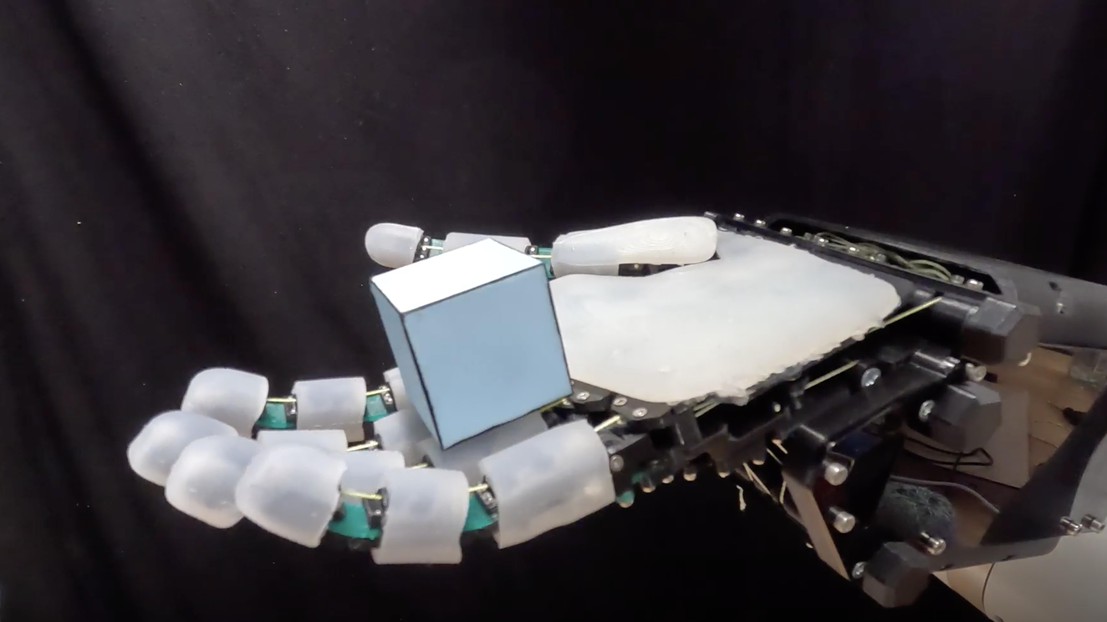
    In everyday life, people instinctively reach for objects without knowing their exact position. Robots, on the other hand, usually require precise environmental information and complex calculations. The newly developed robotic hand from EPFL dispenses with this computational burden. Instead, the robotic hand uses soft materials, spring mechanisms and an intelligent design that enables human-like gripping without high-resolution sensors.

    Self-organising movements with a93% success rate
    The hand uses silicone straps, mechanical springs and a foldable robotic joint, supplemented by just 12 motors instead of the usual 20. Thanks to this reduced but optimally distributed control, ADAPT achieved a gripping success rate of 93% in tests with 24 objects, with a similarity of 68% to human movements. The interaction between material, mould and environment partially replaces classic programming, a form of mechanical intelligence.

    From rigid machines to adaptive systems
    Instead of controlling each joint separately, the robot hand follows only four main points of movement. Everything else is determined by physical interactions with the object. This not only reduces computational effort, but also creates robust systems that can deal with uncertainties and unknown shapes. In future, this flexibility will be supplemented by sensory feedback and AI algorithms. A hybrid approach that combines precision and adaptability.

    New perspectives for robotics and locations with a future
    The findings of the EPFL researchers are not only important for research, but also for industrial applications in unstructured environments – such as logistics, care, agriculture or urban service systems. Robots that act flexibly without permanent reprogramming open up new possibilities for automation and relieve the burden on skilled workers in specific areas where conventional systems reach their limits.

    The ADAPT hand shows that intelligent robotics is not only created in the code, but also in the material. Investing in adaptive systems opens up new markets, from collaborative manufacturing to human-centred assistance systems. The EPFL project sends a strong signal about the role of research and site development in a world where machines will have to act autonomously and safely in the future.

  • The symbiosis of steel and drywall

    The symbiosis of steel and drywall

    Walk-in room-in-room solution
    Coop had been thinking about building a comfortable lounge for its employees for a long time. A 5-meter-high room, a kind of gallery, which is also adjacent to other rooms, was ideal for this purpose. But it would have been much too big, with its sand-lime brick walls, not comfortable and not heated. A room-in-room solution therefore offered itself, which could be implemented quickly, without a lot of dirt, but in compliance with all statics and fire protection requirements. Because the assembly took place while the high-bay warehouse was in operation, everything had to be well prepared and done quickly.

    Only half a day for the substructure
    As with all construction systems with a high degree of prefabrication, precise planning data and error-free transmission to the manufacturer were decisive. All steel profiles were cut to size and provided with the screw and punch holes to facilitate on-site assembly. The individual profiles could be efficiently screwed together using numbers and an assembly plan. Thanks to the corresponding planking, the entire construction has a fire protection rating of REI60. Plasterer entrepreneur Hansjörg Alder: “The steel structure was in the distribution center in just half a day, and within three days it was planked and ready for expansion.” You don’t notice the stylish room and its quality of stay that it was delivered as a kit and set up within a very short time.

    Like lightweight construction, simply much more stable
    RiModul® is actually nothing more than lightweight construction with stronger profiles. They achieve the best possible ratio of strength to weight, which among other things leads to dimensionally stable constructions – that is, walkable and resilient ceilings with additional usable area – and increased seismic resistance (earthquake security). And the system is based on the principle of prefabrication, which can reduce the overall construction time by up to 60%. RiModul® lightweight steel construction systems also result in significantly lower loads on the foundations than conventional construction methods. Complex objects in new construction and renovation can thus be realized safely, economically and with almost unlimited design flexibility. The RiModul® lightweight steel construction systems are particularly suitable for additions, extensions and, as in the case of Coop, room-in-room constructions. It also makes sense to use it as an external wall system for infilling in hybrid buildings.

  • Lighthouse project in the canton of Aargau

    Lighthouse project in the canton of Aargau

    Switzerland is at the forefront of the most innovative countries in the world: "We are building a high-tech ecosystem here, based on the research focus of the Paul Scherrer Institute (PSI)," Benno Rechsteiner, CEO of Innovaare AG told Immo! Nvest. “With its top-class large research facilities, PSI is the largest research institute in Switzerland. In order to promote exchange with industry, several departments are moving into the innovation campus, which is connected to the PSI site by an underpass. This gives you direct access to the particle accelerator opposite. " Park Innovaare already houses 17 high-tech companies in existing buildings. These companies originate from research at the Paul Scherrer Institute, ETH, EPFL and CERN. "For us, a mix of research departments, large industrial companies, development-oriented SMEs and high-tech start-ups is ideal."

    Greatest possible flexibility
    In order to meet the demands of a modern innovation campus in the long term, the property must be built as flexibly as possible so that later adjustments are possible: to enter into settling companies ». says Rechsteiner, who sees the Innovaare Park as a lighthouse project in the canton of Aargau.

    Renewable energy sources
    Around 95 percent of the heat requirements of Park Innovaare are covered by waste heat from cooling and around five percent by PSI's district heating network. Highly efficient HFO machines, which draw their energy from the Aare, are used to efficiently generate the cooling energy. From this point of view, the energy requirements of the 38,000 m2 innovation campus for heating and cooling are largely met from renewable sources.