Tag: Flughafen

  • Renovation of the airport runway takes place during ongoing flight operations

    Renovation of the airport runway takes place during ongoing flight operations

    Walo Bertschinger AG, based in Dietikon, is participating in the renovation of the main runway at EuroAirport Basel-Mulhouse together with its partner TRBA from Péruwelz in Belgium. The large-scale project involves the dismantling and restoration of parts of the runway, according to a Facebook post.

    The work is being carried out at high intensity. Within 29 hours, 38,000 square metres of runway were dismantled. Over 15,000 cubic metres of concrete had to be demolished and replaced. At the same time, 500 people are working on the project at peak times. The work is being carried out in parallel with flight operations on the secondary runway 07/25. According to the airport, flight movements with larger A319 and A320 aircraft, which normally use the main runway, will also take place there. Work has been underway since 15 April and will continue until 20 May 2026, with the new runway due to reopen on 21 May.

  • Last key building in the airport area now belongs to one hand

    Last key building in the airport area now belongs to one hand

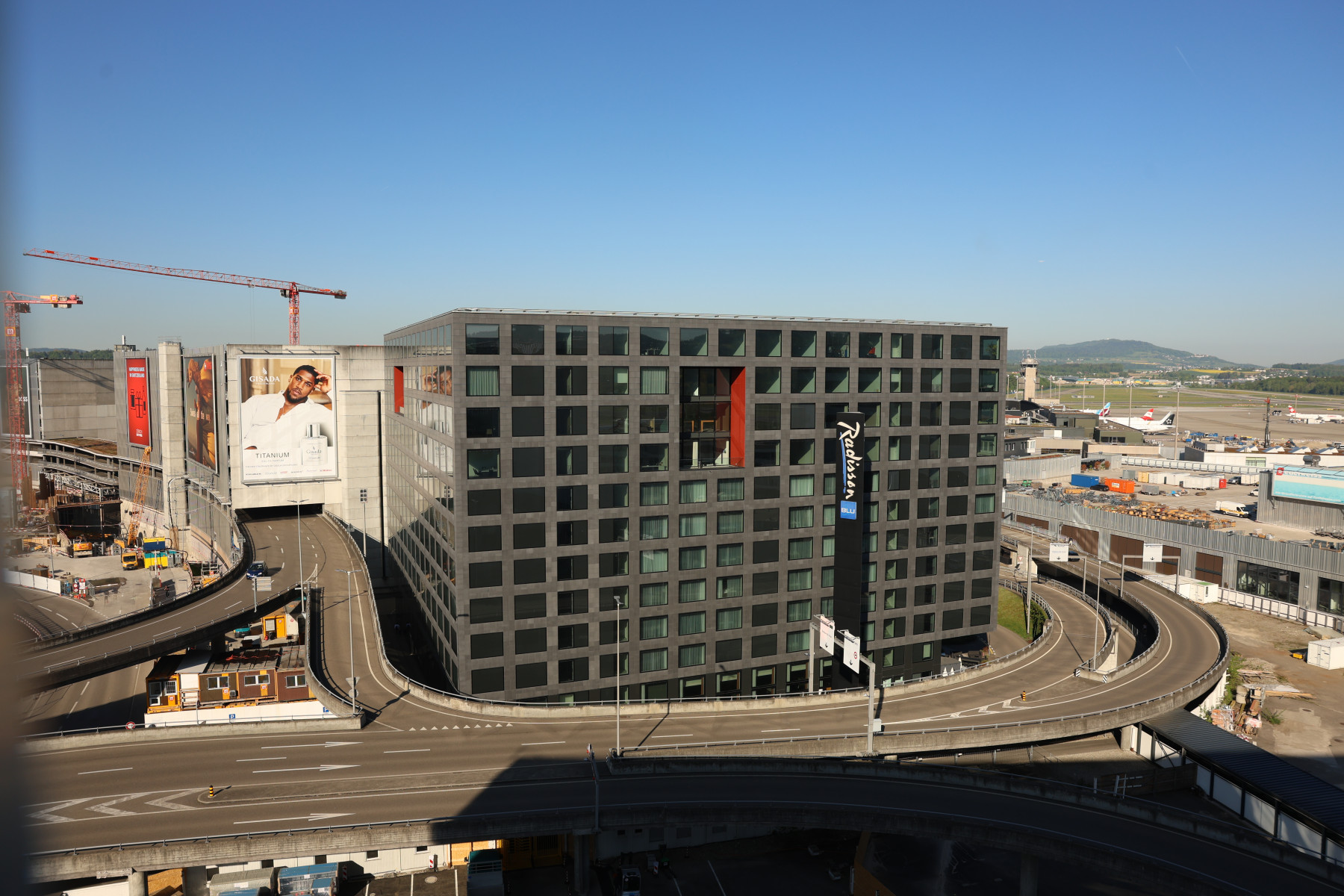
    Flughafen Zürich AG has announced the takeover of the Radisson Blu building in a press release. The previous owner, Al Maha Real Estate AG, has handed over the property in full for the purchase price of CHF 155 million. This is the last site within the airport perimeter that has not previously belonged to Flughafen Zürich AG.

    According to the press release, the building, which was constructed under building rights from 2005 and inaugurated in 2008 and is home to the Radisson Blu hotel chain as well as offices and a meeting and conference centre, was subject to a building rights agreement until 2080, which was terminated prematurely following its reversion to Flughafen Zürich AG. The rental agreement with Radisson Blu will continue. Hotel operations are to continue. In addition, there will be no changes to the existing utilisation.

    The strategic idea behind the complete takeover of ownership is the development and growth objectives of Flughafen Zürich AG in the central airport perimeter.

  • Modernised lounge opened at St.Gallen-Altenrhein Airport

    Modernised lounge opened at St.Gallen-Altenrhein Airport

    The People’s Passenger and Crew Lounge at St.Gallen-Altenrhein Airport has been extensively renovated, according to a statement from the operating company People’s Air Group. The focus was on giving the space a fresher and more modern look and substantially raising the quality standard, the statement continues. A new design concept was developed together with the interior design firm Jürgen Krämer from Lustenau in Vorarlberg, Austria. The work was completed in three weeks.

    According to the press release, the entire interior was redesigned, from the choice of colours to the furnishings and fittings through to the technology. There are armchairs and sofas for relaxing. A work area has also been set up with a high table, bar stools and plenty of power sockets. It should enable customers and guests to work productively during their stay at St.Gallen-Altenrhein Airport.

    Access to the People’s Lounge is included in the People’s and Full Flex fares or can be purchased directly at check-in. A large selection of hot and cold drinks is available free of charge, supplemented by various snacks, according to the press release.

    There is a direct connection from St.Gallen-Altenrhein to Vienna as well as flights to more than a dozen holiday destinations in the Mediterranean region.

  • Trinational S-Bahn: 33 new Flirt Evo France trains for the Basel area

    Trinational S-Bahn: 33 new Flirt Evo France trains for the Basel area

    New S-Bahn connections for the Basel area
    Every day, 60,000 people commute in the border triangle of Switzerland, France and Germany – including 30,000 commuters between Alsace and north-west Switzerland. Around 90 per cent of them currently use the car. This is set to change: From the end of 2030, a direct S-Bahn connection will be introduced between north-west Switzerland and Alsace. The aim is to get as many commuters as possible onto the railway, including the more than 6,000 employees in the EuroAirport catchment area and the approximately eight million air passengers a year.

    Introduction in stages
    The new cross-border S-Bahn lines will be introduced in stages:

    • From December 2030: Commissioning of the S2 (Olten-Basel-Mulhouse) and S4 (Laufen-Basel-St. Louis) lines every 30 minutes.
    • From 2034/35: Connection of EuroAirport to both lines, together with the French regional express line Strasbourg-Mulhouse-Basel (TER200) every 10 minutes between EuroAirport and Basel SBB.

    Procurement of the new trains
    SBB is procuring 33 Flirt Evo France trains from Stadler to operate the new railway service. These vehicles are characterised by two special features:

    • A standardised fleet:
      The trains can be used in both countries, which reduces complexity and increases operational flexibility. The vehicles can be efficiently coupled as single or multiple traction and replace the previous vehicles on the Mulhouse-Basel line (TEROmnibus).
    • Two systems:
      The trains are technically equipped to be authorised in Switzerland and France. They have two integrated traction current and railway safety systems to ensure smooth cross-border operation.

    Investment and project management
    The investment for the procurement of the 33 trains amounts to around 320 million Swiss francs. SBB and SNCF Voyageurs jointly founded EuroBasilea AG in July 2023 to ensure efficient preparation and timely commissioning of the new service. Further information is available at www.eurobasilea.com

  • Densification despite noise pollution in the airport communities

    Densification despite noise pollution in the airport communities

    The Zurich Cantonal Council decided on Monday to allow the airport communities of Oberglatt, Niederglatt and Niederhasli to build additional apartments despite existing noise pollution. This reclassification in the structure plan allows densification in municipalities that have already grown together. Local authorities supported the decision for additional living space, which could provide room for around 5,000 people.

    This decision was opposed by the Greens, the AL and parts of the SP, who expressed concerns about the increasing number of people affected by noise. According to the critics, the planned densification was a clear contradiction to the noise problem.

    Barbara Franzen from the FDP recognized a conflict of interest with airport policy, but emphasized that the settlement area already had the character of an “urban residential landscape”. Stefan Schmid from the SVP supported densification and argued that population growth made this measure necessary.

    Building Director Martin Neukom from the Green Party also supported the reclassification and emphasized that the affected municipalities wanted this development. Although he recognized a conflict of interest, he pointed out that there was potential for inner densification and that the areas were well developed.

  • The Circle is 95 per cent let

    The Circle is 95 per cent let

    The Circle service centre at Zurich Airport is attracting further tenants, as detailed in a press release. With nationally and internationally established companies now opting for office space in The Circle, the office space is almost fully let. The occupancy rate is around 95 per cent.

    According to the Zurich Airport press release, there are new developments in the catering and wellness areas. Leon’s Loft has been part of the catering operations in the Circle since 2020. Thanks to its successful development, the restaurant will be expanding its premises in early summer to include the area directly next door, the press release explains. A bodega concept with integrated wine sales will be created there in collaboration with Zurich winery Smith & Smith. In addition to the existing terrace on the main square, further outdoor seating areas will also be created in the alleyway.

    The health and wellness offering in the Circle will also be expanded, according to the press release. The Flooat floating centre opens in February and offers a special relaxation method: floating in a brine of water and salt, the body experiences weightlessness through natural buoyancy, which relieves the joints and organs.

    Regarding the new lettings, it is reported that another internationally established company, Be-Terna, which belongs to Telefónica Tech, has decided in favour of the Circle as a location. BE-Terna offers Microsoft cloud solutions. The move is planned for the fourth quarter of 2024. The CSS Group and Grenkeleasing AG will also be expanding their office space. Novo Nordisk and Inventx, two companies that already rent space in the Circle, will expand their premises in the first half of 2024.

  • Zurich Airport has exceeded the canton’s requirements

    Zurich Airport has exceeded the canton’s requirements

    The Zurich cantonal government presented its airport report on 7 December. According to the report, Zurich Airport met the economic and transport requirements in 2022. At CHF 1,024 million, total revenue exceeded CHF 1 billion for the first time since coronavirus, an increase of 50.5 per cent. Costs rose by only 22.9 per cent to CHF 468 million. Profit amounted to 138 million francs, an increase of 149.3 per cent.

    Passenger numbers continued to recover to 23 million, with the government expecting 28 million travellers by 2023. The airport is also doing well in terms of quality: it is ranked 7th globally in terms of accessibility and 8th in terms of quality. According to the presentation by the cantonal government, the number of people affected by aircraft noise fell below the target value of 47,000 at around 43,400. The airport also remained well below 320,000 aircraft movements with 216,000 – 10,000 of which were at night.

    However, the complexity of flight operations remains high, emphasises the government council. Extending the runways, which will be put to the vote in the spring, will reduce the number of intersections in the air and on the ground. This will increase the safety margin, according to a press release on the airport report.

    The cantonal government emphasises the importance of the airport for the location. It is crucial for Switzerland’s international accessibility, an important employer and an economic driver for the canton and Switzerland as a whole.

  • Zurich cantonal parliament approves runway extension

    Zurich cantonal parliament approves runway extension

    Flughafen Zürich AG wants to extend Runway 28 by 400 metres to the west and Runway 32 by 280 metres to the north. With this project, the airport wants to implement the conclusions of the 2012 safety review of Zurich Airport(SÜFZ) by the Federal Office of Civil Aviation. The extension of the runways is intended to increase the stability of air traffic in all weather conditions and for all types of aircraft.

    According to a press release, the Zurich Cantonal Council approved the extension on 28 August with a narrow majority of 87 to 83 votes, with two abstentions. The SVP, FDP, Mitte and EVP voted in favour of the proposal, while the other parties rejected it.

    Zurich Airport is pleased with the decision, as it writes in a statement. The longer runways would increase braking distances and reduce crossing points on the ground and in the air. More stable operations would reduce the number of delays as well as those affected by aircraft noise. “There are no alternative measures in flight operations that would bring the same improvements in terms of safety and reduction of delays,” the statement says. The number of flight movements, on the other hand, would remain the same.

    The Zurich Chamber of Commerce(ZHK) also welcomes the decision of the cantonal council. “Zurich Airport is of great economic importance for the greater Zurich area and for the entire country,” it writes in a statement. “To ensure Zurich’s international connectivity with the world in the long term, the airport must be able to adapt to changing circumstances.” ZHK Director Regine Sauter had already campaigned in advance for approval by the cantonal parliament. “The runway extensions bring multiple benefits: Residents benefit from more peace and quiet at night, and Zurich as a business location can count on a punctual airport and reliable connections to the world in the long term,” she is now quoted as saying in the ZHK release.

    The cantonal council’s decision is subject to an optional referendum, so the electorate is likely to have the final say. Only then can the airport submit an application for planning permission to the federal government.

  • Swiss Life invests in development of JFK Airport

    Swiss Life invests in development of JFK Airport

    The Zurich-based life insurer Swiss Life is investing in a development project at JFK Airport in New York through its Swiss Life Asset Managers division. According to a media release , Swiss Life Asset Managers has committed itself to a minority stake in the new construction of Terminal One. Together with JLC Infrastructure and other consortium partners, a sum of 9.5 billion dollars will be provided.

    An approximately 223,000 square meter "ultramodern" terminal is to be built. It represents an "infrastructure investment with attractive long-term growth potential and fits very well with our fund's investment strategy," said Sinisha Ponzio, Head of Value Add Infrastructure at Swiss Life Asset Managers.

    The new investment represents the third investment in the aviation sector for Swiss Life Asset Managers. The insurer sees this as "a vote of confidence in the future of modern aviation". Swiss Life Asset Managers does not expect the aviation industry to slow down. In this context, the airlines' improved capacity utilization, new aircraft orders, technological progress and the construction of modern airport facilities are highlighted.

  • «Set planning framework conditions with foresight»

    «Set planning framework conditions with foresight»

    Zur Person
    Balz Halter ist Hauptaktionär und Verwaltungsratspräsident der Halter AG. Die Unternehmensgruppe der Schweizer Bau- und Immobilienwirtschaft beschäftigt rund 320 Mitarbeitende an den Standorten Schlieren, Bern, Basel, Luzern, Lausanne, Genf und St. Gallen. Der Ingenieur ETH und Jurist ist bekannt für Unternehmergeist und Innovationskraft. So hat sein Unternehmen «The Branch», ein Do-Tank und eine Kollaborationsplattform für eine innovative und integrierte Immobilienwelt, initiiert.

    Herr Halter, Ihr Unternehmen ist seit über 100 Jahren am Markt tätig. Was hat sich seither in der Stadtplanung verändert und was ist gleichgeblieben?
    Unverändert ist sicher immer noch die Anziehungskraft von Wirtschaftsmetropolen wie Zürich. Den Drang in die Stadt gab es schon vor 100 Jahren und er ist heute nicht geringer, wahrscheinlich sogar grösser. Es ist immer noch der gleiche Kampf um günstigen Wohnraum. Das wird ein ewiges Thema in allen Städten bleiben. Anders als damals macht man sich heute kaum Gedanken zu einer übergeordneten Stadtplanung und der Frage, wie sich Stadt über ihre politischen Grenzen hinaus entwickeln soll. Mit Aufkommen des Individualverkehrs und Ausbau der S-Bahnen wurde primär in Infrastrukturen gedacht und geplant. Entstanden ist die konturlose Agglomeration, die weder Dorf noch Stadt ist und ihre Identität sucht. Den Herausforderungen des Wachstums und die damit verbundene Not an zahlbaren Wohnraum begegneten unsere Ahnen vor 100 Jahren mit dem internationalen Städtebauwettbewerb Gross-Zürich, der sich weit über die damaligen Stadtgrenzen Zürichs erstreckte. Es wäre höchste Zeit, wieder einen derartigen Wettbewerb angepasst auf die aktuellen Anforderungen und Herausforderungen zu veranstalten.

    Gibt es hier vielleicht einen Wechsel durch die aufkommende Elektromobilität?
    Wir wissen, dass sich etwas verändern wird, aber wir sehen noch zu wenig klar, was da auf uns zukommt. Wie und wann sich Konzepte des Selbstfahrens, motorisierter Individualverkehr im Sharing-Modell kommen wird, wissen wir noch nicht. Wie dieser im Zusammenspiel mit öffentlichen Verkehrsträgern wie Tram, Bus und Bahn funktionieren oder diese sogar teilweise ersetzen werden, können wir noch nicht abschätzen. Es ist jedenfalls anzunehmen, dass diese Entwicklungen Auswirkungen auf die Stadtplanung haben werden, insbesondere auf den öffentlichen Raum. Möglicherweise werden weniger Parkplätze als Umschlagplätze gefragt sein.

    Im Wandel der Mobilität, von der Pferdekutsche bis zum Automobil und vielleicht sogar bis zur künftigen Drohne als individuelles Verkehrsmittel, muss man wie früher auch schon die Strukturen grosszügig planen, dann kann sich Vieles ergeben. Wir sehen gerade vor der Tür in Schlieren mit der Limmattalbahn oder auch im Glatttal die Wiedergeburt der Strassenbahn. Das ist möglich, wenn öffentliche Räume zur Verfügung stehen. Deshalb wäre es falsch, grundsätzlich von einem Paradigmenwechsel auszugehen.

    Faktor Flugzeug und Flughafen – wie strahlt das auf die Region Zürich und die Immobilienprojekte aus?
    Der Flughafen ist ein Treiber für Arbeitsplätze, Wohlstand und Prosperität. Wir verdanken wohl dem Airport Zürich auch, dass Zürich die Wirtschaftsmetropole in der Schweiz ist. Es war damals ein strategischer Entscheid, den Landesflughafen im Gebiet des damaligen Waffenplatzes Kloten-Bülach anzusiedeln. Davon profitieren wir alle heute in hohem Mass. Wir müssen diesen Vorteil weiter nutzen und dem Flughafen mit seiner Hub-Funktion Sorge tragen, so dass er direkte Verbindungen in alle Welt auch nach Corona bieten wird. Das Reisen wird wieder zunehmen, wenn auch nicht in dem rasanten Tempo, wie wir es zuvor erlebt haben. Der Flughafen Zürich hat eine enorm grosse Bedeutung und ich hoffe, dass das auch so bleibt.

    Braucht es einen Flughafenausbau, und falls ja, wie und wann?
    Im Wettbewerb der Volkswirtschaften ist die Schweiz als Binnenland und Exportnation auf diese Stärke angewiesen. Wir müssen den Flughafen als langfristiges Projekt verstehen, dass sich wandelnden Bedürfnissen anpassen kann und muss. Deshalb müssen wir planerisch und regulatorisch die Basis schaffen, dass ein weiterer Ausbau möglich bleiben wird. Ob das dann wirklich geschieht, steht auf einem anderen Blatt. Das können und müssen wir nicht heute oder morgen entscheiden. Aber die Rahmenbedingungen müssen mit Weitsicht gesetzt werden.

    Im Moment sind Lärm und Nachhaltigkeit sowie fossile Brennstoffe grosse Themen. Dank Fortschritt bei neuen Antriebsmodellen und bei der Energiegewinnung wird es auch in der Flugindustrie zu Veränderungen kommen. Es wird andere Kraftstoffe geben, die nachhaltiger sind. Die Lärmbelastung durch den Luftverkehr wird von Jahr zu Jahr weiter sinken. Auch deshalb können und sollten wir Weichen stellen, um einen Airport-Ausbau zu ermöglichen und Wachstum zuzulassen.

    In der Flughafenregion sind Sie zuhause und haben bereits eine Vielzahl an Projektentwicklungen mit Ihrer AG realisiert. Die jüngste in dieser Reihe ist eine Neuüberbauung in Wetzikon in unmittelbarer Nähe zum Bahnhof. Was ist hier der aktuelle Stand und was entsteht dort genau?
    Das Zentrum Metropol, so der Name des Projektes, ist in meinen Augen ein wegweisendes Vorhaben, das als Modell für Zentrumsüberbauungen in Subzentren dienen könnte. Aus der Sicht des Stadtentwicklers ist es deshalb spannend, weil wir es mit der Um- und Neunutzung eines Einkaufszentrums zu tun haben. Shoppingcenter kennt man aus den 1960er und 1970er Jahren und mit dem Projekt Metropol erfolgt in Wetzikon eine Neuinterpretation dieses Modells. Geplant ist ein neuartiges Einkaufskonzept, das auch nach aussen strahlt. Wir bauen einen Stadtbaustein, der die verschiedenen öffentlichen Räume vernetzt und das Leben dort unterstützt. Wir interpretieren Stadt quasi neu. Es wird nicht mehr ein in sich geschlossenes System sein, sondern ein offener, zugänglicher und vielfältiger Ort für alle. Die Nutzungen werden gemischt sein: neben Retail- entstehen Dienstleistungsflächen, Wohnungen sowie Angebote für Coworking und neue Formen des Zusammenarbeitens. Wir streben einen guten Mix an, so dass der Ort lebt, nicht nur zu Büro- oder Geschäftszeiten. Wetzikon soll an Attraktivität gewinnen, gegenüber den grossen Zentren Zürich und Winterthur, so dass die Leute in ihrer Stadt bleiben.

    Stichwort «Digitales Planen und Bauen»: Mit Raumgleiter besitzt Halter hier eine wegweisende und innovative Schwestergesellschaft. Was wird heutzutage noch analog gemacht und was bereits alles digital?
    Raumgleiter ist ein Pionier im Bereich Virtualisierung, digitaler Planungs- und Bauprozesse auf der Basis von 3D-Modellen, respektive des digitalen Zwillings eines Gebäudes. An diesen Themen arbeiten wir bei Raumgleiter, aber eigentlich in allen Unternehmen unserer Gruppe. Doch: Immobilien sind und bleiben real. Deshalb ist deren Realisierung und auch vieles im Betrieb analog und wird es auch in Zukunft bleiben. Die Digitalisierung hilft uns jedoch, die heute sehr komplexen, hoch fragmentierten Bau- und Betriebsprozesse neu zu gestalten. Das Ziel muss sein, dass Gebäude effizienter und nachhaltiger erstellt und betrieben werden können, in hoher Qualität und ausgerichtet auf die tatsächlichen Bedürfnisse ihrer Nutzer. Wir stehen noch am Anfang: die Digitalisierung bietet unserer Industrie jedoch ein enormes Potenzial.

    Welche Rolle spielt dabei der von Ihnen mitinitiierte Do-Tank «The Branch»?
    Im Branch kommen viele verschiedene Beteiligte aus der Bau- und Immobilienwirtschaft zusammen: Unternehmer, Dienstleister, Bauherren, Investoren und finanzierende Institute. Wir als Halter-Gruppe sind auf Planer und Unternehmer angewiesen, wenn es um die Entwicklung und Realisierung von Gebäuden geht. Deshalb müssen wir Partner haben, die denken wie wir und die bereit sind, neue Prozesse, Produkte und Tools zu entwickeln und auszuprobieren. Deshalb laden wir Gleichgesinnte aus der Branche ein, auf unserem Weg in die Digitalisierung mitzumachen und durch innovative Konzepte neue Geschäftsmodelle, Berufsbilder und Plattformen zu schaffen und zu gestalten. Wir sind ein Do-Tank. Es geht nicht nur darum nachzudenken, sondern konkret zu handeln. Das können gemeinsame Pilotprojekte sein oder sogar gemeinsame Unternehmungen. Diese Initiative ist auf sehr offene Ohren gestossen. Wir haben enormen Zulauf von Bauunternehmern, Zulieferern, institutionellen und privaten Investoren und Planern. Wir sind auf einem sehr guten Weg, ein neues Verständnis und neue Denkmodelle in unsere Industrie hineinzubringen. Ziel ist es, über die Innovation hinaus unsere Wirkung zu verbessern, insbesondere auch bezüglich Nachhaltigkeitsaspekten und einer zirkulären Wirtschaft.

    Vieles in der Digitalisierung hängt scheinbar von gemeinsamen Standards ab. Sollten diese national oder besser international sein?
    Ich glaube, man überschätzt die Möglichkeiten einer Standardisierung, eines technokratischen Ansatzes in einer Zeit der sich rasch wandelnden technischen Möglichkeiten. Es ist verführerisch zu sagen, wir handeln alle gleich und wir denken alle gleich. Aber die Bauindustrie ist extrem regional und wenn man diese international und global betrachtet, findet man so viele unterschiedliche Kulturen, Usancen, aber auch Normen und Standards. Man kann sehr viel Energien verschwenden, wenn man versucht, den einen gemeinsamen Standard zu bauen. Man muss sich vielmehr an der Denkweise der Softwareindustrie orientieren. Dort ist nicht die Frage, ob alles nach dem gleichen Modell funktioniert, sondern wie kann man das «Handover» zwischen den verschiedenen Lösungen mit den richtigen Programmierschnitt- stellen hinbekommen. Am Ende werden sich aus diesen technischen Innovationen auch gewisse Industriestandards formieren. Diese sind dann nicht kraft Definition entstanden, sondern aus Bewährtem im Arbeitsalltag.

    Wie schaut Raumplanung und Stadtentwicklung in 20, 50 oder gar 100 Jahren dann aus?
    Ich bin kein «Digital Native» und keiner, der sich in den «Metaverses» herumtreibt. Aber auch zukünftige Generationen werden reale Geschöpfe bleiben und in der analogen Welt leben. Daran wird sich nichts ändern. Deshalb lohnt sich ein Blick zurück und zu schauen, wie Städte vor 100 Jahren gebaut wurden. Sie sind damals menschengerecht geplant und realisiert worden. Wir leben noch heute in diesen Städten und schätzen gerade diese bewährten Stadtstrukturen und Quartiere sehr. Natürlich verändern sich Möglichkeiten und Bedürfnisse. Die Grundstrukturen funktionieren aber noch, die wesentlichen Elemente, die Stadt ausmachen, bleiben die gleichen. Das ist vor allem am öffentlichen Raum abzulesen, den man früher mit Grosszügigkeit und Weitsichtigkeit, aber auch zuweilen mit einer gewissen ‘Verengtheit’ geplant hat. Das sind heute spezifische Qualitäten, die wir sehr schätzen.

    Wenn man Bilder vom Zürcher Bellevue vor 100 Jahren anschaut: Das war ein riesiger Platz, wo nicht viel passierte. Irgendwann kam das Tram, die Pferdekutschen verschwanden und dann sind die Autos, Zweiräder und Busse dazugekommen. Das konnte alles aufgenommen werden und funktionierte. Man muss offen sein für künftige neue Bedürfnisse und auch neue technologische Möglichkeiten. Grosszügige öffentliche Räumen schaffen Identität, Flexibilität und die Chance neue Entwicklungen zuzulassen. Das ist eine Qualität, die auch den Menschen gerecht wird und die die Attraktivität der Stadt ausmacht. Wenn wir an den bewährten Grundelementen weiterarbeiten, wird die Stadt in 100 Jahren zwar grösser und vielzähliger, aber nicht deutlich anders ausschauen. Gewisse Flächen und Räume werden anders bespielt werden als heute. Aber die Anziehungskraft von Städten wird bleiben.

  • Linking EuroAirport to the district heating network is progressing

    Linking EuroAirport to the district heating network is progressing

    The expansion of the heating network to the planned connection of the EuroAirport Basel Mulhouse Freiburg is progressing. The construction company SMCE forage et tunnel based in Sierentz has drilled two 90 meter long tunnels under the A35 motorway in Alsace, according to a press release from Primeo Energie from Münchenstein. The pipes that will transport the heat to the airport in the future will then be laid in the tunnels.

    The heat comes from the biomass power plant in the Alsatian town of Saint-Louis. It is operated by the energy company R-CUE , a subsidiary of the energy supplier Primeo Energie. So far, R-CUE has been supplying the equivalent of 5,000 households with heat via the existing district heating network of 12.3 kilometers and producing electricity at the same time.

    With the EuroAirport, a large heat consumer is added. The airport alone has a heating energy requirement of 3000 apartments. Its connection to the network “will reduce the consumption of fossil fuels by 90 percent” and thus decarbonize its energy mix. At the same time, the connection saves on heating costs, according to the press release.

    Other urban and commercial areas are later to be connected to the district heating network in the Saint-Louis metropolitan area, including the Saint-Louis hypercentre, the centre, south and north zones, the Lys development zone (ZAC) and the Technoport. In total, the network is to grow to a length of 30 kilometers.

    By 2030, up to 68 gigawatt hours of additional heat are to be distributed each year. This corresponds to 10,000 households and requires the construction of a new biomass heating plant, the press release continues. The expansion of the Saint-Louis heating network was decided at the end of 2020.

  • Five start-ups move into Büro Züri Innovationspark

    Five start-ups move into Büro Züri Innovationspark

    The Züri Innovationspark office has officially opened, according to a press release . Five start-ups have moved into a total of 170 square meters in the converted fire station of the former Dübendorf Airport. They were selected by public vote from among ten candidates last summer.

    The modern building offers 16 flexible workplaces, meeting rooms, a kitchen and a generous infrastructure. With their move into the Dübendorf office in Züri, the teams will also become part of the ecosystem in the Switzerland Innovation Park Zurich, according to the Zürcher Kantonalbank . The Zürcher Kantonalbank, co-founder of the Zurich Innovation Park, makes this space available free of charge for an innovative and collaborative working group. In a statement , the bank describes the Züri office, of which there is another edition in Zurich's Bahnhofstrasse, as its "gift" to the population.

    The five start-ups from Büro Züri Innovationspark include Medtech aiEndoscopic and the data processing platform for artificial intelligence, Lightly . Soma Rem is also on site, which helps people with body image disorders with virtual and augmented reality. TerraRad Tech brings remote space sensing technology to agriculture. And Tethys Robotics develops underwater robots.

  • Airport opens The Circle

    Airport opens The Circle

    The Circle has been the largest building construction site in Switzerland for years. The building complex next to the airport has been open to the public since Thursday, as the airport writes in a message .

    The opening takes place gradually. The University Hospital Zurich has been represented in the Circle with a health center since October, and the Victoria Pharmacy has already opened. Stores like Avec and Bayard open in November. The Hyatt Regency Hotel with the Convention Hall for 2500 people opens in December, the Hyatt Place Hotel follows in the spring. Some office tenants have already moved in. Other tenants such as Abraxas, Microsoft, MSD, Novo Nordisk, SAP and Oracle are gradually following suit. A shared office from Westhive will follow in the spring.

    Andreas Schmid, Chairman of the Board of Directors of Flughafen Zürich AG, emphasizes that construction costs have been kept under control and The Circle is almost fully let. “The decision to implement was a courageous step by the two co-owners,” he is quoted in the press release. "Today we can reap the benefits."

    Rolf Dörig sees it similarly: "The Circle is a future-oriented development in every respect: compact and sustainable construction in the right location and a modern usage concept that is geared to the needs of current and future generations," said the Chairman of the Board of Directors of co-owner Swiss Life quoted.

  • Zurich Airport: New hangar for business aviation

    Zurich Airport: New hangar for business aviation

    For business aviation, Zurich Airport is planning a new hangar in the far west, near Rümlang. The airport expects costs of 50 million francs. A hangar is planned in which the machines will be serviced and parked, a terminal for passengers with security and customs controls as well as office space. Flughafen Zürich AG has therefore submitted an application for planning permission to the Federal Department for the Environment, Transport, Energy and Communication (DETEC) for the "Zone West, building construction including apron and development" project, Flughafen Zürich AG writes in a press release. The planned building has an area of 80 x 280 meters and a maximum height of 30 meters. Business aviation is still located at the General Aviation Center in the east on the airport grounds. This location is to be relocated in the long term for other buildings such as a new freight facility. In the vicinity of the future new hangar, new stands are also to be created. For this reason, the spotter hill and the heligrill, which are popular with flight fans, have to give way. However, there will be a new spotter spot, says a spokeswoman for Zurich Airport AG. The start of construction of the new hangar has not yet been determined. ■

  • Real estate summit sheds light on change

    Real estate summit sheds light on change

    The topic of change was already the focus of this year's Real Estate Summit of Flughafenregion Zürich AG ( FRZ ) in the opening speech by André Ingold. Specifically, the newly elected President of the FRZ presented the around 20 major construction projects planned or under construction in the airport region, explained the FRZ in a communication on the event. Ingold had highlighted the planned Steinacker district in Kloten as an example. An urban area for 6,700 residents and 4,000 employees is to be created here along the Glattalbahn.

    The FRZ was able to win the longstanding Federal Minister and former German Vice Chancellor (SPD), Sigmar Gabriel, as the main speaker. The former top politician, who was elected to the Supervisory Board of Deutsche Bank in May, addressed the challenges for Europe such as Brexit, the coronavirus pandemic and the trade war between the USA and China. With regard to Switzerland, Gabriel stated that the development of Switzerland indicated that “the path this country has taken so far has been the right one”. The country has "developed so well precisely because of the close and relaxed relationship with the EU," said Gabriel.

    Tobias Straumann outlined his view of developments in the real estate market. "In the next one to two years the probability of a real estate crisis is zero," the economic historian is quoted as saying in the press release. According to him, there is no threat of an interest rate shock or “ruinous cutthroat competition”.

    In other presentations, entrepreneurs such as André Wyss, CEO of Implenia AG , Christine Novakovic, CEO of UBS Europe SE , Romeo Deplazes, Division Manager Solutions and member of the management of Energie 360 ° AG , and Rudolf Tschopp, Partner at Asia Green Real Estate , presented the strategies their companies in dealing with the global transformation processes.

  • André Ingold is the new president of the airport region

    André Ingold is the new president of the airport region

    180 representatives of members of the business network took part in the eighth general assembly of the FRZ on September 15 in Dübendorf, the FRZ informed in a message . The FRZ currently includes 644 companies, twelve cities and municipalities, and 19 associations and associations from the region. At the end of the 2019 financial year, the business network had just under 640 members.

    At this year's General Assembly, President René Huber resigned from his position, is further explained in the announcement. Huber (SVP), who has been mayor of Kloten since 2006, was “significantly involved in the creation” of the FRZ in 2011, it continues. With his resignation, the outgoing president wants to initiate a "staggered renewal of the management structures" of the business network. In recognition of his services to the FRZ, Huber was appointed the first honorary president of the FRZ by the general assembly.

    The board of the FRZ had proposed the incumbent mayor of Dübendorf, André Ingold (SVP), as the successor to Huber. The participants in the General Assembly unanimously followed this proposal, writes the FRZ. Jan Schibli from the Schibli Group and the mayor of Dietlikon, Edith Zuber (SVP), were also newly elected to the board.