Tag: Fortschritt

  • Cham-Hünenberg bypass

    Cham-Hünenberg bypass

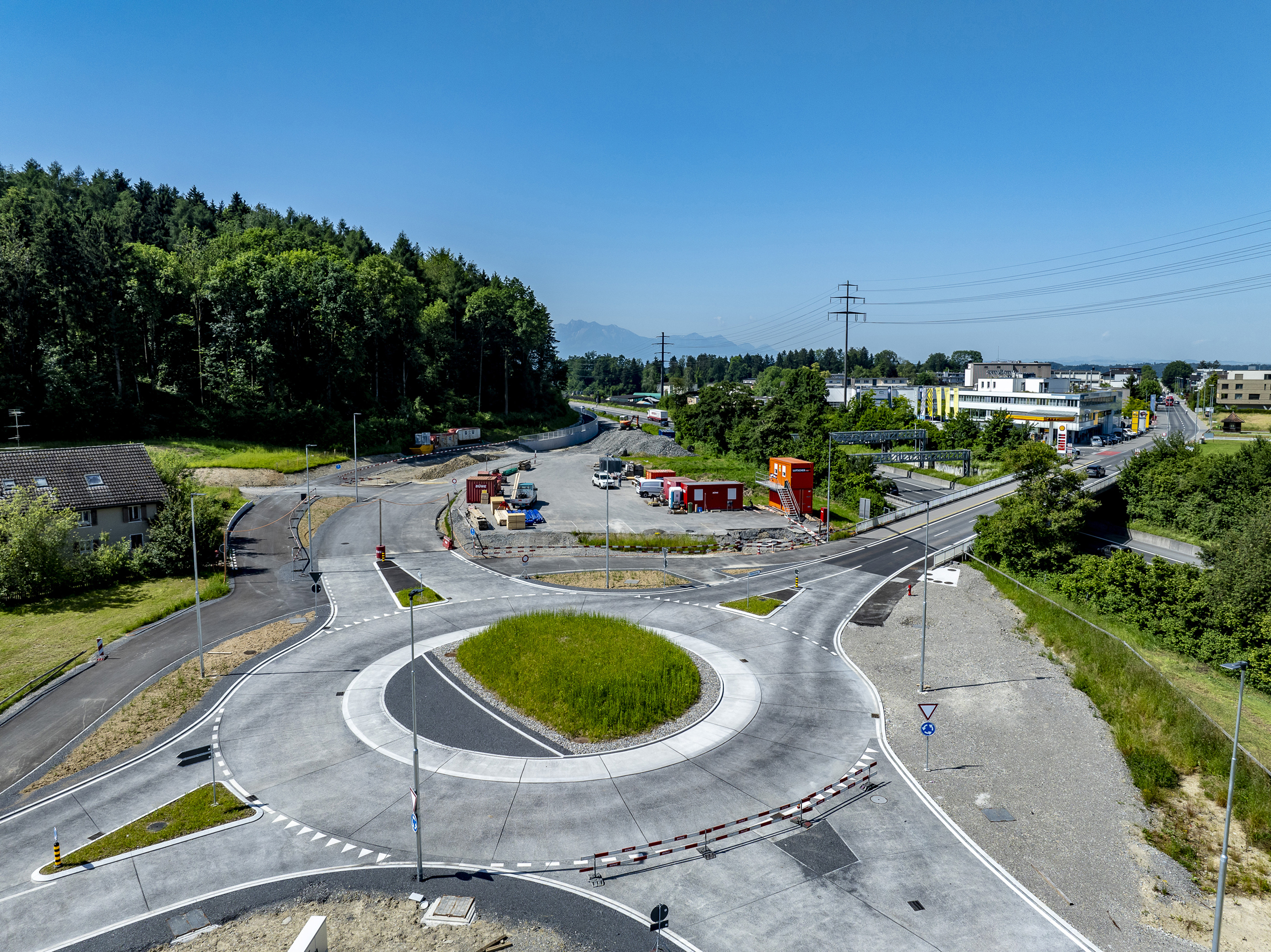
    The Cham-Hünenberg bypass (UCH) is more than just a new road. It is the last big piece of the puzzle in the transport planning of the Canton of Zug, which not only serves to bundle transit traffic, but also to free the centre of Cham from through traffic. This ambitious project, which is being implemented by the Canton of Zug’s Department of Construction in collaboration with the Ennetsee municipalities, aims to enhance living and economic areas and improve mobility for all road users.

    Construction and location
    Construction of the UCH has already begun and is scheduled for completion in 2027. The route runs predominantly parallel to the A4 motorway, which allows for minimal land consumption and efficient use of space. This aspect is particularly important in order not to jeopardise the planned settlement and landscape development in the Ennetsee municipalities.

    Tunnelling and construction work
    The main work on the Städtlerwald road tunnel began in March 2024 with the construction of the pumping stations and settling basins. The tunnel operations centre is also being built, while the pre-cut for the Stumpen tunnel portal is being constructed in parallel. The tunnel itself will have a total length of 543 metres, the majority of which will be created underground using a roadheader.

    Progress of the preliminary work
    Preliminary construction work has been taking place along the future UCH route since 2022 and has now been completed. The first ground works along the western UCH perimeter and neighbouring N4 national roads are already in full swing. Neighbouring woodland areas have already been cleared, with the standing tree trunks being handed over to the hydraulic engineering department for later projects.

    A benefit for all road users
    The Cham-Hünenberg bypass not only promises improvements for road traffic, but also positive effects on the quality of life of local residents. By relieving the congestion in the villages of Cham and Hünenberg, a quieter and safer living environment will be created, offering space for additional leisure and recreational activities. The improved transport links will also encourage companies to settle in the region, which in turn will strengthen Zug as a business location.

  • Breakthrough in quantum computing technology

    Breakthrough in quantum computing technology

    Quantum computers could fundamentally change our understanding of problem solving and calculations in the near future. However, the technology still faces a crucial hurdle – the error-proneness of quantum bits, which are the central building blocks of quantum computers. Google has now reached a significant milestone with its latest success in quantum error correction.

    Researchers at Google’s Quantum Artificial Intelligence Lab have managed to combine 97 error-prone quantum bits into one logical quantum bit that has a significantly lower error rate. This is an important step on the way to error-tolerant quantum computers that could perform complex calculations in the future.

    Challenges of quantum error correction
    The biggest challenge for quantum computers is the high probability of errors during computing operations. In current systems, the probability of error is between 0.01 and 1 per cent, depending on the operation. As quantum computers potentially require thousands of calculation steps, this means that the possibility of errors increases exponentially. Without effective error correction, the advantages of quantum computers would be almost impossible to utilise in practice.

    The Google researchers developed a method in which quantum information is distributed across several quantum bits. Measurement bits ensure the stability of the states without directly changing the information. This redundant approach, which is also used in classical computers, led to the formation of a more robust logical quantum bit.

    A decisive advance – but not yet the goal
    Google was able to achieve a critical error threshold by reducing the error rate of a 97-qubit quantum bit system to half that of a 49-qubit system. This progress is highly rated by experts and can be compared to the groundbreaking results of 2019, when Google demonstrated for the first time that quantum computers can outperform conventional computers in certain tasks.

    Despite this promising development, quantum research still faces huge challenges. The next step is to perform basic computing operations with the stabilised logical quantum bits. In the long term, these stable bits will be used to enable complex and fault-tolerant calculations.

    Fault-tolerant quantum computers and their application
    Although the progress made so far is impressive, there is still a long way to go before quantum computers are able to solve really complicated problems. It is estimated that around 1457 physical quantum bits are needed to achieve an error rate of 1 in 1,000,000 – a minimum requirement for solving simple problems.

    For complex challenges such as breaking modern encryption methods, even thousands of logical quantum bits are required. Therefore, further progress in quantum error correction and more efficient algorithms are urgently needed to reduce the required number of physical quantum bits.

    A clear path ahead
    The current results from Google and other research groups form a solid basis for the development of the quantum computers of the future. While many technical hurdles remain, recent advances are making the goal of a powerful, fault-tolerant quantum computer more tangible. Whether and how the technology will become established in practice remains to be seen, but the outlook is now clearer than ever before.

  • Synhelion and Cemex scale up solar clinker to industrial level

    Synhelion and Cemex scale up solar clinker to industrial level

    Synhelion, the global pioneer for sustainable solar fuels, had produced solar clinker for the first time in January 2022 with cement producer Cemex in a Spanish pilot plant. Now, according to an identical media release, the two companies have scaled up production to an industrial level.

    In the process, solar receivers from Synhelion, a spin-off from the Swiss Federal Institute of Technology Zurich, use concentrated sunlight to generate temperatures of over 1500 degrees. This heats a gaseous heat transfer medium. In this way, the heat required to fuse limestone, clay and other materials together can be provided. In traditional clinker production, fossil fuels are used for the energy-intensive process, which are responsible for about 40 per cent of direct CO2 emissions. The goal of the cooperation between Synhelion and Cemex is to develop a completely solar-powered cement production.

    The current stage of development is “an exciting milestone for all parties involved, achieved through the excellent collaboration between the Cemex and Synhelion teams,” Gianluca Ambrosetti, co-CEO and co-founder of Synhelion, is quoted as saying in the release. “Our technology can make an important contribution to the decarbonisation of cement production, and we look forward to further breakthrough achievements in this area.” Cemex CEO Fernando A. González adds, “The solid progress I see here proves that solar cement is not just a dream, but can be achieved through continued collaboration and rigorous research and testing.”

  • Low data literacy and low data maturity as barriers to digital progress in the real estate industry

    Low data literacy and low data maturity as barriers to digital progress in the real estate industry

    The Digital Real Estate Survey 2023 shows that the digitalisation maturity of real estate companies in Germany and Switzerland is moderately increasing. The index measures the extent to which market participants are addressing digitalisation and how far they have already taken and implemented measures. The Digital Real Estate Index across the entire market is 4.7, an increase of 0.2 points compared to the previous year. While the Swiss index rose slightly, the German index fell by 0.1 points to 4.8.

    The assessment of digital technologies has been stagnating for years and is thus developing only slowly. Although all technologies are being used more frequently, the increase and expectations of benefits are rather moderate. With the exception of “Decentralised Energy Technologies”, which have experienced a boost due to the looming energy shortage.

    Expensiveness inhibits digital investments
    The development of digital maturity of the different roles in the industry also continues to be even. FM service providers have a higher level of maturity in terms of digital transformation than other market participants, but rising inflation is apparently putting them under such pressure that investments have had to be drastically reduced. Planners and contractors, on the other hand, are investing more in innovation and digitalisation, especially due to the increased use of BIM in project planning. Two thirds of the companies spend more than 1 percent of their annual turnover on innovation and digitalisation, with small companies with up to 49 employees investing proportionately more than medium-sized and large companies. Large companies with 250 or more employees have a higher digital maturity than SMEs.

    “If you compare the investments as a percentage of annual turnover across all company sizes with the turnover of the construction and real estate industry in the narrower sense, this results in a considerable sum in the billions which is spent in the industry on innovation and digitalisation,” explains Rebekka Ruppel, CEO of pom+Germany. “It makes you wonder why the digital maturity level is not increasing faster.”

    Immature data skills as the biggest challenge
    One possible explanation is low data maturity combined with low data literacy. The survey shows that data analytics is used by only a quarter of respondents and that most are engaged in pilot projects or knowledge building (38% of respondents). Only 4 percent are already using the technology in their day-to-day business. The results show that data analytics has a positive impact on more areas of a company than expected – especially in investment, portfolio and asset management. Improved reporting is seen as the biggest benefit, while the lack of quality of the database and the lack of know-how in handling data are seen as the biggest challenges.

    “The awareness of data as an asset has not yet taken hold in the construction and real estate industry. At the same time, the requirements for data architectures are very complex in the extremely heterogeneous environment with highly fragmented processes and different participation groups. Clear and transparent communication in conjunction with structured data governance is necessary here to create a better understanding of data,” explains Rebekka Ruppel.

    The maturity of digitisation in the industry depends not only on technical possibilities, but also on experience, competences and know-how. Companies should focus on expanding and maintaining partner networks as well as overarching business models in order to move from individual performance to joint development. The exchange of data across company and industry boundaries is expected to increase rapidly, so companies should raise awareness of data.