The canton of Zurich offers a huge pool of data with a spatial reference (geodata). Most of it is accessible free of charge via the GIS browser. Around 200 digital maps, grouped according to 21 main themes such as buildings, flora and fauna, leisure and geology, can be accessed online. Most of the data can be used without restrictions and the map content can be downloaded and printed directly.
Broad benefits for professionals and private individuals The GIS browser is a useful planning and decision-making tool not only for professionals, but also for private individuals. Location factors such as the age of a house, proximity to public transport stops, shops, schools or sports facilities, planned building sites and journey times on the road network can be easily checked. Up-to-date and precise facts on numerous issues are available.
History and development of the GIS browser Since its launch in 1999, the GIS browser has undergone continuous development. The new version is the third generation. Most of the publicly relevant maps are already available and the migration of the remaining maps is continuing.
Advantages of the new GIS browser The portal has a new design and the user interface is intuitive and self-explanatory, even on smartphones and tablets. An intelligent search function makes it easier to find the desired map. The map views can be customised and used even better thanks to new functions such as filters and favourites lists.
Integration into the new cantonal geoportal The geodata of the Canton of Zurich is also available in the geodata catalogue and geodata shop. These systems are now centrally accessible via the new geoportal geo.zh.ch. The geoportal also offers news on new maps and a help and support area.
The area along the picturesque River Aare, which stretches between the bustling city centre and Lerchenfeld, holds a vibrant future for the city of Thun. The Tryber development will create a new, mixed-use and sustainable district that promises a wide range of possible uses. The special feature here is the deliberate retention of local qualities such as existing jobs, existing buildings and the favourable location, while the new forms of use are being introduced gradually and thoughtfully.
A lively mix of regional businesses, culture, local recreational opportunities, gastronomy and mixed residential construction is being created in the Tryber. This mix not only revitalises the district itself, but also contributes to the vitalisation of the entire city and creates a new, vibrant sub-centre that enriches Thun as a whole.
The foundations for this transformation from a pure workplace area to a lively, mixed district were laid in the “STEK 2035 urban development concept”, which identified the Thun-Nord area as one of four premium development priorities. Cantonal planning has given the area top priority. An important step towards planning and development security was taken with the start of work on the revision of the ESP Thun North structure plan. This structure plan forms an essential spatial and urban planning basis for the larger, as yet undeveloped areas of the Tryber Quartier.
The development is a long-term endeavour that will gradually create an interesting mix of residential, commercial and leisure space on an area of 110,000 m2 . Where ammunition was once manufactured, a space for living, working and relaxing is now being created.
The central company behind this project, RUAG Real Estate Ltd, is planning to revitalise the area along Uttigenstrasse in the Thun North development focus (ESP) and create a completely new sub-centre. An integral part of this development is the opening up of Uttigenstrasse, which has been reopened to traffic after a long break of 40 years. The planned new “Thun Nord” S-Bahn stop is also an important element in improving access to the site.
RUAG Real Estate Ltd has a sustainable vision for the development of the Tryber. It is not intended to be an abrupt change, but a gradual transition that makes the most of the existing building fabric and only creates something new where it is absolutely necessary. Innovative concepts such as co-working spaces, pop-up uses and other interim uses are being considered in order to create a “trendy quarter”.
RUAG Real Estate Ltd’s ambitious revitalisation of the Patronenfabrik visibly marks the start of the guided Tryber development. Around 1,000m2 of light-flooded and freely divisible office and studio space is being created in a stately historic building directly on Uttigenstrasse and in the immediate vicinity of the future S-Bahn station.
The S-Bahn station in particular will not only position the Tryber as a local link between Thun’s city centre and Lerchenfeld, but will also increase its accessibility and attractiveness beyond the region towards Bern, the Mittelland and even as far as Valais. The coordinated planning between RUAG Real Estate AG and the planning department of the City of Thun ensures that the Tryber project will proceed in harmony with the other planned developments in the Thun North ESP and lays the foundation for a dynamic, well-connected and vibrant community that will take root in Thun in the coming years.
The Papieri site in Biberist, Solothurn, can look back on a long industrial history: Its existence began in 1862 as the site of the “Papieri” paper mill. After almost 150 years, the factory ceased operations in 2011, most recently owned by the international paper group SAPPI. Subsequently, HIAG from Zurich acquired the 60,000 square metre site – with the aim of creating a lively and diverse quarter.
However, the industrial spirit that is strongly anchored here is not to be lost: The “Papieri” is to continue to be used for commercial and industrial purposes. The location and general conditions of the area are still ideally suited for this. The site can be reached in a few steps from Biberist Ost railway station. In addition, it is served by the bus stops Biberist Emmenbrücke and Biberist Derendingenstrasse (BSU). Attractive pedestrian and bicycle connections are also planned for the medium term. HIAG has worked out a sustainable development strategy in close consultation with the canton, municipalities and other stakeholders. As early as 2013, an urban planning study was carried out in collaboration with five architectural firms. The findings of this study commission formed the basis for the master plan, which was completed in 2015 in consultation with the municipality of Biberist. The partial zone plan revision is currently underway. This is currently undergoing a cantonal preliminary examination.
The long-term planning envisages a division of the site into two parts: The “West” area near the Biberist East railway station comprises about one third of the total area and is to become an area open to the public with quiet commerce, services, leisure, culture and housing. No concrete residential projects are planned yet. But: “The future usage regulations allow for a residential share in the western area,” says Dominik Ulrich, project developer of HIAG Immobilien Schweiz AG. The eastern area towards Derendingen, on the other hand, will be transformed into a workplace area for the manufacturing industry.
nightnurse.ch
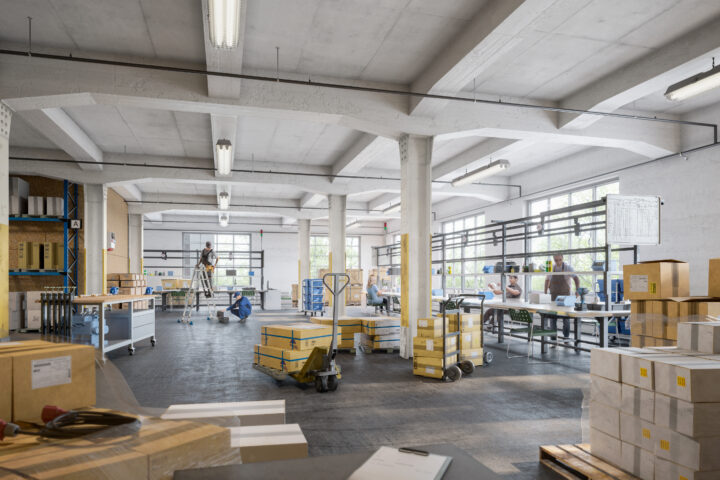
Access to the publicly accessible western area of the site is already from the southwest. In future, the triangular Papier-Platz will mark the beginning of the site. The square is enclosed by the striking existing building at Fabrikstrasse 1, which will be made fit for the planned transitional uses by mid-2023: On the ground floor, spaces between 160 and 1000 square metres will be rented to commercial and service providers. The rooms on the upper floors are ideally suited for commercial and storage space as well as studios. Offices are also available in the neighbouring building. “The transitional use of Building 1 is planned for up to ten years. The goal is to establish uses that will last in the long term,” explains Ulrich. The dismantling of the machinery was a prerequisite for opening up the area. The machines were successfully sold in recent years and transferred to new owners.
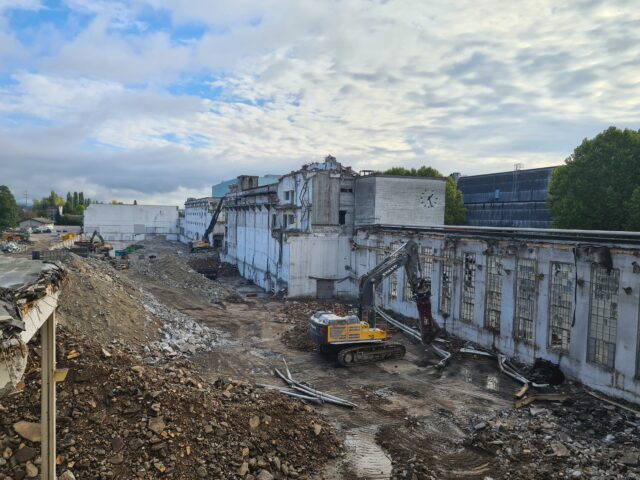
The centre of the area, and thus the centre, is the square by the canal: Demolition work is currently underway here to create open spaces and breakthroughs in the hall structures. So far, 17,000 tonnes of material have already been removed. HIAG attaches great importance to sustainability: 14,000 tonnes of it will be processed into granulate on site and reused. The deconstruction work is scheduled to be completed by the end of this year. From mid-2023, the construction of a new modern building is planned, which will offer around 15,000 square metres of usable space for trade, production and offices. The first tenants are expected to move in by the end of 2024. According to Ulrich, concrete negotiations are currently underway with prospective tenants.
Demolition work is currently underway in the middle of the site.
Wir verwenden Cookies zur Unterstützung und Verbesserung unserer Dienste. Mit der Nutzung dieser Website erklären Sie sich mit der Verwendung von Cookies einverstanden. Weitere Informationen finden Sie in unserer Datenschutzerklärung.