Tag: Gastronomie

  • A new landmark at the Rhine Falls with great potential

    A new landmark at the Rhine Falls with great potential

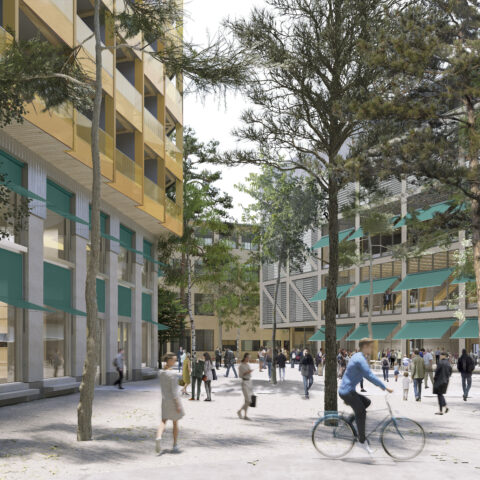
    The goal was clearly defined. A third of the 900,000 annual Rhine Falls tourists were to be lured to the other side of the river and attracted to the “Rhyfall Village” area. “Rhyfall Village”, or “RIVI” for short, is the name of the new neighbourhood. With a mix of gastronomy, art and shopping, the area will become a centre of attraction – not only for tourists, but also for the local population.

    The site and its future
    The “RIVI”, once the site of industrial production, is undergoing a reorganisation. The neighbourhood is characterised by two striking high-rise buildings, one of which was acquired by Helvetia. These offer living space with impressive views and space for catering, office and retail areas.

    Potential and challenges
    The visionary project met with broad approval in the region. Beat Hedinger, Managing Director of Schaffhauserland Tourismus, saw the village at the time as a “colourful mosaic piece” in the overall tourism picture. The rooftop restaurant with a view of the Alps in particular promised to be a special highlight. Hedinger also recognised the challenge of skilfully bridging the distance between the Rhine Falls basin and the site.

    Felix Tenger, Mayor of Neuhausen, is optimistic that the “RIVI” will revitalise the centre of Neuhausen and also strengthen the retail trade. Building director Martin Kessler also saw great potential to turn the site into a meeting place that creates synergies with existing facilities and increases the attractiveness of the entire region.

    Good connections and creative solutions
    The site’s location scored highly thanks to its proximity to the Rhine Falls and good public transport connections. The Badische Bahnhof Neuhausen railway station is located directly next to the site and numerous bus connections and over 200 parking spaces are available to visitors. Visitors can travel in comfort between the Rhine Falls basin and the Rhyfall Village on the Rhyfall Express tourist train.

    A project with vision
    Rhyfall Village is more than just another residential neighbourhood in Neuhausen. Whether rooftop restaurant, promenade or art gallery – the RhyTech site stands for a modern, versatile and vibrant future in the immediate vicinity of one of Switzerland’s most impressive natural wonders.

  • New building at headquarters in Weggis officially opened

    New building at headquarters in Weggis officially opened

    Thermoplan inaugurated its new building at its headquarters in Weggis on 22 June after almost 960 days of construction, the globally active Lucerne-based manufacturer of fully automatic coffee machines announced in a press release. The red ribbon in front of the spacious entrance area of the modern production and office building was cut by Thermoplan CEO Adrian Steiner together with the founding couple Esther and Domenic Steiner. Over the course of the entire open day, almost 5,000 visitors gathered on the festive mile along Weiherstrasse.

    Thermoplan develops and produces fully automatic coffee machines for professional use in catering and other businesses. Among other things, Thermoplan equips the global Starbucks chain with fully automatic coffee machines. The globally active company is committed to Switzerland as a production location: the fully automatic coffee machines are all manufactured at the headquarters in Weggis, Thermoplan states in its self-promotion. Around 80 per cent of the components used also come from Swiss production.

  • New catering project in Baden’s city centre on 1000 square metres

    New catering project in Baden’s city centre on 1000 square metres

    The catering and hotel company SV Group is setting up a restaurant with 300 seats and a terrace covering 1000 square metres at Konnex Baden. According to a press release, SV, headquartered in Dübendorf, will also be responsible for catering for guests in the conferencing area. The SV Group employs around 4800 people in Switzerland and will offer a catering service for the conference and meeting areas as well as event catering.

    According to the landlord’s press release, this means that the so-called city-within-a-city concept of Konnex Baden is increasingly taking shape. SPGI Zurich AG is responsible for the marketing and letting of Konnex Baden. Around 35,000 square metres of commercial space will be available following the total refurbishment.

    The city-within-a-city concept includes a range of services and amenities, including restaurants, shops for everyday needs, fitness, childcare and co-working. The Konnex building is located in the city centre, just a five-minute walk from Baden railway station and 20 minutes from Zurich.

    SPGI Zurich AG, based in Zollikon, is a subsidiary of the Intercity Group, an independent property services provider with group companies in Zurich, Lucerne, Bern, Basel, St. Gallen, Olten SO and Zug. Since 1993, the company has been an alliance partner of Cushman & Wakefield, a leading global provider of property services with headquarters in Chicago and 53,000 employees in 60 countries.

  • Pistor’s growth requires larger buildings

    Pistor’s growth requires larger buildings

    Pistor has expanded the WUZ West goods handling centre in Rothenburg. According to a press release, the investment for the fully automated replenishment warehouse amounts to CHF 34 million. The building now has space for 22,000 pallets, 7,000 more than before.

    According to Pistor, a solar system on the roof will supply enough electricity to power 66 households each year. “We have also installed a large underground storage system that allows us to heat the site with our own summer waste heat in winter and minimise CO2 emissions,” says business performance member and logistics manager Richard Betschart. Pistor is also reportedly expanding the number of electric lorries.

    With the expansion measures, the catering wholesaler and service provider is reportedly responding to the continuously increasing demand. In addition to its core business of supplying bakeries and patisseries, the company also supplies catering and healthcare businesses such as hospitals and retirement homes.

    However, Pistor says that the big leap is still to come: the company is planning new office, warehouse, goods handling and distribution space at its headquarters in Rothenburg, covering an area the size of four football pitches, by 2030. In addition, the ground-breaking ceremony for a distribution centre in Sennwald SG will take place this year. The aim is to supply eastern Switzerland even better from this centre.

  • Halter plans high-rise in St.Gallen

    Halter plans high-rise in St.Gallen

    The Schlieremer construction company Halter AG is developing plans for the redevelopment of a quarter on the edge of St.Gallen’s city centre. According to a media release, a new high-rise building with high-quality architecture is planned on the Bogenstrasse site next to Kreuzbleiche. The investment costs amount to around 60 million Swiss francs.

    The planned building is to be sustainable. According to Halter, there will be below-average land consumption per capita and a minimum number of parking spaces. The building will be supplied with district heating and will also produce energy via photovoltaic systems. The new high-rise building will mainly be used for condominium and rental living. Gastronomy will be located on the ground floor. Team offices with divided areas, such as meeting rooms and co-working zones, are also planned in the new high-rise.

    “The broad utilisation concept will create a versatile place for working, living, gastronomy and culture for a mixed public,” project initiator Rolf Geiger of Halter AG is quoted as saying. The added value for the neighbourhood and the city includes the newly created public square, which will be landscaped as much as possible.

    The special use plan procedure is to be carried out in 2024 and provides for public participation. Another year is planned for the building permit procedure, followed by realisation.

    “Building inner development offers a great opportunity to make our city fit for the future. All those involved in the project want to take advantage of this opportunity with a high-quality development that combines the tried and tested with the new,” councillor Markus Buschor of the Planning and Construction Directorate is quoted as saying.

  • Maaglive makes Zurich West even more attractive

    Maaglive makes Zurich West even more attractive

    Up to now, the Maag site has been characterised mainly by office use. The large-scale Maaglive project will give Zurich West a versatile and green centre with various uses by 2027. An ensemble of three buildings is planned: a residential tower with a roof garden and loggias, a four-storey cultural centre and the existing Building K, which will be renovated and converted.

    Building K will be protected as a historic monument – after all extensions have been removed. In the future, it will offer operational synergies with the neighbouring Kulturpavillon with a foyer, restaurant and bar as well as a market hall and book café. Wooden constructions provide for an attractive interior of the culture pavilion.
    The residential tower is characterised by flexible usage possibilities, with the residential area predominating. Office space and rooms for events complete the offer. A co-working space with café and wine bar will be incorporated into the two-storey base.

    The visualisation shows the town square near the tower.

    At the highest point of the tower – next to the green roof garden – residents will have access to a library and a communal kitchen. Public-oriented uses are planned for the ground floors. An area of around 6000 m2 is planned for the flats, 3000 m2 for the cultural and event area, and a further 3000 m2 for studios, co-working and gastronomy.

    The centre of the area is formed by the neighbourhood square, which is planted with up to 80 high-stemmed native trees and extends over 4000 m2 . The canopy of foliage thus created is intended to provide the square with the quality of stay that has been lacking up to now. Open spaces and additional green areas with seating as well as various play and rest areas will also provide more life on the site during the day. At the same time, this will optimise the microclimate and reduce the heat that accumulates in summer. The latter is a particular problem in the city centre. Maaglive also counters this with pavement structures that offer a certain degree of retention as well as heat reduction. The entire construction project focuses on circular building and the use of resource-efficient building materials.

    The historic Lichtstrasse and the Maschinenstrasse will be opened up to the public. In addition, new pedestrian and bicycle paths will be created. The project is the brainchild of the Berlin architectural firm Sauerbruch Hutton. Hager Landschaftsarchitekten is responsible for the landscape architecture. The owner of the site, Swiss Prime Site, has already submitted the building application. Realisation will begin in the 3rd quarter of 2024 at the earliest. If everything goes according to plan, Maaglive should be ready for occupation in the 3rd quarter of 2027.

    The cultural pavilion is intended to become a lively meeting place for art, the creative industries and the population.
  • Andermatt Swiss Alps Invests CHF 350 million

    Andermatt Swiss Alps Invests CHF 350 million

    The CHF 149 million investment by Vail Resorts consists of two parts: CHF 110 million for Andermatt-Sedrun Sport AG to improve the guest experience, for example in the area of lifts, snow-making systems, gastronomy, leisure activities and other infrastructure on the mountain .

    ASA will invest the proceeds of CHF 39 million in the further development of its core business in hotels, infrastructure and the expansion of Andermatt Reuss over the next three to five years, in addition to the CHF 350 million already earmarked. The investments are shared between Andermatt and Sedrun.

    Following shareholder and regulatory approval, Vail Resorts now owns 55 percent of the shares in Andermatt-Sedrun Sport AG. ASA continues to hold 40 percent of the shares, the remaining 5 percent are in free float. The aim of the partnership between Vail Resorts and ASA is the expansion of Andermatt and Sedrun into the common vision of "The Prime Alpine Destination".

    Effective August 4, management of the company will be the responsibility of Vail Resorts. Mike Goar is appointed Chairman of the Board of Directors and Managing Director of Andermatt-Sedrun Sport AG. There will be no changes to the ongoing operations of Andermatt-Sedrun, in particular the SkiArena Andermatt-Sedrun.

    "I'm looking forward to working with the incredible team at Andermatt-Sedrun Sport AG, our passionate partners and the committed authorities – and learning from them," says Mike Goar. “I can't wait to move forward with these important investments in the destination as together we are working to make Andermatt-Sedrun one of the leading Alpine destinations in Europe. We are proud of this special

    ski area in the Vail Resorts network, and I personally vouch for operational excellence and a good working relationship." Raphael Krucker, CEO of Andermatt Swiss Alps AG and member of the Board of Directors of Andermatt-Sedrun Sport AG, says: "Vail Resorts is the ideal partner to achieve our goal. Together we will develop Andermatt and Sedrun into Prime Alpine Destinations. I am really looking forward to a successful cooperation and the additional experience and skills that Vail Resorts will bring to the destination of Andermatt and Sedrun."

  • Inventx can expand its headquarters in Chur

    Inventx can expand its headquarters in Chur

    Inventx has received the green light to expand its headquarters in Chur, according to a press release . The IT service provider wants to build a new building on the area of the old forestry workshop in the city center. This should offer space for more than 200 employees. In addition, there will be space in the new building for apartments, restaurants, a daycare center and the Chur city archive.

    Inventx has been planning to expand its headquarters for four years. However, the project was delayed due to “objections from the neighborhood”. Ultimately, the complaints landed before the federal court. But she rejected this.

    “We are pleased that the project can now finally be realized and that the fallow area in the city center is revitalized,” says Mayor Urs Marti (FDP) in the press release. “In addition, the project strengthens Chur as a business location in the long term and thus also strengthens the city’s position as an attractive ICT location,” he adds.

  • Spinning mill, girls' home and soon residential area

    Spinning mill, girls' home and soon residential area

    The Emmenhof is located in the center of Derendingen and looks back on a varied history: It began 150 years ago with the establishment of a cotton spinning mill. In 1897 a girls' home was also built. In 1932 there was another change of ownership: when Scolari AG moved in, the Emmenhof served as a pasta production facility until 1973. From then on, various SMEs settled on the 50,000 m² area. Even today there are around 100 companies that have their offices or warehouse here. The area, which has so far only been built on in the southern part, is characterized by its own hydropower plant, the striking factory and the former manufacturer's villa.

    Emmenhof Immobilien AG has planned a fundamental transformation of the area: by 2030, a new quarter with residential offers, leisure facilities, various office and commercial space as well as a catering concept is to be built here. In addition to the preservation of some detached historical buildings, several new buildings are planned. A total of 270 apartments are planned, the construction of which is based on the history of the area.
    Access to the new quarter is marked on the south side by the “Wollturm” with ten floors, an underground car park entrance and a visitor parking lot in front of it. This entrance is followed by the “cotton yard”, which is framed by two buildings and closed off by the historic factory building. The “Garnwerk”, “Turbinenhaus” and “Därberei” buildings are being built in the north of the site. Generous green areas and direct access to the Emmen Canal and the Schluchtbach give the quarter a natural character.

    The development of the area is planned in six stages. The first stage has already been completed and includes the “Spindelgut” project in the southwest. The new building, designed by the architects Liechti Graf Zumsteg, consists of three wings with 14 apartments.

    Emmenhof Energie AG is the area's electricity producer. This enables tenants and owners to obtain sustainable energy: from photovoltaic systems that are installed on the roofs of the new buildings and from hydropower. Hot water and heating get into the houses by means of district heating.

  • Shed Zug: "Every visit to us is unique"

    Shed Zug: "Every visit to us is unique"

    Can you even plan the construction and opening of a gastronomy concept like the Shedhalle in today's crisis-ridden times?
    Lina Fluri: The current situation certainly doesn't make planning the opening easy. However, we are adjusting to the originally planned opening date and are constantly watching how the situation develops. The construction was only marginally influenced by the pandemic and could therefore be carried out without major problems.

    In retrospect, what were the most important changes due to the corona pandemic?
    We recognize significant changes in the difficulty of planning certain projects and uncertainty about future developments. In addition, the home office has fundamentally shaken up the world of work. What was only possible physically in the past is now easily achieved digitally. This development will have far-reaching consequences for various industries and types of work.

    Can you give an example?
    In the catering industry in particular, people's consumer behavior has changed. Take-away food has become more important. The need of people to cultivate more social contacts again is great and will become noticeable in a rush to restaurants and bars after a relaxation. One or the other guest will probably spend an above-average amount of money to satisfy the appetite for social experiences.

    All are corona tired. Can you get something positive out of this long time without meetings and events?
    I believe that the corona pandemic caused a lot of suffering for many people. However, there are certainly branches and industries that have benefited enormously in these times of crisis. On a personal level, I notice that life has slowed down a bit, that we are increasingly focusing on the essentials again and appreciating the little things more, which is basically a very nice development.

    The Shedhalle is intended for smaller events. Is that an advantage nowadays?
    The Shed is characterized by its enormous flexibility. We can hold events for 6 to 300 people and always put together an attractive offer for the customer. However, the focus is on events between 20 and 100 people, which can be an advantage in the coming years. We close a big gap in the market with our private dining rooms, which can be booked for meetings of all kinds. The cozy rooms leave nothing to be desired and offer the customer the unique opportunity to combine business with high-quality cuisine.

    The special industrial charm of the Shedhalle is emphasized again and again. What do you mean by that?
    The Shedhalle will remain as one of two monuments from the industrial beginnings of Zug and is prepared for the next 50 to 100 years. We have tried to carry on the industrial touch with a lot of charm and passion and have created a place where industry meets contemporary and modern architecture. The industrial charm is noticeable in our attention to detail and in the respectful handling of the history of this place.

    Lina Fluri, Shedhalle project manager.
  • The hotel construction site in Geroldswil has been secured

    The hotel construction site in Geroldswil has been secured

    With more than 60 percent, the Geroldswilers approved an additional loan of 650,000 francs, which increases the project planning loan, which was too tight in 2017, to around 2.6 million francs. This means that work on the project can continue. A center development with a lower level garage, a major distributor in the basement and apartments on the upper floors are to be created. According to a media release by the municipality of Geroldswil , 872 voters voted for the approval of the additional funds. In contrast, there were 559 no votes with a participation of 50.45 percent.

    The leases for the Hotel Geroldswil and the pizzeria on Dorfplatz are limited in time and will expire on December 31, 2021, the municipality announced when the project was presented . Based on an economic and feasibility study, the two floors with the hotel rooms are to be converted into apartments. As a supplement, a new building with family apartments is to be built as a so-called point building in the north-western part of the property. The current community hall is to be demolished and a new, modern and well-equipped community hall will be implemented as a connecting wing between the current Hotel Geroldswil and the apartment building. There should be space for one or two restaurants on the village square, it said.

    The independent mayor Michael Deplazes is quoted in an article in the “Limmattaler Zeitung”: “The voters recognize the necessity of the project and understand why we are investing in age-appropriate apartments and in new buildings.” According to Deplazes, the planners and architects can now do their work again record: "We put a project freeze until the additional loan was approved because we cannot spend money that we don't even have."

    The next ballot will take place on June 13, 2021. Then the people should decide on the building loan. "We expect an estimated 26 million francs," said Deplazes.

  • Corona-influenced half-year results of the Zug Estates Group

    Corona-influenced half-year results of the Zug Estates Group

    • The property income increased by 5.4% compared to the same period of the previous year
    • CHF 28.2 million
    • Doctorate profit before taxes of CHF 9.5 million in the Aglaya project
    • The group result amounts to CHF 8.3 million (previous year period: CHF 26.1 million). Without
    • Revaluation and special effects reduced the group result from CHF 15.4 million.
    • to CHF 11.9 million
    • Solid capital base with an equity ratio of 55.7% (54.7% as of December 31, 2019)

    At Zug Estates, too, the first half of 2020 was dominated by the challenges we were faced with by the COVID-19 pandemic.

    In the real estate sector, many of our tenants had to close their shops during the officially ordered lockdown. This mainly affected our retail tenants and thus the Metalli shopping mall. In the Hotel & Gastronomy segment, the almost complete standstill of international business travel led to a considerable drop in sales.

    Fortunately, despite Corona, we were able to hand over all of the remaining 49 condominium units of the Aglaya doctoral project to their new owners on time. In addition, we have already been able to find a partnership-based and conclusive solution for a one-off rent waiver with over 90% of the tenants directly affected by the lockdown.

    In the first half of 2020, the group result was CHF 8.3 million, 68.3% below the previous year's period (CHF 26.1 million). Adjusted for revaluation and special effects, the declining figures in the Hotel & Gastronomy segment in particular lead to a reduction in consolidated earnings by 22.7% from CHF 15.4 million to CHF 11.9 million.

    Increase in property income with significantly lower hotel and catering sales

    The full period of validity of rental contracts, the majority of which were concluded in the previous year, increases property income in the first half of 2020 compared to the same period in the previous year by 5.4% to CHF 28.2 million. Due to the COVID-19 pandemic, rent payments of CHF 0.7 million were granted.

    Income in the Hotel & Gastronomy segment fell from CHF 8.2 million to CHF 3.6 million. The occupancy of our hotels was temporarily reduced to less than 10% during the lockdown. Since then we have been able to record growth again, but are still well below the corresponding prior-year figures. The gross operating profit (GOP) is only 7.8% compared to 39.3% in the first half of 2019.

    The sale of the last 49 condominiums in the Aglaya project resulted in income of CHF 72.5 million and a pre-tax promotion profit of CHF 9.5 million
    In the Aglaya doctoral project, we were able to generate a return on the investment volume of 17.3%. Since no sales revenue was posted in the same period of the previous year, there was an overall significant increase in operating income from CHF 36.7 million to CHF 105.4 million.

    The real estate portfolio was valued a total of CHF 13.6 million lower, which corresponds to around 0.9% of the portfolio value of all investment properties as of June 30, 2020 and is due to a slightly more conservative assessment of the market rents for retail space in general and individual specific office spaces. In the same period of the previous year there was a revaluation gain of CHF 11.5 million.

    The average interest rate of the interest-bearing debt capital could be further reduced from 1.4% to 1.3%. As expected, the significantly lower construction activity led to a decrease in capitalizable interest and a corresponding increase in financial expenses from CHF 2.5 million to CHF 3.5 million.

    Stable portfolio with a higher vacancy rate

    At CHF 1.63 billion, the market value of the portfolio is at the same level as on December 31, 2019. In the first half of 2020, the last building in construction site 1 in Rotkreuz was put into operation. As expected, this increased the vacancy rate from 3.3% as of December 31, 2019 to 5.3% as of June 30, 2020. We invested a total of CHF 16.2 million in our portfolio in the reporting period. The weighted average remaining lease term (WAULT) is 6.7 years (6.8 years as of December 31, 2019), a very high level compared to the industry.

    While our residential products are enjoying very good demand in the current market environment, we are currently noticing a certain reluctance due to the COVID-19 pandemic, especially among those who are interested in office space. However, we are confident that the centrally located, high-quality and sustainably operated office space at Zug Estates will continue to be in high demand in the future. Fortunately, the number of inquiries for retail space in Metalli remained stable. We currently have no evidence of a decline.

    Solid capital base

    With the repayment of funds from the sale of the last apartments in the Aglaya and despite the distribution of a special dividend, the interest-bearing debt capital was reduced from CHF 597.4 million to CHF 587.1 million in the first half of 2020. The average remaining term of this financing is 4.8 years (previous year: 5.2 years). With an equity ratio of 55.7% higher by one percentage point, Zug Estates has a very solid equity base.

    Project development with a focus on the Metalli habitat

    After the city of Zug and Zug Estates presented the first result of the joint planning process for the “Metalli living space” in March 2020, a feasibility study was carried out with the specialist planners. The alignment project and the application for adapting the two development plans concerned are currently being drawn up with all the relevant documents. The guideline project is to be submitted to the city of Zug in the third quarter of 2020. The legally amended development plans are expected in 2022/23.

    After receiving the building permit, the Board of Directors approved the planning phase for the last two buildings (S43 / 45) on the Suurstoffi site in Rotkreuz. The start of construction will be triggered as needed, taking into account the market recovery in connection with COVID-19.

    Step-by-step implementation of the sustainability strategy

    The connection of the Metalli-Gevierts to the lake water network Circulago could take place according to plan in April 2020. The corresponding contracts for the connection of the remaining 16 properties were signed in December 2019. Commissioning is to take place in stages in 2021, 2023 and 2025. From this point in time, Zug Estates will be able to operate its entire portfolio almost CO2-free.

    Public electric charging stations have been available to customers on the Metalli shopping street since the beginning of June. Two of the six stations are high-performance fast charging stations, the first in the city of Zug.

    The installation of the CO2-neutral cooling in the rooms of the Parkhotel Zug was completed on schedule in April 2020, which means a significant increase in comfort for the guests from now on.

    Outlook 2020

    Due to the temporary effect of the rent reductions in connection with COVID-19, we continue to expect increasing rental income for the year as a whole. As a result of increased renovation and maintenance work or lower capitalizable financing costs, real estate expenses and financial expenses will be higher.

    In the Hotel & Gastronomy segment, we are assuming that sales and GOP will be well below the previous year's level due to the considerable drop in sales due to the stoppage of international business transactions by our regular customers, although the developments in the second half of the year are difficult to forecast.

    Therefore, both an operating result before depreciation and revaluation and a consolidated result without revaluation and special effects are expected to be significantly below the previous year.

  • Implenia wins building construction projects in Germany

    Implenia wins building construction projects in Germany

    The construction service provider Implenia has received new building construction contracts in Germany. According to a press release , the order is worth around 108 million francs.

    Implenia will construct three buildings with an area of around 25,000 square meters for Landmarken AG in an industrial park in Bochum-Laer. Construction is scheduled to start this fall.

    As a European pilot project, the new construction of an innovative sports and leisure facility on an industrial wasteland in the Ruhr area "which is being built for the first time in continental Europe" is intended. The 60 systems of this type that already exist worldwide serve as a model. They should offer a mixture of entertainment, sport, music, gastronomy and events. Further systems are to follow, it says in the message. Construction will start in October and handover is planned for February 2022.

    Prior exclusive partnership phases were decisive for the commissioning of both projects. Implenia worked with the customers and their planning teams to develop economic and technical suggestions for optimizing the project. "The result is cost and deadline security for the client as well as for Implenia."

    In addition to these two projects in the Ruhr area, Implenia will build a residential complex in Mannheim-Waldhof and the expanded shell “for a well-known hotel chain” in Munich near the train station.