The Aargau energy supplier AEW Energie has plans to build a heating centre for the Mutschellen area on the Sika factory site in Widen, according to a media release. Private and municipal consumers in the heating network around the Mutschellen Pass are to be supplied with sustainable energy via a district heating network. The communities of Widen, Berikon AG and Rudolfstetten-Friedlisberg AG are connected.
The local heating concept envisages predominantly regionally grown wood to generate the heat. The installation of modern, low-emission plant technology is intended to prevent the formation of a steam plume.
Letters of intent have been signed with Sika Schweiz AG, the Turidomus investment foundation and other owners. The interest of the population in a district heating solution is being ascertained by means of a survey.
The core mission of ETH Zurich is teaching and research as well as the transfer of knowledge to the economy and society. A modern infrastructure is a key factor in this. In order to cope with the increasing number of students and researchers and to create the necessary space for new research areas and innovative teaching methods, ETH Zurich is working on the further development of its main locations Zurich Centre and Zurich Hönggerberg. With regard to future space requirements, the Hönggerberg campus plays a central role. As a basis for its further development, ETH Zurich, together with the City and Canton of Zurich, has drawn up the master plan “Campus Hönggerberg 2040”. It describes the long-term spatial development goal. The structural densification and further development of the campus should preserve the current conditions of the site, such as the sensitive embedding in the local recreation area as well as listed buildings and gardens, and only take place in accordance with the emerging demand. In the next few years, a new building for quantum physics, a computer centre and a centre for student and entrepreneurial initiatives will be built, among other things. The central Wolfgang-Pauli-Strasse will also be renovated and upgraded as an important master plan element. Until the campus is fully developed, a conversion, new construction, extension or renovation of around a dozen buildings is planned, including four new high points. Various green areas are to be expanded. With the new master plan, ETH is building on the previous “Science City” master plan from 2005. ETH Zurich wants to develop its campus sustainably on various levels: ecologically, economically and socially. Among other things, it wants to take a big step towards climate neutrality and is focusing on energy supply without fossil fuels. A central element of this is the expansion of the current energy grid. Projects are also planned with regard to sustainable building, local climate, biodiversity as well as retention and drainage. For the further development of the campus, ETH Zurich is in dialogue with internal and external interest groups and involves selected people in a participatory manner on a selective basis.
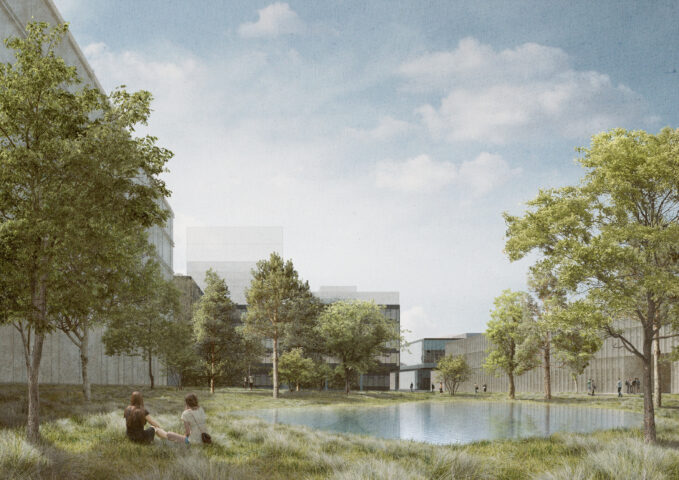
Attractive open spaces should ensure a high quality of stay and support biodiversity on the campus.
In order to protect the surrounding landscape, the campus will be developed inwards and densified within the existing area. A green ring road around the campus symbolises this development and serves as a transition from the campus to the landscape. Attractive open spaces will ensure a high quality of stay and further promote biodiversity on the campus. The campus should be easily accessible by environmentally friendly means of transport such as public transport or bicycle. To relieve the local public transport system, a direct electrically powered bus, the so-called eLink, already runs between the Hönggerberg Campus and the Campus Zentrum for ETH members. Other local services such as bike sharing are available and are being continuously expanded. The current urban district character of the Campus is to be further strengthened. The central Wolfgang-Pauli-Strasse will become a lively and green promenade with versatile ground floor uses for the public. The central “piazza” will also gain in importance in the future and will invite people to meet and exchange ideas.
Das Ziegler-Areal soll gemäss heutiger Planung zu einem vielfältigen Quartier mit Schwerpunkt Wohnen entwickelt werden. Seit der Spitalbetrieb auf dem Areal im Jahr 2015 eingestellt wurde, sorgt die Stadt Bern als Grundeigentümerin mit verschiedenen Zwischennutzverträgen für Leben und Vielfalt auf dem Gelände. Insgesamt steht heute eine Nutzfläche von rund 23’000 Quadratmeter zur Verfügung.
So betreibt die Firma ORS Service AG im Auftrag des Staatssekretariats für Migration (SEM) das einstige Bettenhochhaus als Empfangs- und Verfahrenszentrum. Der Kanton Bern zeichnet als Mieter der Räumlichkeiten des Renferhauses verantwortlich und stellt diese der Medizinischen Fakultät der Universität Bern zur Verfügung. Büroräumlichkeiten und eine Wohnung sind im Haus Bellevue untergebracht. Zur Wohnnutzung dient auch das Personalhaus 2 sowie das Wohnhaus Kirchbühl.
Der Verein Boulissima betreibt im Personalhaus Ost/West eine IndoorBoule-Anlage, während der Verein Ziegler-Freiwillige im Personalrestaurant ein Begegnungszentrum für Quartierbewohnende und Asylsuchende geschaffen hat. Ansonsten wird das Gebäude vom Hostel77, der Geschäftsstelle des Vereins «Helvetiarockt», als Studentenwohnheim und von der Quartierküche Ziegler genutzt. Hierbei handelt es sich um die erste Quartierküche der Stadt Bern, die seit dem Beginn des Schuljahres 2019/20 insgesamt 19 Tagesschulen und Kitas mit Mahlzeiten versorgt.
Das Leitbild für die Entwicklung des Ziegler-Areals wurde in Partizipation mit den verschiedenen Anspruchsgruppen erarbeitet. Auf Grundlage dieses Leitbilds wird eine Areal- und Nutzungsstrategie entwickelt. Diese soll den zuständigen politischen Gremien Anfang 2023 zur Beschlussfassung vorgelegt werden. Die Volksabstimmung zur Planungsvorlage dürfte frühestens 2028 stattfinden.
Das Areal grenzt direkt an die Gemeinde Köniz an. In unmittelbarer Umgebung liegen der Naherholungsraum Gurten und dessen Talstation. Das Gelände ist durch die Buslinien 19, 22 und 29 bereits heute gut erschlossen. Ein mögliches zukünftiges Wohnareal soll sich sorgfältig in sein Umfeld einfügen und dank vielfältigen Nutzungen – die sich mitunter aus den der-zeitigen Zwischennutzungen ergeben können – zu einem belebten Ort werden.
Wir verwenden Cookies zur Unterstützung und Verbesserung unserer Dienste. Mit der Nutzung dieser Website erklären Sie sich mit der Verwendung von Cookies einverstanden. Weitere Informationen finden Sie in unserer Datenschutzerklärung.