Tag: Gemeinschaft

  • New partnership promotes regional networking in Eastern Switzerland

    New partnership promotes regional networking in Eastern Switzerland

    The St.Gallen-based association IT rockt! and collektiv AG will be working together in future. According to a press release, IT rockt! Will move into premises in the coworking space collektiv (st.gallen). This means that IT rockt! will be “at the centre of events”, which will also enable the Eastern Switzerland IT cluster to expand its offering for members and employees. From September, IT rockt! will also be more flexible than before when organising events at collektiv (st.gallen).

    According to the press release, the collaboration between the two organisations will promote local exchange. This will promote regional networking. “We are very much looking forward to working with collektiv (st.gallen)”, Eva De Salvatore, Managing Director of IT rockt!, is quoted as saying in the press release. “The stimulating atmosphere creates ideal conditions for our IT community, and the region will benefit from such an enriching programme.”

    “It’s great to have a partner like IT rockt! at our side,” adds Majid Parente, founder and CEO of collektiv AG.

  • Answers to the challenges of the urban future

    Answers to the challenges of the urban future

    Around 56% of the world’s population currently lives in cities, a figure that is set to rise to 70% by 2050. This urbanisation brings with it numerous challenges, including increasing demands on space and land use as well as conflicting objectives between different sectors. Forward-looking planning is essential in order to make cities, rural areas and the areas in between fit for the future. BAU 2025 will show what answers already exist and where new approaches need to be developed.

    Blurring boundaries between urban and rural areas
    Traditionally, urban and rural areas were defined by clear geographical and functional boundaries: cities as centres of population, industry and services and the countryside as an agricultural area. However, these boundaries are becoming increasingly blurred and the challenges facing urban and rural areas and the space in between are becoming more and more similar. Issues such as demographic change, necessary infrastructure, mobility and sustainable spatial planning and settlement development affect all regions equally.

    Spatial planning and spatial development
    The tasks of spatial planning and spatial development are central to the sustainable design of our living spaces. These range from sustainable land use and the avoidance of land sealing to the promotion of social integration and quality of life. The “New Leipzig Charter” serves as a policy document of the National Urban Development Policy and offers guidelines for innovative and sustainable solutions in urban planning and neighbourhood development. The digital transformation and changing demands on consumption and mobility require a new mix of production, work and living in favour of vibrant neighbourhoods.

    Transformation of existing buildings
    The adaptation and upgrading of existing buildings is a key future task for the construction industry. Intelligent concepts for the flexible conversion and continued use of existing buildings help to preserve cultural identity and minimise emissions. Examples of this include the conversion of former industrial sites into vibrant urban districts and inner development in rural areas, which revitalises and uses existing buildings. Innovative projects combine public infrastructure and social services, promote the sustainable use of resources and revitalise town centres.

    Ecological transformation as an investment in the future
    The ecological transformation of our cities and rural areas is a genuine investment in the future. It leads to climate-friendly living conditions and offers economic added value for everyone involved. Architects, interior and landscape architects and urban planners combine ecological, social, economic, functional and design aspects and support the harmonisation of individual interests with the common good. Prof. Lydia Haack, President of the Bavarian Chamber of Architects, emphasises the importance of “ClimateCultureCompetence” and the responsibility of members to drive forward the ecological transformation in planning and construction.

    Affordable housing
    Affordable housing is crucial for stabilising local communities and the economy. The creation of 400,000 homes per year, as agreed in the coalition agreement, contrasts with the decline in residential building permits. New strategies for repurposing existing buildings, such as office buildings or hospitals, as well as innovative forms of housing that focus on community and openness, are approaches to creating affordable housing and promoting social interaction.

    New formats and processes
    Sustainable development in urban, spatial and regional planning requires new processes, methods and tools in order to be able to react quickly to current challenges. The rapid digitalisation and technological progress of the last 20 years require dynamic processes that need to be continuously adapted. Scenario development and innovative participation formats promote new ways of co-design and acceptance. Best practices and scalable impulses will be presented at BAU 2025, as will the necessary product and system innovations.

  • The Rolf-Liebermann-Weg on the outskirts of Zurich

    The Rolf-Liebermann-Weg on the outskirts of Zurich

    Das Projekt «Rolf-Liebermann-Weg» entwickelt von Mettler Entwickler AG mit der Bauherrschaft Asga Pensionskasse, profitiert von seiner einmaligen Lage am Stadtrand von Zürich, zwischen dem Schulhaus Staudenbühl und den idyllischen Grünflächen des Hürst-Gebiets. Die Hanglage eröffnet spektakuläre Ausblicke auf den Zürichberg und die Alpen, während die gute Anbindung an das Verkehrsnetz und die Nähe zu Einkaufs- und Dienstleistungszentren urbanen Komfort bieten.

    Die geplante Wohnsiedlung zeichnet sich durch ihre L-förmige Anordnung aus, die grosszügige Freiräume für Gemeinschaftsaktivitäten und individuelle Entfaltung lässt. Der vielfältige Wohnungsmix reicht von kompakten 1½-Zimmer-Wohnungen bis zu geräumigen 5½-Zimmer-Wohnungen, um ein breites Spektrum an Bewohnerinnen und Bewohnern anzusprechen – von Singles über Senioren bis hin zu Familien.

    Architektonisch setzt das Projekt auf einen innovativen Hybridbau. Eine Kombination aus tragendem Mauerwerk im Inneren und einer ästhetisch ansprechenden, hinterlüfteten Holzfassade. Betonelemente in den Untergeschossen und den Erschliessungskernen sowie die Wohnungstrennwände garantieren Stabilität und Privatsphäre. Die begrünten Dächer fördern die Biodiversität und das Mikroklima der Siedlung und werden durch die Integration von Photovoltaikanlagen ergänzt, die nachhaltige Energiegewinnung unterstützen.

    Mit der geplanten Fertigstellung Ende 2027 setzt der «Rolf-Liebermann-Weg» neue Massstäbe für modernes, nachhaltiges Wohnen in Zürich, indem er die Balance zwischen Natur und städtischem Leben meisterhaft gestaltet.

  • Glarner Kantonalbank seeks projects for sustainability award

    Glarner Kantonalbank seeks projects for sustainability award

    The Glarner Kantonalbank(GLKB) awards the Glarus Sustainability Prize once a year. With this award, GLKB aims to promote projects and initiatives by Glarus residents that contribute to sustainable development in the canton. The prize is endowed with CHF 10,000. According to GLKB, applications for the third edition of the prize can be submitted from now until 30 June.

    Projects that deal with at least one of the three pillars of environment, society and economy can be submitted. The environment includes the reduction of greenhouse gases and renewable energies, energy efficiency, conservation of resources, reduction of harmful substances or biodiversity. In the area of society, the projects should deal with fairness and justice, social commitment or the promotion of Glarus culture. For economic development, ideas are sought that contribute to the creation of local jobs or include sustainable business models with development potential and innovative technologies.

    Private individuals and legal entities such as associations can take part. Research projects and applications for scientific work are also eligible, provided they “have a clear sustainability impact on the canton of Glarus” or, in the case of supra-regional impact, the designated prize winners have a direct connection to the canton of Glarus, according to the press release.

    Last year, the Obstalden heating network won the prize. The heating network is fuelled solely by local and renewable energies and secures jobs. The project was selected from a total of 21 entries.

  • Increased efficiency in property management

    Increased efficiency in property management

    Although intergenerational living concepts have the potential to strengthen coexistence in neighbourhoods, many owners of large property portfolios are reluctant to implement them. The reason for this lies in the lack of experience with the administrative burden of these special forms of housing, which differ significantly from conventional offers.

    In order to meet these challenges, an orientation framework and a toolbox have been developed that offer insights into the necessary administrative tasks and questions that need to be clarified. The aim is to provide owners, portfolio managers and property managers with a clear guideline to simplify the realisation of such innovative forms of housing. These useful tools emerged from an intensive exchange of experience organised by Zimraum and Stratcraft, in which various stakeholders took part. In a total of four brown bag meetings, essential topics such as marketing, letting, operational management and advice on project development were discussed and solutions developed.

    With the new orientation framework and the toolbox, SVIT Zurich is providing important impetus for the property sector by not only paving the way for the implementation of community-promoting forms of housing, but also helping to rethink and redesign housing for the elderly.

  • New forms of housing at the centre of a recent study

    New forms of housing at the centre of a recent study

    At a time when social interaction is increasingly coming to the fore, a new study by Dr Joëlle Zimmerli from Zimraum and Stratcraft provides valuable insights into the design of forms of living that promote social interaction. Supported by the Age Foundation, SVIT Zurich and the Swiss Real Estate Institute, the study looks at how properties need to be planned and managed in order to facilitate and encourage different types of encounters.

    The study identifies and analyses three main categories of encounters: low-threshold encounters that occur spontaneously and by chance; neighbourly encounters that are facilitated by deliberate architectural decisions such as arcades or attractive open spaces; and communal encounters that are created by specially planned and managed infrastructures such as common rooms.

    The decisive factor for the success of these forms of encounter is the customisation to the needs of the respective target group. The authors of the study emphasise that there is no universally best solution, but that the choice of meeting form depends on the specific expectations and needs of the residents. Building owners and developers are therefore required to clearly define the target group to be addressed and the requirements for management and social interaction in the residential projects as early as the strategic planning phase.

    With this well-founded analysis, the study makes an important contribution to the discussion about the future of housing and shows how well thought-out planning and management can have a positive influence on coexistence in modern society. It provides valuable guidance for anyone working in the property sector who wants to increase the importance of social interaction and community within housing projects.

  • Communities can strengthen Alpine destinations

    Communities can strengthen Alpine destinations

    Community building is an approach that can be used to minimise seasonal fluctuations in Alpine destinations and combine tourism with living space, Andermat Swiss Alps AG explains in a press release. Together with Bregaglia Engadin Turismo and the Graubünden University of Applied Sciences, it has launched a research project funded by Innotour to explore ways of building resilient communities. The research partners have now presented their initial findings in a recent report.

    In the report, communities are understood as networks with a group identity. In mountain regions, they form in different compositions of locals, second home residents, guests, employees and employers. According to the researchers’ findings, three areas are crucial for the development of communities. Firstly, the understanding of identity at the centre of each of these communities. The second and third areas are collective experience and structure.

    According to the press release, building and expanding resilient communities is time-consuming and costly. The communities “require coordination, maintenance and moderation, which in turn emphasises the targeted activation of individual community members”.

  • Thun’s step into the vibrant future

    Thun’s step into the vibrant future

    The area along the picturesque River Aare, which stretches between the bustling city centre and Lerchenfeld, holds a vibrant future for the city of Thun. The Tryber development will create a new, mixed-use and sustainable district that promises a wide range of possible uses. The special feature here is the deliberate retention of local qualities such as existing jobs, existing buildings and the favourable location, while the new forms of use are being introduced gradually and thoughtfully.

    A lively mix of regional businesses, culture, local recreational opportunities, gastronomy and mixed residential construction is being created in the Tryber. This mix not only revitalises the district itself, but also contributes to the vitalisation of the entire city and creates a new, vibrant sub-centre that enriches Thun as a whole.

    The foundations for this transformation from a pure workplace area to a lively, mixed district were laid in the “STEK 2035 urban development concept”, which identified the Thun-Nord area as one of four premium development priorities. Cantonal planning has given the area top priority. An important step towards planning and development security was taken with the start of work on the revision of the ESP Thun North structure plan. This structure plan forms an essential spatial and urban planning basis for the larger, as yet undeveloped areas of the Tryber Quartier.

    The development is a long-term endeavour that will gradually create an interesting mix of residential, commercial and leisure space on an area of 110,000 m2 . Where ammunition was once manufactured, a space for living, working and relaxing is now being created.

    The central company behind this project, RUAG Real Estate Ltd, is planning to revitalise the area along Uttigenstrasse in the Thun North development focus (ESP) and create a completely new sub-centre. An integral part of this development is the opening up of Uttigenstrasse, which has been reopened to traffic after a long break of 40 years. The planned new “Thun Nord” S-Bahn stop is also an important element in improving access to the site.

    RUAG Real Estate Ltd has a sustainable vision for the development of the Tryber. It is not intended to be an abrupt change, but a gradual transition that makes the most of the existing building fabric and only creates something new where it is absolutely necessary. Innovative concepts such as co-working spaces, pop-up uses and other interim uses are being considered in order to create a “trendy quarter”.

    RUAG Real Estate Ltd’s ambitious revitalisation of the Patronenfabrik visibly marks the start of the guided Tryber development. Around 1,000m2 of light-flooded and freely divisible office and studio space is being created in a stately historic building directly on Uttigenstrasse and in the immediate vicinity of the future S-Bahn station.

    The S-Bahn station in particular will not only position the Tryber as a local link between Thun’s city centre and Lerchenfeld, but will also increase its accessibility and attractiveness beyond the region towards Bern, the Mittelland and even as far as Valais. The coordinated planning between RUAG Real Estate AG and the planning department of the City of Thun ensures that the Tryber project will proceed in harmony with the other planned developments in the Thun North ESP and lays the foundation for a dynamic, well-connected and vibrant community that will take root in Thun in the coming years.

  • Future-oriented neighbourhood management: cultivating an active living space

    Future-oriented neighbourhood management: cultivating an active living space

    It is essential to involve all relevant actors in the neighbourhood design process to promote social sustainability. This includes both residential and commercial tenants. The creation of activity and meeting zones not only strengthens social cohesion but also provides a platform for business synergies.

    Added value through neighbourhood activation
    The active management of a community increases the attractiveness and value of the neighbourhood, which has a positive effect on the marketing of vacant spaces. At the same time, sustainable social hubs are created that strengthen the sense of community.

    Pioneers in nationwide implementation
    Initial projects in various neighbourhoods in Switzerland show the success of this approach. For example, a pop-up event was launched in Winterthur that combined gastronomy and culture for six weeks. Due to the great popularity, this concept will be further expanded and also implemented in Zurich for the coming winter.

    A young but promising discipline
    Although community management is still quite new as a field, it is seen by experts as a promising and as yet untapped area. “We see great potential in this approach and want to develop and promote it,” say industry experts. I hope this paraphrase meets your needs and offers a new perspective on the subject.

  • PostFinance and GLKB join CredEx

    PostFinance and GLKB join CredEx

    Credit Exchange AG has gained two new shareholders, PostFinance and GLKB, according to a press release. The two banks will also sit on the company’s board of directors. Mobiliar and Swisscom from Berne, Vaudoise Insurance from Lausanne and Bank Avera from Wetzikon ZH are already represented on the board. Mobiliar and Vaudoise Versicherungen will also participate in the current capital increase.

    The new shareholders want to help expand the mortgage marketplace CredEx. To this end, PostFinance will also contribute its comparison and closing platform Valuu to CredEx. Specifically, Valuu is to be transferred to the joint venture CredEx, as PostFinance explains in a statement. CredEx will then bundle the brokerage business under the Valuu brand and continue to operate the brokerage business.

    GLKB is already a long-standing partner of CredEx. “Over the years, a unique settlement ecosystem has been developed together with GLKB, which has greatly contributed to CredEx’s success,” Andrea Canonica, CXO of Credit Exchange AG, was quoted as saying in the statement. “With GLKB’s rich experience in the fintech sector, I am convinced that we will also achieve similar milestones together on the financing side,” Canonica added.

  • Papillon: Vielfältiger Wohnraum

    Papillon: Vielfältiger Wohnraum

    Wie ein Schmetterling entfaltet sich das neue Quartier «Papillon» bei Köniz. Der «letzte Flügelschlag» ist auf 2028 geplant. Bis dann finden hier rund 2000 Menschen einen neuen Lebensraum – inmitten von Wäldern und Wiesen. Die insgesamt acht Baufelder werden auf einer Gesamtfläche von
    324’000 m2 schrittweise entwickelt.

    Bereits bewohnt sind die rund 250 Wohnungen von «Aurora» und «Eisvogel». Die sechs hofartig angelegten Gebäude des «Monarch» umfassen 218 1,5- bis 4,5-Zimmer-Wohnungen. Diese sind im Herbst 2022 bezugsbereit. Den Auftakt zum östlichen Teil bildet ab 2025 der «Feuerfalter» mit 240 Wohnungen. Dieser erfüllt unter anderem mit Wärmedämmungen und Holzfassaden die Anforderungen an ein «Plusenergie-Quartier» und «2000-Watt-Areal». In den sechs Gebäuden von «Cleopatra» entstehen ab 2023 120 Miet- und STWE-Wohnungen mit nachhaltiger Bauweise. In den letzten drei Baufeldern «Apollo», «Heliconius» und «Pallidana» werden rund 300 weitere Wohneinheiten realisiert. Im ganzen Quartier wird nachhaltig und klimaneutral gebaut. Das Ziel: Mindestens 50 Prozent des Jahresenergiebedarfs vor Ort selbst zu produzieren. So werden beispielsweise Photovoltaik- und Wärmepumpen-Anlagen errichtet.

    Die insgesamt rund 1000 Miet- und Eigentumswohnungen eignen sich mit ihren Grössen von 40 bis 130 Quadratmetern für Singles, Paare und Familien. Dreimal pro Stunde hält ein Bus in der Papillonallee. Direkt vor der Haustür finden die Bewohnerinnen und Bewohner Einkaufsmöglichkeiten, eine Kita, Schule, Sportplatz sowie soziale und gemeinschaftliche Angebote. Eine Sozialplanerin ist eigens dafür da, den Gemeinschaftsgeist zu fördern. Von der Interessengemeinschaft «Eisvogel»
    werden regelmässig Quartierfeste, Bastelnachmittage, Schachturniere und
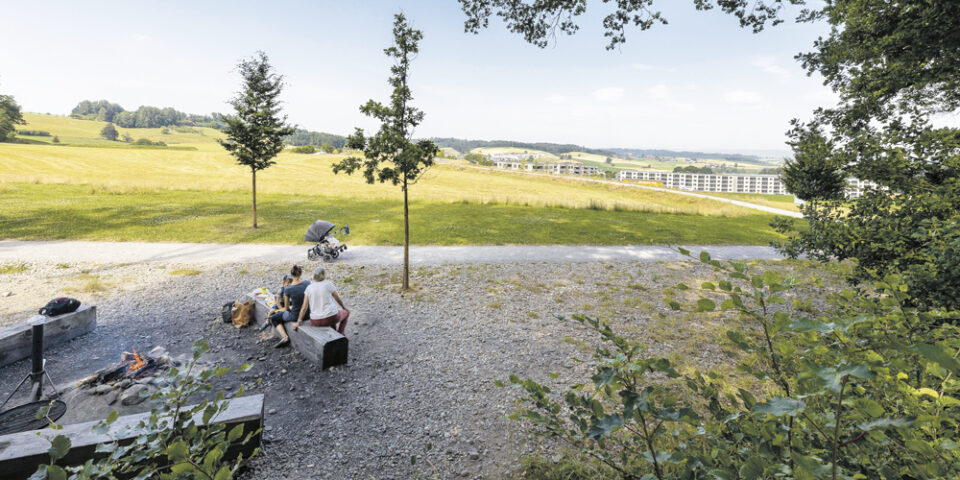
    andere gemeinschaftsfördernde Akti-vitäten veranstaltet. «Ruedü» bietet frische Bio-Lebensmittel von lokalen Produzenten im 18 Quadratmeter grossen Holzcontainer rund um die Uhr zur Selbstbedienung an. Der nahe Wald und die «Tubetränki» sowie die «Allmend» mit Grillplätzen und Fernsicht in den Jura sind zudem beliebte Destinationen für Erholungssuchende, Ausflügler, Sport- und Naturfreunde.

    Dieser Pavillon beherbergt die «IG Eisvogel».

    In absehbarer Zeit bildet der Weiler Ried als Quartierzentrum das Herzstück der Siedlung: Ein aus Leichtholz erbautes PRISMA-Gebäude wird neben einem Lebensmittelladen, Gewerbeflächen sowie Gastronomie auch Loftwohnungen beherbergen. Zusätzlich werden drei neue Mehrfamilienhäuser gebaut. Und in einem der ehemaligen Bauernhäuser ist ein Gemeinschaftsraum für die Quartierbewohner vorgesehen.

    Blick vom nahegelegenen Waldrand auf das Quartier.

  • Branch Collab – everything is there, everything is included

    Branch Collab – everything is there, everything is included

    All the user has to do is bring their personal device – WiFi, printer, coffee bars and everything they need to work are already available in the Branch Collab. And here you not only work at your own table, but also in the work lounge and in creative zones, in lobbies, in big rooms and at the “work bar”. The opportunity to meet other entrepreneurs and exchange experiences over a casual coffee is a great advantage in creative work and networking.

    Work as a community project
    The new co-working area enables the exchange of ideas and opinions, increases productivity and enables more targeted work. More sustainable and often more unconventional results are achieved collaboratively. In addition, the Branch Collab provides meeting rooms with modern equipment, which allow presentations to be held with customers and employees in a professional environment.

    Industrial environment
    Branch Collab is an initiative of Halter AG, which also relocated its headquarters to Schlieren to JED last year. The architectural concept of JED combines sustainably converted industrial infrastructure with pioneering new office architecture and is designed entirely for knowledge transfer, creativity and innovation.

    Flexible booking packages
    Workplaces and meeting rooms can be rented flexibly and on an hourly or daily basis. Attractive packages offer individuals and smaller companies modern plug & work workplaces as well as meeting rooms, work lounges and creative rooms – all of this paired with varied gastronomy – from the Caffetino coffee bar with its own roastery to the Eve’s Kitchen restaurant.