Tag: Geothermie

  • Change of ownership to accelerate growth in the geothermal market

    Change of ownership to accelerate growth in the geothermal market

    The investment company Dundee AG has acquired Bohrfix Erdsonden AG, according to a press release. The company is one of the most established and successful independent providers of geothermal probe drilling in Switzerland, with around 240,000 meters drilled annually and 1150 boreholes worldwide.

    With the new owner, the drilling company will have a slightly different management structure. Effective immediately, Hans Rosenberger, Chairman of the Board of Directors of Dundee AG, is Chairman of the Board of Directors of Bohrfix Erdsonden AG. Sascha Jordi will continue to manage the company operationally. Jordi has been a drilling foreman since 1998 and has worked as a project manager at Bohrfix Erdsonden AG since June 2025. Vinzenz Schönenberger will remain Commercial Director and Delegate of the Board of Directors. Despite the change in management structure, all existing employees will be retained. Nothing will change operationally for customers and clients.

    “With the acquisition of Bohrfix Erdsonden AG, we are investing in a company with an excellent market position, an experienced team and great growth potential in the geothermal and renewable energy sector. We are looking forward to this exciting partnership,” Hans Rosenberger is quoted as saying.

    The background to the takeover is the decision by the previous owner Alban Berisha to concentrate fully on the further development of his investment and real estate portfolio. The new owner plans to further develop the market-leading position of Bohrfix Erdsonden AG and also to invest in growth, technology and personnel in the future.

  • Decarbonisation will rely on heat pumps in the future

    Decarbonisation will rely on heat pumps in the future

    The National Sports Centre in Magglingen will not be heated with heat from deep underground in future. According to a statement, the Federal Office for Buildings and Logistics (BBL) is discontinuing the project. The subsoil proved to be too complex. Deep drilling would therefore incur higher costs than forecast.

    The FBL launched the geothermal project in 2018. Studies had identified potential for hot water at a depth of 1,500 to 2,000 metres in 2023. The intention was to exploit this potential as early as 2029.

    However, the BBL is sticking to its intention to decarbonise the sports centre’s heat supply. To this end, it plans to use geothermal energy closer to the surface and heat pumps. These are to replace natural gas and wood pellets as the main heat suppliers. However, this is not likely to be possible until 2031 at the earliest, according to the press release.

  • Haute-Sorne pilot project demonstrates usable geothermal reservoir

    Haute-Sorne pilot project demonstrates usable geothermal reservoir

    According to a press release, Geo-Energie Jura SA has completed theexploration phase of the Haute-Sorne pilot project. A deep borehole has confirmed that the rock can be utilised as a geothermal reservoir. The seismic limit values are complied with when the permeability of the rock is increased.

    Independent experts commissioned by the canton of Jura will now examine the documents from a safety point of view. The canton will then decide whether to continue with the project.

    Geo-Energie Suisse will now evaluate further projects in Switzerland with an electrical output of between 10 and 30 megawatts. Based on experience abroad, the company assumes that production costs for the generation of electricity of 15 centimes per kilowatt hour are possible. If the production of electricity is combined with that of heat, the economic efficiency could be further improved.

    Geo-Energie Jura SA, based in Bassecourt, is a joint venture founded in 2015 by Geo-Energie Suisse SA and the energy suppliers of Baselland(ebl), Bern(ewb) and Zurich(ewz). The Haute-Sorne project aims to explore the use of heat at a depth of 5 kilometres for a geothermal power plant.

    The energy suppliers in Ticino(aet), western Switzerland(EOS) and Basel(iwb) as well as Gasverbund Mittelland are also involved in Geo-Energie Suisse SA, which is based in Zurich.

  • Examination of geothermal potential in the Burgdorf area started

    Examination of geothermal potential in the Burgdorf area started

    According to a press release, Localnet AG and CKW want to examine the potential for utilising geothermal energy in the Burgdorf area. The local energy supplier will contribute its knowledge of Burgdorf, while the Lucerne-based Axpo subsidiary will contribute its experience from ongoing geothermal projects.

    If the review is positive, the two companies want to inform the population about the next steps before the end of the year. “It is very important to me that the population is informed transparently about this project right from the start,” said Mayor Stefan Berger in the press release. “In any case, it makes sense to carefully examine the geothermal potential in our region. This is also in line with the objectives of our ownership strategy of a sustainable energy supply and long-term security of supply.”

    Localnet supplies 11,500 customers in the region with electricity, 2,500 with gas and a further 350 with heat.

  • Geothermal energy in underground structures

    Geothermal energy in underground structures

    Engineers from the Laboratory of Soil Mechanics(LMS) at EPFL have investigated the use of geothermal energy in two very different applications: in a subway station and in an underground data center . In this Innosuisse project, the researchers, together with the internationally active engineering firm Amberg Engineering from the canton of Zurich, focused on optimizing air conditioning through the improved use of energy geostructures.

    These are building components that are located in the ground and can be used for heat conduction. These include energy piles, floor slabs and basement walls. The two studies were published in the journal “Tunnelling and Underground Space Technology”.

    The transferable models developed by the team took into account either most of the physical factors of the underground railroad infrastructure or the capacity to dissipate excess heat through geothermal activation, in addition to the geometry of the building and mechanical ventilation.

    Among other things, the researchers found that a geothermal system in an underground data center pays for itself in three to seven years. If geothermal energy replaces the heat generated by gas boilers, annual CO2 emissions at the typical site in this case study could be reduced by 45 percent.

    Sofie ten Bosch, a civil engineer at LMS and lead author of the study, was able to apply her PhD research to two specific applications in these two studies. She says: “The technology to assess the potential of geothermal energy in a given area is now mature and we see that the industry is ready to explore new opportunities for the optimal use of this sustainable heat source.”

  • Airport tests water reservoir under glacial channel

    Airport tests water reservoir under glacial channel

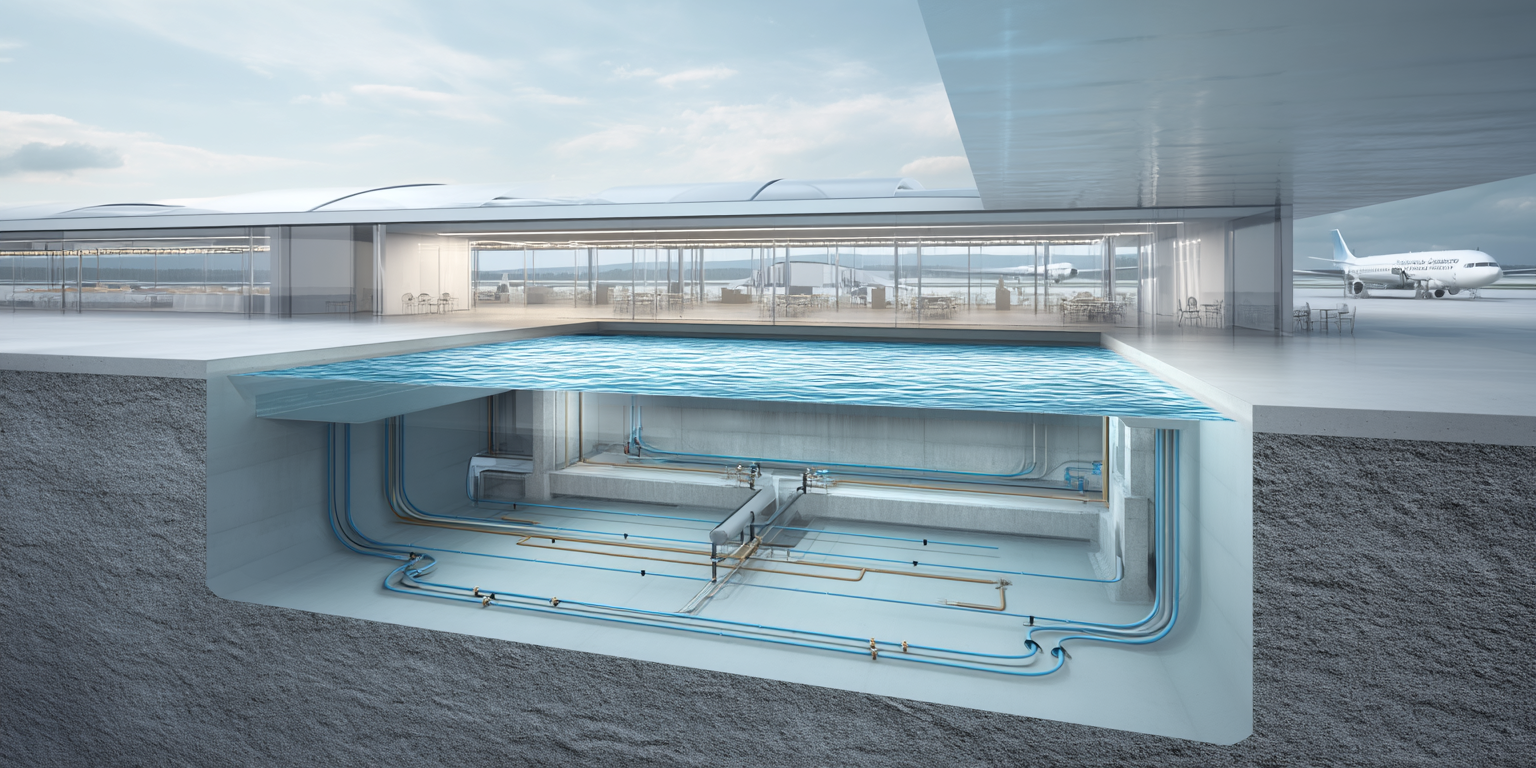
    Flughafen Zürich AG is starting the construction of a second test well in an ice-age channel located around 300 meters below the airport site, the airport operator announced in a press release. It plans to use the water-bearing channel as a heat and cold reservoir for emission-free heating and cooling of the airport building. A test well installed last fall had already delivered promising results.

    “The volumes of water that could be pumped and the flow rate of the water give us further confidence that the channel can be used to store heat and cold,” said Guido Hüni, Head of Energy and Decarbonization at Flughafen Zürich AG, in the press release. “Further tests are now needed to determine the extent to which this storage facility can be used.”

    A suitable location for the second well is currently being sought. Once installed, it will be connected to the first well for circulation tests. “This next step will allow us to test the efficiency of such a storage facility and, if the results are positive, we can then plan the actual expansion,” explains Hüni.

    The airport operator is counting on being able to cover the majority of the heating and cooling requirements for the airport building via the channel. Depending on the yield, the water reservoir could be combined with geothermal probe fields. The estimated cost of the investment is stated in the press release as around CHF 8 million. Flughafen Zürich AG can rely on financial support from the Swiss Federal Office of Energy.

  • Heat from a depth of 2000 meters planned

    Heat from a depth of 2000 meters planned

    The Federal Office for Buildings and Logistics (BBL) has announced an exploratory borehole for a planned geothermal project in Magglingen. Provided the necessary credit approval from the Federal Assembly and drilling permits from the cantonal authorities are obtained, deep water should be detected at a depth of around 1,500 to 2,300 meters.

    According to a press release, “several potential deep water reservoirs” are suspected there, which are to be used for a geothermal plant at the Magglingen National Sports Center of the Federal Office of Sport (FOSPO). The plant could supply heat there from 2029.

    This was preceded by underground investigations in 2023 by the FOBL. These were intended to help obtain a “geological image of the subsoil that is as precise as possible”. The exploration step that has now been announced is intended to further clarify whether the deep water is suitable for the economic use of a geothermal plant in the event of positive evidence.

    Seismic investigations are the basis of many geothermal projects to clarify the exact location of the deep water and because key figures such as water temperature, water volume and flow rate are lacking. The planned exploratory drilling reduces uncertainties and project risks.

  • New technologies for geothermal utilisation developed in Switzerland

    New technologies for geothermal utilisation developed in Switzerland

    Researchers at ETH are fully utilising energy from underground to generate electricity and heat. Several research groups at the university are exploring the possibilities of geothermal energy, the ETH announced in a press release. According to the statement, Switzerland is better prepared for the utilisation of geothermal energy than it was a few years ago in terms of technology, regulations and public acceptance.

    A group led by Stefan Wiemer, Professor at the Department of Earth and Planetary Sciences at ETH and Director of the Swiss Seismological Service, is conducting research in the BedrettoLab on minimising earthquake risks in so-called enhanced geothermal systems. A sensor-supported system monitors the creation of the necessary artificial cracks in which water heats up. The knowledge gained in the BedrettoLab is being utilised in the planning of the geothermal pilot power plant in Haute-Sorne JU.

    The group led by Martin Saar, Professor of Geothermal Energy and Geofluids in the Department of Earth and Planetary Sciences at ETH, is exploring the possibilities of closed raw circuits in which CO2 circulates. These so-called deep closed-loop advanced geothermal systems could be “a climate-friendly alternative to CO₂-intensive reserve gas power plants”, Saar explains in the press release. The group has also already patented so-called CO2-Plume Geothermal Systems. These combine the permanent storage of CO2 in rock with its utilisation for the production of heat and electricity. The storage of process and summer heat from buildings in rock, which can be used for heating in winter, is also being investigated.

  • Enerdrape wins sustainability award from AMAG

    Enerdrape wins sustainability award from AMAG

    Enerdrape has received recognition for its pilot project on energy efficiency in buildings. According to a press release, the Renens-based start-up was named the winner of the first AMAG Sustainability Challenge by car dealer AMAG Group for its innovative panel solution.

    The expert jury was impressed by the world’s first geothermal panel, which transforms underground spaces such as parking garages or tunnels into renewable sources of heating and cooling. The waste heat generated there can be used to heat and air-condition the rooms above without the need for drilling and without direct contact with the ground, according to the explanatory statement.

    The start-ups 8inks and Exnaton came second and third. Other finalists were CarDust and Grensol.

    Helmut Ruhl, CEO of the AMAG Group, was full of praise for the solutions presented. “On our way to decarbonizing our business model by 2040, we are relying on electromobility and photovoltaics as well as entrepreneurship and innovation. This requires new technologies and business models. that’s why we held the AMAG Sustainability Challenge for the first time in 2024. I am overwhelmed by the response and inspired and excited by the ideas,” he is quoted as saying.

    For its contribution to reducing CO2 emissions, Enerdrape will receive CHF 50,000 from the AMAG Climate Fund as well as a branded VW ID.3 for one year.

  • Successful drilling of Haute-Sorne geothermal project completed

    Successful drilling of Haute-Sorne geothermal project completed

    A pilot project for deep geothermal energy is underway in Haute-Sorne. The initiators, Geo-Energie Suisse and Geo-Energie Jura, have announced that the first borehole has been drilled. According to a press release, it took less than three months to explore the subsurface at a depth of 4000 meters. The borehole ran completely through the sediments and penetrated deep into the crystalline bedrock.

    This provides geological data on the underground in the Swiss Jura arc between Geneva and Basel. “From a scientific point of view, this is a great opportunity to significantly improve our knowledge of the geology of the Jura. Until now, the deep underground has only been described in such detail at a very localized level at a national level.”

    Strict environmental safety precautions apply to the project. There has been no damage or water ingress during ongoing construction work, and noise pollution has been kept to a minimum.

    In the view of Geo-Energie Suisse and Geo-Energie Jura, this step paves the way for innovative future prospects for a sustainable energy supply. The data will provide geological insights into the use of geothermal energy to generate electricity and heat. The first success was celebrated on August 28, 2024. Employees, operational, technical and scientific partners and political representatives were invited to the event.

    The site is suspended while the data is evaluated and the project progress is planned. Tests in the borehole and a geophysical campaign are scheduled for early 2025. The exploration phase is scheduled until the end of 2025.

  • Thurgau agrivoltaics and energy storage projects receive funding

    Thurgau agrivoltaics and energy storage projects receive funding

    Four projects will receive support from the EKT Energy Foundation. According to a press release, 20 applications were submitted to the foundation board for consideration in the second round of awards. All of the projects are working towards a secure, sustainable energy supply and the realisation of climate targets. They were convincing due to their high practical orientation and their connection to the canton of Thurgau. They are also “good examples of how both the Thurgau economy and Thurgau agriculture can benefit from the EKT”, according to Foundation Board President Fabian Etter.

    One of the research projects is in the field of agrivoltaics. Ways of dual utilisation of agricultural land are being investigated, both for the production of crops and solar power. A test plant with semi-transparent photovoltaic modules from the Arenenberg Agricultural Competence Centre is intended to provide insights into the suitability of varieties, weather protection, irrigation and light management.

    Two other projects relating to energy storage are also being funded, as these are central to the restructuring of the energy supply. One is being carried out at the animal carcass collection centre in the city of Frauenfeld, which is involved in the pilot project. The prototype of a sorption heat pump is being investigated. This will allow the waste heat generated during cooling to be stored thermochemically together with the electrical energy from the photovoltaic system during the summer months. The second energy storage project is a preliminary study investigating the opportunities and framework conditions for using modular sand batteries as heat storage systems.

    The EKT Energy Foundation sees further innovative approaches for the energy transition in the Thurgau Energy Utilisation from Underground 2023 project. The funding will be awarded in combination with a loan and is intended to support the basic research and planning work required to apply for funding from the canton and the federal government. The aim of the research is to gain insights into the utilisation of geothermal energy sources.

  • Venture Kick supports Borobotics with 150,000 Swiss francs

    Venture Kick supports Borobotics with 150,000 Swiss francs

    Borobotics from Winterthur has received 150,000 Swiss francs from Venture Kick for the further development of its innovative drilling robot after reaching the third stage of the programme. In response to the problem of the previously energy-intensive and expensive drilling of holes for geothermal probes, Borobotics is revolutionising geothermal heating processes with a drilling robot that can work in up to 90 per cent less space and at significantly lower cost, according to a media release.

    In addition to the high costs and large space requirements, previous methods bring disadvantages such as energy intensity, inaccuracy, noise pollution and landscape destruction, according to the release. Borobotics describes its development as “an earthworm-like robot that moves vertically into the earth” without a rig or drill pipe. It is intended to enable a much wider spread of geothermal heating.

    Borobotics emerged from a research project at the Zurich University of Applied Sciences, according to the release. The start-up wants to invest the 150,000 Swiss francs in several drilling tests of its robot in order to be able to present a functioning prototype at the geothermal energy trade fair GeoTHERM 2024 in Offenburg during demonstration drillings on 29 February and 1 March 2024.

  • Canton of Jura gives electricity from geothermal energy a new chance

    Canton of Jura gives electricity from geothermal energy a new chance

    Generating electricity from deep geothermal energy in Switzerland is given another chance. As announced by the Jura government, it wants to negotiate with Geo-Energie Suisse SA about a gradual resumption of the project. Additional safety requirements are to be set. In addition, an advisory committee made up of independent experts is to ensure the transparency of the project. If security is guaranteed, the government sees many advantages in the development of renewable energies, according to a statement from the canton.

    The canton approved the Geo-Energie Suisse SA project in 2015. It provides for the production of electricity from deep geothermal energy for 6,000 households. A magnitude 5.4 earthquake triggered by a similar project in Pohang, South Korea, in November 2017 also sparked fears in the Haute-Sorne region. An analysis by Geo-Energie Suisse SA came to the conclusion that a scenario like that in Pohang in the Jura was “unthinkable” due to the safety requirements. However, the project actually came to a standstill.

    Similar projects to generate electricity from deep geothermal heat had previously led to minor earthquakes in Basel and St.Gallen. The affected projects were then stopped.

  • Federal government uses geothermal energy for buildings

    Federal government uses geothermal energy for buildings

    Most of the buildings in the National Sports Center in Magglingen are currently heated with gas, according to a press release from the Federal Office for Buildings and Logistics (BBL). The BBL is currently realizing a number of new construction and renovation projects for the Federal Office for Sport at the sports center. For the first time, the federal government is using geothermal energy to supply heat to buildings. A new district heating network will supply both the existing and the new buildings.

    Geothermal energy from a depth of 1,300 meters is used for the heat supply. It is expected that the extracted water has a temperature of 30 to 50 degrees Celsius. For this purpose, two wells are being built. The warm water is pumped up via one, the cooled water is let down again via the other. In between, a heat exchanger on the surface takes the heat from the water and uses it to supply the building.

    While the gas supply currently emits 1,300 tonnes of CO2 annually, this should only be 70 tonnes in the future.

  • Riehen receives the green light for geothermal expansion

    Riehen receives the green light for geothermal expansion

    Riehen can continue with its planning for the expansion of another geothermal system. It would increase the number of residents supplied with climate-friendly thermal energy from the current 8,500 to 12,500. The referendum period expired at the end of October. The positive decision from the residents' council is now legally binding. This is now announced by Wärmeverbund Riehen AG ( WVR ).

    In the next step, seismic surveys to explore the subsurface for the geo2riehen project are due in summer 2021. A suitable location for the boreholes is thus sought. If the feasibility of the plant is confirmed, drilling could begin in 2023. They should open up more naturally occurring thermal water for heat utilization.

    An already existing feasibility study confirms that the project has “good prospects for success”. The drilling to promote the thermal water and the construction of the facility will cost around 20 million francs. The costs are shared between the two shareholders, the municipality of Riehen and the Basel energy supplier IWB . The Swiss Federal Office of Energy has promised a grant of 1.2 million francs and has announced a further 5.1 million francs.

    IWB's stake has risen from initially 27 to 50 percent. According to the WVR, this not only makes financing easier. The operation of the systems and the growing supply network can also be better coordinated with IWB: "The gradual and partial shutdown of the gas supply is thus optimally coordinated with the growth of the Riehen heating network."