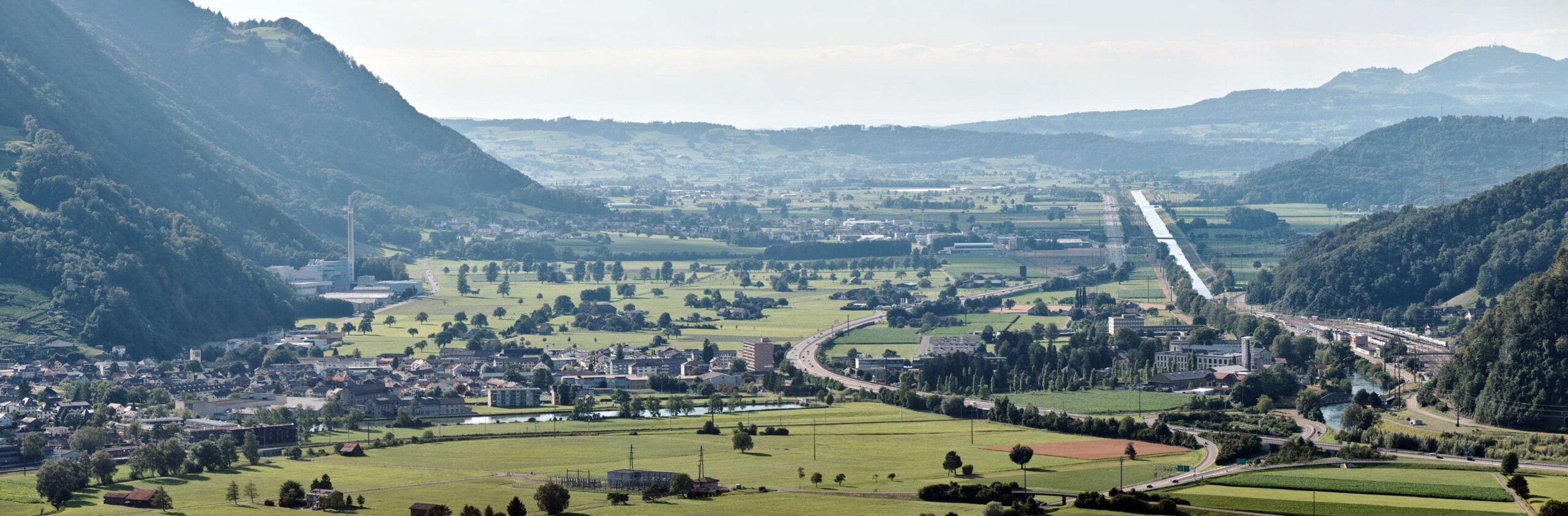
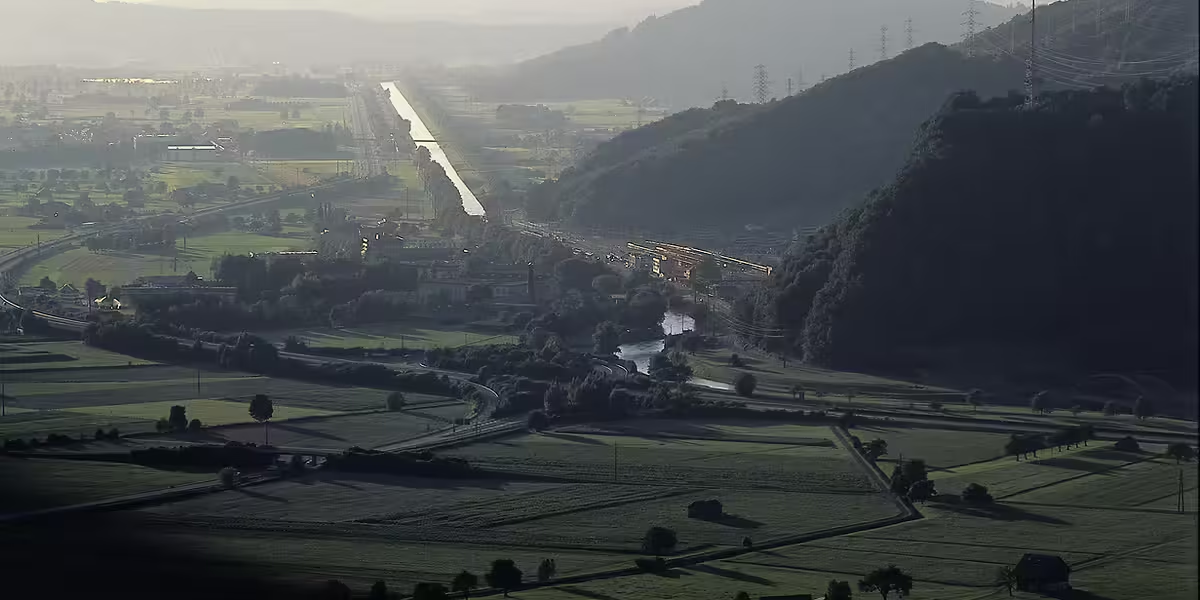
The Biäsche work area combines location qualities that are rare in this form. The motorway junction, a goods station and natural recreational areas are right on the doorstep. Between municipal boundaries, transport axes and the natural environment lies an area that is to be economically considered, intelligently planned and sustainably utilised. The plots are in public, private and cantonal ownership. A constellation that requires integrative development.
From area to function There is currently a lack of maturity in terms of planning and building law. Without development and development planning, the potential remains unutilised. For this reason, a test planning procedure examined various utilisation scenarios and development strategies. The aim was to create a clearly positioned, marketable economic area that is ready for low-emission, high value-added businesses. Staging this development is key. The site can only be developed sustainably in the long term with flexible, compatible concepts.
One location, many interests The municipality of Glarus Nord holds 3.8 hectares of undeveloped employment zone land in the Unterflechsen sub-area. The canton of Glarus owns a further 2.7 ha in the neighbouring Mittelflechsen area. There are specific interests for this area. A salmon farm and a new penal centre are under discussion. The area is supplemented by private land and existing uses. This diversity makes spatial coordination a key planning task.
Infrastructure as a driver of development Biäsche is ideally positioned in terms of transport links. The area is served by national transport routes operated by SBB and FEDRO. However, future-proof development requires that motorised traffic, public transport, pedestrian and bicycle traffic as well as supply and disposal infrastructures are coordinated and planned with foresight. This is the only way to create a location that is economically attractive and ecologically responsible.
Indicative project as the key to progress After the test planning for the Biäsche site development was completed in June 2023, the concepts of Ernst Niklaus Fausch Partner AG and Studio Vulkan Landschaftsarchitektur AG will be further developed into an indicative project by August 2025 as part of a synthesis phase. As a synthesis, the indicative project summarises the parameters of the site development that the signatories consider to be correct and shows the main features of how the site should develop in the short, medium and long term. This serves as the basis for the subsequent development plan and perimeter procedure.
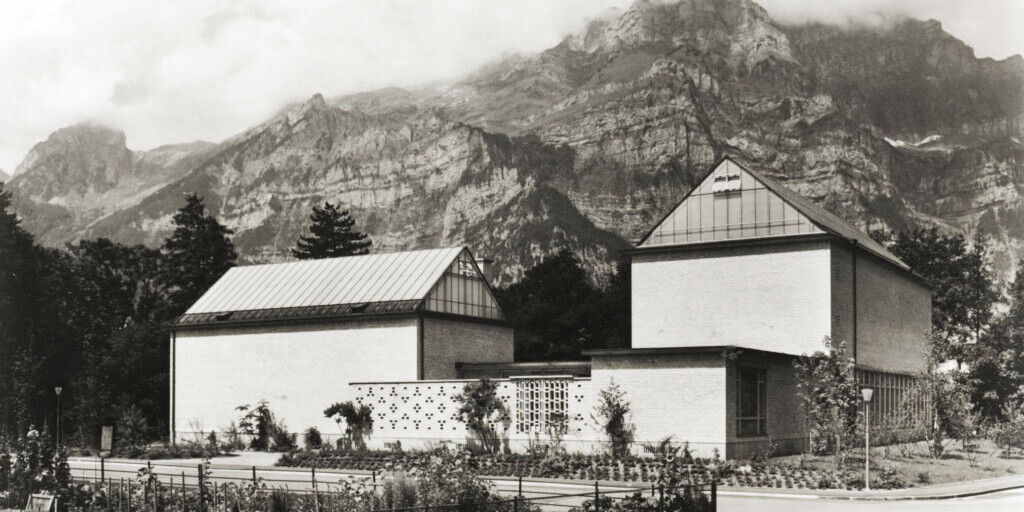
When the art historian and diplomat Gustav Schneeli was looking for a location for his own museum in 1942, he found the perfect place in Glarus. The Glarus Art Association, which had been considering the idea of its own museum for decades, recognised the opportunity for collaboration. Schneeli made his Symbolist and Impressionist-influenced works available and promised 250,000 francs for a foundation. The foundation stone for today’s Kunsthaus.
Architectural clarity with vision After Schneeli’s death in 1944, the architect Hans Leuzinger developed a project of remarkable consistency. The path led from classical approaches through numerous variations to a finely tuned lighting design. Scandinavian influences, careful site inspections and creative foresight formed a building that consciously distanced itself from monumental representational intentions and blended sensitively into the Glarus valley basin.
Political hurdles, patient negotiations The realisation was anything but straightforward. Disputes over the location, delays caused by the war, critical voices from the administration and the community of heirs as well as the threat of the foundation’s withdrawal jeopardised the project on several occasions. It was only through diplomatic skill, architectural persuasion and tireless commitment that construction could begin on the last possible day, 15 July 1950.
Art and architecture as a sign of the times The opening in 1952 was not only an architectural success, but also a strong signal for Glarus as a cultural centre. A cultural attitude manifested itself in a simple but expressive building that continues to have an impact today. Architect Reto Fuchs’ research reveals this masterpiece and its eventful construction history. The Kunsthaus Glarus stands for masterful architecture, the courage to take a stand and the idea of thinking big about culture in rural areas.
The approximately 30-hectare Jenny site of Fritz Caspar Jenny AG is deeply rooted in the industrial history of the Glarus region. Where textile production has taken place since 1834, a multi-layered site with new prospects is being created today. The proximity to Ziegelbrücke railroad station, the size of the site and the existing infrastructure make the area a key location for economic and urban development in the canton.
Planning with vision and participation A strategic master plan was developed as part of a multi-stage process, based on comprehensive test planning with four interdisciplinary teams. The resulting findings form the basis for a long-term development that is aligned with regional spatial planning, economic potential and social diversity. The winning design by Blättler Dafflon Architekten with Tony Fretton Architects and Studio Vulkan impressed with its strong combination of nature, building culture and open spaces.
Diverse use as a location strategy The site already combines a variety of uses. From the Carlsberg Supply Company to creative work and residential forms such as Loft Z25 and the Glarus cantonal vocational school. The master plan builds on this diversity and expands it to include new educational, service and residential facilities. A hotel project is also being examined. The aim is to permanently establish and sustainably revitalize the Jenny site as a business, residential and educational location.
Building culture as an identity-forming element Respectful treatment of the architectural heritage is central to the development. The site is part of the inventory of sites worthy of protection in Switzerland. Existing buildings of architectural and historical significance are to be preserved and integrated in a targeted manner. The listed riding stable, for example, is intended to enrich the new site concept as a defining element and contribute to the identity of the location.
Focus on the legal framework The implementation of the master plan requires adapted land use planning. The project is currently awaiting the legal validity of land use planning II of the municipality of Glarus Nord. The first steps towards rezoning have been taken, but key legal requirements are still outstanding. Once this process has been completed, the development potential of the Jenny site can be fully exploited. A decisive step for the future of the site.
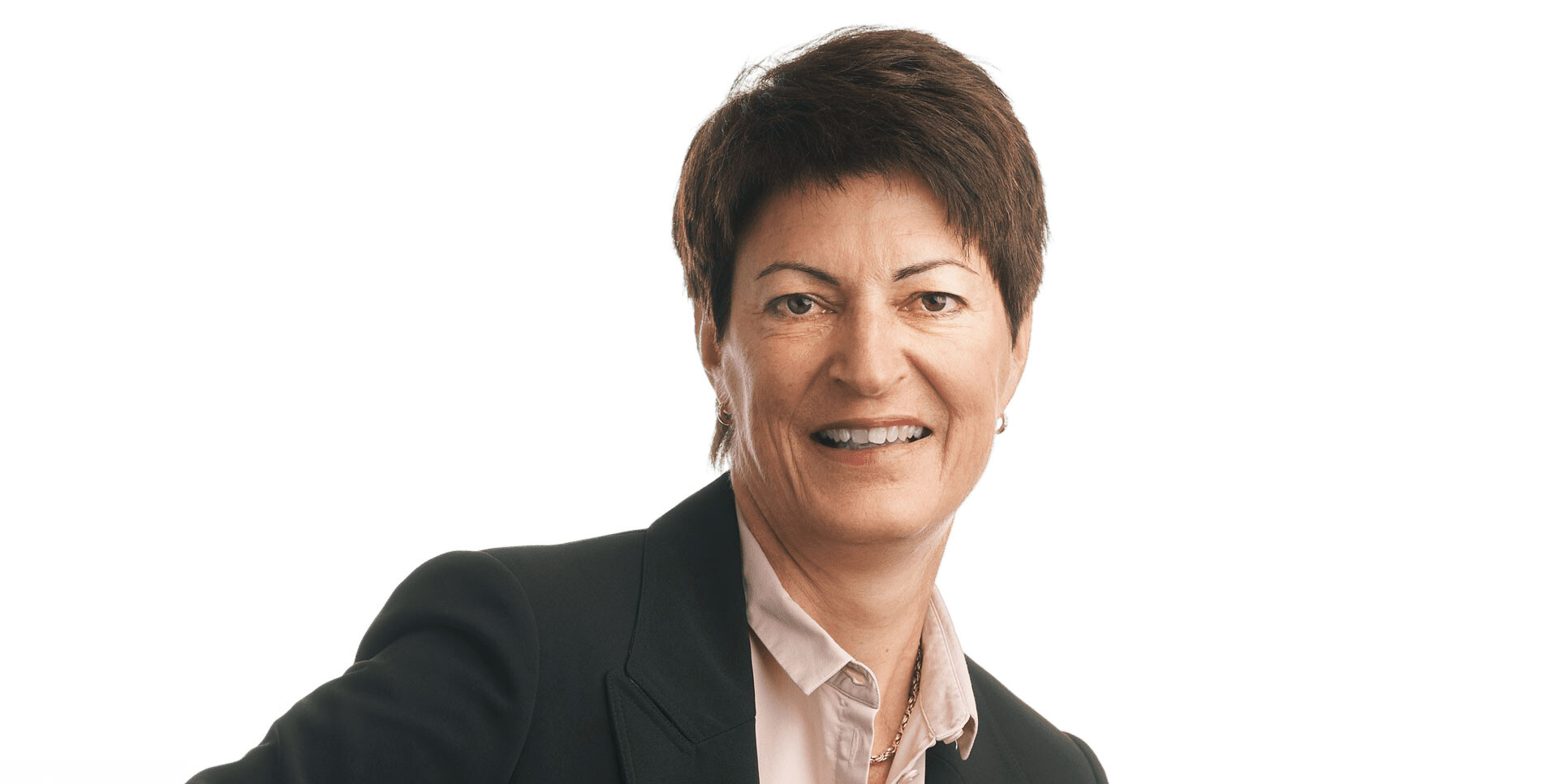
The canton of Glarus has a long industrial tradition. What impetus are you providing to strengthen economic competitiveness and create sustainable jobs? The canton of Glarus has always been extremely business-friendly. We were one of the first Swiss cantons to regulate economic development by law (1978). Glarus is also a Swiss pioneer in social legislation with the Factory Act (1864) and compulsory old-age insurance (1916). Against this background, Glarnerland is traditionally a modern business location with competitive advantages for employers and employees that may only become apparent at second glance. For example, the Glarnerland is large enough to offer companies sufficient space, but also small enough to make decisions quickly and unbureaucratically. The contact point for business provides pragmatic and reliable support to both company founders and existing companies or companies wishing to relocate. In our three large municipalities, which have merged in an exemplary manner throughout Switzerland, investors can find affordable real estate and employers can find well-trained, motivated employees who enjoy living in an intact environment with the advantages of a modern environment.
How does the Department of Economic Affairs promote innovative digital business ideas? On the one hand, the possibilities of digital transformation serve to redesign processes and products, but they also form the basis for the circular economy. This involves both greater resource efficiency and data management. As a result, tomorrow’s employees will know which materials were used in which processes. Supply chains are another opportunity: New digital processes enable a more robust, efficient and transparent supply chain. With this in mind, we are supporting the digital transformation in the Glarus economy with digitalization loans. The funding program has two million francs available until the end of 2027. Funding is available for innovative projects that incorporate new technologies in processes and production, create new products and business models and establish collaborations. Specifically, we carry out an analysis of the current situation in participating companies with the expertise of the Innovation Network Eastern Switzerland (INOS). The analysis is financed by the new regional policy (NRP) and includes an assessment of the current situation, including an action plan and roadmap for implementation. This basis is required for the application for financial support of up to CHF 100,000 for individual companies and CHF 300,000 for inter-company and/or industry-wide projects.
How do you think the real estate sector will develop in the industrial and commercial sector? The pressure from the agglomeration is noticeable in Glarnerland. However, population growth is moderate, which is conducive to sustainable development. The municipality of Glarus North has particularly high capacities in terms of industrial and commercial space, which are currently being used in several projects at the Bilten site. With active land management, we are focusing on sustainable development with high-quality industrial and commercial projects.
What trends do you see in the development of supply and demand in the residential sector? The majority of new residential construction projects are being implemented in the municipalities of Glarus and Glarus North. This also has to do with land use planning, which can take a holistic and progressive view thanks to the municipal merger. In Glarus South, land use planning is still undergoing a challenging political process, which is also being monitored by the canton.
How can you ensure that the development of the real estate market meets the needs of the population? Anyone who lives in one of our 29 villages, towns or districts appreciates the special features of their place of residence. These are reflected, for example, in the location or club life. Life is completely different in Elm or Braunwald than in the cantonal capital or in Näfels. And there again different from the Kerenzerberg or Lake Walen. This creates a sense of identity and solidarity, which keeps people here. This is consistent with the moderate pace of population growth and the comparatively stable real estate prices.
How can you ensure that your real estate market develops sustainably? With our unique combination of closeness to nature and urban proximity, with its manageable size and compact living and economic area, Glarnerland scores highly. Careful management of these advantages is therefore essential – they are our resources, our capital.
What infrastructure projects are planned by FEDRO and SBB and what potential for improvement do you see? Glarnerland is perceived as a rural region, but thanks to its location between Zurich and Chur, it has very good transport connections. The city of Zurich and the airport are only an hour away by car or train, one of the most important north-south axes runs through the canton, and private planes and helicopters can take off and land in Mollis.
Naturally, the canton of Glarus is also dealing with the increasing mobility requirements. In recent years, the canton has implemented three of four major road construction projects, in particular to provide future-oriented access to the Mollis airfield development focus. The fourth project to optimize access to the industrial area in the south of the municipality of Glarus is currently in the planning phase. The focus of our efforts is close cooperation with the federal government on the bypass projects to relieve congestion on the current main axis. We have received assurances from the federal government that the Netstal and Glarus bypasses will be combined into one overall project under the leadership of FEDRO. The aim is to relieve the canton of Glarus of all its road traffic problems.
In terms of public transport, we have had a new legal basis for future public transport services since the Landsgemeinde 2025. Our region is already well connected today with direct connections to Zurich and Rapperswil as well as transfer options in Ziegelbrücke to St. Gallen, Chur and Zurich. Our population and businesses depend on this convenience and the continuous half-hourly service agreed at the Landsgemeinde 2025. We are working hard to achieve this with the federal government and in cooperation with SBB and SOB. We are actively cooperating with companies to make commuting by public transport more attractive for employees – for example, the Bonus Pass creates incentives to switch from car to public transport.
Short distances within and between our localities also play a key role in mobility. For example, it only takes 20 minutes to cycle from Näfels, Glarus North, or from Schwanden, Glarus South, to the cantonal capital. The trend towards cycling is also reflected in the cantonal Cycle Path Act, which was passed by the Landsgemeinde 2024.
How does location promotion help to present Glarus as a liveable and future-oriented region? The canton of Glarus is the third most financially attractive place to live: in addition to low housing costs, we offer a moderate tax burden and comparatively low health insurance premiums. These are our major advantages in terms of financial factors. Added to this is the high quality of the living environment, which combines the advantages of the countryside with urban amenities. This is evident at first glance when you arrive in the canton of Glarus. Together with the impressive mountain scenery, the witnesses of early industrialization shape the landscape and life in our canton. The historic industrial areas, factory owners’ villas and workers’ settlements from the 19th century and the landscape are also the backdrop for films and TV series for good reason. In people’s everyday lives, this is reflected in a contrasting and lively environment with contemporary settlements for professionals and families who value living, working, culture and leisure in our modern communities. With this in mind, Glarus has been actively marketing the canton in a targeted manner for over ten years. This year, we are using our role as host of the Swiss Wrestling and Alpine Festival (ESAF) to put the spotlight on the canton of Glarus as a center of life. With the upcoming major event, the whole of Switzerland is turning its attention to the Glarus region. Under the motto “Really fabulous”, the focus is on working, living and leisure. The face of the campaign is the popular Glarus chef and influencer Noah Bachofen. He and his colleague are accompanied on their mission to create an authentic image film about the Glarus region. The campaign aims to make the unique Glarus lifestyle visible and tasty.
Why do skilled workers stay in the region and what does location promotion contribute to this? Of course, a good campaign alone is not enough. The municipal location promotion agencies make a major contribution to the high quality of life. They continue to develop their residential and leisure areas with new projects and in cooperation with investors – examples include the optimally developed development focal points at the Näfels/Mollis and Glarus railroad stations. The municipalities provide modern schools and supplementary family services, operate sports facilities and offer retail, gastronomy, medical care, industry, commerce and culture space for a lively and functioning everyday life. The canton ensures the operation of the cantonal school, the sports school, the vocational schools, the cantonal hospital, security and social services. The lean administrative structures enable an efficient and direct exchange between the cantonal specialist offices and those responsible at municipal level.
What is your long-term vision for Glarus as a business location? In the coming years, it is crucial for the canton of Glarus that the initiated development is implemented in a coordinated manner. It is important to support and accompany the private initiatives and at the same time create the right framework conditions for companies and skilled workers. If this succeeds, the canton of Glarus will be a secure, networked and economically strong canton with a strong middle class, surrounded by unspoiled nature.
Future-oriented and efficient structures are decisive for the success of a company. This also applies to the public sector. Glarus is the only canton that has consistently adapted its own structures to the new circumstances. With today’s highly efficient administration, we are fit for the future.
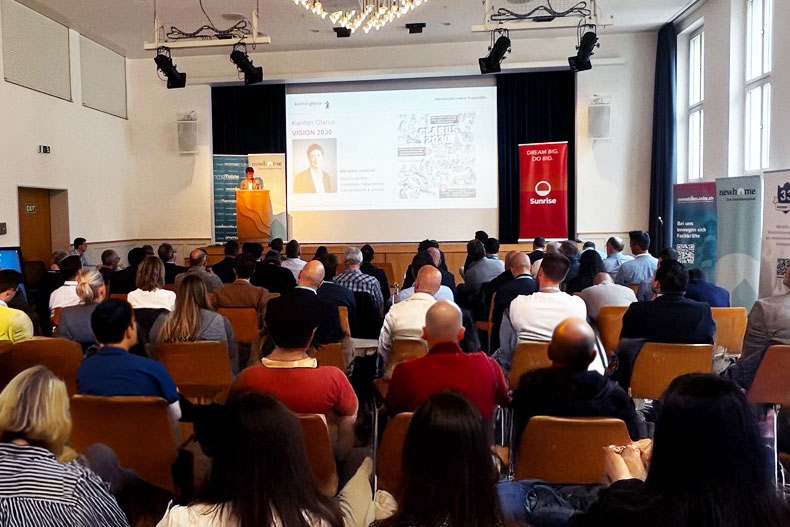
Monika Schärer opened the event with a clear impulse. The Glarus region is ready to reinvent itself and serve as a model for urban development in the Alpine region. Andreas Binkert, architect, lecturer and board member of the Nüesch Group, led the guests through the Spatial Concept Switzerland 2050, emphasizing the need for polycentric structures, forward-looking site development and environmentally friendly mobility and energy solutions. According to the SIA, a development strategy for the whole of Switzerland up to 2070 is needed, which serves as a binding basis for prioritization, weighing up interests and investment security.
Smart Valley Glarus The focus was on the question of how alpine regions such as Glarus can benefit from change. The vision of a “Smart Valley Glarus” was outlined, not as an artificially created city, but as a cluster-like spatial structure with high density, mixed use and seamless integration of existing villages. Education, the circular economy, digitalization and energy-efficient construction form the basis for this. Glarus could thus become a pilot region for an Alpine smart city in which sustainable ways of living and working are created.
Location quality and pioneering spirit Marianne Lienhard, the canton’s Director of Economic Affairs, emphasized the strong pioneering spirit and high location quality in her talk. The canton of Glarus is an “industrial pearl with a down-to-earth attitude” that is economically strong and at the same time offers space for quality of life, recreation and innovation. The heterogeneity of the localities and the close connection of the population to their places of residence are decisive locational advantages that strengthen social cohesion.
Active location development Andreas Mächler from the cantonal contact point for the economy showed how actively location development is being pursued. Thanks to revised land use planning, several hectares of building land are available in Glarus North. Well developed, centrally located and significantly cheaper than the national average. Companies benefit from attractive framework conditions, short distances to the administration and a dynamic relocation policy.
Real estate market analysis Andrea Bernhard from Wüst und Partner analyzed the current situation on the Glarus real estate market. Despite growing demand and an almost empty supply, the price level is stagnating compared to other regions. In Glarus South in particular, new construction activity is low and most of the housing stock is outdated. But this is precisely where the opportunities lie. Densification, flexible building zones and targeted development could provide new impetus, provided a balance can be struck between growth and identity.
Real Estate Award To conclude, Tim Caspar from Real Estate Award AG presented the upcoming award event on October 2, 2025. With over 400 decision-makers, a gala and awards ceremony in five categories, the innovative strength of the industry will be made visible here. A strong starting point for all those who want to help shape the future.
The immoTable Glarus has shown that the canton is at the beginning of a new stage. With a clear attitude, an open mind for cooperation and the courage to transform, Glarus can become a role model for sustainable development in the Alpine region, as a space for investment, innovation and a good life.
Company settlements are increasing again after the Corona dip. The Greater Zurich Area AG (GZA), as the location marketing organization for nine cantons, was able to settle a total of 125 companies in 2021, an increase of 36 companies compared to the first Corona year 2020. According to a statement by the GZA, 42 companies came from the USA (+20 ), 19 from Germany (+4), ten from Italy (+5) and five each from China (-6), Great Britain and Singapore.
Overall, the companies created 582 jobs in the economic area, an increase of 11 percent compared to the previous year. In the next five years there should be a total of 1843 jobs.
The ICT sectors are most strongly represented with 42 companies, followed by the life sciences with 25 companies and the machine industry with 18 and financial services with 13 companies. The life sciences companies created 235 jobs, followed by the ICT companies with 154 jobs.
However, the importance of the companies for the location goes beyond the number of new jobs. “We specifically address those companies that achieve high added value and strengthen the existing ecosystem,” said GZA Managing Director Sonja Wollkopf Walt at a digital media conference.
One of the newly settled companies is Benchling . The American provider of cloud solutions for life sciences wants to create up to 150 jobs in the Circle at Zurich Airport. The Chinese pharmaceutical company Hengrui already has its European headquarters in Basel and is now setting up a research and development site in Zurich.
The German RegTech company targens will sell its software for compliance solutions to banks in Switzerland and Liechtenstein from Schwanden GL. Ruedi Becker, the Swiss head of the Landesbank Baden-Württemberg subsidiary, was able to convince his superiors of the advantages of Glarus together with the GZA.
That pleases the Glarner location promoter Christian Zehnder. So far, Glarus has been strong in manufacturing and food production. “We want to get away from our traditional image,” he said. “When companies settle here, however, we depend on the strong partner GZA, who markets the location internationally.”
Sonja Wollkopf Walt sees it similarly: the settlement of targens strengthens the ecosystem as a whole and sends the signal that the economic area extends beyond Zurich and Zug. “In the Greater Zurich Area there is the ideal location for every company.”
The Greater Zurich Area includes the cantons of Glarus, Graubünden, Schaffhausen, Schwyz, Solothurn, Ticino, Uri, Zug and Zurich.
As early as 2013, the municipality of Glarus declared the Kartoni-Areal and Untere Allmeind areas in Glarus to be key development areas as part of their structure planning, the project company Kartoni Quartier AG informed in a message. A mixed living and working area with private, semi-private and public open spaces is to be created here. A footbridge for pedestrians and bicycles across the Linth will connect the quarter directly to the train station and the center of Glarus.
The project management team at Sutter Projects, in cooperation with the municipality of Glarus, has now been able to win two local investors for the implementation of the project. One of these is the Glarus Pension Fund . It is described in the communication as a guarantor for “a sustainable and far-sighted project that does not allow real estate speculation”.
On the other hand, Sutter and the community were able to get Trümpi Immobilien AG enthusiastic about the project. The Glarus real estate company is "a local partner who understands project development and construction from the ground up," the press release said.
Together with Robert Sutter's Immolmpuls AG, the investors have now founded the Kartoni Quartier AG project company. She will take over the implementation of the construction plans on the Kartoni site. According to the announcement, Kartoni Quartier AG has already acquired all the properties in the area from the previous owners.
The Thun-based system manufacturer Meyer Burger wants to set up a production facility for solar panels in Linthal GL. The planned plant will have a capacity of 400 megawatts and employ over 100 people in three-shift operation, according to a statement from the Association of Swiss Electricity Companies ( VSE ).
The project is related to the planned realignment of Meyer Burger. The company based in Gwatt BE no longer wants to build and sell machines for the production of panels in the future, but instead wants to get into panel production itself.
The main argument in favor of locating the plant in Linthal is a solar park project on the Limmernsee in Glarus Süd, 1860 meters above sea level. A floating photovoltaic system with a capacity of 250 megawatts per year is to be installed there. The Limmern Solar Park (SPL) on the storage lake of Kraftwerke Linth-Limmern AG ( KLL , Axpo ) could generate 300 gigawatt hours of electricity and thus cover the needs of 75,000 to 100,000 four-person households.
There are other advantages that speak in favor of Glarus. In this way, not only is the inexpensive energy supply guaranteed by the Technischen Betriebe Glarus Süd ( tbgs ), but also the building land is available. In addition, the canton of Glarus is ready to set tax incentives. The plant also benefits from the efficient approval process, the rail connection for goods transport and the interesting Swiss market.
Wir verwenden Cookies zur Unterstützung und Verbesserung unserer Dienste. Mit der Nutzung dieser Website erklären Sie sich mit der Verwendung von Cookies einverstanden. Weitere Informationen finden Sie in unserer Datenschutzerklärung.