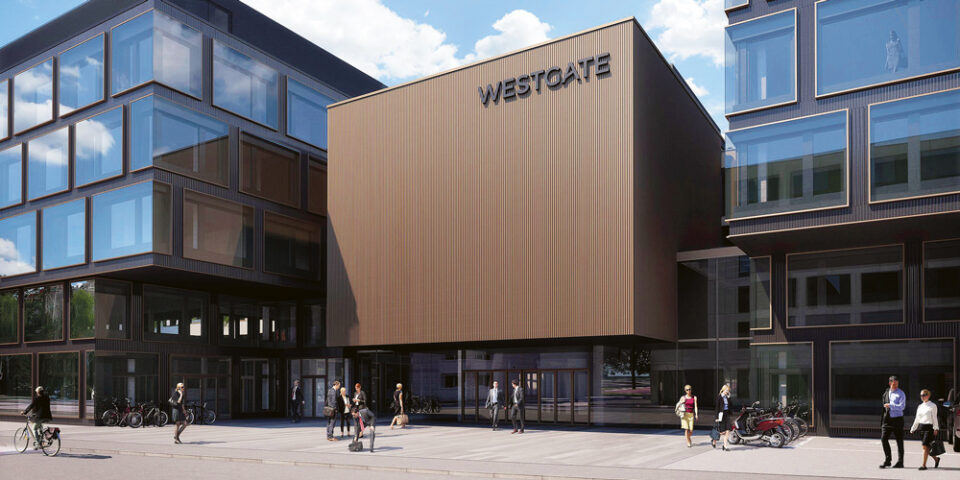
With Westgate, a representative business center is being built in the immediate vicinity of Zurich Airport – and thus to the whole world: “The unique mix of state-of-the-art office space, optimal accessibility and first-class infrastructure makes Westgate the perfect company headquarters,” says Patrick Angioy from Seitzmeir Immobilien AG. “The Westgate combines everything that makes a successful business location: outstanding architecture, over 16,000 m² of flexibly scalable office space, excellent gastronomy and a well-developed conference center.”
But not only the infrastructure is excellent, the location is also hard to beat: The Westgate is being built in the economically successful Zurich airport region – only 600 meters from Zurich Airport and a few steps away from the new Glattalbahn. The building elements Dock A, B and C together with the cube form the architectural work of art. The constitutive element of the building is the interior atrium with a spacious lobby, lounge area and bar. The light-flooded architecture meets the highest aesthetic standards. “The interplay of warm bronze and gray tones as well as the combination of metal, textile and wood has a timelessly modern effect and is at the same time a symbiosis of home and far away,” says Angioy.
The Westgate Business Center meets all the requirements of “Green Building Switzerland”, is CO2-neutral and is certified according to Minergie P and Leed Gold Standard. Natural building materials such as wood and stone ensure a pleasant, healthy indoor climate. Thanks to intelligent building technology, the networked systems of heating, cooling, ventilation, sun protection, photovoltaics, etc. are ideally coordinated with each other and enable maximum efficiency. Heating and cooling (free cooling) are provided by groundwater pumps, and optimized heat recovery supports the sustainable energy cycle. The high insulation quality of the building envelope prevents energy losses and at the same time reduces unwanted heat input through high-quality glazing.
Good things take time – there is no better way to describe the development of the Oberhauserriet in Opfikon. As early as 1952, the city separated the 67.4 hectare Oberhauserriet as an industrial zone. A district plan procedure was initiated five years later, but this was only approved in 1979. The first district plan provided for 30,000 jobs. But the project dragged on due to numerous appeals and requests for revision. In 1986, the city council of Opfikon stopped the enforcement request. Because: The planned jobs would also have meant 30,000 parking spaces. Traffic problems and environmental pollution threatened.
Interest in the planned industrial area increased sharply with the construction of the north ring road in the 1980s. In 1987, Planpartner AG was commissioned to review the planning. The planning office proposed a renewed revision of the building and zoning regulations with a significantly reduced use. New only 9700 jobs were planned. In addition, living space for 3000 people was considered for the first time, as well as a park that should cover around a third of the country in the direction of Glatt. Access to public transport rounded off the project in terms of environmental compatibility.
These adjustments found favor with the electorate in 1990. The city council of Opfikon, the city of Zurich and the interest group of landowners that had been created in the meantime also approved of the new overall plan. The then 25 landowners were closely involved in the planning by the city council. It is probably thanks to this circumstance that they were willing to make a significant financial contribution: in terms of green space or the planned “monorail” – a kind of elevated railway that should have opened up the new district.
It was spring 1996 before the first draft for the new district plan was available. Due to numerous requests, this was revised twice before the city council was finally able to set the district plan in 1999. The Government Council of the Canton of Zurich passed it on October 11, 2000, paving the way for implementation – after almost 50 years of planning.
First area marketing organization in Swiss real estate history They had agreed on living space for 6,600 people and 7,300 jobs. A 12.4-hectare green area with an artificial lake was planned for the park. A project competition was announced in 2001 for the design of the park, which the Kiefer landscape architecture office in Berlin won. Central was the elongated rectangular lake, which later received the name “Glattpark-See”.
In 2000, the city of Opfikon, the city of Zurich and the company Allreal tendered a contract for the development of a comprehensive platform for the development area. Halter Immobilien + Treuhand with the then managing director Bernhard “Beny” Ruhstaller was awarded the contract. Ruhstaller’s communication strategy envisaged making a brand out of the Oberhauserriet in order to simplify the search for investors and key tenants as well as communication with the population and image cultivation. Ruhstaller proposed area marketing empowered by all landowners.
The mission was clear: from the mass of planned individual projects, a vision of a completely new district should find its way into people’s minds. Ruhstaller already brought experience from the Limmatwest, Zurich-West and Zurich-North development areas. «It was precisely these experiences and insights that helped me with the Oberhauserriet development area. The Glattpark was of course one size bigger. On the other hand, it was almost easier to create a new identity here, since there was no inhabited area,” Ruhstaller sums up. He also remembers the founding of the new area marketing well: “The first difficulty was convincing the then many private landowners to pay money into a marketing pot, although a possible start of construction could not even be estimated.”
The real estate professional was successful together with the city of Opfikon: In December 2001, 63.64 percent of all property owners recognized the added value of joint marketing. On May 13, 2002, for the first time in Swiss real estate history, 14 of the 21 landowners founded an area marketing organization. This merger quickly bore fruit: Thanks to marketing and communication measures such as a showroom, website, trade fair appearances and intensive networking, the organization quickly became the central information and contact point for the new district, which the city of Opfikon had given the name “Glattpark” in 2001. With the increasing success of the marketing efforts, more landowners could be brought on board: in 2017, the area marketing organization had a maximum of 35 members.
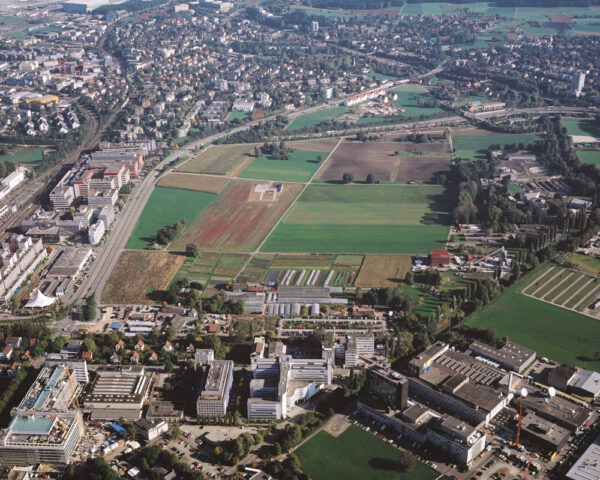
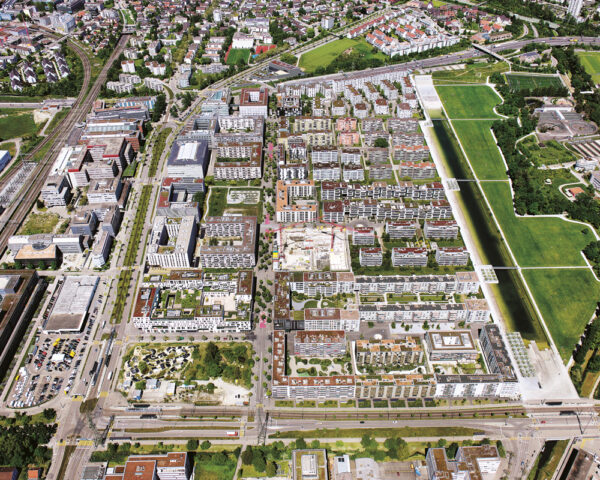
↑ The aerial photo – taken from a helicopter at the time – shows the Oberhauserriet in 2001. The city of Opfikon commissioned the company Comet Photoshopping GmbH, which specializes in aerial photos, to document the construction progress. And this is how the Glattpark looks from the air 20 years later. ↓
Thanks to the Glattpark, Opfikon is now one of the 50 largest cities in Switzerland Again and again, there were discrepancies between area marketing and the city of Opfikon: “The planning authorities involved in the Oberhauserriet district plan were not used to the fact that market and marketing issues suddenly played a role,” explains Ruhstaller and adds: “The private organization of the In the beginning, landowners might also have been perceived as a danger.” Today, cooperation between the city authorities and area marketing has normalized and can be described as mutually beneficial.
The transition from the development to the operational phase in 2016 brought with it changed tasks for area marketing. A simplification of the landowner’s contributions and the renaming to IGG Glattpark were decided. Today, the organization takes care of overarching issues. “It’s about processes that go beyond the parcel boundary of an individual property owner – such as the boulevard, parking or media work,” says Ruhstaller, who has been working as managing director of the area marketing organization for around 20 years and meanwhile from his Daughter Janina is supported. The IGG Glattpark is intended to protect and further develop the identity of the still young district. “In cooperation with the city of Opfikon, we are currently conducting a needs survey among the more than 70 businesses in the Glattpark,” Ruhstaller gives an example.
The former vision of Glattpark has become reality: the first residents moved in as early as 2006. The Monorail, which was originally planned, became the Glattalbahn, the last stage of which was inaugurated in 2010. In 2019, the majority of the second construction phase was completed. By the end of 2019, 3100 jobs were created and 5781 residents were counted. And that’s not the end of the development of the young part of the city: the hard-fought school building should be ready for occupancy in 2023/24. The often neglected 3rd stage of the Glattpark could also be in motion in the near future: “The city of Zurich, as the largest property owner, is facing an early solution together with the city of Opfikon and other private property owners,” says Ruhstaller.
The development of the Oberhauserriet – which was often referred to in the media as “the most expensive meadow in Europe” – into the Glattpark district has definitely been a success: in the past 16 years, Opfikon has grown from 13,000 to 21,000 inhabitants thanks to the Glattpark. This means that Opfikon is now one of the 50 largest cities in Switzerland.
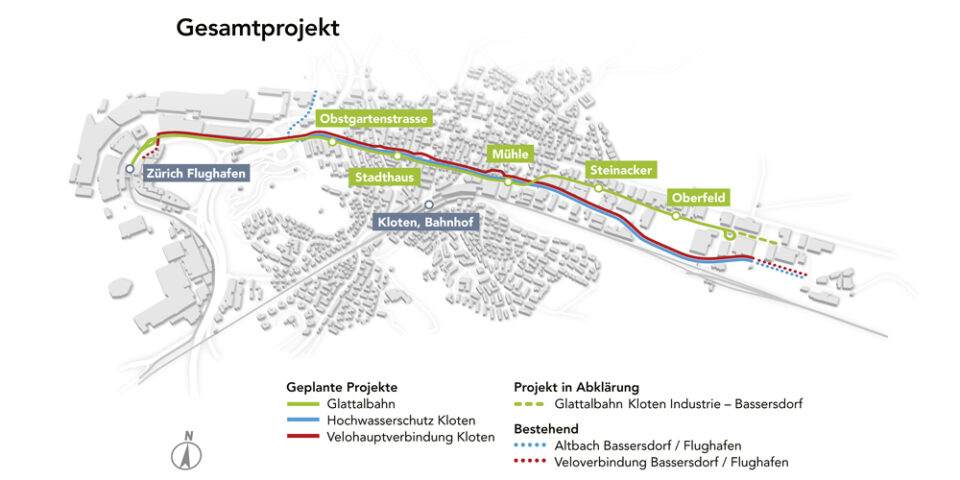
The transport system in the Kloten region is reaching its limits. The consequences are increasing hours of traffic jams and severe noise and air pollution. The Glattalbahn extension to Kloten promises a chance for improvement, which, in addition to the extension of the tram line between the airport and the Steinacker development area in Kloten, includes two other sub-projects: A main bicycle connection with a separate footpath and flood protection for Kloten and for the airport. The spatial proximity and the dependencies of these sub-projects require joint project planning and construction. This means that the canton of Zurich can effectively and sustainably master three challenges in one project and make optimal use of synergies.
On July 16, 2020, VBG Verkehrsbetriebe Glattal AG (VBG) submitted the application for the infrastructure concession to the Federal Office of Transport (BAV). The procedure examined whether there was a public interest in the construction and operation of the new tram connection and whether there were no significant public interests – for example environmental protection or nature and heritage protection – opposed to the granting of the concession. The Federal Council examined the application and decided to grant the license to the VBG. This decision cannot be contested. There will be opportunities for objections at a later point in time during the public approval of the plan.
The VBG is currently working on the construction project that forms the basis for the cantonal loan approval. The decision of the cantonal council is expected in 2024. This is subject to an optional referendum. The project was submitted to the federal government in June 2021 as part of the 4th generation agglomeration programme. This will probably decide on co-financing by the end of 2023. The approval process (plan approval process under the Railway Act) is expected to run in parallel from 2023. Construction is currently expected to start in 2026, subject to legally binding planning approval and secured funding from the canton and the federal government. The construction work will take around four years.
The Glattalbahn has big plans.
Wir verwenden Cookies zur Unterstützung und Verbesserung unserer Dienste. Mit der Nutzung dieser Website erklären Sie sich mit der Verwendung von Cookies einverstanden. Weitere Informationen finden Sie in unserer Datenschutzerklärung.