For eight years, Beny Ruhstaller shaped the umbrella organisation of Swiss location and business development agencies as president, and he had already been a member of the board since 2013. But he had his first contact with the SVSM much earlier: “In 2007, I received the first SVSM award for my mandate as managing director of the Glattpark area marketing Ruhstaller is not a classic location promoter. Rather, he has represented the real estate industry’s point of view in the association by sitting on the SVSM board and, from 2015, as president. It has always been important to him to bring the real estate industry and location promotion closer together. Ruhstaller will be succeeded as president of the association by Remo Daguati, owner of LOC AG, and Stefan Otziger, managing director of the Thun economic region, will take over as vice-president.
As president of the SVSM, Beny Ruhstaller benefited from a large network that he built up during his decades of activity in the real estate industry. He became particularly well known as “Mister Glattpark”: as Managing Director of the Glattpark Area Marketing – now IGG Glattpark – 21 years ago, he built up an organisation that was unique in Switzerland at the time. The association of several property owners aimed at the overall marketing of the area, which was then still called Oberhauserriet. In the following 21 years, Ruhstaller not only acted as a mediator between landowners, representatives of the city of Opfikon, media representatives and the public, but also sat on juries for individual building projects, set up a showroom with a large model and visualisations of the new district or founded the IG Boulevard. Ruhstaller took a lot of time for lectures and guided tours of the new district: he gave about 1,000 of them. Ruhstaller also recently gave up his mandate as managing director of IGG Glattpark.
Furthermore, Beny Ruhstaller made a name for himself in the field of real estate marketing – at a time when this discipline did not actually exist in Switzerland: Together with Roman H. Bolliger, he wrote the non-fiction book “Immobilienmarketing: Mehrwert für Liegenschaften” (Real Estate Marketing: Added Value for Real Estate), which has become a standard work and textbook and has sold over 10,000 copies to date. Ruhstaller was active as a consultant and marketer in numerous real estate projects with his company acasa Immobilienmarketing and was involved as a lecturer and speaker on the subject.
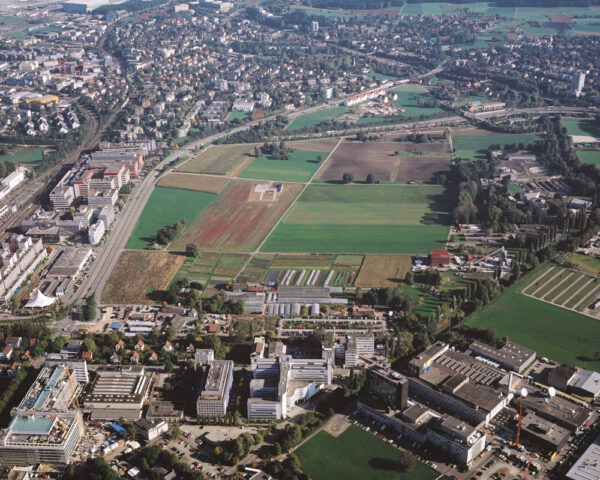
Good things take time – there is no better way to describe the development of the Oberhauserriet in Opfikon. As early as 1952, the city separated the 67.4 hectare Oberhauserriet as an industrial zone. A district plan procedure was initiated five years later, but this was only approved in 1979. The first district plan provided for 30,000 jobs. But the project dragged on due to numerous appeals and requests for revision. In 1986, the city council of Opfikon stopped the enforcement request. Because: The planned jobs would also have meant 30,000 parking spaces. Traffic problems and environmental pollution threatened.
Interest in the planned industrial area increased sharply with the construction of the north ring road in the 1980s. In 1987, Planpartner AG was commissioned to review the planning. The planning office proposed a renewed revision of the building and zoning regulations with a significantly reduced use. New only 9700 jobs were planned. In addition, living space for 3000 people was considered for the first time, as well as a park that should cover around a third of the country in the direction of Glatt. Access to public transport rounded off the project in terms of environmental compatibility.
These adjustments found favor with the electorate in 1990. The city council of Opfikon, the city of Zurich and the interest group of landowners that had been created in the meantime also approved of the new overall plan. The then 25 landowners were closely involved in the planning by the city council. It is probably thanks to this circumstance that they were willing to make a significant financial contribution: in terms of green space or the planned “monorail” – a kind of elevated railway that should have opened up the new district.
It was spring 1996 before the first draft for the new district plan was available. Due to numerous requests, this was revised twice before the city council was finally able to set the district plan in 1999. The Government Council of the Canton of Zurich passed it on October 11, 2000, paving the way for implementation – after almost 50 years of planning.
First area marketing organization in Swiss real estate history They had agreed on living space for 6,600 people and 7,300 jobs. A 12.4-hectare green area with an artificial lake was planned for the park. A project competition was announced in 2001 for the design of the park, which the Kiefer landscape architecture office in Berlin won. Central was the elongated rectangular lake, which later received the name “Glattpark-See”.
In 2000, the city of Opfikon, the city of Zurich and the company Allreal tendered a contract for the development of a comprehensive platform for the development area. Halter Immobilien + Treuhand with the then managing director Bernhard “Beny” Ruhstaller was awarded the contract. Ruhstaller’s communication strategy envisaged making a brand out of the Oberhauserriet in order to simplify the search for investors and key tenants as well as communication with the population and image cultivation. Ruhstaller proposed area marketing empowered by all landowners.
The mission was clear: from the mass of planned individual projects, a vision of a completely new district should find its way into people’s minds. Ruhstaller already brought experience from the Limmatwest, Zurich-West and Zurich-North development areas. «It was precisely these experiences and insights that helped me with the Oberhauserriet development area. The Glattpark was of course one size bigger. On the other hand, it was almost easier to create a new identity here, since there was no inhabited area,” Ruhstaller sums up. He also remembers the founding of the new area marketing well: “The first difficulty was convincing the then many private landowners to pay money into a marketing pot, although a possible start of construction could not even be estimated.”
The real estate professional was successful together with the city of Opfikon: In December 2001, 63.64 percent of all property owners recognized the added value of joint marketing. On May 13, 2002, for the first time in Swiss real estate history, 14 of the 21 landowners founded an area marketing organization. This merger quickly bore fruit: Thanks to marketing and communication measures such as a showroom, website, trade fair appearances and intensive networking, the organization quickly became the central information and contact point for the new district, which the city of Opfikon had given the name “Glattpark” in 2001. With the increasing success of the marketing efforts, more landowners could be brought on board: in 2017, the area marketing organization had a maximum of 35 members.
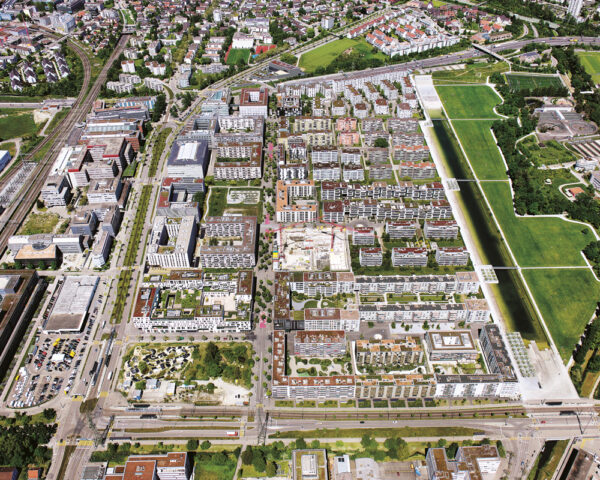
↑ The aerial photo – taken from a helicopter at the time – shows the Oberhauserriet in 2001. The city of Opfikon commissioned the company Comet Photoshopping GmbH, which specializes in aerial photos, to document the construction progress. And this is how the Glattpark looks from the air 20 years later. ↓
Thanks to the Glattpark, Opfikon is now one of the 50 largest cities in Switzerland Again and again, there were discrepancies between area marketing and the city of Opfikon: “The planning authorities involved in the Oberhauserriet district plan were not used to the fact that market and marketing issues suddenly played a role,” explains Ruhstaller and adds: “The private organization of the In the beginning, landowners might also have been perceived as a danger.” Today, cooperation between the city authorities and area marketing has normalized and can be described as mutually beneficial.
The transition from the development to the operational phase in 2016 brought with it changed tasks for area marketing. A simplification of the landowner’s contributions and the renaming to IGG Glattpark were decided. Today, the organization takes care of overarching issues. “It’s about processes that go beyond the parcel boundary of an individual property owner – such as the boulevard, parking or media work,” says Ruhstaller, who has been working as managing director of the area marketing organization for around 20 years and meanwhile from his Daughter Janina is supported. The IGG Glattpark is intended to protect and further develop the identity of the still young district. “In cooperation with the city of Opfikon, we are currently conducting a needs survey among the more than 70 businesses in the Glattpark,” Ruhstaller gives an example.
The former vision of Glattpark has become reality: the first residents moved in as early as 2006. The Monorail, which was originally planned, became the Glattalbahn, the last stage of which was inaugurated in 2010. In 2019, the majority of the second construction phase was completed. By the end of 2019, 3100 jobs were created and 5781 residents were counted. And that’s not the end of the development of the young part of the city: the hard-fought school building should be ready for occupancy in 2023/24. The often neglected 3rd stage of the Glattpark could also be in motion in the near future: “The city of Zurich, as the largest property owner, is facing an early solution together with the city of Opfikon and other private property owners,” says Ruhstaller.
The development of the Oberhauserriet – which was often referred to in the media as “the most expensive meadow in Europe” – into the Glattpark district has definitely been a success: in the past 16 years, Opfikon has grown from 13,000 to 21,000 inhabitants thanks to the Glattpark. This means that Opfikon is now one of the 50 largest cities in Switzerland.
During a tour of the Glattpark development area in Opfikon on June 15, the board of directors of the Swiss Association for Site Management ( SVSM ) and leading members and consultants inspected the development . The meeting organized by Schlierem location promoter Albert Schweizer was part of the site development initiative – the supreme discipline of location promotion. It is about the interaction between the public sector, investors, architects, area management, users and associations of different interests in the development of a common vision and strategy.
The two-hour tour was led by Beny Ruhstaller, Glattpark Area Manager and SVSM President. He edited the publication ” Glattpark – a city is created “. The participants visited the different neighborhoods, looked at the inner courtyards, appraised the architecture and visited the lake and park.
Arun Banovi, publisher of Immoinvest and media partner of the SVSM, also took part in the visit. Likewise the former SVSM board member Beat Ritschard and Alexandra Vogel, the managing director of the SVSM in Winterthur, as well as Jasmina Ritz, managing director of the Limmatstadt AG location promotion.
For the purpose of the event, the initiators said that the SVSM board actively cultivates relationships with its senior members and experienced experts. It is about preserving the great wealth of knowledge and network of these personalities. And with such invitations, it is also about the appreciation of their merits for the benefit of the association and the entire industry. The SVSM sponsors are also invited to events such as those in the Glattpark.
After the visit in the afternoon, an aperitif and dinner was scheduled for 5 p.m. in the Casa Cosi restaurant.
Allreal achieved rental income of CHF 200.4 million last year, according to a statement . The company was thus able to maintain the level from the previous year despite the Corona crisis. In 2019, it had received 203.1 million francs from rents.
In the spring, Allreal stated that it was able to agree on rent waivers in connection with the lockdown with all affected tenants. In total, the company has granted rent leases amounting to 1.5 million francs.
The cumulative vacancy rate has meanwhile fallen by 0.8 percentage points to 1.4 percent despite the crisis. According to the information, it is at the lowest level that Allreal has ever reached.
The company result including the revaluation effect is 167.2 million francs after 243.2 million francs in the previous year. Excluding the revaluation effect, the company result is 124.7 million francs after 142 million francs in the previous year. Allreal explains the decline primarily with one-off effects from the sale of development properties.
According to the announcement, Allreal is satisfied with its annual result and expects overall “stable business development” in the long term. The Board of Directors is therefore proposing to the General Meeting of Shareholders a stable distribution at the previous year's level of 6.75 francs per share.
Allreal is based in Glattpark in Opfikon. The company is listed on the SIX Swiss Exchange.
The Oberhauserriet – today's Glattpark – has a long and eventful history behind it. The planning of the development of the former swamp and agricultural area took more than forty years. After the approval of the neighborhood plan in 2001, however, the development picked up speed: A new district of Opfikon was built on what was once a green field at a rapid pace, with currently around 5780 residents and 3100 jobs in the neighborhood plan area. Today the Glattpark has a model character in its uniqueness. A new book, which appeared in mid-September, shows challenges and solutions on the way from the meadow to the urban district and traces the individual development steps. **
Breathe life into a vision The founding of an organization that was unique in Switzerland at that time contributed significantly to the success of the Glattpark: a merger of several landowners to form a superordinate area marketing department, which was responsible for the overall marketing of the Oberhauserriet. The aim was to create a common brand from which all individual projects would in turn benefit. The new organization – the Glattpark area marketing – was supposed to act as an information hub for landowners, the media and the general public on the one hand, and to provide marketing services to the individual landowners on the other. But first and foremost, it should breathe life into a vision, because offices and apartments should not simply be built in Oberhauserriet – an urban vision would be realized here. Communication with the development area therefore required a way of thinking that went beyond the mere application of individual projects.
Marketing offensive for a meadow In view of the rather difficult economic environment at the time, the establishment of joint area marketing must be described as courageous. The developments at the airport and in terms of aircraft noise, the uncertain realization of the Glattalbahn – a location advantage that should not be underestimated for the new district – but also the generally difficult economic situation made "big hits" appear difficult. The area marketing Glattpark was aware of this fact from the beginning, but saw the overall quality of the area as an opportunity. The success soon proved the area marketing right: Thanks to extensive marketing and communication measures, the organization quickly developed into the central information and contact point for the new district. When marketing the area, it was initially about making the vision visible. For this purpose, the Glattpark area marketing relied on the one hand on visualizations and on the other hand on a large model that was constantly updated. In the specially set up showroom, interested parties and investors were able to get an idea of the future district. In addition, a comprehensive website offered a lot of information. Events, trade fair appearances and classic media work complemented the marketing measures. And finally the former Riet even became a town: in 2005 the Glattpark officially became a separate district with the postal address “8152 Glattpark (Opfikon)”. The process was initiated by the landowners: They were rightly convinced that the «Glattpark» postal address would contribute a lot to branding.
Coordination between landowners and the city Another important success factor for the development of the Glattpark was the close cooperation between the city of Opfikon and the landowners. The complexity of the development of a new district also made it necessary for the city of Opfikon to create new forms of organization: the Glattpark area management. The new organization was commissioned by the Opfikon City Council to take over the strategic and operational management of the new district. The area management should include the needs of all administrative departments in the city that affected Glattpark in the development process. The main task of the committee, however, was the overall coordination and the exchange of information between those involved. Representatives of the authorities, administrative employees, landowners' representatives and external specialists from the areas of spatial planning, marketing, business administration and social science had a seat in the area management.
What the urban heart desires With the rapid construction progress in Glattpark, the new district quickly revived – and thanks to the establishment of an active neighborhood association, the initiative of committed residents and external organizers, it developed its own neighborhood identity. The "Glattpark-Barometer" showed the concerns of the residents – and initiated various measures to improve the quality of life. So Glattpark became more and more popular with families; and the demand for a school building of their own grew correspondingly louder. After several referendums, nothing stands in the way of its realization. And so the new district will soon really offer everything that the urban heart desires: a comprehensive district supply with shops and services, optimal connections to public transport, a spacious park landscape with its own lake, crèches, kindergarten and soon a primary school. ■
* Alexandra Vogel is the head of the office of the Swiss Association for Location Management SVSM
** The book “Glattpark – a city is created”, published by IGG Glattpark, can be ordered by e-mail to info@glattpark.ch or by phone on 043 211 50 10 for CHF 50 plus shipping costs. The book with high-quality hardcover binding in the format 24 x 34 cm traces the eventful history of the development area on 128 pages with texts, pictures, quotations and newspaper articles. The book has been available since mid-September.
Wir verwenden Cookies zur Unterstützung und Verbesserung unserer Dienste. Mit der Nutzung dieser Website erklären Sie sich mit der Verwendung von Cookies einverstanden. Weitere Informationen finden Sie in unserer Datenschutzerklärung.