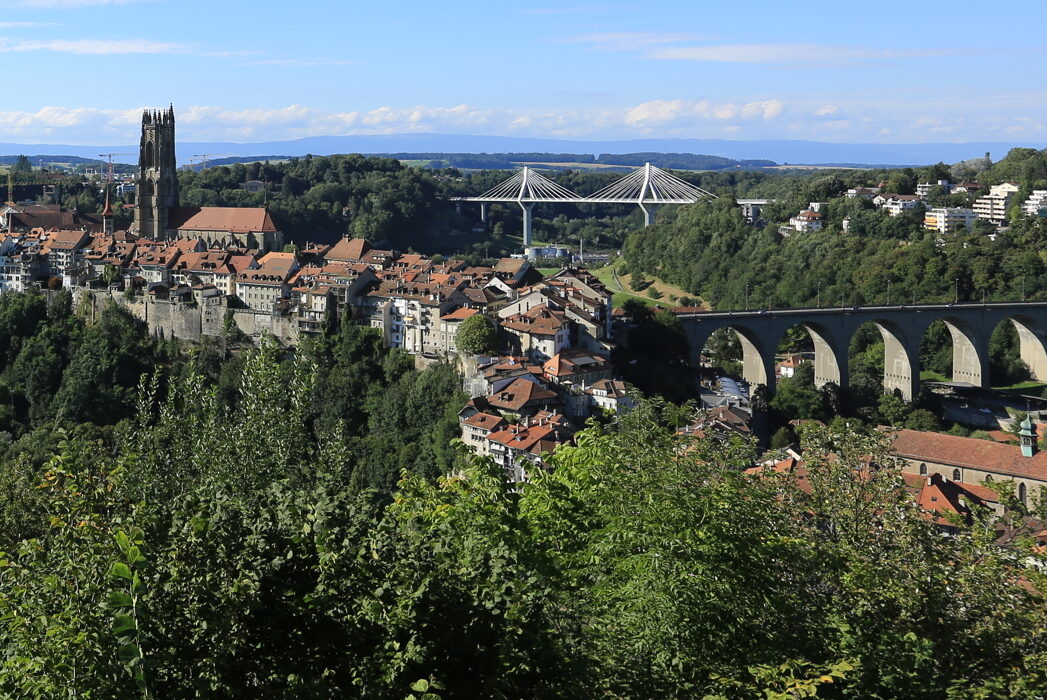
The canton of Fribourg is sharpening its profile in global competition. With fribourg.swiss, the economic development agency is focusing on a clearer and internationally recognisable brand. The new platform is aimed specifically at companies, investors and innovation players in Switzerland and abroad. Thanks to the official domain extension “.swiss”, the affiliation to Swiss quality standards is emphasised in a compact, accessible and strong brand.
Making excellence visible “fribourg.swiss is our strategic showcase to the outside world,” says WIF Director Jerry Krattiger. The focus is on companies, educational and research institutions as well as centres of excellence that shape the economy of the canton of Fribourg. Topics such as the bioeconomy, Industry 4.0, life sciences and technology transfer demonstrate the diversity and future viability of the location.
Multi-channel communication for maximum reach The new brand is already active on all external channels, from the website to newsletters and international LinkedIn activities. The content is distributed worldwide via embassies, consulates and specialist networks. At the same time, the new brand identity also strengthens the internal perception of the economic strengths and creates a shared awareness within the canton.
Visibility and identification With fribourg.swiss, the canton of Fribourg is opening a new chapter in location marketing. One that focuses on digital clarity, international reach and regional anchoring. The canton’s economic dynamism is thus becoming more visible and more widely recognised, both within and outside Switzerland.
As part of its local-for-local strategy, Sika is expanding its presence in China, Brazil and Morocco. In China, the globally active speciality chemicals company for construction and industry has expanded its existing site in the Suzhou metropolitan region, Sika announced in a press release. The site produces polyurethane bonding and sealing solutions for the automotive, construction and industrial sectors.
In Brazil, Sika has expanded its site near Belo Horizonte. In this strategically important industrial region of the country, Sika manufactures admixtures for ready-mix concrete, cement and mining. The company has built a new plant for mortar and admixtures near Agadir. From here, Sika intends to supply the south of Morocco and neighbouring markets.
“These site investments reflect our customers’ trust in us and our long-term commitment to our markets,” said Sika CEO Thomas Hasler in the press release. “By expanding our local production capacities, we are not only improving flexibility, but also creating a resilient, sustainable foundation for our continued growth alongside our long-standing customers and partners.” Sika expects the construction industry in the three countries to grow by more than 4 per cent annually until 2028.
In a new study by the Swiss Energy Foundation (SES), Switzerland ranks at the bottom of the league table for electricity production from solar and wind energy. It produces 681 kilowatt hours of solar power per capita and 19 kilowatt hours of wind power. In total, the country produces 700 kilowatt hours per capita from solar and wind energy, putting it in 22nd place out of 28 EU member states.
Sweden is the leader in wind power production with 3930 kilowatt hours per capita, followed by Denmark with 3448 kilowatt hours. Even neighbouring Austria comes in at 1004 kilowatt hours. In terms of solar production per capita, the Netherlands leads with 1206 kilowatt hours per capita, followed by Spain and Cyprus. However, even Austria has 941 kilowatt hours and Germany 888 kilowatt hours.
Switzerland was able to increase its production of electricity from wind and solar from 7.2 per cent to 11 per cent within five years. However, other countries in Europe often achieved higher increases of up to 20 percentage points in the same period. In a European comparison, only Malta, Slovenia, Romania, the Czech Republic, Latvia and, bringing up the rear, Slovakia are behind Switzerland in the production of electricity from wind and solar per capita.
In the view of the SES, wind energy in particular must be expanded in Switzerland, according to a press release. A total of 11 per cent of domestic electricity consumption is generated by wind and solar, 7.2 percentage points more than five years ago. European neighbours
The new Electricity Act shows that the Swiss population wants to intensify sustainable electricity production in the future. Political instruments for implementing the law are already active or will be from 2026. Their impact will become apparent in the coming years, according to the SES.
The exchange of electricity with neighbours also holds great potential for Switzerland. Switzerland is already integrated into the European electricity grid with over 40 cross-border transmission grids. European electricity trading is central to Switzerland’s ability to obtain winter electricity from its European neighbours’ wind turbines, according to the press release. The planned EU electricity agreement forms the basis for increased electricity trading.
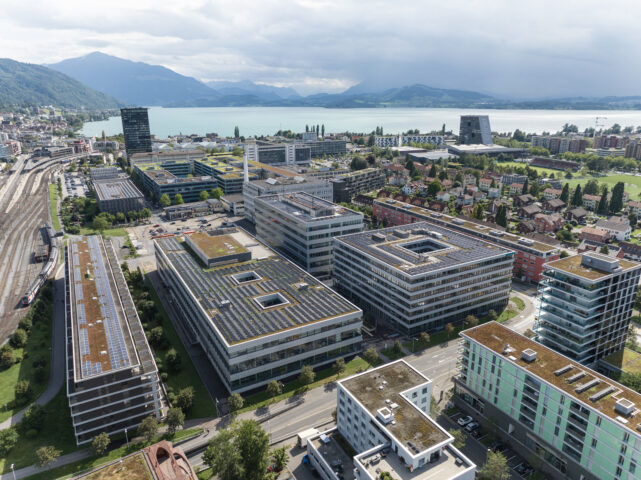
Over the years, more and more companies from the same industries have settled here, resulting in the formation of various industry clusters, as they are known. This also includes education, research and various platforms such as the Innovation Park or associations, in which a lively exchange takes place. The large number of companies, service providers, suppliers and private institutions provide mutual support and promote a service-orientated and efficient administration. The local companies also benefit from the high educational standards and excellent infrastructure.
Blockchain, fintech and IT Zug has developed into a global hotspot for blockchain, fintech and IT. Here, innovations unfold in a symbiotic ecosystem where pioneering technologies meet and create a wealth of limitless opportunities. Zug has earned recognition for its transparent regulations, crypto-friendly banks and administrations, a dynamic labour market for cryptocurrencies and a varied calendar of events. Due to its proximity to the Zurich region, Zug is developing an attractive ecosystem for around 600 crypto companies in the “Crypto Valley” and is the birthplace of Ethereum. This environment is favoured by a positive regulatory framework, attractive taxes, incubators such as CV VC and a large number of fintech companies. The Canton of Zug supports research in this area financially by contributing almost CHF 40 million to the blockchain research initiative of the University of Applied Sciences and Arts Lucerne and the University of Lucerne.
Zug’s “Fintech Cluster” embodies a centre of innovation in the field of financial technology. Within the “Crypto Valley”, this cluster acts as a dynamic meeting place for fintech companies, start-ups and financial institutions. Zug is also home to the National Test Centre for Cybersecurity (NTC) as well as various labs and research centres in the fields of blockchain, AI, ML and robotics at HSLU, located in Rotkreuz.
Life sciences (pharma/biotech and medtech) The canton of Zug is a leading location for life sciences with around 300 companies and 9,000 employees. In addition to the strong focus on commercial functions, the medical and clinical areas are also growing. The regional innovative strength is reinforced by other leading clusters in deep tech, AI and ICT, which creates innovative synergies.
Pharma/biotech Zug attracts numerous international pharmaceutical and biotech companies, including Biogen, Amgen, Astra Zeneca and Johnson & Johnson. In addition, around 60 US biotech companies have chosen Zug as their European headquarters in recent years. The high density of pharmaceutical and biotech companies in the canton of Zug and the large number of service providers specialising in life sciences create an advantageous business environment.
Medtech In the medical technology sector, more than 100 companies specialising in diagnostics and medical production are represented with production sites and global headquarters. Representative examples of global headquarters are Roche Diagnostics, Medela, SHL Medical, Schiller and Johnson & Johnson Medtech with important global functions at their international campus in Zug.
Zug also offers up-and-coming medtech start-ups such as Deep Breath Intelligence, Heart Force and Sedimentum optimal conditions for growth and innovation.
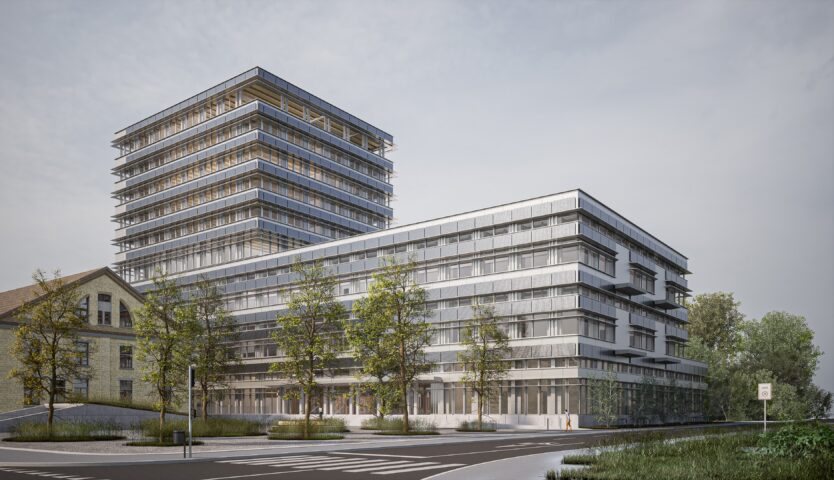
New SHL Medical AG building
The 5,000 m² office and 10,500 m² production building for the tenant SHL Medical AG is being built on the Tech Cluster Zug site. The compact design, the reduction in materials and the innovative hybrid construction of wood, steel and concrete promote resource-saving, efficient construction. Visible wood on the inside and a protective aluminium layer on the outside reflect the high quality standards. A 20% reduction in CO2 emissions is made possible by on-site concrete production using Jura Eco cement.
SHL’s energy supply is designed as part of the site-wide multi-energy hub. The energy supply is supplemented by lake water cooling and large-scale PV systems on roofs and façades. The surplus heat and energy is recovered for further use in the hub.
New Roche production building
Roche is investing 215 million in a new 29,000 m² diagnostics production building in Rotkreuz, which will be completed by 2027. The flexible design will allow the building to be adapted to future production needs, thereby increasing long-term efficiency. Sustainability is a top priority: a fossil-free energy supply, water circulation systems and resource-saving construction methods are planned. The surrounding area will be designed to be close to nature, with wet meadows, a fen and a roof garden at a height of 23 metres to promote biodiversity.
Tech industry The tech industry is one of the largest employment sectors in Switzerland. With around 14,000 employees and 750 companies, this sector is also important for the canton of Zug. The focus of the high-tech cluster in Zug is on the development, design and manufacture of electronic products and services. Digitalisation, the Internet of Things (IoT), robotics and artificial intelligence (AI) also play important roles.
Zug stands out as one of the most dynamically expanding technology centres in Europe. The canton of Zug is home to numerous notable SMEs and start-ups specialising in cutting-edge and pioneering technologies. Their influence extends across various industries as they develop ground-breaking solutions based on emerging technologies. Access to various research and networking institutions such as the University of Applied Sciences (HSLU), the Innovation Park Central Switzerland and the Technology Forum Zug create the ideal framework for innovative, technology-driven companies.
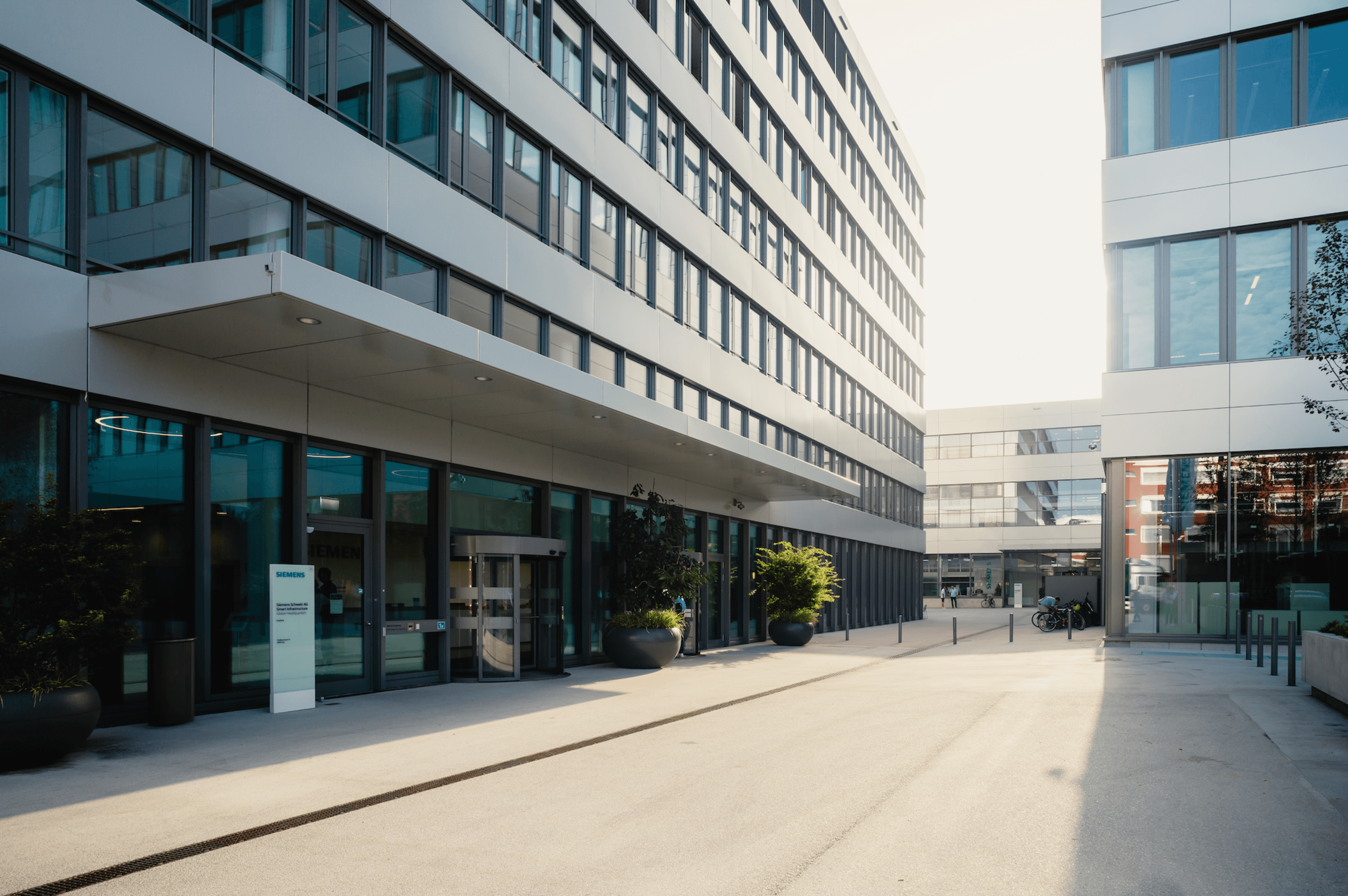
Siemens Campus
The 81,000 m2 Siemens Campus Zug is a showcase project for digitalisation and sustainability and demonstrates how modern products and solutions can accelerate the digital transformation. It sets technological standards in every respect and shows how buildings and infrastructures can be developed from static, inactive objects into responsive and reactive objects. The campus combines everything a community needs: Fire protection, access and intrusion control, CCTV, CO detection, extinguishing, voice-controlled evacuation, room automation and much more.
Financial service providers Around 2,000 companies form a dynamic environment for financial services in the canton of Zug. Hundreds of companies from the fields of asset management, family offices and hedge funds are based in the canton of Zug.
In the private equity/venture capital sector, for example, Partners Group, Capital Dynamics, HBM Healthcare Investments, CAPVIS and Invision should be mentioned. Leading Swiss financial institutions and platforms are also based here, including the Institute of Financial Services Zug IFZ, the Swiss Private Equity and Corporate Finance Association SECA, the Swiss CFO Forum and the VQF, the leading self-regulatory organisation in the non-banking sector.
New Partners Group Campus
Partners Group, Switzerland
Partners Group’s new global headquarters consists of three buildings: the “Green Building”, an elongated, elliptical structure whose variously curved, terraced layers provide a richly planted, forward-looking counter-accent to the two brick buildings, which are modelled on historic factory buildings and evoke the past. This is Partners Group’s way of emphasising its focus as a company builder.
The building not only impresses with its architecture, but also with its high-quality infrastructure, including an in-house gym, canteen, daycare centre and car park.
Consumer goods The canton of Zug is also home to over 1,700 consumer goods companies with around 14,000 employees, which account for around a third of GDP. Zug is home to international and regional headquarters of leading brands in the areas of food and beverages (e.g. Anheuser-Busch InBev, Burger King, Coca Cola HBC), personal care (e.g. Galderma, Kenvue), textiles (e.g. Odlo, Hugo Boss) and sporting goods (e.g. Specialized). The automotive supply sector and the wholesale of raw materials and pharmaceutical products also play an important role.
Commodities trading Zug is a leading global trading centre for commodities, particularly in the areas of metals, (renewable) energy and agricultural commodities, with over 200 companies (e.g. Glencore, Shell) and specialised professionals. Key areas include headquarters, trading, supply chain, production, processing and marketing.
Headquarters, Supply Chain Management & Procurement In recent decades, Switzerland has developed into a leading location for international headquarters with over 1,000 companies. The canton of Zug has the highest density of headquarters with globally leading industry clusters.
A special centre for companies in the supply chain & procurement sector has developed here.
Centralisation enables cost-effective procurement and efficient management of production resources along the entire value chain. Large multinational companies such as Bossard, Glencore, Johnson & Johnson and V-Zug have located global supply chain and procurement functions here.
Implenia, the construction and property company based in the Glattpark district of Opfikon, has won several tenders for building construction contracts. According to a press release, the contracts have a total volume of 160 million Swiss francs.
The company will construct the new office building of the Swiss National Science Foundation(SNSF) in Bern. The sustainable building will be constructed using local timber and recycled concrete in accordance with the Swiss Sustainable Building Standard (SNBS). Implenia has also been awarded several contracts in Germany.
In Mainz, Implenia, together with its partners Gemünden and Apleona, was awarded the contract to construct a new 10,000 square metre research building for TRON. The research institute develops new diagnostics and active ingredients for immunotherapeutic treatments.
In Leipzig, Implenia and its partner GP Günter Papenburg AG are building a seven- to eight-storey residential development on nine connected properties. In addition to 202 residential units, many commercial and ancillary premises are to be built. The buildings will be constructed as low-energy buildings in accordance with the Efficiency House 55 standard and the entire complex will be handed over on a turnkey basis.
Three residential buildings with 101 units are being built in Munich, which should be ready for handover by 2026. Implenia will also realise a further stage of an ongoing project in Heilbronn and has been commissioned with a pre-construction phase in Siegburg.
The Spanish stock exchange Bolsas y Mercados Españoles(BME), a SIX Group company, has become one of the main shareholders of OpenBrick, according to a press release. The Madrid-based company founded by Grupo Lar, Renta 4 Banco and ioBuilders is developing a platform using blockchain technology. This connects issuers, investors and financial intermediaries with a large number of property projects whose tradable securities can be purchased on a primary market and then traded on a secondary market. In addition to BME, Garrigues and Teras Capital are also new strategic partners.
The market will act as a financing channel outside of banks. The aim is to enable property players to obtain funds for the development of their projects more quickly and cost-effectively. BME will assume the role of platform operator via the Spanish central securities depository Iberclear and will be responsible for managing the trading and settlement system under the DLT (Distributed Ledger Technology) Pilot Regime of the European Securities and Markets Authority.
OpenBrick received authorisation to sandbox from the Spanish Securities and Exchange Commission(CNMV) in February 2023 with a positive preliminary assessment. The company reportedly expects to receive the EU licence for operations via BME 2025. The first project will start with the Madrid-based property manager Alquiler Seguro.
“With this investment, SIX is positioning itself as a key player in the EU’s digital agenda and in the further development of the financial markets,” said Javier Hernani, Head Securities Services and member of the Executive Board of SIX. SIX is convinced “that this is the first step on a long and successful journey”.
Sika has opened a new plant for the production of concrete admixtures in Stafford, Virginia. According to a press release , the additional production capacity and in combination with the existing plant in Fairless Hills, Pennsylvania, will serve the strong demand in the North East and Mid-Atlantic metropolitan areas more effectively.
Short transport routes for raw materials and end products reduce CO2 emissions and have a positive impact on operational efficiency. The performance of the new system is geared to the increasing demand from the announced infrastructure program in the amount of 200 to 250 billion Swiss francs.
For the construction industry, the signs in North America point to growth. The infrastructure will be modernized and expanded over the next few years with investments totaling CHF 1 trillion.
Sika is positioning itself for further dynamic growth in Tanzania and the Republic of Ivory Coast. The company has moved into a new location in the East African economic center of Dar es Salaam. There, the Zug-based company now also produces mortar and tile adhesive in addition to concrete additives. This shortens the transport routes, according to a press release from the company.
In the Republic of Ivory Coast in the west of the continent, Sika has doubled the size of its factory premises. With new areas for storage, offices and laboratories in Abidjan, Sika can double the production capacities for tile adhesive and repair mortar in the medium term and expand storage capacities. The neighboring countries of Burkina Faso, Togo, Benin, Mali and Sierra Leone will also be supplied from there.
Sika is committed to “sustainable business activities in Africa” in the long term, Regional Manager EMEA, Ivo Schädler, is quoted as saying. “At both locations, we produce high-quality solutions that are used for large infrastructure projects.” As examples, he cites the metro project and the expansion of the seaport in Abidjan, the Standard Gauge Railway and the Julius Nyerere hydroelectric power station in Tanzania.
Global scarcity of resources The prices of many building materials are currently skyrocketing. This will not change this year either – insulating materials, steel, everything will become more expensive and scarce. Construction prices are rising accordingly and threaten to make many projects unprofitable. In addition, the emerging countries in particular are currently asking for a lot of material and are buying the market empty. So the situation will continue to worsen. In the long term, only improved project planning with a greater focus on reusability can help, because circular economy and resource protection already begin in the planning phase. If entire buildings, parts of buildings and building materials can be recycled or found a subsequent use, this not only reduces the material requirement, but also contributes to greater sustainability at the same time. It is important to think big about Cradle to Cradle in the future.
Sustainability not only through energy savings in the usage phase The German construction industry in particular has an urgent need to catch up when it comes to sustainability. In the Netherlands there is already a CO 2 cap per square meter of new construction. With the new government with green participation, it is quite conceivable that such a cap will also become the new guideline in Germany. In addition, disposal costs will remain a major issue and will increase proportionately. Due to the still immature framework conditions for recycling processes and the low landfill capacities, waste is becoming a further driver of construction costs. This shows how important it will be in the future to use building materials and building parts for a long time and to reuse them later – as is already possible in modular construction by refurbishing reused modules. The circular economy should therefore be the focus of the project early on in the planning.
Digitization and AI also in construction In order to increase sustainability across the entire industry and to counteract the scarcity of resources, both planning and production must be optimized. Both must become more intelligent overall and network. The use of “artificial intelligence” is ideal for this. It supports construction projects, for example, through generative design, proactive problem detection and the avoidance of delays and cost overruns. But it also has to be used in production. An example: Digitizing the cut leads to less offcuts and waste. Thanks to good advance planning and the use of an AI, the remaining material from a cut can be used for further use in other future projects. This not only saves material, but also additional work steps and thus increases the efficiency of the entire production process. After all, residual materials are also resources.
Industrialized manufacturing as in the automotive industry The advance of digitization within the construction industry also enables the use of semi- or fully automated processes. They reduce sources of error and make production more efficient. Affordable living space can be optimally realized with robot-supported construction processes in connection with the necessary digital management of the construction data – from planning to construction site. In view of the acute shortage of skilled workers, which will not be solved in the next few years, this development is the logical consequence. Daiwa House Modular Europe will also rely on automated processes in the already planned German gigafactory.
These four trends should encourage the construction industry to rethink. In addition, there are a number of other changes such as a generational change in the ranks of managers as well as political and social change. Builders are now open to standardized building solutions. Modularly planned and built buildings offer a short construction time and high quality thanks to around 90 percent prefabrication in the factory. In the residential, care, hotel and education segments in particular, there are similar needs despite the different locations – so not every building has to be a prototype.
There are no special requirements for participation, only the will to complete 6 kilometers within 24 hours. Alone or with the family, at your own pace or with team support. Every participant is free to run or take a walk. A welcome occasion for a chat among work colleagues, for digital socializing in what seems to be eternal times of social distancing. A pleasant side effect: Exercising in the fresh air is not only good for the soul, one or the other kilogram of body weight due to the corona lockdown can also give way.
Anyone can take part – anywhere in the world. Those interested can register online at globalrealestaterun.com until April 28th. After registering, the participant receives access to a geotagged app. The route can be chosen freely and regardless of location. With this initiative, the organizers want to draw attention to the need for innovations to achieve sustainability goals in the real estate industry. Everyone can contribute something to this. Because sustainability is not a local but a global issue. Just like the Global Real Estate Run. Thanks to the main sponsors Homegate, SPG Intercity Zurich AG and PropTechMarket, a tree will be planted for each participant as a “green” sign.
Wir verwenden Cookies zur Unterstützung und Verbesserung unserer Dienste. Mit der Nutzung dieser Website erklären Sie sich mit der Verwendung von Cookies einverstanden. Weitere Informationen finden Sie in unserer Datenschutzerklärung.