Tag: Graue Energie

  • 11. May on which Switzerland crosses its borders

    11. May on which Switzerland crosses its borders

    Since the ecological footprint was first recorded in 1961, Switzerland’s Overshoot Day has moved forward by more than seven months, from the end of December to mid-May. If the entire world population lived like Switzerland, it would need the resources of 2.8 Earths in 2026. Switzerland’s ecological footprint is 4.15 global hectares per person, while the available biocapacity is just 1.48 hectares. The gap is growing.

    Housing as an underestimated driver
    Housing is one of the strongest drivers of the Swiss overshoot, alongside mobility, food and imported goods. Between 1990 and 2021, living space in Switzerland increased by 54%, while the population only grew by 31%. Individual changes in behavior can only achieve around 20 percent of the savings. The big levers lie elsewhere.

    Buildings as raw material stores
    The building sector is responsible for over 40 percent of global greenhouse gas emissions. In addition to the operating energy for heating, cooling and electricity, it is primarily gray energy that determines how large a building’s footprint really is. It includes all energy from the extraction of raw materials to processing and dismantling. As long as demolition is cheaper than recycling, the potential of the circular economy remains untapped.

    Regulation is tightening
    The legal framework is tightening. The Climate and Innovation Act has been in force since January 2025 and creates incentives for the replacement of fossil heating systems and energy efficiency measures. The MuKEn 2025, adopted in August 2025, define limit values for gray energy in new buildings for the first time and increase the requirements for photovoltaics and renewable heating systems. However, they will only become binding once the cantons incorporate them into their energy laws.

    System change instead of symbolic policy
    The message of Overshoot Day is clear: small adjustments are not enough. Scalable solutions are needed in energy, mobility, materials management and site development. As a cross-sector industry, the construction and real estate sector can have an impact in all of these areas if data is recorded precisely, materials are documented and circular processes are standardized. Buildings as raw material stores instead of landfill suppliers – that is the direction.
  • Gray Energy Steep Pass for Tenant Protection

    Gray Energy Steep Pass for Tenant Protection

    Grey energy in context
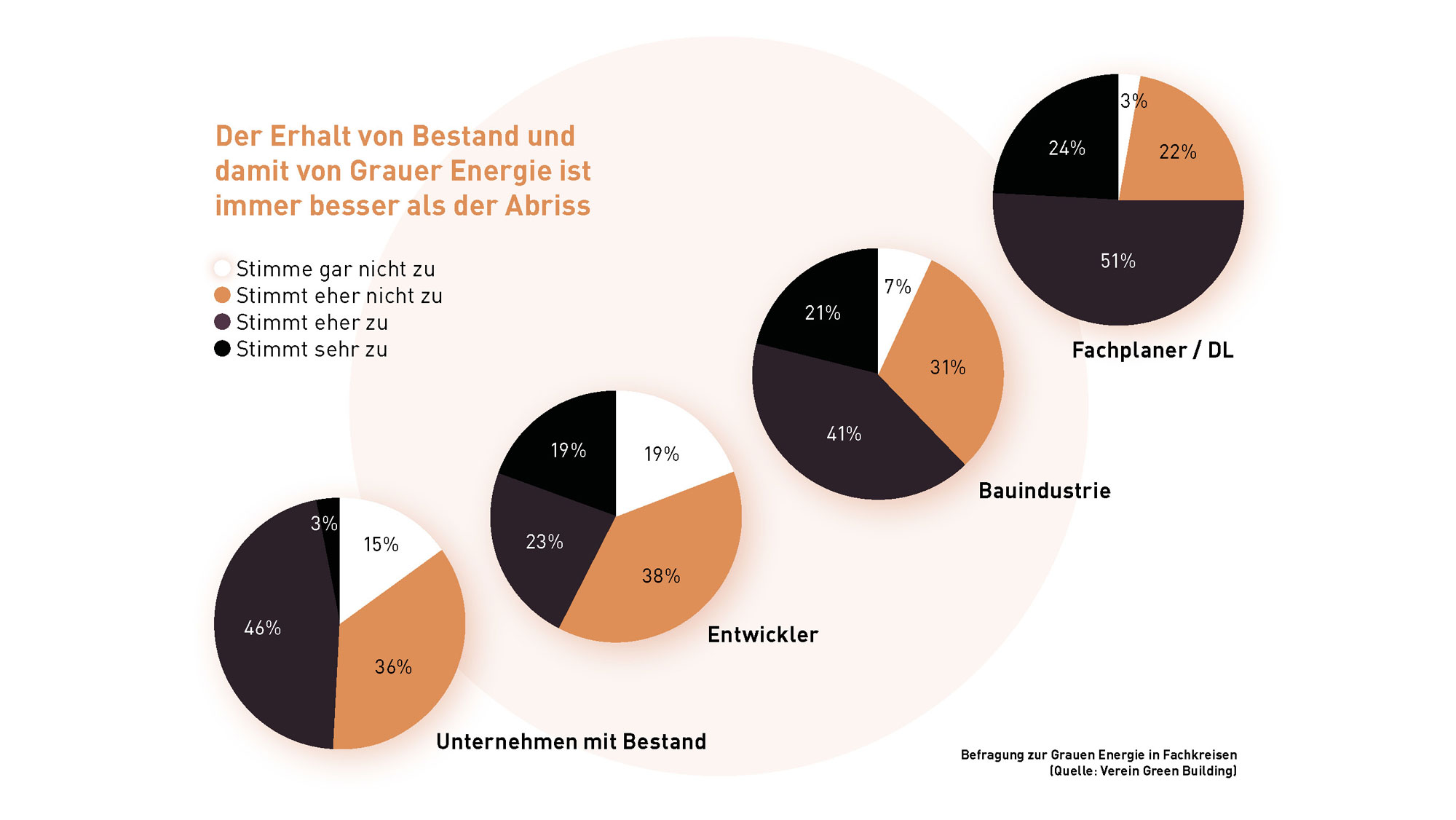
    The strength of the argument comes from the absolute statement that “the preservation of existing buildings and thus grey energy is always better than demolition”. According to a survey of experts, the vast majority of specialist planners, architects and service providers in the property sector agree with this stance. However, just under half of property owners also share this view, albeit with reservations.

    When asked in more detail, the respondents differentiated their attitude. Poor building fabric or poor energy efficiency, an outdated usage structure, utilisation that cannot be activated for the realisation of more living space or economic viability could be arguments against preservation. The sector rightly emphasises that there is no absolute truth and that the treatment of each property must be weighed up between ecological, economic and social aspects.

    One regulation for two different concerns
    Parallel to the intensification of the debate on the conservation of grey energy, the tone on tenant protection has become more heated. Various initiatives at cantonal and federal level want to prevent tenants from having to leave their homes due to extensive renovations or building replacements. These initiatives also take the uncompromising position that no eviction is always better than eviction. The canton of Basel-Stadt shows how quickly regulations can take effect. Barely three years after the introduction of the housing protection initiative, fewer properties are already being demolished and therefore fewer properties are being let out. The protection of residential property has a predominantly economic effect, with the regulated prices for new flats making replacements and renovations less financially attractive for property developers. As a result, fewer projects are being realised.

    Cautious discussion about social and societal costs
    As little as the absolute statement on the preservation of grey energy is correct, the blanket statement that not renting out is always better than renting out does not apply. The statement may be true for the individual tenant concerned, but not when it comes to providing housing for the entire population. Extensions and replacements can create more living space for more people, often in locations that are already well developed and supplied. Structural deficits in housing cannot be remedied without interventions in the building structure.

    What is needed is a more objective discussion on how the conflict of objectives between the protection of the individual and the interests of society can be resolved in the best possible way. In some cases, delaying a replacement or upgrading the existing housing stock for a further life cycle may make sense; in other cases, the social benefit of more living space outweighs this. The focus should be on the discussion of how to best cushion the social impact of rent reductions. Regulations should be focussed on finding solutions for cases of hardship.

    A balanced discourse is needed
    Absolute considerations ignore the fact that decisions are often complex and require diverging concerns to be weighed up. Sustainable solutions are usually caught between different arguments.

    Representatives of the industry should be aware that generalised statements reduce the scope for context-specific discussions. If the sector unthinkingly backs the preservation of grey energy or opposes rent reductions, the door for the discussion of moderate regulations closes.

  • Timber as a key building material for the development of urban areas

    Timber as a key building material for the development of urban areas

    Efficient use of energy and climate protection in buildings
    In view of the high energy consumption of buildings and their contribution to CO2 emissions, it is crucial to reduce energy requirements both during the construction phase and during the use of buildings. Thanks to its CO2-storing nature and efficient production methods, timber construction makes a significant contribution to reducing so-called grey energy.

    Modernisation and renovation of the building structure
    Many buildings in Germany are over 25 years old and need to be modernised and renovated in terms of energy efficiency. Timber construction offers innovative solutions here, such as adding storeys for efficient space utilisation and redensification, combined with an improved energy balance. Increasing urbanisation and rural exodus require intelligent building concepts in cities.

    Urbanisation and the role of timber construction
    Timber construction is proving to be the ideal solution for vertical and horizontal redensification. Thanks to its low weight and high degree of prefabrication, timber construction is particularly suitable for use in densely built-up metropolises.

    Timber construction is more than just a traditional construction method – it is an answer to the pressing questions of our time regarding climate protection and sustainability. Similar to concrete and steel at the beginning of the 20th century, timber construction has the potential to solve future construction tasks efficiently and sustainably and thus contribute to a more sustainable design of our urban landscapes.

  • New ways of dealing with grey energy and housing allocation

    New ways of dealing with grey energy and housing allocation

    The property sector faces the challenge of reducing its carbon footprint. While institutional investors have already made progress, Fredy Hasenmaile points out that the next step is to consider grey energy – the energy used to construct properties and their materials. Previous efforts have focused mainly on the operational phase of properties, but including grey energy in the calculations could revolutionise the understanding of sustainability in construction.

    In his analysis, Hasenmaile also points to a problematic misallocation of living space in Switzerland, caused by the current tenancy law, which leads to a large discrepancy between asking rents and existing rents. Older households in particular remain in flats that are too large, as moving to smaller units is financially unattractive. This leads to inefficient utilisation of living space and an increasing housing shortage.

    The study by Raiffeisen Switzerland identifies enormous potential for improving the allocation of living space: if flats were distributed in such a way that each household had just one more room than people, 170,000 flats could be saved. This would not only alleviate the problem of housing shortages, but would also save considerable amounts of grey energy.

    In view of the expected increase in new rents and the resulting increase in disincentives, which also lead to vacancies and low tenant mobility, Hasenmaile appeals to the need to address the causes of this misallocation under tenancy law and to find innovative solutions for a more effective transfer of living space.