Tag: Grünflächen

  • Recovery despite noise pollution

    Recovery despite noise pollution

    Cities are growing, noise levels are rising and natural recreational areas are shrinking at the same time. A comprehensive study by Empa and the Swiss Federal Institute for Forest, Snow and Landscape Research has now shown for the first time in Switzerland how crucial green environments are for coping with stress in noisy cities. Physical and mental recovery processes are significantly promoted by access to green spaces, and this effect can even be measured in the long term.

    Virtual realities prove real effect
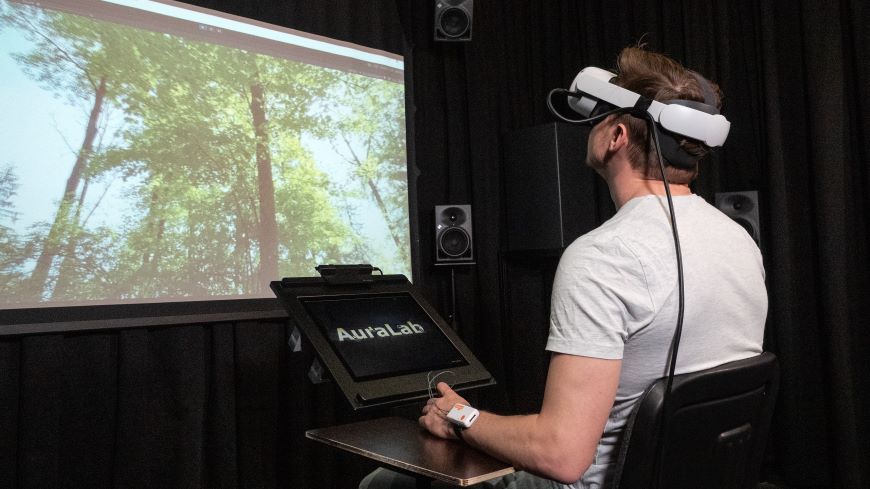
    In Empa’s Auralab, test subjects were immersed in various environments using virtual reality, from quiet urban landscapes to near-natural scenarios. After a targeted stress phase, triggered by cognitive tasks under traffic noise, a clear trend emerged. Natural soundscapes such as forests or lakes reduced physiological stress more than urban settings. Sweat production on the fingers and cortisol concentrations in saliva clearly demonstrated the effect on the body.

    Long-term study confirms sustainable recovery
    The findings from the laboratory were also confirmed in field research. A study with over 230 participants in Zurich showed that green spaces in the neighborhood reduce chronic stress levels. Hair samples showed a lower concentration of the stress hormone cortisol in people living in green and quieter environments. Even moderately greened urban spaces can therefore make a significant contribution to long-term stress management.

    Guide to healthy cities of the future
    The RESTORE project (“Restorative green spaces in noise-polluted areas”) summarizes the results of the four sub-studies and provides an important basis for policy, urban planning and health protection. In particular, the findings should influence the further development of Swiss noise legislation as well as spatial and environmental planning. At a time when three quarters of the European urban population is affected by noise pollution, the integration of green spaces opens up new perspectives for a resilient, liveable urban future.

  • Strategies against urban heat islands: The importance of green spaces and water

    Strategies against urban heat islands: The importance of green spaces and water

    The challenge facing urban and industrial centres in the face of global warming is the phenomenon of heat islands, which is exacerbated by a combination of climate change and urbanisation. The overheating of urban areas results from a lack of vegetation and an excess of heat-absorbing surfaces such as concrete and asphalt. The high density of buildings and the lack of air circulation on narrow streets further exacerbate the problem.

    To combat the negative effects of these heat islands, such as increased energy costs for air conditioning, air pollution and health risks, cities such as Zug and Zurich have begun to integrate comprehensive climate analyses and models into urban planning. The aim is to design new neighbourhoods in such a way that they contribute to reducing heat and do not lead to the creation of heat islands.

    However, the adaptation of existing structures requires additional efforts. Many cities are exploring a combination of greening, the creation of water features and the use of building materials that absorb less heat. One example of this is the city of Sion, which has built a Japanese garden on the roof of an agricultural school and created a pond in front of the school building. In addition, soil sealing is being broken up and replaced with lighter-coloured asphalt to reduce heat storage.

    It is clear that individual measures are not enough to solve the complex problem of heat islands. A holistic approach based on the motto “More green and blue instead of grey” is required to maintain and improve the quality of life in urban areas, even in hot summer conditions.

  • Rorschach: New district on a former industrial site

    Rorschach: New district on a former industrial site

    The beginnings of the field mill, once a grain mill, go back to the Middle Ages. Towards the end of the 19th century, embroidery, fabric and adhesive foils were produced in the factories on the Feldmühle site. In 2015, the adhesive tape manufacturer Scapa (Schweiz) AG gave up the Rorschach production site.

    Since then, it has been quiet on the Feldmühle site at Rorschach Stadt train station. Only the historical buildings are evidence of the once industrial boom. But in the coming years a new chapter will begin on the site.

    In 2017 the Steiner Investment Foundation bought the Feldmühle site. Together with the city of Rorschach and the project developer Steiner AG, she developed a concept for the area based on the urban development program “Seestadt Rorschach” in order to ensure both quality and economic viability. The renovation of existing buildings and the construction of new ones should bring the area back to life. From 2026 the Feldmühle site will offer the population more than 300 new rental and owner-occupied apartments as well as commercial space, squares, green spaces and quiet inner courtyards.

    The project for the Feldmühle is also the result of an architecture study competition in 2018. The winning project combines individual buildings that are valuable in terms of building history and create identity with new buildings. The original character of the former industrial plant should remain noticeable and is underlined by the equivalent urban planning address. A green outside space connects buildings and inner courtyards. The area can be crossed via alleys and stairs.

    The lively west of the area creates meeting places for the population, space for business and is located directly at the Rorschach Stadt train station. A quieter, more individual world, on the other hand, is emerging in the east of the Feldmühle area. It contains mostly apartments and is characterized by a strong relationship to the inner-city green space. In addition, there is the future open stream and the free space in the direction of the Evangelical Reformed Church. The two worlds are closely interwoven and give the quarter a varied overall appearance.

    The area is currently being used temporarily. Under this name, the former gluing factory serves as an event space for events for up to 100 people. When the weather is nice, the glue shop runs a garden restaurant. She has an open
    air area with a covered event stage and space for 300 people. In addition, the roofs of the Feldmühle area were home to a colony of bees from summer 2019 to summer 2020 – a collaboration with a local beekeeper.

  • A residential area to feel good

    A residential area to feel good

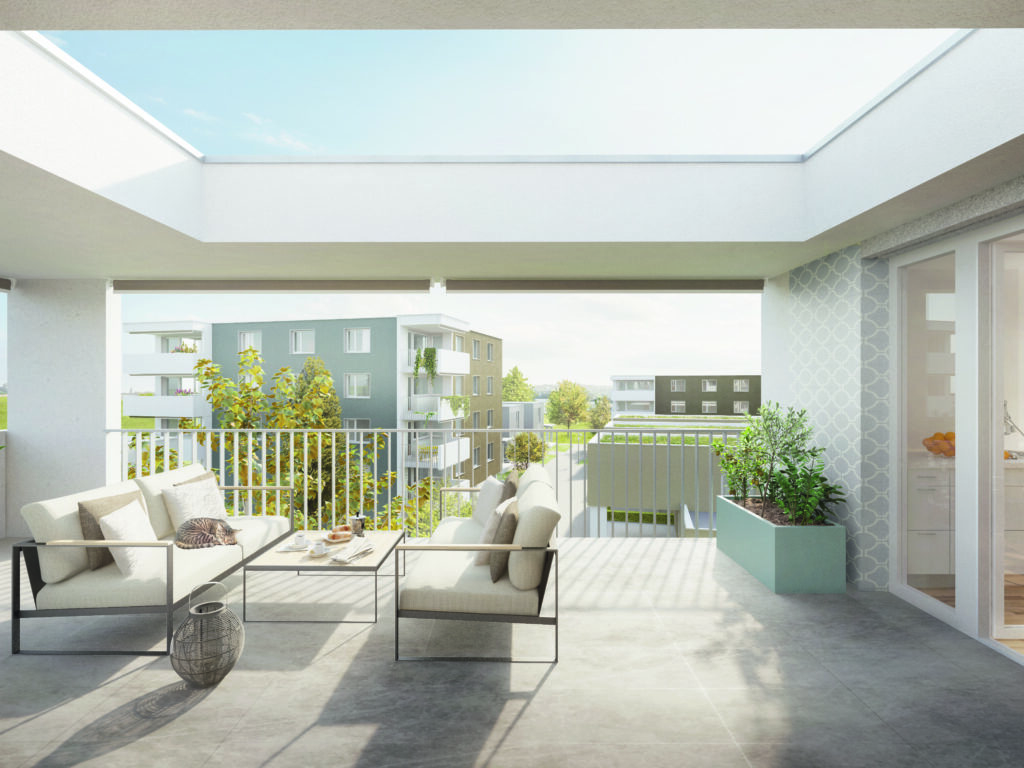
    With this project, Steiner AG is creating living space for young people, singles, couples, families and senior citizens. In the new quarter there will be attractive housing offers, private retreats and communal meeting areas. Numerous green areas with playgrounds and playgrounds invite you to spend a lot of time outside. At first glance, the many green and recreational areas as well as the bright apartments catch the eye: "We have placed great emphasis on open, well-lit interiors with a beautiful view, which ensure a pleasant, feel-good climate, peace and relaxation," says Stefan Gabriel, Team Leader Real Estate Development at Steiner AG. «The apartments are barrier-free, functional and can be flexibly furnished. Private gardens and community gardens invite you to linger and round off the multi-generational living in the quarter. "

    Here, a fallow industrial area is being transformed into a new place to live in the countryside. Existing listed buildings such as the barn and the Alte Post are carefully integrated and revitalized for living and common areas. This project aims to create a comfortable living area that will enrich Fischbach-Göslikon.

    Contemporary renovation
    Steiner AG sees its project as a symbol of the connection between the past and the future of Fischbach-Göslikon. “The listed barn is an important cultural and historical witness in the community and in the neighborhood – a building that needs to be preserved. The barn is being gently but modernly renovated and used for new purposes. A day-care center with 16 places and a workshop are to be built on the ground floor. A common room for various occasions, such as birthdays or family celebrations, is planned on the upper floor. The room can also be rented by the public, ”says Gabriel.

    Start of construction in 2022
    The start of construction on the first stage is scheduled for 2022. The overall project, which consists of three stages and should be completed by 2032, will one day include 165 residential units in 10 apartment buildings and 46 row single-family houses. Due to the current design plan, there must be an interval of four years between building applications. Gabriel concludes: “We are now expecting the building permit for the first stage to become legally binding. We are pleased about the excellent cooperation with the authorities and everyone involved. This is an important prerequisite for such a project to be implemented successfully. "

    The 165 residential units are all very bright.