Tag: Herstellung

  • Research into concrete as a carbon sink

    Research into concrete as a carbon sink

    Researchers at the Swiss Federal Laboratories for Materials Science and Technology(Empa) want to remove large quantities of excess carbon dioxide from the atmosphere with the Mining the Atmosphere working group. According to a press release, 5 to 10 billion tonnes of carbon could be used annually as concrete aggregate. This would be enough to permanently store the excess CO2 within 100 years after the energy transition and thus bring the atmosphere back to a climate-friendly level. This is estimated to be 400 billion tonnes of carbon or the equivalent of around 1500 billion tonnes of CO2.

    However, surplus renewable energy is needed to realise this. This is the only way to convert the carbon dioxide into methane or methanol and then process it into polymers, hydrogen or solid carbon. “These calculations are based on the assumption that sufficient renewable energy will be available after 2050,” Pietro Lura, Head of Empa’s Concrete and Asphalt Department, is quoted as saying in the press release.

    However, the amount of building materials required worldwide far exceeds the surplus carbon in the atmosphere. “Even if sufficient renewable energy is available, the key question remains as to how these huge amounts of carbon can be stored in the long term,” Lura continues. The researchers see one approach here in the production of silicon carbide, which can be used as a filler in building materials and the production of asphalt. This should bind the carbon in the long term and have excellent mechanical properties. However, Lura describes the production process as extremely energy-intensive. Production still requires considerable material and processing research in order to make it economically viable.
  • AI accelerates perovskite solar cells for the mass market

    AI accelerates perovskite solar cells for the mass market

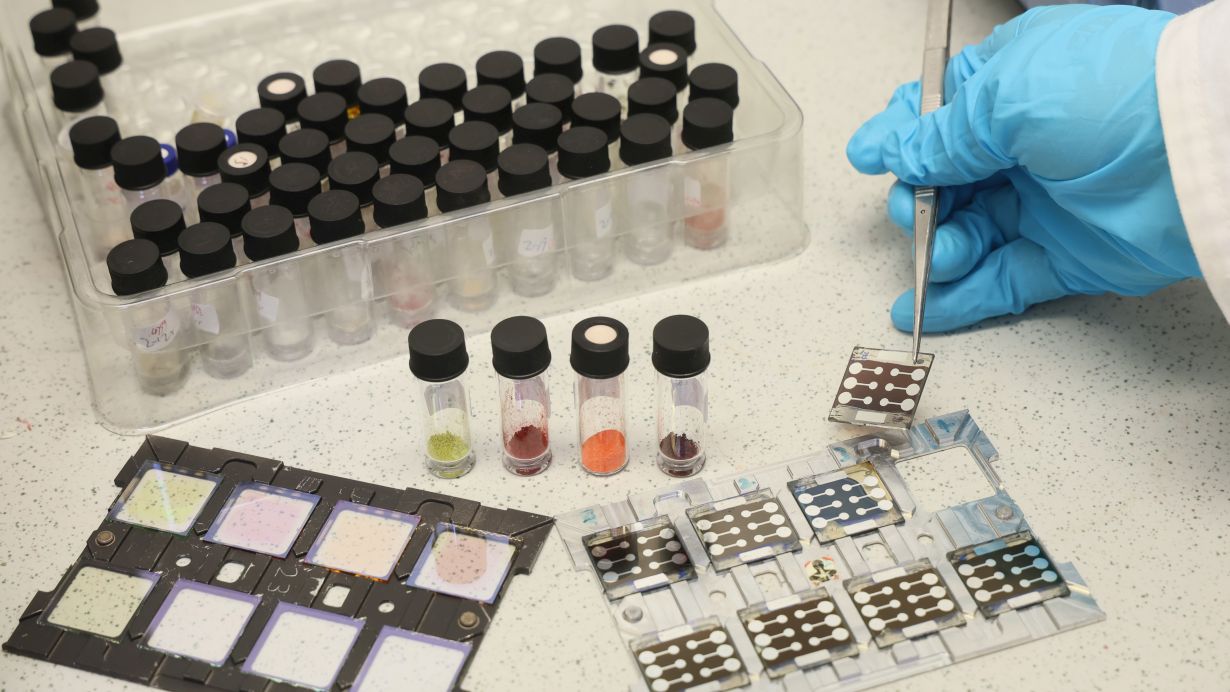
    Perovskite solar cells already achieve efficiencies of over 26% and are light, flexible and inexpensive to produce. They are considered a promising alternative to conventional silicon modules. However, challenges such as long-term stability and scalability still stand in the way of industrial utilisation.

    AI as the key to optimising production
    The Karlsruhe Institute of Technology (KIT) is researching how machine learning can improve the manufacturing process for perovskite cells. Deep learning models analyse material properties in real time and optimise the parameters for maximum efficiency.

    Detecting errors before they occur
    AI uses in-situ imaging techniques to monitor thin-film formation and detect errors at an early stage. This allows process deviations to be corrected immediately and expensive rejects to be avoided.

    Simulations for maximum efficiency
    AI-supported simulations allow production conditions to be precisely adapted. The control of the vacuum quenching time in particular plays a decisive role. AI optimises this process to ensure the best possible material structure.

    The path to market maturity
    The KIT study shows that AI is a key driver for the further development of perovskite photovoltaics. The technology could revolutionise the solar energy market and become industrially usable faster than ever with AI.

  • SAEKI Robotics receives $2.3 million in funding

    SAEKI Robotics receives $2.3 million in funding

    SAEKI Robotics has received $2.3 million from investors. The early financing round of the spin-off from the Swiss Federal Institute of Technology Zurich(ETH), founded in 2022, was led by the Zurich-based investment firm Wingman Ventures. In addition, the two venture capital firms Vento from Turin and GETTY from New York as well as angel investors participated.

    According to a SAEKI announcement on LinkedIn, the funding will “support our mission to build a network of decentralised automated factories that combine digital manufacturing and robotics to produce large parts at the speed of light”, such as wind turbine blades, components for concrete building parts or aircraft and car parts.

    According to a Techcrunch article linked by SAEKI in the release, the three founders are focusing on building fully automated factories with independent robotic cells that can be booked by customers. “What we hear over and over again from people and companies is the desire for faster and more sustainable solutions for their parts,” co-founder Andrea Perissinotto is quoted as saying there. “The mere offer of savings from a multi-million dollar machine that requires a lot of space and additional resources, including hiring people who know new processes and materials, is not attractive to them.”

    The company also reportedly plans to collaborate with the composites industry for lightweight but strong parts in aircraft, cars and bicycles. SAEKI’s technology is expected to eliminate the time-consuming and expensive production of complex moulds from metal or composites, and thus a bottleneck for companies.