Tag: HIAG

  • The transformation of the Papieri site

    The transformation of the Papieri site

    The Papieri site in Biberist, Solothurn, can look back on a long industrial history: Its existence began in 1862 as the site of the “Papieri” paper mill. After almost 150 years, the factory ceased operations in 2011, most recently owned by the international paper group SAPPI. Subsequently, HIAG from Zurich acquired the 60,000 square metre site – with the aim of creating a lively and diverse quarter.

    However, the industrial spirit that is strongly anchored here is not to be lost: The “Papieri” is to continue to be used for commercial and industrial purposes. The location and general conditions of the area are still ideally suited for this. The site can be reached in a few steps from Biberist Ost railway station. In addition, it is served by the bus stops Biberist Emmenbrücke and Biberist Derendingenstrasse (BSU). Attractive pedestrian and bicycle connections are also planned for the medium term.
    HIAG has worked out a sustainable development strategy in close consultation with the canton, municipalities and other stakeholders. As early as 2013, an urban planning study was carried out in collaboration with five architectural firms. The findings of this study commission formed the basis for the master plan, which was completed in 2015 in consultation with the municipality of Biberist. The partial zone plan revision is currently underway. This is currently undergoing a cantonal preliminary examination.

    The long-term planning envisages a division of the site into two parts: The “West” area near the Biberist East railway station comprises about one third of the total area and is to become an area open to the public with quiet commerce, services, leisure, culture and housing. No concrete residential projects are planned yet. But: “The future usage regulations allow for a residential share in the western area,” says Dominik Ulrich, project developer of HIAG Immobilien Schweiz AG. The eastern area towards Derendingen, on the other hand, will be transformed into a workplace area for the manufacturing industry.
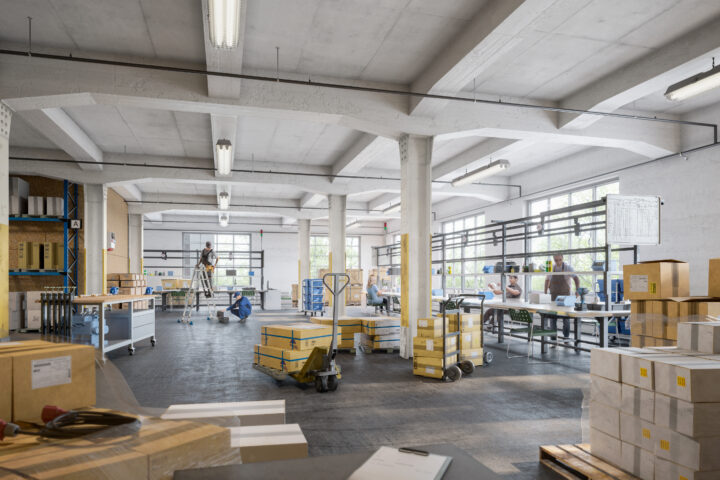
    nightnurse.ch

    Access to the publicly accessible western area of the site is already from the southwest. In future, the triangular Papier-Platz will mark the beginning of the site. The square is enclosed by the striking existing building at Fabrikstrasse 1, which will be made fit for the planned transitional uses by mid-2023: On the ground floor, spaces between 160 and 1000 square metres will be rented to commercial and service providers. The rooms on the upper floors are ideally suited for commercial and storage space as well as studios. Offices are also available in the neighbouring building. “The transitional use of Building 1 is planned for up to ten years. The goal is to establish uses that will last in the long term,” explains Ulrich. The dismantling of the machinery was a prerequisite for opening up the area. The machines were successfully sold in recent years and transferred to new owners.

    The centre of the area, and thus the centre, is the square by the canal: Demolition work is currently underway here to create open spaces and breakthroughs in the hall structures. So far, 17,000 tonnes of material have already been removed. HIAG attaches great importance to sustainability: 14,000 tonnes of it will be processed into granulate on site and reused. The deconstruction work is scheduled to be completed by the end of this year. From mid-2023, the construction of a new modern building is planned, which will offer around 15,000 square metres of usable space for trade, production and offices. The first tenants are expected to move in by the end of 2024. According to Ulrich, concrete negotiations are currently underway with prospective tenants.
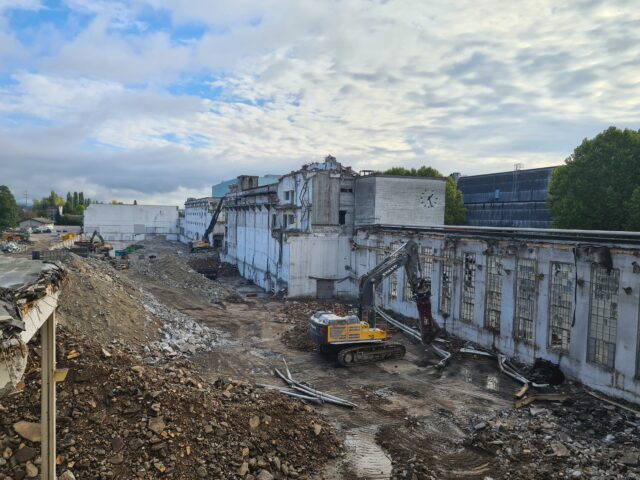
    Demolition work is currently underway in the middle of the site.
  • HIAG remains on course for growth

    HIAG remains on course for growth

    HIAG strengthened its own position in the Swiss real estate market in 2021 and significantly improved its financial figures, explains HIAG Immobilien Holding AG in a press release . According to her, all three business areas of the Basel real estate company have contributed to the continuation of the growth course. Real estate income increased by 5.7 percent year-on-year to CHF 63.1 million.

    The operating result at EBIT level increased from CHF 69.9 million to CHF 115.1 million. Net income rose from CHF 55.2 million to CHF 89.3 million. Without revaluations and deferred taxes, an EBIT of CHF 54.6 million and a net profit of CHF 37.0 million were realized.

    The value of HIAG’s real estate portfolio increased by 8.9 percent to CHF 1.78 billion as of the end of 2021. According to HIAG, the vacancy rate fell from 13.2 to 10.7 percent year-on-year “despite the sale of fully let properties”. In the announcement, the company highlights successful follow-on leases, some with higher rents.

    HIAG also expects business to develop well in the current year. The company can rely on a development pipeline of currently more than 60 projects with a total volume of 2.98 billion Swiss francs. HIAG is also particularly interested in the purchase of residential building land in the future in order to quickly realize condominium ownership. Non-strategic properties are to be divested for capital recovery.

  • From the metal factory to the mixed neighborhood

    From the metal factory to the mixed neighborhood

    The Wydeneck was a closed area for over 100 years and was used exclusively by the "Schweizerische Metallwerke AG Dornach" for metal processing. Swissmetal still produces today and uses around half of the area. Small craft businesses and manufacturing SMEs also work.

    In 2015, Hiag acquired the area in Dornach and began planning its future use. In close cooperation with the canton and municipality, the owner developed a coherent basis for the transformation of Wydeneck. The leading office for the test planning process was the Zurich urban planning office Feddersen & Klostermann in collaboration with Brühlmann Loetscher. 90 interested residents brought their wishes and suggestions into the planning process during a two-day participation process. On this basis, the master plan was drawn up and approved by the municipal council in 2018. In this context, the new name was also announced: Wydeneck – Metalli im Wandel.

    The area-specific sub-zone plan revision and the development of a sustainable mobility concept are currently on the agenda. Central topics are the development of the quarter with a bus line, its own S-Bahn stop and the integration of the feeder to the A18 motorway. Building land is to be re-zoned along the Birs and the river basin is to be revitalized.

    The opening of the aeral will initially take place through transitional uses. This creates space for business, leisure and culture. The offers are intended to attract customers and visitors. With the start of the first construction phase, these uses will be successively replaced or relocated. Several hundred apartments as well as commercial and service-oriented offers will be built in the next 20 to 25 years. Some of the existing historical buildings will be renovated and will remain as a contemporary witness of industrial history.

    The Wydeneck is to become a lively, mixed and urban district. Around 1,800 residents and a wide range of commercial and service offerings with up to 400 jobs are planned. The publicly accessible riverside park and the preservation of the historical substance also ensure the special flair.

  • Industrial wasteland is becoming a place of work for companies

    Industrial wasteland is becoming a place of work for companies

    There used to be a cement factory and chemical works here. Today the 75,000 Reichhold area is a huge industrial wasteland. Now it is to become the Reichhold campus.

    In 2012, Hiag bought the site, half of which is on the ground of the municipalities of Hausen and Lupfig. She has carried out the remediation of contaminated sites by 2020. According to the vision of the owner, traditional commercial operations such as a carpenter's workshop should find space here, as well as industrial companies with development and production departments or SMEs such as a catering company. The versatile space is to be adapted to the needs of the tenants.

    The idea of sharing is very important on the Reichhold campus. Not only meeting rooms and co-working spaces, but also bicycles and motorized vehicles should be bookable by the hour via an app. In addition, the planned structures should encourage the individual companies to use infrastructures such as the reception, the canteen or exhibition rooms together. Restaurants, take-aways, shops with everyday goods, a day-care center and a fitness studio should also make the environment attractive for the employees of the local companies.

    Sustainability plays an important role on the Reichhold campus. Innovative materials on and in the buildings, renewable energy and solar panels are part of the self-image of the campus. There are numerous meadows and green spaces around the building.

    The building application for the first projects is to be submitted from 2022. If everything goes according to plan, the first properties will be ready for occupancy from summer 2023.

  • Forest Tower: creative center in the lower Aare valley

    Forest Tower: creative center in the lower Aare valley

    As a six-storey building with a wooden facade and ribbon windows, the Forest Tower protrudes over the Kleindöttingen industrial park – an area with an industrial history in the lower Aare valley, which is now primarily used by logistics-intensive and production-oriented companies as a location.

    The former production building was converted into an office building earlier. So far, the owner Hiag has advertised the office space contiguously. Now she wants to liven up the rooms with a new idea: The Forest Tower is to become a creative hotspot. In order to realize the project, Hiag is looking for creative minds – companies, private individuals, freelancers and self-employed – who want to settle in the Forest Tower. As soon as two or three interested parties agree, the owner wants to start renovating the first floor.

    For teams that need their own office, office space of various sizes and with plenty of daylight should be created. A shared studio should provide space for creative work, for example with a work area in the middle of the room and with additional workplaces on the walls. A co-working space is also being planned.

    A common meeting room should be created for meetings, customer presentations or workshops. The Community Area, a communal area with a coffee kitchen and lounge, is to serve as a meeting point. The Ideation Salon, a room with a large screen, whiteboard and moderation material, is intended to provide a creative environment for workshops and networking. Company aperitifs with a view of the Klingnau reservoir could soon take place on the roof of the building. The fast internet, a professional printer and the common rooms should be available to the entire Forest Tower community.

    Kleindöttingen is part of the so-called Zurzibiet, an economic region that is also gaining in importance on a supraregional level. It comprises 26 communities between Baden and Brugg. The area is characterized, among other things, by its convenient location and moderate cost structure. The proximity to research and innovation centers makes it particularly attractive for qualified specialists and companies.