Tag: Highlight

  • "You have to offer your customers alternatives"

    "You have to offer your customers alternatives"

    What exactly does Swiss Circle do?
    Swiss Circle is the network for the Swiss real estate industry. We look after our around 250 members, network them with one another and support them with marketing tools. Our members want to get to know each other better, but also want to be more noticed in the industry. We also give them the opportunity to expand their know-how in special disciplines of the real estate industry.

    How exactly does that work?
    We offer various platforms: We are present at the major international real estate fairs such as MIPIM in Cannes or the Expo Real in Munich. We have been active on international stages for 25 years. At these trade fairs, we present our Swiss companies at a joint Swiss stand. In addition, we regularly organize networking events and various congresses on current real estate topics spread over the year. Online tools such as realestate-experts.ch complete our offer.

    Important trade fairs will be canceled this year due to the corona crisis. How does this affect Swiss Circle?
    We are creative and have created replacements for unusual activities. Including the online series “Real Estate Brains”. Here we produced a program online every Tuesday morning. This year we implemented the “The Marketing Round” congress entirely digitally via Zoom. We are launching the “Innovation Day” as a hybrid event: using two programs that we stream live and a print product that offers our customers another platform to present themselves. As a replacement for the Expo Real in Munich, which is not taking place, we are organizing the “Swiss Networking Circle” at Zurich Airport in October. Members who would otherwise have gone to Munich are given the opportunity to network and present themselves.

    How are registrations for the Swiss Networking Circle going in autumn?
    We have already received numerous bookings. However, we do not yet know how many guests we will actually be able to invite – that depends on the federal regulations for events in October. Certainly not everyone can take part. However, partners who are actively involved in the event will definitely receive a quota of invitations for their customers. We at the Swiss Circle will also be inviting a contingent of members. The need of our customers to meet again in person is definitely great.

    "Immo21 takes place in a larger hall."

    How are the online offers received by the members?
    “Real Estate Brains”, for example, is very well received – we have 200 to 300 viewers at a time. The speakers come from Germany, Austria and Switzerland. We usually recruit the Swiss speakers from among our members. After the summer break, we will continue this format on a monthly basis until further notice.

    How do you assess the current situation on the real estate markets?
    The situation is controversial. The retail market is critical. The corona crisis acted as a fire accelerator, the retail trade had it difficult even before the corona. Hotel properties are another loser. Office buildings are likely to give way only slightly – we have to wait and see whether and how much home office will become established and how digitalization trends will develop. The housing market is stable – at best there are still long-term effects. But of course there are also winners: for example logistics real estate.

    What feedback do you get from your members?
    Real estate service providers such as facility and property managers are hardly affected. On the other hand, there is a certain reluctance to deal with transactions; trading is currently more defensive than before the crisis. This should be reflected in the sales of marketers or lawyers.

    What long-term consequences do you expect due to the corona crisis?
    I don't expect a long-term negative effect in the real estate business. However, it is possible that business will be a bit more resinous this year due to the prevailing uncertainty and the lack of personal contact. As far as the Swiss Circle is concerned, however, I am confident that next year events and trade fairs will run almost as usual again. Which changes will remain remains to be seen. The motto of the time is: be flexible and expect different scenarios. We do that too. If you want to get out of the crisis as unscathed as possible, you have to offer your customers alternatives.

    Immo21, which is co-organized by Swiss Circle, will take place in January next year. Are there any changes due to the corona?
    We have already reacted to the situation and with Hall 550 in Oerlikon we have chosen a larger location than before. In this way, we can offer a possibly still limited number of visitors more space so that the distance rules can be adhered to. This could also prevail in the future: that you have to factor in more square meters per participant.

    What is your advice to young entrepreneurs in the real estate sector during this time?
    Of course, they very much lack contact with the established industry. Young entrepreneurs are usually looking for investors and platforms to present their new ideas – and are dependent on growing quickly and showing success. The handbrake effect is certainly more serious for start-ups than for an established company. At the Swiss Networking Circle and the Innovation Day we have special offers to involve young entrepreneurs and give them preferential access. Since the exchange between young and established will continue to gain in importance in the future, Swiss Circle and SwissPropTech will increasingly appear together in the future. I would like to extend a warm welcome to all future-oriented real estate decision-makers! ■

  • Nancy's Art Nouveau landmark

    Nancy's Art Nouveau landmark

    Under leadership, the company flourished and opened branches in Paris, London and Berlin, among others.

    The Frenchman, born in 1859, was only 39 years old and was able to commission the construction of a magnificent villa. He relied on the then 26-year-old architect Henri Sauvage (1873–1932). The two gentlemen met in the house of their mutual friend – the sculptor Alexandra Charpentier. Sauvage had never worked on a project like this before. The only experience Sauvage could boast was working for a few months with the Brussels architect Paul Saintenoy. Majorelle liked the youthfulness and boldness of the architect as well as his good network in the art world. He preferred Sauvage to the experienced Nancy-based architect Lucien Weissenburger. Weissenburger was allowed to carry out the project on site.

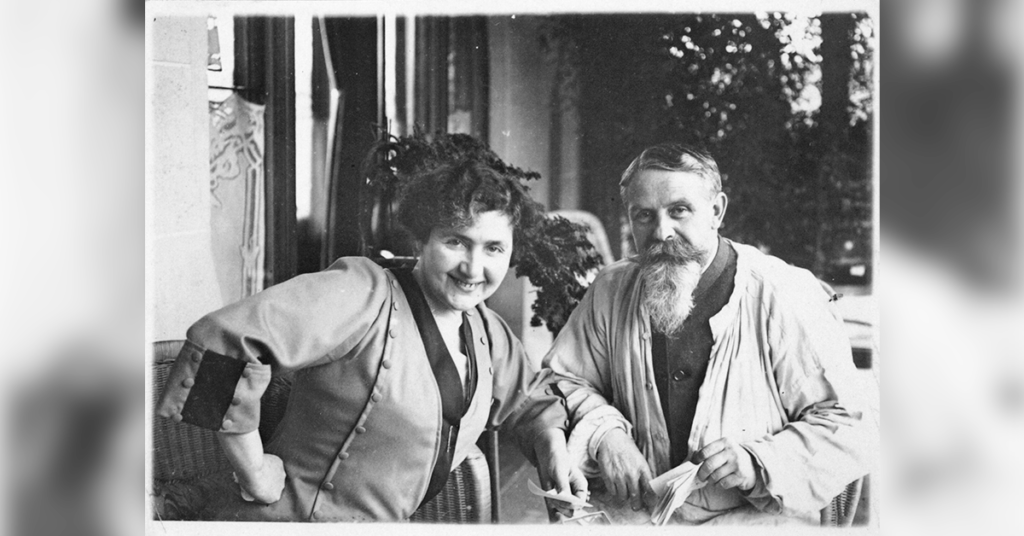
    The Majorelle family's photo album provided important information
    In the years 1901–1902 the villa was built according to Sauvage's plans. It was the first completely Art Nouveau house in Nancy and is considered a prime example. Sauvage did not build the villa single-handedly: he called on other renowned artists. For example his Paris friends, the ceramic artist Alexandre Bigot and the painter Francis Jourdain. Bigot carried out the ceramics, Jourdain designed the decorative paintings in the dining room. The furniture comes from Majorelle's own production. The landlord also took care of the ironwork and the railings. The stained glass windows in the main rooms (staircase, dining room, living room and bedroom) were designed by the master glazier Jacques Gruber. The majority of these artists belonged to the Ecole de Nancy, which Emile Gallé co-founded in 1901.

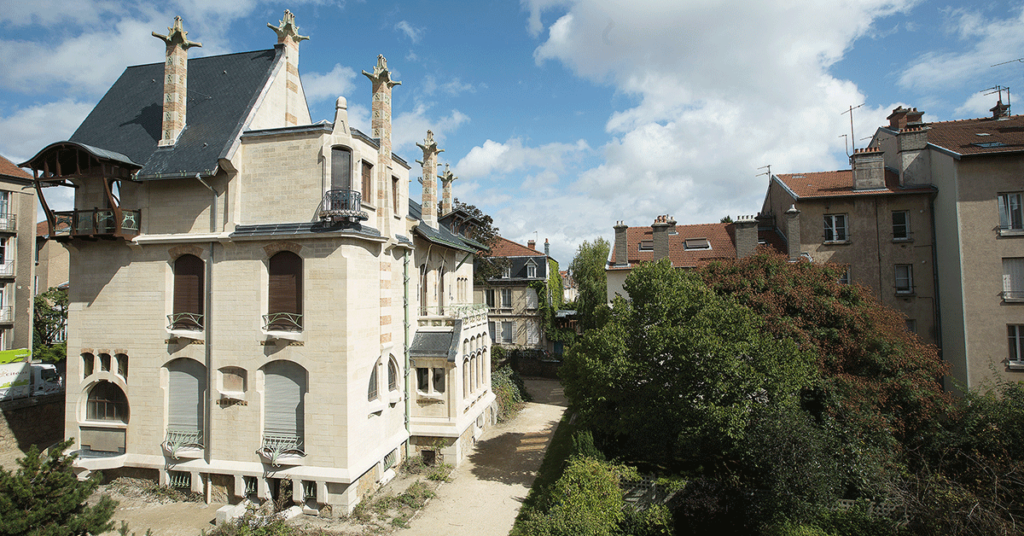
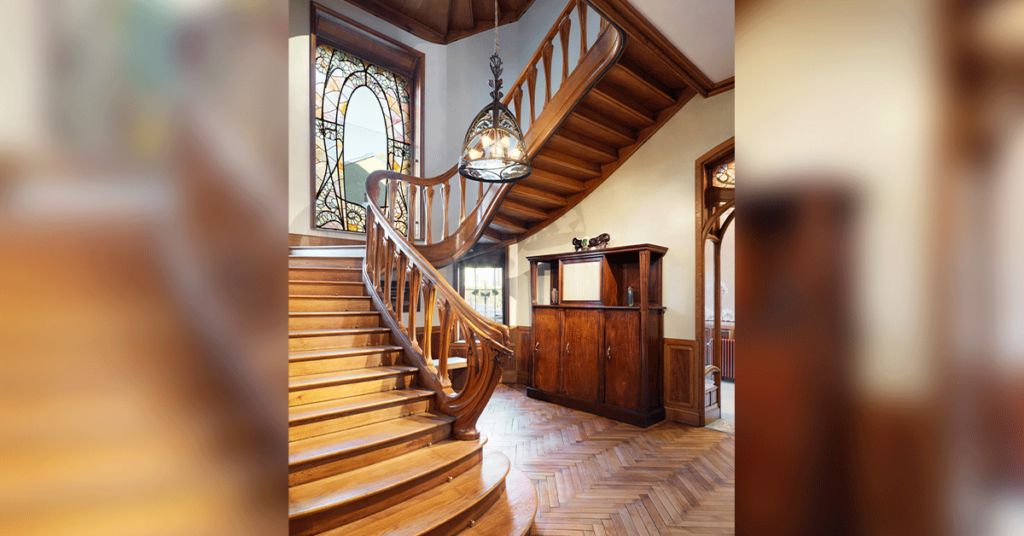
    For four years, the Villa Majorelle was repaired internally and externally through extensive restoration work. The building, completely in Art Nouveau style, was commissioned in 1898 by Louis Majorelle, himself a cabinet maker, designer and blacksmith. Majorelle actually wanted to be a painter and studied at a young age at the School of Fine Arts in Paris. After the death of his father, he had to return to his hometown Nancy (F) early to take over the family business. He had modern furniture made and was inspired by nature and Emile Gallé. Gallé specialized in the material glass and did pioneering work in this area. He is one of the founders of Art Nouveau. Louis Majorelle's floral elements run from the facade to the interior of the house: they can be found in ornaments, carvings, mosaics and enamel work. Architect Sauvage arranged the windows and exterior doors to match the logic of the interior layout, breaking with the tradition of the horizontally symmetrical building. Flowing forms and decorative motifs run through the entire architecture. Sauvage played with the opposites: the bare Euville stone contrasts with the polychromy of bricks, stoneware, wood and ironwork. The constant presence of wood runs like a red thread through the interior design and creates a connection with the exterior of the villa.

    The Villa Majorelle is considered a unique experimental work. Henri Sauvage later said: “I worked there for two years and I am deeply grateful to my first client for the incredible freedom he has given me. Despite my young age, he never imposed any budget restrictions on me or his personal ideas. " After completion, Louis Majorelle lived there with his wife Jane Kratz and their son Jacques. The building is also known under the name «Villa Jika» – after the initials of Jane Kratz.

    Louis Majorelle died in 1926, the villa was inherited by his son, who sold the house to the state. He initially had offices built there. The gradual rediscovery of Art Nouveau led to the villa being classified as a historic monument in 1975 and finally a listed building in 1996. The city of Nancy has owned the villa since 2003. In the last few years the villa has been repeatedly renovated. In the most recent and most extensive renovation, the villa was returned to its 1926 state. The renovation work was carried out by the Atelier Grégoire André. Articles and publications from the time the villa was built provided important information about the original appearance of the house. The Majorelle family's photo album also served as a valuable source of information.

    Some changes made afterwards were removed this time: For example, a bay window on the north facade was removed and the chimney hoods that were removed a few years ago for safety reasons were reinstalled on the roof. The facade was cleaned and damaged masonry replaced. The work on the outer facade and the roof only took two years.

    Original Gruber window destroyed in bombing
    But the interior of the building was also completely restored in close collaboration with the Musée de l'Ecole de Nancy and a committee made up of Art Nouveau specialists and art historians. In order to create adequate reception areas for visitors, the cash register, cloakroom and souvenir shop are located in the kitchen and pantry area. A new elevator was installed, otherwise the wooden and mosaic floors as well as the glass work were completely redesigned.

    The living room has an elaborate stucco decor with a pine cone motif, which can also be found on the furniture and the fireplace. The same motif was also used on Jacques Gruber's stained glass window. However, the Gruber window was destroyed in the bombing of Nancy in 1916 and replaced by another oriental-style window that can still be seen today.

    Almost 100 pieces of furniture, paintings and art objects then found their way from the Musée de l'Ecole to the villa. Most of the furniture is original. Works were selected that were designed by Louis Majorelle and / or by companies with whom he had worked (Manufacture Daum, Manufacture Keller et Guérin, the ceramic workshops de Rambervillers and Frères Mougin). The choice depended mainly on the similarity to the objects visible in the old photos. In the same way, the museum has also selected from its collection paintings made by Louis Majorelle or his son Jacques.

    Between 2021 and 2022, minor renovations will be carried out inside the villa, but these will not require the house to be closed. The works include recreating the bathrooms, creating teaching and educational areas on the first floor, and renovating Louis Majorelle's studio on the second floor. The costs so far amount to 2.5 million euros. ■