Tag: Historik

  • Historic site becomes new cultural and educational centre

    Historic site becomes new cultural and educational centre

    The city of Schaffhausen is pursuing an ambitious goal with the redevelopment of the Kammgarn site: to transform the historic area into an attractive location for culture, education and socialising. The Schaffhausen electorate approved this project back in August 2020.
    The comprehensive redesign not only creates a better connection to the urban fabric, but also new utilisation options. In addition to the existing entrances from Baumgartenstrasse, Rheinuferstrasse and Rheinstrasse, a new passageway will be created along Klosterstrasse. This strengthens the connection with the old town and increases the attractiveness of the neighbourhood. The Kammgarn area will become part of a “string of pearls” of meeting places along the banks of the Rhine, which will enhance the area in the long term.

    More quality of stay through new open spaces
    The redesign of the Kammgarnhof will transform the inner courtyard, which was previously used as a car park, into a car-free zone. Green spaces, seating and a water feature will increase the quality of stay and turn the courtyard into a central meeting place. The redesign will enable a variety of uses for events, culture and recreation.

    Another core element of the development is the construction of a single-storey underground car park with around 90 parking spaces under the courtyard. This will make the entire area above ground car-free and open up new possibilities for use. A pergola will be erected in front of the west wing, while a spacious terrace will be created in front of the north wing.

    Modern infrastructure for culture and education
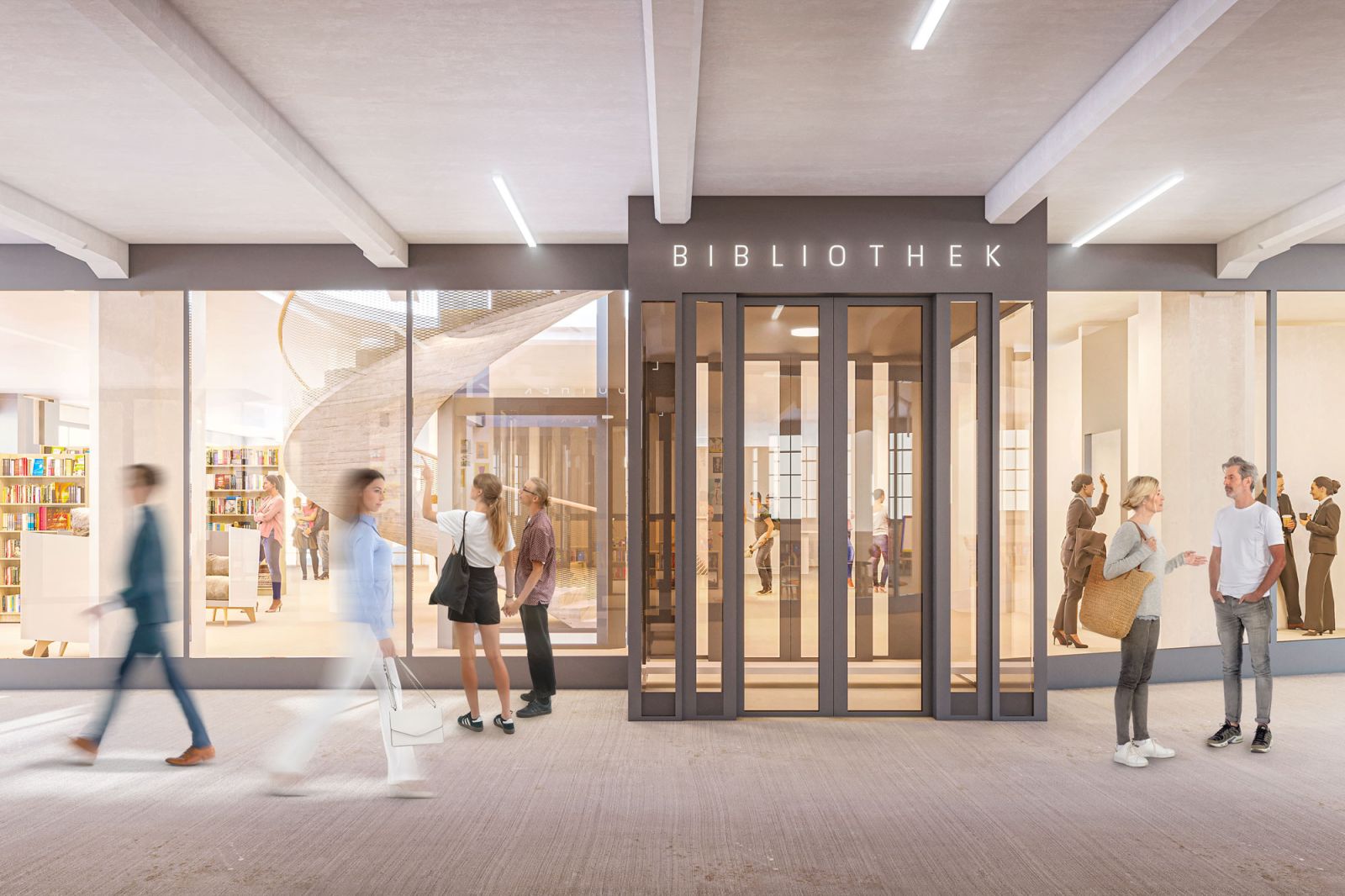
    The west wing of the Kammgarn site is being prepared for new uses as part of the refurbishment. The library and toy library will move into the ground floor and first floor. Glazed façades offer passers-by a glimpse into the world of books and games.
    The Schaffhausen University of Teacher Education will move into the second and third floors, while the fourth floor will be available for other tenants. The diverse use of the site reinforces its importance as an educational and cultural centre.

    Construction progress and archaeological work
    Construction officially began in September 2024 with the symbolic ground-breaking ceremony. Prior to this, archaeological rescue excavations were carried out, during which significant finds from the last 1000 years were discovered.

    Work is currently underway on the underground car park and the redesign of the courtyard. At the same time, the renovation of the west wing is progressing. In addition to structural measures, the façades and roof are being renovated and preparations are being made for the interior work.

    The first floor slab for the new courtyard was concreted in January 2025. To protect the valuable trees, a retaining wall (Rühlwand) is being erected around the large chestnut tree in the courtyard.

    A new meeting place for Schaffhausen
    After the remodelling, the Kammgarnhof will be an attractive place for locals and visitors to the city. Reading, meeting friends or enjoying concerts – all this will be possible in the redesigned surroundings.

    The construction of the underground car park is being financed jointly with IWC Schaffhausen, the direct neighbour of the site. This close collaboration will result in a sustainable solution that improves both the flow of traffic and the quality of life.

    A lively neighbourhood with a future
    The comprehensive renovation and redesign will transform the Kammgarn site into a modern cultural, educational and meeting centre. The connection to the old town and the Rhine will be strengthened, while new uses will enrich Schaffhausen’s cityscape. The project is scheduled for completion at the end of 2026 – a significant step for the long-term development of the city.

  • Neuchâtel equips three historic buildings with 33,300 solar roof tiles

    Neuchâtel equips three historic buildings with 33,300 solar roof tiles

    According to a press release, roof surfaces on three listed buildings in the city of Neuchâtel will be used for sustainable energy generation in future. The city’s Collège des Parcs and the cantonal school and university buildings Beaux-Arts and A.-L. Breguet will be equipped with a total of 33,300 solar tiles from Freesuns. The renovation project is supported by the CSEM research and development centre. For the city and canton, it represents a further step towards the energy transition.

    According to the press release, the college can generate 150,000 kilowatt hours of electricity itself each year, which is equivalent to the consumption of 50 Swiss households. The installed capacity on the cantonal buildings is 130 kilowatts peak for A.-L. Breguet and 95 kilowatts peak for Beaux-Arts.

    Architectural conditions required special solutions: At the Collège des Parcs, the tiles had to be installed in such a way that they followed the curved lines of the roof without damaging it.

    The conversion of historic buildings to solar energy could provide an inspiring model for other cantons and municipalities. The tiles could “enable the balance between cultural preservation and sustainable development”, Deborah Learoyd, General Manager at Freesuns, is quoted as saying.

    The renovation projects are “an example of how we can combine roof tiles, photovoltaics, energy transition and preservation of architectural heritage”, Matthieu Despeisse, Group Leader Solar Modules at CSEM, is quoted as saying.

    The work should be completed between September and November 2024. CSEM and Freesuns are considering continuing their collaboration.

  • Museum invites you to the Day of the Empty Langmatt

    Museum invites you to the Day of the Empty Langmatt

    The two-year renovation of the Langmatt Museum in Baden begins on 1 March. The museum is inviting the public to visit on Sunday, 25 February, on Empty Langmatt Day. The public can circulate freely with free admission and view all the rooms, including those that were previously not open to the public, according to a press release. The Empty Langmatt Day offers spectacular insights from the cellar to the attic, it continues.

    Director Markus Stegmann and assistant curator Daniela Minneboo will guide visitors on a 40-minute tour of the empty Langmatt at 2 pm, 3 pm, 4 pm and 5 pm. Children aged five and over can go on a 15-minute discovery tour of the house with art and culture mediator Vera Horat at 3 pm, 4 pm and 5 pm.

    For the complete renovation, around 2,500 historical objects and paintings as well as countless everyday items had to be carefully packed and transported to an external storage facility, from Renoir’s famous “plait” to the last coffee spoon. All the rooms had to be emptied, even the historic libraries, curtains and crystal chandeliers had to leave their original places.

    The ground-breaking ceremony for the renovation will take place on Friday, 1 March. Under the direction of Zurich architects Ernst Niklaus Fausch Partner AG, the Langmatt, including the park, will be transformed into a building site. During the two-year renovation, occasional public tours of the construction site and themed workshops for school classes are planned.

    Before all the objects return to the newly renovated Langmatt in spring 2026, a day at the empty “new” Langmatt will give the public the opportunity to compare the differences to the “old” Langmatt, according to the museum’s press release.

  • ETH Zurich starts construction of the digitally printed “White Tower” in Mulegns

    ETH Zurich starts construction of the digitally printed “White Tower” in Mulegns

    ETH Zurich has completed the construction of the first columns for the 30 metre high “White Tower” in Mulegns, a project that pays tribute to the historic emigration of the Graubünden confectioners. The tower will not only be an architectural masterpiece, but also an important cultural venue.

    The use of revolutionary robotic manufacturing technology will halve the amount of concrete used and offer an unprecedented variety of shapes. This modular construction method allows the tower to be erected and dismantled several times.

    The tower, which will redefine the silhouette of the village of Mulegns, is a symbol of hope for the small village on the old Julier Pass route. Mulegns, which currently has only 14 inhabitants and belongs to Savognin, is to be revitalised and protected from extinction through this project.

    The column components will be manufactured at the ETH in Zurich before being assembled in Savognin. The ground-breaking ceremony is planned for April, and the official opening by Federal Councillor Guy Parmelin and ETH President Joël Mesot is scheduled for 25 June.

    The project, which will cost CHF 4.1 million, is being financed by public funds, foundations and private sponsors. Once completed, the “White Tower” will not only be an impressive example of progressive architecture, but also a driving force for culture and tourism in the region.