Tag: Hochschule

  • New course director for Real Estate Management at the HWZ – focus on digitalisation and AI

    New course director for Real Estate Management at the HWZ – focus on digitalisation and AI

    Facchinetti brings with him extensive experience in digitalisation, innovation and PropTech. “We are convinced that he will offer students great added value thanks to his broad network and expertise,” says Markus Streckeisen, Head of Real Estate Programmes at the HWZ.

    In future, the new programme director will be responsible for three practical CAS programmes, which can be completed individually or in modules over several years up to a Master’s degree:

    • CAS Smart Real Estate Business (start: March 2025)
    • CAS Smart Real Estate AI, Data & Value (start: September 2025)
    • CAS Smart Real Estate Life Cycle Management (start: September 2025)

    “I am looking forward to working with experts from the field to impart future-oriented skills that are necessary for the challenges of our time,” says Facchinetti.

    The part-time continuing education programme, centrally located at Zurich Main Station, is aimed at specialists and managers who want to strengthen their digital skills in the real estate sector – practical, modern and future-proof.

  • Limmattal should actively shape its urbanisation

    Limmattal should actively shape its urbanisation

    Urbanist Thomas Sevcik assumes that the region between Schlieren and Turgi will increasingly become a city. In his publication “Limmattalstadt – Impulse für die Region entlang der Limmat” (Limmat Valley City – Impulses for the Region along the Limmat), he proposes to shape this urbanisation “actively and strategically”. “The Limmattal city will come anyway. But we should make it as good as we can,” he writes.

    Among other things, Sevcik proposes so-called neo-areas. These should close gaps between settlement areas. For example, a campus on part of the marshalling yard could offer space for a Hochschule Limmat, a computer centre, but also a congress and entertainment centre. A new residential quarter could be built between Neuenhof and Killwangen, and a future-oriented quarter for new forms of living and working in the Tägerhard to the east of Wettingen. In the Hard in Siggenthal, too, a new district could combine work, living and leisure.

    Sevcik points out that the Limmat has so far had little presence in the region. He suggests upgrading the river landscape in Dietikon to a riviera.

    Economically, the future Limmat Valley city should rely on its strengths in applied technology and design, logistics and trade, as well as medtech and biotech. Mobility in the region should be facilitated by the extension of the Limmattalbahn, the use of the railway line between Dättwil and Wettingen, cable cars and the bicycle network. Sevcik also proposes a take-off site for vertical take-off electric helicopters at the Würenlos motorway service station.

    Sevcik developed the strategy ideas on the initiative of the Limmatstadt Location Promotion Agency and presented them at the general meeting of Limmatstadt AG on 15 August. 20 companies, mainly from the region, supported the project. The publication can be ordered digitally.

  • New process enables individual design of bricks

    New process enables individual design of bricks

    Keller Unternehmungen, based in Pfungen, and the Lucerne University of Applied Sciences and Arts(HSLU) have developed a process for customising bricks. It allows builders and architects new design options in series production for the visible surface of the bricks, according to a media release.

    According to the new process, the natural irregularities of historic bricks in texture and colour are brought to bear. This means that the uniqueness of a stone can be used specifically to design a façade.

    “Our goal was to revive and complement these deviations, which have largely disappeared in modern brick production,” project manager Cornelia Gassler is quoted as saying.

    With the cooperation of an interdisciplinary research team consisting of product designers, mechanical engineers and architects, modular tool attachments for the design of the brick surface were thus created. “The production of bricks is a technique that is thousands of years old,” Gassler continues. “Our approach, with its technically simple attachments, reflects that, but at the same time can be controlled very precisely thanks to modern digital control.”

    In modern industrial brickmaking, uniformity is usually sought in bricks. Cornelia Gassler initially questioned this in her Master’s thesis in 2018 and received the Master of Arts Design promotional award from HSLU for it. In 2019, this developed into the research project ExxE, funded by Innosuisse, the Swiss Agency for Innovation Promotion, in cooperation with Keller companies.

    The new designs are now available under the kelesto Signa brand from Keller Systeme AG.

  • Neuer Campus Horw schafft Synergien

    Neuer Campus Horw schafft Synergien

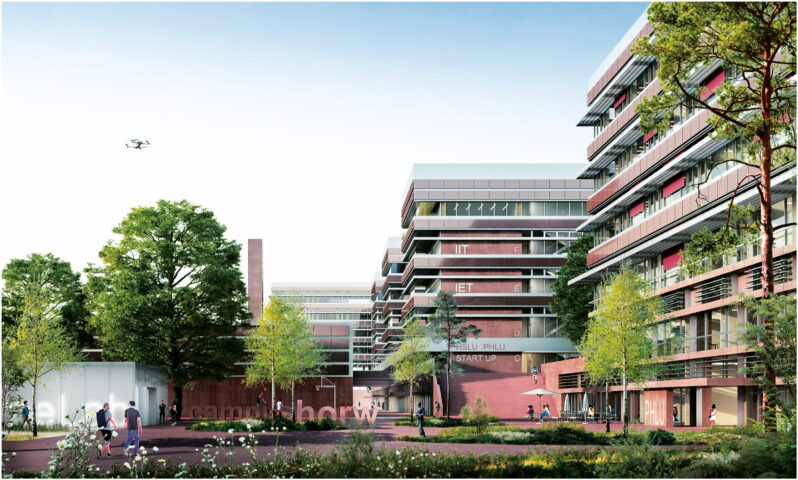
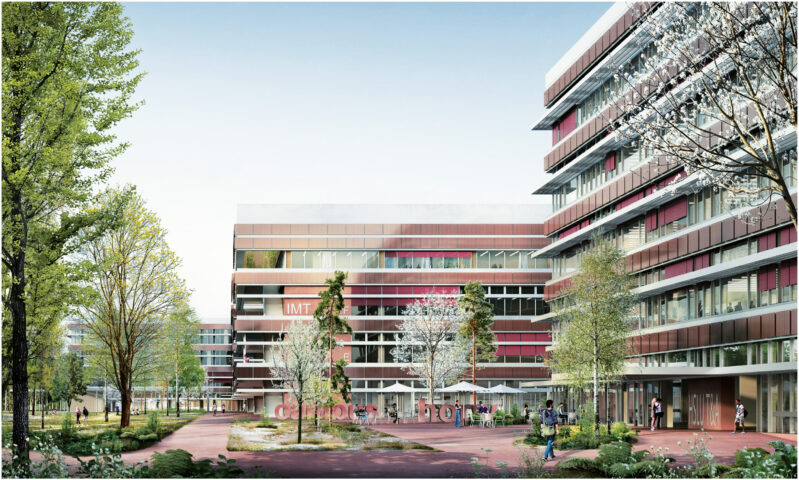
    Der Kanton Luzern zählt immer mehr Studierende – die bestehende Infrastruktur auf dem jetzigen Campus Horw hat ihre Kapazitätsgrenzen aber bereits erreicht und einige Gebäudeteile sind zudem veraltet. Dank den Erneuerungen und Erweiterungen des Hochschulcampus in Horw sollen nach Fertigstellung ab dem Jahr 2029 rund 4000 Studierende und 1000 Mitarbeitende des HSLU-Departements Technik und Architektur sowie der Pädagogischen Hochschule Luzern Platz finden.

    Die beiden Institutionen bleiben dabei eigenständige Organisationen mit einer je eigenen Identität und mit unterschiedlichen Kulturen. Der Campus lässt diese Diversität zu und ermöglicht eigenständige Auftritte. Trotzdem prägt ihn Gemeinsamkeit nach innen und aussen. Die gemeinsame Nutzung von Räumen und Einrichtungen, überschneidende und komplementäre Lehr-, Forschungs- und Dienstleistungsangebote sowie die zentrale Bewirtschaftung der Campusanlage basieren auf gemeinsamen Abmachungen und bewirken Synergien. Dadurch entsteht für die Pädagogische Hochschule wie auch Technik & Architektur ein qualitativer und ökonomischer Mehrwert.Geplant sind zwei neue Baukörper: Im Norden ein sechsgeschossiges Hauptgebäude der PH Luzern und im Süden ein siebengeschossiger Bau des Departements Technik & Architektur der Hochschule Luzern. Die bestehenden Trakte II, III und IV werden saniert und um ein Geschoss erweitert. Die leicht versetzte Anordnung der neuen Bauvolumen sorgt für eine spannungsvolle Gesamtkomposition auf dem Areal. Den Zuschlag für das Projekt erhielt das Architekturbüro Penzel Valier AG aus Zürich.

    Die neuen Bauvolumen werden leicht versetzt angeordnet.

    Die Architekten haben sich für eine Hybridbauweise aus Beton und Holz entschieden. Für die Erweiterung der Bestandesbauten sowie für die aussenliegenden Raumschichten der Neubauten soll unter anderem heimisches Holz zur Verarbeitung kommen. Dieses verleiht den Unterrichtsräumen eine angenehme und warme Atmosphäre. Die innenliegenden grossen Raumbereiche werden aus Recyclingbeton konstruiert.

    Die Unterrichts- und Büroräume der beiden Neubauten entstehen rund um zentrale Atriumfiguren. Die Räumlichkeiten werden flexibel und an sich verändernde Bedürfnisse anpassbar gebaut. Die Atrien vernetzen die Institute der jeweiligen Schulen untereinander sowie mit den übergeordnet genutzten Sockelgeschossen. Diese sehen gemeinsame Nutzungen für den Gesamtcampus wie Bibliothek, Mensa, Audimax oder Campusaula vor.

    Die rötliche Farbgebung der verschiedenen Fassaden-Elemente setzt die bestehende Tradition und Identität des Campus Horw fort.

    Für die Realisierung des rund 365 Millionen kostenden Projekts sowie für den späteren Betrieb des Campus ist eine eigens dafür gegründete Aktiengesellschaft, die Immobilien Campus Luzern-Horw AG, verantwortlich. Die Realisierung ist ab 2026 vorgesehen. Die etappierte Inbetriebnahme ab 2029.

    Der neue Campus Horw entsteht in Hybridbauweise aus Beton und Holz.
  • Switzerland has the best higher education system in the world

    Switzerland has the best higher education system in the world

    Switzerland has the best higher education system in the world. This is one result of this year’s ranking by global higher education analyst Quacquarelli Symonds (QS). The 13th edition of the QS World University Rankings by Subject identified the world’s best university offerings in 54 academic disciplines.

    A total of 32 Swiss university programmes are among the ten best in the world in their respective disciplines. That is 15 percent of all Swiss university programmes – the highest proportion worldwide. The country is thus home to 6 per cent of all the world’s top ten subjects. This share is only surpassed by the USA with 47 percent and the UK with 27 percent. The ranking assessed a total of 1594 universities from 93 countries in 54 academic subject areas.

    Switzerland came out on top in four of these subject areas. The Swiss Federal Institute of Technology Zurich (ETH) combines three of them: Earth and Ocean Sciences, Geophysics and Geology. No other university in continental Europe holds first place more often. In addition, Switzerland leads the way in the hospitality university programme with the Ecole Hôtelière de Lausanne. Seven of the world’s ten leading hotel management schools are located here. ETH Zurich is among the top ten with numerous degree programmes such as Architecture (ranked 3rd), Engineering – Mechanical, Aeronautical & Manufacturing (ranked 5th), Chemistry (ranked 7th) as well as in Mathematics, Physics and Astronomy (each ranked 8th). Two of the world’s top ten courses in dentistry are in Switzerland: the University of Bern is ranked 7th here, and the University of Zurich 8th. The Swiss Federal Institute of Technology Lausanne (EPFL) is represented in the world’s top 10 with two subjects: Data Science (9) and Civil Engineering (10). The biggest leap forward in Switzerland was made by the life sciences at the University of Geneva. They improved by 18 places to 62nd place. Mathematics at EPFL also climbed into the top 20.

  • Zurich Cantonal Council approves credit for new UZH centre

    Zurich Cantonal Council approves credit for new UZH centre

    The Zurich Cantonal Council has approved the property loan for the new FORUM UZH education and research centre. The loan is estimated at 598 million Swiss francs, minus 1.3 million Swiss francs for art in construction, according to a media release. The new building is to become the most important central location of the University of Zurich in the centre of the city.

    As a modern counterpart to the historic main building, the FORUM UZH is of “central importance” for the future development of the university, the UZH said. “The cantonal council has made a forward-looking decision so that Zurich’s higher education area can continue to develop,” Michael Schaepman, rector of UZH, is quoted as saying in the statement.

    The new building will create 37,000 square metres of urgently needed additional space for research and teaching an increasing number of students. More than 700 student workplaces are planned. A total of 6000 people will be able to study, research and work on nine floors.

    The space concept according to plans by architects Herzog & de Meuron is to correspond to the latest forms of learning and teaching and offer ideal conditions for exchange between teaching staff, researchers and students. The design of the lecture halls, for example, is much more strongly oriented towards cooperation and group work than before. Modern workplaces for research are also planned.

    The next step for UZH is to prepare a building application. It plans to submit it to the city of Zurich in autumn. If planning permission is granted by spring 2024, construction can begin in autumn 2024. Completion is planned for the end of 2029.

  • Lucerne University of Applied Sciences and Arts locates fossil heating systems

    Lucerne University of Applied Sciences and Arts locates fossil heating systems

    Experts from the Thermal Energy Storage Competence Center at the Lucerne University of Applied Sciences and Arts(HSLU) want to promote the climate-friendly replacement of fossil-fuel heating systems. To this end, the team worked with geoimpact AG, based in Lüterkofen SO, to use machine learning to calculate models that locate fossil fuel heating systems.

    This is because around 80 percent of oil and gas heating systems are currently being replaced by new fossil-fuel heating systems, according to a media release from the HSLU. “A new heating system needs planning,” HSLU energy expert Esther Lindner is quoted as saying. “Of course, if the old one breaks in the winter, you don’t have time for that, and then you just quickly replace what you had before with the same system again.” To counteract this, the project aims to provide these households with timely information about alternatives and counseling services.

    First, a model was created for 1957 municipalities, then one for 158 districts, and finally another for all of Switzerland. At the community level, the model is reported to be the most accurate, with close to 80 percent accuracy. The artificial intelligence of these models was trained with publicly available data from the building and housing register.

    Now the model is being developed into a referral program for a Sweet Edge project supported by the Federal Office of Energy. This is intended to assist communities with energy planning. “Communities that want to use the model and develop it at the same time,” Lindner said, “are welcome.” The project will also be presented at this year’s Evening of Business of the Department of Engineering & Architecture. It will take place on October 20, 2022.

  • FHNW inaugurates pavilion made from recycled components

    FHNW inaugurates pavilion made from recycled components

    As part of the annual theme Constructive Futures – beyond Concrete, the University of Applied Sciences for Architecture, Civil Engineering and Geomatics held a competition among the students of the third year of their bachelor's degree in architecture. The task was to reuse the components of a storey-high wooden ramp that was temporarily attached to the Swiss Architecture Museum. A place to stay protected from wind and sun was to be created in the park of the FHNW campus in Muttenz.

    The Silvestris project, which won the competition, was deepened and implemented in an interdisciplinary elective course last spring semester, explains the FHNW in a statement . "Various structural and static challenges" had to be mastered. The project also showed the limits of the recyclability of the components. Specifically, the waste wood of the ramp did not have the necessary strength for the structurally relevant components of the planned pavilion. Here, construction wood not originating from the ramp had to be used.

    The now completed "Arena Circular" is intended to serve as a place for teaching, performances and as a place for use and participation by members of the university and residents of the quarter. On September 27th, the FHNW invites all interested parties to the inauguration in the park of the FHNW campus in Muttenz. Registration is not required.

  • HSLU develops recommendations for sustainable high-rise buildings

    HSLU develops recommendations for sustainable high-rise buildings

    Researchers from various departments of the HSLU have dealt with the question of how a high-rise building can be designed in a socially sustainable manner, the HSLU informs in a press release . Architectural, social and economic aspects were examined for this purpose. The researchers have derived planning and action recommendations from their findings. The interdisciplinary university project was funded by the Swiss Agency for Innovation Promotion, Innosuisse .

    A sustainable high-rise offers “both a high individual and collective quality of life and has an eye on community life today and for future generations,” project initiator Alex Willener is quoted as saying in the statement. In order to meet these requirements, the building must be of use to both its occupants and those around it, promote social cohesion and also be economically viable, writes the HSLU.

    In a skyscraper, people with different lifestyles and expectations live under one roof. The researchers recommend that these differences be taken into account as early as the planning stage and promoted in the completed building. In order for a high-rise to be accepted in the area, it should offer something for the entire district. Doctors’ surgeries, crèches or a neighborhood meeting point are given as examples in the communication. In order to be able to adapt the high-rise to changing needs, the researchers recommend making sure during construction that rooms can be combined or re-divided with little effort. hs

  • New reuse pavilion at the FHNW Campus Muttenz

    New reuse pavilion at the FHNW Campus Muttenz

    In the spirit of the annual theme "Constructive Futures – Beyond Concrete", the students of the third year course of the bachelor's degree in architecture, under the direction of Professors Ursula Hürzeler and Shadi Rahbaran, dealt with the reuse of components. The starting point for this was the floor-to-ceiling wooden ramp, which was attached to the front facade of the Swiss Architecture Museum S AM as an urban intervention as part of the exhibition "Access for All – Architectural Infrastructure Buildings São Paulo" 2021. This ramp was dismantled again after the end of the exhibition and the components should now be used for a new purpose.

    Architectural competition for students
    For this purpose, an architecture competition was held among the students in the 2021 autumn semester. The task was to design a place to stay in the park that was protected from the wind and sun, for use and free use by the university and the district. The winning project "Silvestris" that emerged from the competition was selected for further development and implementation. The students then developed the design idea together and in the spring semester of 2022 went into more detail in an interdisciplinary elective course. At the same time, the structural design, the static dimensioning, the development of the node connections and the execution planning were carried out by the Institute of Civil Engineering under the direction of Prof. Dr. Simon Zweidler, head of the construction laboratory. From the design to the manufacture of all steel nodes, digital fabrication was used in a pioneering way: After the complete 3D modeling, the surfaces required for the fold were calculated by software and the developed surface was cut from the solid sheet by laser; the subsequent three-dimensional bending was also carried out fully automatically.

    Static Challenges
    In the course of this detailed planning, various structural and static challenges had to be mastered. The limits of the reusability of components also became apparent; In this specific case, the old wood did not have the strength required for the new arena and the planned intensive use and duration. This led to the decision to build the statically relevant components with construction wood intended for this purpose with the appropriate strength and to use some of the old wood for secondary components. This resulted in a valuable learning process regarding the complexities and challenges of reusing components. However, the original structure of the ramp is still reflected in the dimensions of the elements and the shape of the new arena.
    The arena created in this way should offer various possible uses. The roof made of light fabric creates a shady place to stay, which can not only be used for teaching and teaching at the university, but also provides space for performances and also invites residents in the neighborhood to use and help shape it. The winning project and all other project proposals developed by the students are also on public display in an exhibition in the porch of the campus building.

  • ZHAW offers four new courses

    ZHAW offers four new courses

    At the Zurich University of Applied Sciences ( ZHAW ), 4,500 new students are starting their academic training in the winter semester. In the previous year there were 4,700. As of September 19, a total of 14,100 people will be studying at the three ZHAW locations in Winterthur, Wädenswil and Zurich. That's 600 fewer than at the beginning of last year.

    The ZHAW Department of Life Sciences and Facility Management recorded the largest increase with an increase of 13 percent. According to a press release , the two new bachelor’s courses in biomedical laboratory diagnostics and applied digital life sciences as well as the master of science in real estate and facility management are primarily responsible for this.

    The two ZHAW departments of Health and Life Sciences and Facility Management work together on the Biomedical Laboratory Diagnostics course. According to the ZHAW, the course meets the growing social and technical requirements for diagnostics and health care.

    The Applied Digital Life Sciences course forms the interface between data science and life sciences. The Applied Law course is also new. It provides a general basic legal education. Real Estate & Facility Management is the first master's degree in Switzerland to combine real estate and facility management with sustainability and digitization.

  • EPFL doctoral student calls for smaller apartments

    EPFL doctoral student calls for smaller apartments

    The ecological footprint of living in Switzerland by 2050 can only be reduced through a joint effort by homeowners and tenants. According to a press release from the university in Lausanne, this demand for smaller living space per capita is raised in Margarita Agriantoni's doctoral thesis. She is a civil engineering student at the Swiss Federal Institute of Technology in Lausanne ( EPFL ).

    The work is based on computer simulations of various living scenarios for the next 30 years from 2020 to 2050. The result is therefore: If the energy consumption of apartments in Switzerland is to be significantly reduced, the entire industry must rethink its practices. This affects the way homes are planned and built, as well as the way they are used. Less living space is required per resident.

    Around 58 percent of Swiss households rent their homes. The average living space of these apartments has risen steadily in recent years, as has the living space per capita – a key figure that directly correlates with a building's ecological footprint, according to the statement. Today, a 100 square meter apartment is built or heated in the same way, whether it is intended for two or four people. "The per capita area is the key figure that we have to reduce in the long term," the author Agriantoni is quoted as saying. "Reducing space by just a few square feet can have a real impact."

    Agriantoni and her colleagues examined 11,000 apartments in buildings across Switzerland and interviewed 1,000 households.

  • FHNW gets professor for circular building

    FHNW gets professor for circular building

    For the Institute of Sustainability and Energy in the building of the University of Architecture, Building and Geomatics of the FHNW , circular economy is an important part of environmentally and resource-saving construction. In order to further develop research and education in the areas of energy-efficient and climate-neutral building, integral building technology, sustainable building and operation, resource-efficient and circular building as well as health aspects in buildings, the institute is establishing the professorship of circular building. The architect Andrea Klinge is to take over the corresponding chair.

    Klinge studied architecture at the Technical University of Berlin, the FHNW informs in a message about the new professorship. After further training in sustainable building at the London Metropolitan University, the designated professor worked in various architecture offices in London, Rome and Berlin. Klinge is currently active at ZRS Architekten Ingenieure Berlin. The architect and trained carpenter have established a research department here, according to the announcement.

    In her new position, Klinge wants to tackle “the current challenges in the construction sector”. "This is one of the most resource-intensive economic sectors in the world and contributes significantly to climate change," the professor-designate is quoted in the press release. “In order to meet the Paris climate goals, we urgently need consistent approaches that implement the necessary building turnaround in the construction sector.” According to Barbara Sintzel, Head of the Institute for Sustainability and Energy in Construction, Klinge “has specialist expertise in the use of ReUse components and renewable building materials to help achieve a breakthrough in practice with applied research and thus make the building turnaround possible ”.

  • University of St. Gallen, new campus by Pascal Flammer

    University of St. Gallen, new campus by Pascal Flammer

    The University of St. Gallen is running out of space. A second campus is therefore being built on the Platztor site at Unteren Graben in order to continue to fulfill its core tasks in teaching and research in a high-quality manner. Not only will space be created for research and teaching, but a new piece of the city will also be added. The architectural competition for the design of the new urban building block has been decided.

    The new campus should one day offer enough space for the training of 3,000 students. A large auditorium with space for 400 people is planned for the two basement floors. A spacious park will be created around the building, which, like the building, will be open to the public.

    59 projects were submitted to the open competition. After none of them were unreservedly convincing, the jury decided on an anonymous level of adjustment. In the end, Pascal Flammer's “House in the Park” project prevailed. Flammer's proposal envisages a building eighty meters long and forty meters wide that will stand in the middle of a public park. To do this, the building is set back from the street. The six-story building made of wood, concrete and glass appears light and transparent on the visualizations.

    The public-oriented uses such as the cafeteria are oriented towards St. Gallen's beautiful old town. When developing the campus, Flammer focused on public transport. From the existing campus, you can walk above and below ground to the new building.

    After construction begins in 2025, the building is expected to be operational in 2029. For the urban development of St. Gallen, the project means a big step into the future.

  • "The potential is enormous"

    "The potential is enormous"

    In the heart of the city of Zurich is the university area with the knowledge and health clusters of the University Hospital Zurich (USZ), the University of Zurich (UZH) and the Swiss Federal Institute of Technology (ETH) Zurich – three successful institutions with a high international reputation. The spatial proximity of the three institutions offers unique opportunities for intensive cooperation, which brings about innovations in research, teaching and medical care. However, numerous buildings in the Zurich center university area no longer meet the requirements of modern hospital, research and teaching operations. The infrastructure has reached its capacity limits. With the generation project at the Zurich Center University Area (HGZZ), the infrastructure of the USZ, UZH and ETH Zurich is being improved and the leading position of the institutions is being secured.

    Common vision
    The “Zurich Center University Area” building project is a Herculean task: “There are three levels of government (federal, canton and city) and three institutions (university, university hospital, ETH) involved,” says Roman Bächtold, head of the HGZZ office, which is responsible for the various projects in the Coordinated university area. “Getting the interests and needs of all these players under one roof, right in the center of Zurich, was and is a special challenge. The potential is enormous. If it succeeds, the population will benefit far beyond Zurich, and not just today and tomorrow, but across generations. ” Zurich has a unique knowledge and health cluster that integrally combines research, teaching and health care in a very small space. It is important to secure and strengthen this advantage. This shared vision made it possible to unite the parties. That was and remains demanding and time-consuming.

    Upgrading the quarter
    The planning goes way back. The main milestones were the location decision in September 2011, the elaboration of a master plan (2012/2013), its approval in August 2014, the tendering and implementation of the study contract for the urban space concept HGZZ (2016/2017). But the adoption of a joint white paper in March 2018 was also an important stopover on the way to our destination. The University of Zurich can be recognized from afar by its green dome. Will it stay that way? – «The green dome remains. But the quarter will be massively upgraded, greener, more accessible, more liveable, ”says Bächtold. And he adds: “There are hardly any projects in Switzerland that are so complex and varied. You come into contact with countless stakeholders from politics, business, the population and the media. This great challenge is appealing and exciting ».
  • Smaller rental apartments save resources

    Smaller rental apartments save resources

    According to a press release , three scientists from the Swiss Federal Institute of Technology in Lausanne ( EPFL ) have tried to find out what is behind the ever increasing space requirements of tenants. The background to this is that residential construction is not only the second largest source of energy consumption and CO2 emissions in Switzerland, right after traffic.

    The researchers at the Laboratory on Human-Environment Relations in Urban Systems ( HERUS ) at EPFL have therefore launched a survey among tenants. In Switzerland they make up 60 percent of the apartment occupancy. The responses from 968 tenants showed, among other things, that 40 percent of them moved into a larger apartment, although their household size had decreased. Only 25 percent would be willing to downsize under the same circumstances.

    The researchers summarized the following main obstacles to downsizing: the large living space serves as a status symbol, the bond with the current apartment and the neighborhood as well as the fear of loss of privacy.

    They propose several solutions: financial incentives to move and a sufficient supply of small apartments in city centers. In addition, there should be apartments of different sizes in the same building so that tenants can move without losing contact with friends and neighbors.

    They also recommend giving tenants who want to downsize, priority over other potential tenants. In addition, the current approach to privacy in the entire building should be reconsidered, says Anna Pagani from HERUS, for example "by providing workshops and music rooms that can be used by tenants".

  • FHNW trains in geodata analysis

    FHNW trains in geodata analysis

    The FHNW University of Architecture, Building and Geomantics will be offering a certificate course in spatial data analytics at its location in Olten from January. This is intended to enable specialists from the fields of data science, transport, logistics, spatial planning as well as natural and environmental sciences to digitally plan the cities of the future and evaluate the data from infrastructures. The university is responding to a need in the construction and planning industry, according to its media release .

    The Certificate of Advanced Studies (CAS) Spatial Data Analytics is intended to impart the knowledge required to model, process and interpret geodata in a targeted manner in 16 course days and in cooperation with experts from the field. For this purpose, “a balanced mix of lectures, case studies, group work and practical exercises” is planned, according to the FHNW. In addition, time blocks are planned for self-study.

    “The question of where spatially measurable events take place is no longer sufficient,” says Prof. Dr. Pia Bereuter quoted in the communication. “In the future, we also need to understand why these happen. This requires well-founded analysis processes that are integrated into the digitization strategy of companies or organizations. “This expertise represents the basis for decisions with spatial reference” in almost every industry “.

  • Lucerne University of Applied Sciences is dedicated to climate-friendly building

    Lucerne University of Applied Sciences is dedicated to climate-friendly building

    The study “Ready for Climate Change?” By the Lucerne University of Applied Sciences and Arts (HSLU) aims to sensitize building owners to building climate-friendly. But it should also help buyers and tenants to evaluate a property.

    The study suggests that in the future not only heating, but also cooling concepts will have to be taken into account. "The architecture of Switzerland is still too focused on making apartments pleasant and energy-efficient in winter", Gianrico Settembrini from the Institute for Building Technology and Energy at the Lucerne University of Applied Sciences is quoted in a media release. The decisive factor, however, is that buildings are planned with future climate data and not, as is the case today, with data based on past values.

    The building stock consumes around 40 percent of Switzerland's final energy requirements, the HSLU continues. This must be further reduced. However, if the increased use of air conditioning equipment were necessary, this value could instead increase even further. "The use of cooling or air conditioning devices should be avoided, technical solutions may only be used when the passive options have been exhausted," says Adrian Grossenbacher from the Federal Office of Energy . It provided financial support for this study.

    In total, the study team identified eleven parameters that have an impact on energy consumption as well as the thermal and visual comfort of a living space. These parameters, such as the properties of the windows, sun protection and shading elements, were simulated in a reference building in Basel-Binningen, which is typical for the Mittelland.

    The HSLU provides guidelines for planners online for download . In order to accelerate the precipitation of available knowledge in the new architecture, the university will bring experts up to date with the three-day advanced training course “Building in Climate Change – Effective Measures for Builders and Planners” in September.