Tag: Hönggerberg

  • A stove for safe wooden buildings

    A stove for safe wooden buildings

    A house fire does not always proceed in the same way. The combustible material catches fire, the temperature increases, the fire grows and spreads. The existing room volume, the fire load, the temperature and the oxygen concentration in the fire room influence its course. The latest acquisition by the Institute of Structural Analysis and Design at the Department of Civil, Environmental and Geomatic Engineering at ETH Zurich is intended to show how wooden structures behave in different fire scenarios. The knowledge gained will in turn help to expand the possible uses of wood as a safe and sustainable building material.

    Precisely simulating fire processes
    The furnace, which was specially developed for fire simulations, cost around 2.5 million Swiss francs including conversion measures, looks robust and is housed in the heating centre of the Hönggerberg campus. It is a metal cube reinforced with steel beams with a combustion chamber that is one metre high, one metre wide and just under 1.7 metres long. It is fired by 10 gas burners, half of which are mounted on each of the two long sides. They can heat the kiln to over 1,400 degrees. Several cameras outside the combustion chamber record the tests and the composition of the fire gases can also be analysed.

    “We can precisely adjust the temperature in the kiln and also the oxygen content,” Andrea Frangi explains proudly. Furthermore, the wooden components or other common building materials can be loaded with up to 50 tonnes during the tests. The professor of timber construction initiated the procurement of the fire simulator and helped determine its specifications. “The kiln allows us to simulate different fire histories and test their effect on wood structures.”

    Woodas a building material is sustainable and safe
    Timber construction is booming in Switzerland. And the buildings are growing. In Regensdorf, Zug, Winterthur and Zurich, high-rise timber buildings with heights of 75 to 108 metres are currently being planned or are already under construction. The fact that this is possible at all is also due to decades of research work, such as that carried out by Frangis Group in the fire simulator. New building products and technologies for connecting wooden components are also making ever larger and more unusual constructions possible.

    Until 2004, only one- to two-storey buildings with a load-bearing structure made of wood were permitted in this country. From 2005, the limit was six storeys, and since 2015 there has effectively been no upper limit. “The planned high-rise buildings are certainly lighthouse projects,” says Frangi. “But for mid-rise buildings, wood has long since established itself as a building material and convinces with a good price-performance ratio, sustainability and safety.” The latter may be surprising, but while steel beams can deform in the event of a fire and thus become unstable, timber structures can retain their structural integrity for longer.

    The load-bearing capacity of a wooden beam in case of fire is essentially determined by its size. If the beam burns, about four centimetres of the wood are converted into charcoal per hour on the sides exposed to the fire. Possible weak points are connecting elements and constructional details. In order to expand the possible applications of modern timber construction, Andrea Frangi and his team want to further research the burning behaviour of timber components and connections under realistic conditions. “The construction sector causes a large proportion of climate-damaging emissions. With our research, we can help to ensure that even more of the renewable and CO2-storing resource wood is used as a building material,” Frangi is convinced.

  • ETH Campus Hönggerberg continues to develop

    ETH Campus Hönggerberg continues to develop

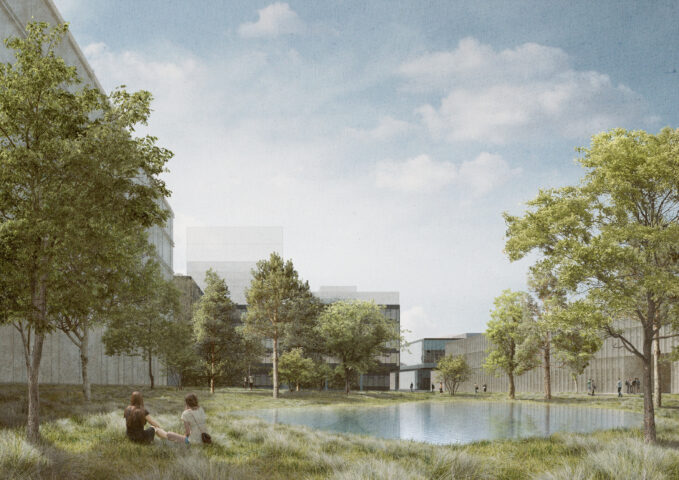
    The core mission of ETH Zurich is teaching and research as well as the transfer of knowledge to the economy and society. A modern infrastructure is a key factor in this. In order to cope with the increasing number of students and researchers and to create the necessary space for new research areas and innovative teaching methods, ETH Zurich is working on the further development of its main locations Zurich Centre and Zurich Hönggerberg. With regard to future space requirements, the Hönggerberg campus plays a central role. As a basis for its further development, ETH Zurich, together with the City and Canton of Zurich, has drawn up the master plan “Campus Hönggerberg 2040”. It describes the long-term spatial development goal. The structural densification and further development of the campus should preserve the current conditions of the site, such as the sensitive embedding in the local recreation area as well as listed buildings and gardens, and only take place in accordance with the emerging demand. In the next few years, a new building for quantum physics, a computer centre and a centre for student and entrepreneurial initiatives will be built, among other things. The central Wolfgang-Pauli-Strasse will also be renovated and upgraded as an important master plan element. Until the campus is fully developed, a conversion, new construction, extension or renovation of around a dozen buildings is planned, including four new high points. Various green areas are to be expanded. With the new master plan, ETH is building on the previous “Science City” master plan from 2005. ETH Zurich wants to develop its campus sustainably on various levels: ecologically, economically and socially. Among other things, it wants to take a big step towards climate neutrality and is focusing on energy supply without fossil fuels. A central element of this is the expansion of the current energy grid. Projects are also planned with regard to sustainable building, local climate, biodiversity as well as retention and drainage. For the further development of the campus, ETH Zurich is in dialogue with internal and external interest groups and involves selected people in a participatory manner on a selective basis.

    Attractive open spaces should ensure a high quality of stay and support biodiversity on the campus.

    In order to protect the surrounding landscape, the campus will be developed inwards and densified within the existing area. A green ring road around the campus symbolises this development and serves as a transition from the campus to the landscape. Attractive open spaces will ensure a high quality of stay and further promote biodiversity on the campus. The campus should be easily accessible by environmentally friendly means of transport such as public transport or bicycle. To relieve the local public transport system, a direct electrically powered bus, the so-called eLink, already runs between the Hönggerberg Campus and the Campus Zentrum for ETH members. Other local services such as bike sharing are available and are being continuously expanded. The current urban district character of the Campus is to be further strengthened. The central Wolfgang-Pauli-Strasse will become a lively and green promenade with versatile ground floor uses for the public. The central “piazza” will also gain in importance in the future and will invite people to meet and exchange ideas.

  • ETH researchers build a dome from construction waste

    ETH researchers build a dome from construction waste

    A group of researchers from the Circular Engineering for Architecture Labs ( CEA ) at ETH have built a dome from construction waste. The aim of the project led by assistant professor Catherine De Wolf in the Department of Civil, Environment and Geomatics was to show the advantages of the circular economy and digitization for the construction industry, according to a press release .

    In doing so, the scientists should go through the entire reuse cycle of building materials – from the dismantling work to the design of a new building and its construction. Before the demolition of a car warehouse in Geneva, they collected usable old components under the guidance of demolition specialists.

    They stored and installed the parts on the Hönggerberg campus with the help of a self-programmed algorithm. This independently calculated the optimal geometry and dimensions of the wood supply in order to use it as efficiently as possible. “The aim was to design the computer program in such a way that it does not cut the largest bars into small pieces and leaves as few residues as possible,” doctoral student Matthew Gordon is quoted as saying in the press release.

    The participants also saved information on each component, which was marked with a QR code, in a database. The idea of the prototype: Architects could find out “when which materials from demolition objects will be available and plan them in new buildings”.

    Because in the project it turned out that the procurement of used components is one of the biggest challenges. “Ideally, the companies would be informed about demolition or dismantling as soon as possible, so that they can start looking for buyers for the materials right away,” De Wolf is quoted as saying in the press release. In fact, this often happens at short notice.