The Fröschmatt School is Pratteln’s central secondary school and is currently undergoing a transformation. Due to a significant increase in student numbers and long-overdue renovations, it is becoming one of the largest and most modern school facilities in the canton of Basel-Landschaft. With an investment volume of just under CHF 119 million, a sustainable new building for around 36 classes and state-of-the-art educational requirements is being constructed on the existing site. The open competition was won by the winning design “Lungo” by Burckhardt Architekten AG, which integrates the school complex optimally into its park-like surroundings.
Innovative architecture and flexible use
The building ensemble is clearly structured. At the centre of the plot, the school building creates space for learning, meeting and development. The gyms, located in the north-east, including an all-weather area on the roof, are being built as separate pavilions. State-of-the-art hybrid timber construction and flexibly designed interiors meet the requirements for sustainability and future viability. Surrounding balconies provide protection from the sun and become lively terraces.
Planning with the region in mind
The schedule is ambitious. Construction of the main building will begin in 2026, with occupancy scheduled for 2029. The gyms will be completed by 2031. In the meantime, lessons will continue uninterrupted thanks to a specially constructed, sustainable temporary facility on the Hexmattwiese and in parts of the old building. The entire complex not only promotes contemporary teaching, but also enhances the attractiveness of Pratteln as a location and its development prospects.
Tag: Holzhybridbau
-
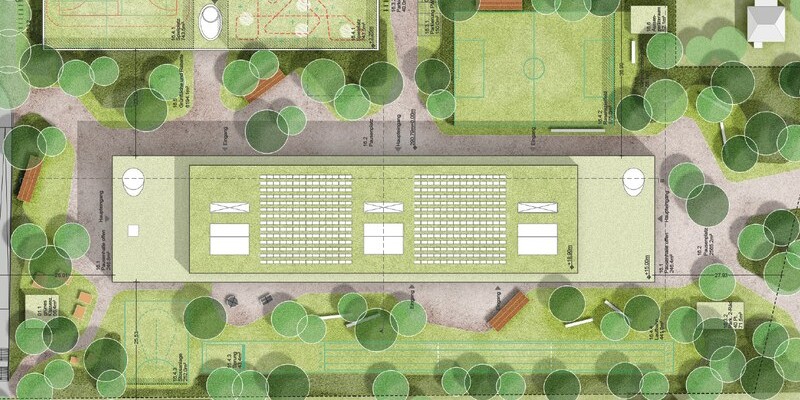
New construction of the Fröschmatt School in Pratteln
-

Between innovation and reality
In the middle of the Zurich conurbation, the new H1 residential tower towers above the Zwhatt site. With a height of 75 meters and 24 storeys, the building is a visible marker for the Regensdorf skyline and for hybrid construction methods between concrete and wood. Despite its striking red hue and eye-catching façade, the interior is dominated by natural and neutral materials. The architecture remains restrained, the structure classic. Three solid base storeys and a central concrete core support the building, while timber columns, timber-concrete composite ribbed ceilings, lightweight façades and solar panels ensure resource efficiency.
The HBV structure allows for a high degree of prefabrication and a significant reduction in gray energy. Compared to conventional solid buildings, 20% of emissions are saved, a total of around 670 tons of CO₂ over a life cycle of 60 years. The horizontally positioned photovoltaic modules serve as a brisesoleil and generate around 155,000 kWh of electricity per year, which covers around 36% of the apartments’ energy requirements.
Quality of living, community and urban density
At the base of the H1, three-sided arcades connect the building to the neighborhood and ensure an urban quality of living. Inside, a clear, modular structure ensures compact, flexible apartments. 156 units are organized around the central core and are reached via short, bundled access routes. There is space for community halfway up the building with a two-storey meeting room, a launderette and spectacular views. The wooden elements create a pleasant indoor climate, while exposed beams and clay surfaces ensure a cozy atmosphere.Sustainability and the ambivalence of the high-rise principle
H1 is a project of transition. The high proportion of wood reduces the CO₂ profile, but does not make the use of concrete superfluous. The climate-friendly construction method, local raw materials such as beech wood from the Jura or clay and the focus on renewable energy make sustainable construction a reality. Nevertheless, the high-rise building remains an ambivalent concept. The densification saves space, but the statics and fire protection still force hybrid constructions.In terms of urban planning, the Zwhatt site represents a new development perspective for Regensdorf. The silhouette of H1 and other towers characterizes the skyline. The quarter combines living, working and open spaces and stands for an urban development that remains flexible and adaptable.
The H1 residential tower exemplifies change in the construction industry. It combines advanced timber hybrid technology, a high degree of prefabrication and urban integration. H1 is thus a “building of transition”, a step towards net zero, but also a reflection of the challenges and potentials facing sustainable residential construction in urban centers today.