Tag: homegate

  • SMG Real Estate: Reach interested parties who are looking for exactly what you have to offer

    SMG Real Estate: Reach interested parties who are looking for exactly what you have to offer

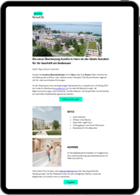
    Those who pursue the goal of successful real estate marketing rely above all on one tool: the efficient approach to potential interested parties. This is the demanding task of drawing attention to current new construction projects or already existing properties with appealing communication that is as accurate as possible. This can be achieved without much effort with a newsletter that exclusively presents an exciting property to those looking for real estate.

    Property seekers are not only grateful, but also very good to activate if they are offered a quick orientation in their search process with an approach that specifically takes their preferences into account. After all, the search for the right property is about implementing personal concrete wishes such as buying or renting, regional preferences and the size of a property.

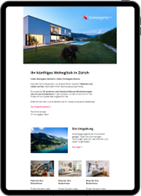
    This match between the real estate professionals with their current property portfolio and interested parties can be optimally supported with the Premium Newsletter from Homegate or the Newsletter Boost from ImmoScout24.

    The newsletters reach an exclusively created distribution list, which ensures that the expectations and demands that the prospective buyers pursue in their property search match the respective property characteristics. In this way, customers can be approached without wastage in a trustworthy and renowned editorial environment.

    The individual appearance of each property is coherent, because the professionally designed newsletter addresses the addressees with meaningful images and a text tailored to the specific property. As part of a marketing campaign, the newsletter can be adapted to specific times. In this way, for example, targeted attention can be generated in an early planning phase for a new project or potential interest can be identified. But the use of the newsletter is also suitable for property units that are not yet available and that are to be pointed out to specific target groups, and above all it pays off, because it is hardly possible to address potential interested parties in a more flawless way.

    Here you can find out more about the opportunities to address potential real estate buyers directly.

  • Rise in Swiss asking rents continues

    Rise in Swiss asking rents continues

    The Homegate rent index for asking rents is compiled by the real estate marketplace Homegate in cooperation with Zürcher Kantonalbank (ZKB). It measures the monthly, quality-adjusted change in rents for new and re-let flats based on current market offers. Compared to the previous month, the index increased by 0.5 points in May and now stands at 121.2 points (plus 0.4 percent). Compared to the previous year, asking rents rose by 3.1 per cent across Switzerland.

    Change in the cantons
    With the exception of the canton of Fribourg (minus 0.2%), asking rents also rose everywhere at the cantonal level. However, the canton of Fribourg recorded a new high in April and March this year, which puts the slight decline in May into perspective. In the remaining cantons, asking rents rose by up to 3.6 per cent in the canton of Schwyz, which clearly reached a new high. The coming months will show to what extent this is a temporary effect. In the cantons of Uri (2.6 per cent), Nidwalden (2 per cent) and Zug (1.9 per cent), asking rents also rose significantly last month. At the same time, the canton of Zug was the only canton to record a negative development compared to the previous year (minus 1 per cent), which can primarily be explained by the comparatively strong fluctuations in asking rents in this canton. The strongest increases in asking rents over the last twelve months were in Uri (7.8 per cent) and Schwyz (6.9 per cent). This is accompanied by fluctuating, but nevertheless rising prices.

    Change in the cities
    A similar picture emerges at the level of the cities surveyed. With the exception of the city of Bern (minus 0.3 per cent), prices for advertised rental flats have risen between 0.5 per cent (Basel) and 1.6 per cent (Zurich). Compared to May last year, asking rents have risen by more than one per cent in all eight cities surveyed, led by Zurich (10 per cent) and Lugano (7.7 per cent). When looking at the asking rents in the cities, it is also noticeable that most of them rose more strongly in May than in the corresponding cantons. The only exceptions are Bern (with falling asking rents in May at city level) and Lucerne (cantonal prices rose by around twice the city prices). This indicates that urban demand remains high.

    Quality adjustment method
    The development of asking rents in Switzerland is adjusted for the different quality, location and size of the flats. The advantage of this so-called hedonic method is that the real rental price development for new and re-let flats is shown on Homegate. The Homegate rent index is the oldest quality-adjusted rent index in Switzerland and is considered a reference source for real estate professionals for determining the price of rental properties.

    The data for all cantons and cities since the start of the survey can be found in the latest release in the news section of SMG Swiss Marketplace Group AG. The next Homegate Rental Index is expected to be published on 18 July 2023.

  • Rents in large cities stable to declining – only Zurich with significant increase

    Rents in large cities stable to declining – only Zurich with significant increase

    The Homegate rent index for asking rents is compiled by the real estate marketplace Homegate in cooperation with Zürcher Kantonalbank (ZKB). It measures the monthly, quality-adjusted change in rents for new and re-let flats based on current market offers. Compared to the previous month, the index increased by 0.5 points in March and now stands at 120.7 points (plus 0.4 percent). Compared to the previous year, asking rents rose by 2.8 per cent across Switzerland.

    Change in the cities
    Of the eight Swiss cities surveyed, only Zurich saw a significant increase in asking rents in April: Here, advertised rents rose by 1.8 per cent, which is significantly more than the 0.6 per cent increase in the canton of Zurich. In most of the other cities surveyed, however, asking rents remained relatively stable within a range of plus 0.3 per cent in St. Gallen and minus 0.3 per cent in Lausanne. In contrast, asking rents declined significantly in Bern (0.8 per cent) and Lucerne (1.4 per cent). However, the year-on-year comparison shows a positive trend without exception, led by the cities of Zurich (8.2 per cent) and Lugano (6.8 per cent). Only in Lausanne are asking rents unchanged compared to April 2022.

    Change in the cantons
    The picture is different at cantonal level. Here, all but two cantons show a neutral or positive development in asking rents in April. Only in Graubünden did the advertised rents decline by 1.2 per cent, in Lucerne the decline was 0.2 per cent. In all other cantons, advertised rents either remained unchanged or rose by up to 2.4 per cent (Schwyz) last month. In addition to Schwyz, the cantons of Nidwalden (1.4 per cent) and Uri (1.3 per cent) are among those with an above-average increase. While Uri has thus reached a new high since the beginning of the measurement period, the asking rents in Nidwalden were already higher once during a few months in 2022. Looking back over the year, however, there are clear plus signs for asking rents at the cantonal level. All cantons show an increase of between one and six per cent, led by Glarus (6 per cent), Uri (4.7 per cent), Valais (4.5 per cent) and Appenzell (4.3 per cent). But even in the canton of Graubünden, which was the only canton to record a marked decline in asking rents in April, they rose by 2 per cent compared to the previous year.

    Quality adjustment method
    The development of asking rents in Switzerland is corrected for the different quality, location and size of the flats. The advantage of this so-called hedonic method is that the real rental price development for new and re-let flats is shown on Homegate. The Homegate rent index is the oldest quality-adjusted rent index in Switzerland and is considered a reference source for real estate professionals for determining the price of rental properties.

  • Swiss asking rents are already rising again

    Swiss asking rents are already rising again

    The Homegate rent index for asking rents is collected by the real estate marketplace Homegate in cooperation with the Zürcher Kantonalbank (ZKB). It measures the monthly, quality-adjusted change in rental prices for new and re-let apartments based on current market offers. The index shows a slight increase of 0.3 points compared to the previous month at 118.1 points (plus 0.3 percent compared to the previous month). Compared to the previous high of June 2022, the index has increased by almost 0.2 percent. In a year-on-year comparison, asking rents across Switzerland have risen by 2.3 percent.

    Change in the cantons
    Looking at the cantons, it is again striking that in August compared to the previous month, only a few cantons showed major changes in asking rents, while the majority of cantons only saw changes of 0.5 percent or less. Only in the cantons of Geneva (1 percent), Bern (0.7 percent) and Obwalden (0.7 percent) have advertised rents increased by more than this mark. It is striking that asking rents have risen in all cantons without exception, especially in the mountain regions: Nidwalden (6.5 percent), Obwalden (4.6 percent) and Graubünden (4.1 percent). A total of eleven cantons recorded an increase compared to the previous year, which is higher than the national average of 2.3 percent.

    change in the cities
    In the surveyed Swiss cities, meanwhile, there were clear changes in August. These are more than 0.5 percent in five out of eight cases. In August alone, asking rents in Lucerne (1.1 percent), Bern (1.1 percent) and Geneva (1 percent) increased by a good one percent. In all three cases, however, this increase also accounts for a considerable part of the increase compared to the previous year, which is around 1.5 percent for each of the three cities. The situation is different in Zurich or Basel: While the asking rents in August changed only minimally compared to July, both cities recorded significant growth compared to the previous year of 5.6 percent in Zurich and 2.9 percent in Basel.

    Method of quality adjustment
    The development of asking rents in Switzerland is corrected for the different quality, location and size of the apartments. The advantage of this so-called hedonic method is that the real rental price development for new apartments and apartments to be rented again is shown on Homegate. The Homegate rental index is the oldest quality-adjusted rental price index in Switzerland and is considered a reference source for real estate professionals to determine the price of rental properties.

  • Asking rents remain stable month-on-month

    Asking rents remain stable month-on-month

    The rental index, which is collected monthly by the digital real estate marketplace Homegate in cooperation with the Zürcher Kantonalbank , closed July at 117.7 points, Homegate informed in a press release . Compared to the previous month, advertised rents fell by an average of 0.2 percent across Switzerland. The analysts of the index have observed different developments within the individual cantons.

    Rents have remained relatively stable in most cantons. In Zug, Graubünden, Geneva and Glarus, however, the analysts observed significant declines of between 3.9 and 1.3 percent. Year-on-year, rents increased across all cantons.

    Of the eight cities examined in the index, the analysts only observed a month-on-month increase in asking rents in Basel and Lucerne. Rents fell slightly in the other cities, but more sharply in Geneva and Lausanne, each by 1.6 percent. Compared to July 2021, asking rents have risen in all cities, with the strongest increase in Zurich at 6.4 percent.

    When recording rental price changes for the rental index, the rental prices are corrected for different quality, location and size of the apartments, explains Homegate. This makes it possible to record the actual rental price development.

    Homegate is a division of SMG Swiss Marketplace Group AG . This combines the digital marketplaces of TX Group , Ringier and Mobiliar .

  • Asking rents continue to rise

    Asking rents continue to rise

    The Homegate rental index now stands at 117.9 points. This means that asking rents increased again by 0.3 percent in June, and by 1.3 percent since the beginning of the year. According to a media release from the real estate marketplace, this is “in stark contrast to the rental price development before the COVID 19 pandemic, when rising vacancies in the Swiss rental apartment market caused nervousness among investors”.

    Because the net rents have also become more expensive, the increased energy costs alone cannot be held responsible. In fact, building applications have been declining for the last two years. At the same time, there is brisk demand for rental apartments. “So just a few years ago there was concern about an oversupply of rental apartments, but these are again extremely scarce in sought-after locations.”

    Homegate describes the half-year increases in the cantons of Zug (5.4 percent) and Graubünden as well as in Appenzell (4.3 percent each) as remarkable. The increases were lowest in the cantons of Basel-Landschaft (0.6 percent) and Ticino (0.5 percent).

    In the cities, demand has increased again since the infrastructure started up again after the first phases of the pandemic, particularly in Zurich (4.8 percent). Lausanne (2.5 percent) and Lugano (1.8 percent) were also above the national average. Only in St.Gallen were rents slightly down (minus 0.2 percent).

  • Asking rents are developing differently

    Asking rents are developing differently

    The rental index, which is collected monthly by the digital real estate marketplace Homegate in cooperation with the Zürcher Kantonalbank , closed in May at 117.6 points, Homegate informs in a press release . Compared to the previous month, advertised rents increased by an average of 0.2 percent across Switzerland. The analysts of the index have observed different developments within the individual cantons.

    Rents have remained relatively stable in most cantons. In the canton of Geneva, asking rents in May were 1 percent lower than in April. In the cantons of Zug, Graubünden, Appenzell Innerrhoden and Appenzell Ausserrhoden, on the other hand, the analysts identified significant increases of between 1.1 and 4.1 percent. However, they mainly attribute the jump of 4.1 percent in the canton of Zug to a decline in the previous month.

    In the eight cities examined in the index, the analysts identified an increase in asking rents of 0.7 percent in St.Gallen and a decrease of the same amount in Geneva and Lausanne. The two cities in western Switzerland are also the only ones where analysts have observed a drop in asking rents year-on-year.

    When recording rental price changes for the rental index, the rental prices are corrected for different quality, location and size of the apartments, explains Homegate. This makes it possible to record the actual rental price development.

    Homegate is a division of SMG Swiss Marketplace Group AG . This combines the digital marketplaces of TX Group , Ringier and Mobiliar .

  • Asking rents remain stable in April

    Asking rents remain stable in April

    The monthly rental index collected by the digital real estate marketplace Homegate in cooperation with the Zürcher Kantonalbank ( ZKB ) was stable in April. According to the media release , asking rents in Switzerland rose minimally by 0.2 percent. The index now stands at 117.4 points. Asking rents rose the most in the last month, at around 1.7 percent, in the canton of Nidwalden. They have fallen significantly in the canton of Zug by around 2 percent. In the other cantons, asking rents also remained stable in April, with fluctuations of less than 1 percent.

    In the cities surveyed, too, the development of asking rents was similarly stable as at the cantonal level. According to the announcement, the biggest change was in Zurich, where asking rents rose by 1 percent. This continues a development of the last five months, in which asking rents there increased by 4.3 percent. Lugano reports the lowest value among the cities at 0.5 percent. Despite the decline in April, Lugano still recorded an increase of 2.1 percent compared to the previous year. However, Homegate reports that it is a long way from the peak in July 2016.

    When recording the rental price changes for the rental index, the rental prices are corrected for different quality, location and size of the apartments, the communication explains. This makes it possible to record the actual rental price development.

    Homegate was founded in 2001 and is a division of SMG Swiss Marketplace Group AG .

  • Demand for condominiums is highly dependent on region and price

    Demand for condominiums is highly dependent on region and price

    The latest edition of the Online Home Market Analysis from the real estate portal Homegate and the Swiss Real Estate Institute (SwissREI) examines the advertisement data for condominiums for 2020 and 2021. The evaluated advertisements come from the four largest Swiss Internet portals and thus comprise around 85 percent of all online advertisements during the period under review. Detailed reports on the study for all regions can be found here in the online media release .

    For Martin Waeber, Managing Director Real Estate, SMG Swiss Marketplace Group, the latest online home market analysis shows how heterogeneous the Swiss condominium market is: “Overall, the demand for condominiums throughout Switzerland developed somewhat less dynamically last year due to the corona. However, certain market segments have seen lively demand over the past year, particularly in cities.” On average, the duration of advertisements in the low price segment has increased significantly in the cities examined, while it has remained practically unchanged in the higher price segment, although the number of advertisements has increased. “Similar to the rental apartment market, preferences in the condominium market have shifted away from smaller and cheaper to larger and more expensive properties during the Covid19 pandemic,” said Waeber, summarizing the study results.

    Longer advertisement duration despite smaller offer
    The significant increase in the average tendering period for condominiums from 61 to 84 days in 2020 compared to 2019 due to the Covid19 pandemic was confirmed at a high level in 2021 with 85 days. In comparison, the length of listings for single-family homes has fallen from just over 61 days in 2019 to pre-pandemic levels.

    On the other hand, around 20 percent fewer condominiums were offered online across Switzerland in 2021 than in the previous year. With such a severe shortage of offers, one would expect that the average duration of advertisements would also be correspondingly shorter. However, the fact that this has not shortened, but actually lengthened slightly, is evidence of a declining demand for condominiums across Switzerland for 2021.

    Prof. Dr. Peter Ilg, head of the SwissREI institute, sees several reasons for the weaker demand for condominiums: “Condominium prices in Switzerland rose by more than 8 percent on average in 2021. This is the strongest price increase in ten years. Such a significant increase in prices is likely to have had a dampening effect on demand in general. Increasing demand can only be seen in selected regions and in individual upper price segments, in which the buyers were probably able to increasingly resort to advance inheritances». This can be deduced, for example, from the distribution of taxable assets and homebuyers by age group. In the canton of Zurich, for example, the over-54s have more than half of the taxable assets, while across Switzerland the majority of home buyers are under the age of 55, Ilg continues. 

    Regional differences in the duration of advertisements are increasing
    From a regional perspective, the differences in the duration of advertisements in the eight major regions examined in 2021 have become more pronounced. In the Zurich region, where sellers have to advertise a condominium for the shortest time in Switzerland, the duration of the advertisement was reduced significantly by around a quarter to just 43 days (minus 14 days). In the two regions with the longest average duration of advertisements for a condominium, on the other hand, they continued to rise significantly, each at around 22 percent; the Vaud/Valais region recorded an increase of 18 to 98 days, Ticino by 25 to 139 days.

    In absolute terms, the greatest reduction in the length of advertisements was seen in the Central Switzerland region. After a decline of 19 days (minus 27 percent) for 2021 with 51 days, this region now has the second shortest advertisement duration of all eight regions surveyed, right after the Zurich region. The Geneva region, on the other hand, which still had the shortest advertisement duration in Switzerland at 52 days in 2020, fell back to third place in 2021 after an increase of 12 percent (plus 6 days).

    Increasing demand only in three out of eight regions examined
    The combination of the change in the duration of advertisements and the change in the number of advertisements allows conclusions to be drawn about the change in demand in the regions examined. In the three regions of Ticino, Vaud/Valais and Geneva, for the year 2021, despite a shortage of supply (i.e. a declining number of advertisements), there has been a significant increase in the duration of advertisements in some cases and thus a shrinking demand for condominiums. For the three regions of Central Switzerland, Northwestern Switzerland and Zurich, on the other hand, increasing demand (larger percentage decline in the length of advertisements than in the number of advertisements) can be observed. The other two regions (Eastern Switzerland and Espace Mittelland) show constant demand for 2021.

    Growth in demand for city apartments, especially in the upper price segment
    In addition to the eight regions, the Online Home Market Analysis also examines eight Swiss cities. When analyzing the demand for condominiums, a closer look at the price segment shows that demand in Basel, Lausanne, Geneva and Lugano in particular has increased. Both in the high price segment (CHF 1.5 million – CHF 3.0 million) and in the low price segment (CHF 0.3 million – CHF 0.5 million). In the high price segment, demand increased overall in six of the eight cities surveyed – in addition to Basel, Lausanne, Geneva, also in St. Gallen and Lucerne – while in the low price segment, the remaining four cities recorded constant or falling demand. This increased demand in the high price segment is now taking very different forms; While in Basel the declining length of advertisements in particular led to higher demand, in Geneva a much higher increase in the number of properties on offer compared to the length of advertisements indicated this conclusion.

  • Second homes make the highest jump in price

    Second homes make the highest jump in price

    The prices of single-family houses increased in 2021 compared to the previous year by an average of 9 percent to CHF 1.42 million. The prices of condominiums rose by an average of 8.3 percent to CHF 0.91 million. This is shown by the figures from the Home Market Price Analysis presented annually by the real estate marketplace Homegate and the Swiss Real Estate Institute of the Zurich School of Economics (HWZ). As stated in a media release , this is the highest price dynamic for residential property in ten years.

    For second homes, prices rose by 35 percent compared to the previous year. “The price increases for first homes are amazing,” says Peter Ilg, head of the Swiss Real Estate Institute. “But in the case of second homes, a market has been created due to the strict limitation on supply by the second home initiative that is ideal for real estate speculation.”

    Condominiums are still the most expensive in the Zurich region, single-family homes in the Lake Geneva region. The sharp rise in prices seems to be leading to fewer sales transactions, at least for single-family homes. They fell by 10 percent.

    There are major differences between the regions at the community level: With the same budget of 3.1 million francs, for which there was a house in Erlenbach ZH, you could buy a good six single-family houses in Brugg AG. The lowest average prices for condominiums were paid in the municipality of Sainte-Croix VD at CHF 0.28 million, the highest in Zumikon ZH at CHF 2.37 million.

  • Asking rents remain largely stable

    Asking rents remain largely stable

    The monthly rental index collected by the digital real estate marketplace homegate.ch from the TX Group in cooperation with the Zürcher Kantonalbank increased by 0.3 points to 116.7 points in January compared to December 2021, homegate.ch explains in a corresponding statement . The analysts explain that the asking rents in most cantons have not increased at all or only slightly. On average, however, there is an increase of 0.26 percent.

    The analysts registered above-average increases of 1.45 and 3.85 percent in the cantons of Nidwalden and Zug in the reporting period. In contrast, asking rents in the cantons of Graubünden, Valais, Schaffhausen and Geneva were between 2.01 and 0.08 percent lower than in December 2021.

    In contrast, the analysts observed rising rents almost everywhere in the cities surveyed. The only exceptions were St.Gallen and Lucerne. Here, the asking rents were 0.77 and 0.40 percent lower than in December 2021. The city of Bern showed the highest increase in a monthly comparison with 0.96 percent.

    When recording the rental price changes for the rental index, the rental prices are corrected for different quality, location and size of the apartments, the communication explains. This makes it possible to record the actual rental price development.

  • Asking rents continue to rise

    Asking rents continue to rise

    The monthly rent index compiled by the digital real estate marketplace homegate.ch from TX Group in cooperation with Zürcher Kantonalbank rose by 0.17 points to 116.1 points across Switzerland in November compared to October, explains homegate.ch in a corresponding message . The analysts write that the index has already exceeded its high in October. Over the past twelve months they have observed an increase in asking rents of 0.96 percent.

    In the month under review, rents rose in most of the cantons, the press release explains. The analysts observed the strongest growth of 2.33 percent in the canton of Graubünden. In Zug and Schwyz, too, asking rents rose at an above-average rate of 2.04 and 0.59 percent. In the cantons of Nidwalden and Neuchâtel, on the other hand, asking rents in November were 0.49 and 0.81 percent lower than in October.

    In terms of cities, the analysts point to striking declines in asking rents in Zurich (-0.82 percent) and Geneva (-0.79 percent). The asking rents in Lausanne and Lucerne rose the most in comparison to October, at 0.30 percent each.

    When recording the rental price changes for the rental index, the rental prices are corrected for different quality, location and size of the apartments, is explained in the communication. This makes it possible to record the actual rental price development.

  • Swiss Marketplace Group combines platforms from TX Group, Ringier and Mobiliar

    Swiss Marketplace Group combines platforms from TX Group, Ringier and Mobiliar

    TX Group , Ringier and Mobiliar as well as the financial investor General Atlantic have founded a joint venture, inform the four partners in a joint announcement . The Swiss Marketplace Group, launched on November 11, is to manage the digital marketplaces of Ringier and Mobiliar as well as TX Group in an independent market presence . The joint venture will be managed by Martin Waeber, Pierre-Alain Regali, Francesco Vass and Boris Gussen under the leadership of Gilles Despas.

    The marketplaces acheter-louer.ch, anibis.ch, AutoScout24, Car For You, FinanceScout24, home.ch, Homegate, icasa.ch, ImmoScout24, ImmoStreet.ch, MotoScout24, Ricardo, tutti.ch and advertising marketing are combined in SMG . TX Group will hold 31 percent, Ringier and Mobiliar 29.5 percent each and General Atlantic 10 percent in the new joint venture, according to the announcement. However, the voting rights in SMG are divided between the partner companies at 25 percent each.

    “Today we are embarking on an exciting journey with a new, forward-thinking and future-oriented company,” Despas is quoted in the press release. According to the CEO of SMG, the new company should strive for sustainability, live “real diversity in an inspiring, multilingual and agile environment” and drive “the digitization of our industries”.

  • Single-family houses are very popular even in times of crisis

    Single-family houses are very popular even in times of crisis

    The speed at which sellers have been able to sell their homes over the past year has varied widely across regions. While single-family houses in the greater Zurich area became even scarcer and were sold within an average of 43 days, it took 100 days longer in Ticino. This is the finding of the Swiss Real Estate Institute of the Zurich School of Economics (HWZ) and the online real estate marketplace Homegate in their biannual evaluation of real estate advertisements on the Internet.

    Accordingly, the average advertisement time for single-family houses on the leading online real estate portals in Switzerland rose by 26 percent in 2020 from 61 to 77 days. This development was driven by the regions of Ticino and Waadt / Wallis. In Ticino, advertisements were on the Internet 60 percent longer before they were sold than in 2019. In the Vaud / Wallis region, it took 25 percent longer and thus 71 days to sell a house than in the previous year.

    The authors of the study see a possible reason for the increase in the average tendering time in the uncertainty in the crisis year, which made many wait and see. Nevertheless, the demand remained high. “In some regions it took a little longer to sell a property for a short time. But we can see that the tide has already turned again and that single-family houses are very popular even in times of crisis, ”Jens Paul Berndt, CEO of Homegate, is quoted in a press release.

  • April rents rise by almost 1 percent

    April rents rise by almost 1 percent

    The homegate-ch asking rent index was unchanged in April compared to the previous month at 115.6 points. The rent for apartments to be re-let, on the other hand, rose by an average of 0.96 percent. This index is calculated monthly in cooperation with Zürcher Kantonalbank . It shows the quality-adjusted change in rental prices for new and re-let apartments based on current market offers.

    “As usual,” the rents developed differently depending on the canton, according to homegate.ch in a press release. According to this, the asking rents recorded an increase in rents, especially in the cantons of Bern (0.26 percent), Thurgau (0.52 percent) and Vaud (0.24 percent). In the canton of Geneva, asking rents have fallen by 0.93 percent. A similar picture emerges in the cities. The city of Geneva in particular recorded a decline of 1.27 percent.

    According to the company, the homegate.ch asking rent index is the oldest quality-adjusted rental price index in Switzerland. Real estate professionals use it as a reference source for determining the price of rental properties.

  • Homegate and MoneyPark cooperate

    Homegate and MoneyPark cooperate

    Homegate , a subsidiary of the media company TX Group , and MoneyPark have entered into a strategic partnership. The two companies are convinced that their new partnership offers property seekers added value. According to a press release , Homegate has now integrated digital tools from the mortgage provider MoneyPark directly into its real estate platform.

    If interested parties have found a suitable property on homegate.ch, they can have an immediate calculation of whether a purchase is financially feasible for them. If so, you will receive a confirmation of financing including a certificate. This is based on the award criteria of MoneyPark's 150 mortgage lenders. The price range shown also provides guidance when it comes to having to strike quickly in a potential bidding process. It also shows you how much this property would cost you per month.

    Homegate doesn't just want to support its users until they find their property, says Simon Herrmann, Business Owner Consumer Services at Homegate. Even after that, “all connection services should be available at one click”. "The fact that MoneyPark advises its customers independently and personally on such an important decision was crucial for us to enter into the partnership." a service environment that is unique in Switzerland, ”says Stefan Heitmann, CEO and founder of MoneyPark.

  • Homes are still in demand

    Homes are still in demand

    The home market continues to grow even during the recession caused by the coronavirus pandemic. In the four most liquid market regions in Switzerland, prices rose by an average of 3.7 percent in 2020 to an average of 1.3 million francs, explains homegate.ch in a statement on the current Home Market Price Analysis. It is created annually by the digital real estate marketplace from TX Group in cooperation with the Swiss Real Estate Institute of the Zurich School of Economics ( HWZ ).

    The study analyzes the development of purchase prices and transactions for single-family houses and condominiums in the regions of Zurich, northwestern Switzerland, Bern and Lake Geneva. The prices for single-family homes rose in all four market regions last year, the press release explains. The most significant price increase was observed in the Lake Geneva region, at 4.1 percent. The lowest price increases of 1.6 percent were in the Zurich region. The number of transactions in the single-family home market increased by 3.1 percent year-on-year.

    For condominiums, the analysts identified price increases of between 3 and 4 percent in three of the four regions examined. In the Lake Geneva region, on the other hand, prices fell by 2 percent year-on-year. On average, the prices for condominiums rose by 0.5 percent to 850,000 francs in the year under review. The number of transactions in the condominium market increased by 2 percent in 2020.

    In times of crisis, the flight into real assets is nothing new, Peter Ilg is quoted in the communication. The “ongoing boom” during the pandemic-induced recession is “astonishing” for him, says the head of the Swiss Real Estate Institute. As a background to the current developments, Ilg cites, on the one hand, the likely long-term low interest rates. On the other hand, "living in the times of Corona has become more important".

  • Asking rents continue to rise

    Asking rents continue to rise

    The coronavirus pandemic has hardly left any traces on the market for rental apartments, writes homegate.ch in a message on the annual review of the homegate.ch rental index. It is created monthly by the real estate portal owned by the TX Group in collaboration with Zürcher Kantonalbank . For 2020, the rent index shows an increase in asking rents for apartments of 0.9 percent year-on-year. This means that apartment rents have even risen faster than in the previous year, explains homegate.ch.

    The analysts observed the sharpest increase in rental prices in the year under review with 2.7 percent in Appenzell. In the cantons of Geneva, Thurgau, Zug, Graubünden and Zurich, rents have also risen faster than the Swiss average, with values between 2.6 and 2.3 percent, the press release explains. Rising net immigration is mentioned as the background for the rental price development.

    The gap in rent prices between urban and rural cantons that had prevailed in previous years was weakened in the reporting year, the analysts further explain in the press release. On the one hand, they attribute this to the concentration of the construction industry in urban regions. On the other hand, the work in the home office, which was funded during the pandemic, "led to evasive effects in the countryside". Urban living remains in trend despite the pandemic.

  • Rents rose in August

    Rents rose in August

    In August, asking rents in Switzerland rose by 0.26 percent. The upward trend is particularly confirmed in the annual analysis with a plus of 0.88 percent. This is shown by the current rental price index figures from homegate.ch and Zürcher Kantonalbank ( ZKB ). It measures the monthly, quality-adjusted change in rental prices based on current market offers.

    The rental price development in the canton of Thurgau is striking, according to a media release from the real estate marketplace homegate.ch. The rent there rose by 0.71 percent, almost three times the Swiss average. The canton of Valais also shows a noticeably higher value with a plus of 0.62 percent. In the cantons of Zurich, Glarus, Appenzell Ausserrhoden and Appenzell Innerrhoden, apartment hunters are confronted with rents that have risen by 0.50 percent, in Schaffhausen it is plus 0.49 percent. On the other hand, Geneva recorded the steepest decline with a minus of 1.48 percent. The rent index is only stagnating in the cantons of Basel-Stadt and Schwyz.

    The cities of Geneva (-2.43 percent) and Lugano (-1.41 percent) recorded a large decline. In contrast, asking prices in the city of Zurich rose (+1.31 percent). Only in the city of Basel does the rent index remain unchanged.

  • Rental prices also rise in the Corona crisis

    Rental prices also rise in the Corona crisis

    As a result of the corona pandemic, an escape from the cities to the countryside or to rural residential areas was expected in the real estate sector because of the supposedly lower risk of infection there compared to overcrowded cities. That has not happened so far. On the contrary, according to the press release on the half-year report prepared by homegate.ch in collaboration with Zürcher Kantonalbank ( ZKB ), cities in particular continue to be very attractive.

    Throughout Switzerland, asking rents have risen by 0.4 percent since the beginning of the year. The slight downward trend of previous years has thus ended and was already broken in mid-2019. The higher rents are particularly evident in the cantons of Geneva with a plus of 4.5 percent, Jura with 1.7 and Uri with 1.5 percent. This trend can also be seen in most of the other cantons, with a few exceptions such as in the cantons of Obwalden and Nidwalden with minus 0.5 percent each, Graubünden and Basel-Land (-0.4 percent) and Ticino (-0.3 percent ). They are still suffering from the weakness in rent trends over the past few years. Vacancies are recorded in many rural cantons and municipalities.

    The half-yearly balance points to the robust rental price development in the cities of Geneva (+3.8 percent) and Zurich (+1.4 percent). This contradicts the expectations regarding the effects of the Corona crisis. However, the report points out, the rental situation could change for another reason, but one caused by Corona. The influx from abroad is likely to decrease and this can lead to downward pressure on rental prices in the case of vacancies, especially in many rental apartment projects that have been started due to the high influx of people to date.