Tag: Hotel

  • New hotel project strengthens tourism in Scuol

    New hotel project strengthens tourism in Scuol

    Halter AG and Bergbahnen Scuol SA have signed a purchase agreement for the land of the former Engadinerhof in Scuol. The two partners intend to establish a hotel business with 130 rooms there, as detailed in a press release. Additional added value is to be brought into the region through the annual occupancy rate. In addition, staff flats, tourist flats as well as first and second homes are to be built to meet local demand.

    “The hotel complex will give visitors unforgettable moments and at the same time help to further consolidate Scuol as a lively and attractive tourist destination,” comments Roman Kummer, project manager at Schlieren-based Halter AG, in the press release. The project aims to strengthen Scuol as a holiday and recreation destination in the long term. Bergbahnen Scuol is contributing its local roots and tourism experience to the collaboration.

    The current plan is to submit the planning application in mid-2028.

  • New hotel harry’s home invites to open day

    New hotel harry’s home invites to open day

    The hotel harry’s home at Industriestrasse 160 in Spreitenbach has been in operation since Monday, 3 July. The opening on Wednesday, 5 July was attended by numerous guests from business and politics as well as the founder of the international hotel chain of the same name, Harald Ultsch. The hotel operates under the name harry’s home Zurich-Limmattal. For Saturday, 8 July, the hotel invites guests to visit the facility at an open day.

    On the website of the new Spreitenbach hotel, the location is highlighted as an asset. In the middle of the beautiful Limmattal and only a few metres away from the largest shopping centre in Switzerland, the harry’s home Zurich-Limmattal is located, it says. This is a reference to the Shoppi Tivoli shopping centre with 150 shops and restaurants right next door. The Umwelt Arena is also in the immediate vicinity.

    Thanks to the Limmattalbahn, the centre of Zurich is easily accessible directly from the hotel. The operators also advertise the region: green valleys, rolling hills, the Limmat river and numerous wellness oases in the spa canton of Aargau form the perfect destination for nature lovers, excursions, hikes or relaxation around the hotel, they say.

    Harald Ultsch from Innsbruck is the inventor and founder of the hotel chain harry’s home and flats. His family has been in the hotel business for five generations, according to the hotel’s website. The concept is based on individualisation and allows for a flexible living experience in the studios. As is usual in modern hotels, there is Wi-Fi, a private parking space and the possibility to bring pets. “Spreitenbach is going through a major phase of renewal in terms of urban development, infrastructure and mobility, and we are pleased to be part of this process,” said Harald Utsch at the opening.

    The harry’s home chain says it comprises ten hotels in Austria, Germany and Switzerland with a total of 729 studios and over 1500 beds. At the new hotel in the Limmat Valley, sustainability and cooperation with companies from the region are also very important. This can be seen, for example, in the cooperation with bakery pioneer Fredy Hiestand’s baked goods provider Fredy dä Beck in the area of baked goods and catering. The company also operates a branch in Schlieren ZH.

  • Arbon gets two b-smart hotels

    Arbon gets two b-smart hotels

    B_smart selection, with locations in Liechtenstein, Austria and Switzerland, will become the new operator of the Müllers self check-in hotel in Arbon and will also open another self check-in hotel. The Müllers brand is to remain, according to Heinrich Toldo, CEO of b_smart selection, who was quoted in an announcement about the change of operator.

    By continuing to operate the Müllers at the same time as the additional new hotel building, the demand for overnight stays in the canton of Thurgau can be served with two different accommodation options in the future.

    Hotel operations at the new b_smart hotel Arbon are scheduled to start in August 2023. The new hotel building was built within walking distance of the Müllers and offers 63 rooms and suites as well as a restaurant and bar. On the top floor, guests can use a fitness and wellness area with a view over Lake Constance.

    The hotel takeover does not involve any changes for guests. For existing and new bookings, coffee to go is included as before, breakfast and other catering must be organised elsewhere. The Schifflände Bar on the ground floor, operated by Schifflände GmbH, will remain open, it says.

    The change of operator of the Hotel Müllers in Arbon has been announced for 1 May. The cooperation between Hotel Müllers and b_smart services AG has already existed since the reopening in autumn 2022, it says. Since then, the service provider for accommodation businesses based in Liechtenstein has been handling the booking management and is responsible for 24-hour availability.

  • Mandarin Oriental Palace is newly opened

    Mandarin Oriental Palace is newly opened

    The five-star hotel Mandarin Oriental Palace from the Belle Epoque has been open again since the end of September. It was closed for five years. After three years of extensive renovation work, guests can now stay again in this exclusive house on the shore of Lake Lucerne.

    According to a press release , the mezzo-soprano Cecilia Bartoli attended the ceremonial reopening, as did the general manager of the hotel, Christian Wildhaber, and the Chinese ambassador, Shi Ting Wang. Also present were Lucerne City Councilor Franziska Bitzi and high-ranking representatives of the Hong Kong-based Mandarin Oriental Hotel Group , which operates the hotel.

    The owner is the Chinese entrepreneur Yunfeng Gao. The representative house, built in 1906, is also intended to attract the important group of Asian travelers. According to the operators, the hotel is "well on the way to becoming Lucerne's most exclusive place".

    The Mandarin Oriental Palace was renovated and furnished by Iwan Bühler Architects from Lucerne and the London interior architects Jestico Whiles in coordination with the monument protection. It features 136 guest rooms, including 48 of the city's largest suites, as well as a spa and function rooms. It also houses four restaurants and bars under the direction of Michelin-starred chef Gilad Peled.

  • CBRE continues to expand Hotels & Operational Real Estate Team in Switzerland

    CBRE continues to expand Hotels & Operational Real Estate Team in Switzerland

    In her new position, Wyss, together with Alessia Breda, is responsible for the further development of the hotels & operational real estate business in Switzerland and supports investors, developers and operators in their hotel and other operational real estate investments. The team is supported by Mona Walder, who was announced as a new addition in March.

    «Last year, CBRE supported our clients with sales and advisory mandates for hotel properties worth around CHF 1.5 billion. Our goal is to continue to grow in the Hotel & Operational Real Estate sector and with Julia Wyss and Alessia Breda we are excellently positioned to advise our customers accordingly and drive our growth forward, »says Florian Kuprecht, Managing Director at CBRE in the Switzerland.

    «Hotels and other operational real estate are increasingly becoming the focus of our customers. I look forward to supporting you in making decisions in these areas and to further expanding our platform together with Alessia and Mona. This internal change with CBRE also means a return home for me – I’m happy, »says Wyss.

  • Silvio Denz and Peter Spuhler acquire the Hotel Florhof

    Silvio Denz and Peter Spuhler acquire the Hotel Florhof

    In a press release , the Lalique Group has informed about the purchase of the Hotel Florhof by shareholder and Chairman of the Board of Directors Silvio Denz and the entrepreneur and CEO ad interim of Stadler Rail , Peter Spuhler . The new owners want to continue the historic building as the Lalique Hotel-Restaurant under the name Villa Florhof.

    After several months of renovation, 15 suites and hotel rooms are planned on the upper floors, a restaurant on the first floor and a bar with terrace, lounge and smoking room as a central meeting place on the ground floor. The historic vaulted wine cellar is also to be continued as the foundation of the Florhof. The name of the villa evokes memories of silk production and silk trading, which flourished in the area in the 16th century.

    For the Spuhler quoted in the media release, the purchase is an affair of the heart. The property is predestined for the design of a unique hotel environment that "combines tradition and future and meets all the requirements of upscale hospitality". Denz emphasizes the great potential of the Villa Florhof, which has been used as a hotel since 1908, as a "hotel-restaurant for the people of Zurich and visitors from all over the world".

    The owners, who have owned the house for almost 100 years, have announced that operations will end at the end of July 2022. Lalique Group SA will be the new tenant and will be responsible for ongoing operations.

  • Artisa Group restores Locarno's grand hotel

    Artisa Group restores Locarno's grand hotel

    Artisa Group wants to renovate and expand Locarno’s Grand Hotel. A corresponding planning application has already been submitted, the Zug-based company, which specializes in real estate investments on the Swiss and European market, informed in a press release . For the project, Artisa Group is collaborating with architect Ivano Gianola.

    Artisa writes that the design envisages the preservation of the existing substance and in particular the listed frescoes, decorations and facades of the historic building. The large hall, in which the peace conference took place in 1925, is to be restored in a contemporary way. A new SPA and wellness center will be set up.

    “The new Grand Hotel Locarno will set standards worldwide in terms of excellence, sustainability and modern service,” explains Stefano Artioli, Vice President of the Artisa Group, in the press release. “In addition, we will take responsibility for 100 employees who will work in the hotel.”

    Outside, the concept envisages a redesign of the more than 4000 square meter park. Together, the hotel and park should complement the tourist offer of Ticino, according to the statement. “The holistic hotel concept fits perfectly with the OTR strategy (Mendrisiotto and Basso Ceresio, Luganese, Bellinzonese and High Ticino as well as Lake Maggiore and valleys): wellness, food and wine, events, meetings, sustainability,” says Fabio Bonetti, Director of the Tourist Organization of Lake Maggiore , cite there.

  • Eberli is building a new Lucerne city hotel

    Eberli is building a new Lucerne city hotel

    The new city hotel Tribschen is to be built in the Tribschen quarter of Lucerne by 2025. The office building of the owners HG Commerciale ( HGC ) and the Central Swiss Builders Association ( ZBV ) that has existed since 1975 will be replaced by a new building.

    Eberli AG from Sarnen will be responsible for the overall project management, construction supervision and construction management, according to a message on LinkedIn. The Lucerne architects Lütolf und Scheuner Architekten GmbH had already won the architectural competition last year.

    A business and holiday hotel with around 140 rooms in the three-star superior class is to be built. The hotel will be operated by Luzerner Tavolago AG . The subsidiary of the shipping company SGV already runs numerous restaurants in the region.

    Eberli AG recently completed another hotel project. She worked as a total contractor at the Kempinski Palace Engelberg. The Obwaldner Hotel started operations last summer.

  • Credit Suisse brings Mama Shelter Hotel to Zurich

    Credit Suisse brings Mama Shelter Hotel to Zurich

    A Mama Shelter hotel will move into the skyscraper at Zurich Oerlikon train station. Credit Suisse Asset Management has concluded a corresponding contract with the operating company KNSA Hospitality on behalf of a real estate fund, Credit Suisse informs in a message . The opening of the first Mama Shelter hotel in Switzerland is planned for the second half of 2024.

    The listed building had previously housed the Swissôtel, which went bankrupt in 2020. The successor Mama Shelter will occupy nine of the total of 28 floors. A total of 132 apartments, mostly with 1.5 to 2.5 rooms, are to be built on the remaining floors. The base of the building will also have a publicly accessible city balcony with a bar, the message says.

    The hotels of the Mama Shelter brand are not only designed as typical hotels, but also as meeting places, work and living spaces, is further explained in the communication. The concept also provides for innovative gastronomy and a co-working zone. The renovation work is to begin next March.

  • Samih Sawiris' son is to take over at Orascom

    Samih Sawiris' son is to take over at Orascom

    Orascom Development Holding ( Orascom DH ) announces a change in leadership. Samih Sawiris will step down from his position as Chairman of the Board of Directors at the next Annual General Meeting in spring 2022 after more than 30 years. The Egyptian investor does not stand for re-election.

    His son Naguib will propose Samih Sawiris as Chairman of the Board of Directors. He has been a member of the Board of Directors since 2016 and its Vice Chairman since 2020. As part of the planned succession plan, Naguib Samih Sawiris is to become the new majority shareholder in Orascom DH. Samih Sawiris will transfer control to his son for this.

    Samih Sawiris wants to continue to be available to the holding company as a consultant. He also remains Chairman of the Board of Directors of Andermatt Swiss Alps AG . Orascom DH holds a 49 percent stake in Andermatt Swiss Alps AG. The majority is and remains privately owned by Samih Sawiris.

    In total, the Orascom DH portfolio includes destinations in seven countries. In addition to Switzerland, these include Egypt, the United Arab Emirates, Oman, Morocco, Montenegro and Great Britain. The holding's shares are listed on the SIX.

  • Ina Invest brings Radisson RED Hotel to Switzerland

    Ina Invest brings Radisson RED Hotel to Switzerland

    “Radisson RED is a new, urban-upscale hotel concept with an unconventional design and an exceptional atmosphere for the modern traveler”, Ina Invest writes in a press release . The real estate company on Opfikon ZH is bringing Radisson RED to Switzerland: After destinations such as Dubai, London, Brussels and Cape Town, a Radisson RED hotel is to move into the Lokstadt halls in Winterthur. Ina Invest informs that a corresponding rental agreement with the Success Hotel Group franchisee was signed at the end of September.

    “We are pleased to have Ina Invest and the Radisson Hotel Group at our side as strong partners for our further international expansion,” said hotel group boss Michael Friedrich in the message. “As a hotel operator, we can hardly imagine a better location than the Lokstadt-Hallen, whose industrial style expresses the flair of the Radisson RED.”

    Two primary school and two kindergarten classes are moving in in the immediate vicinity of the hotel. You could not only enjoy the ambience of the former locomotive factory, but also a roof terrace of around 300 square meters, writes Ina Invest. Here, too, a lease has already been signed with the City of Winterthur.

    In total, the real estate company has already allocated 5100 of the 8200 square meters of usable space in the Lokstadt halls, the announcement further explains. Negotiations are being held with another anchor tenant for the remaining space. Ina Invest wants to bring together “versatile, high-profile uses under one roof” in the halls, explains company boss Marc Pointet.

  • Baulink realizes the Marriot Hotel in Basel

    Baulink realizes the Marriot Hotel in Basel

    Munich Hotel Partners GmbH ( MHP ) has commissioned Baulink with the realization of a Marriot hotel in Basel, informs Baulink AG in a message . Specifically, the Invita division, which specializes in hotel interiors, is to renovate the former Swissôtel Basel. The hotel, which has been closed since November 2020, was bought by MHP and the American HIG Capital .

    Invita will act as the general contractor for the design of the hotel’s 125 rooms and public areas, the communication further explains. “With our experience from the first conversion phase, we offer the best prerequisites for successfully and efficiently carrying out the project for MHP,” Robert Diepenbrock is quoted there. The head of the Invita department at Baulink is convinced that “he can bring specialist knowledge of hospitality to a team of first-class partners”.

    For the execution of the project, Invita will work together with the architects Oana Rosen from Frankfurt. The notification does not provide any information about the financial scope of the contract.

  • Partners Group acquires Australian Travelodge hotels

    Partners Group acquires Australian Travelodge hotels

    The Partners Group creates a hospitality mainstay in Australia. In partnership with the Singaporean sovereign wealth fund GIC and the Australian hotel operator Salter Brothers , it is acquiring the Travelodge hotel portfolio. According to a press release from Partners Group, it is the largest portfolio of its kind in Australia and is spread across major cities such as Sydney, Melbourne and Brisbane. It offers a good starting point for further expansion.

    "This portfolio represents an excellent opportunity to acquire well-located investments" and at the same time benefit from the price discounts caused by the pandemic, says Rahul Ghai, Managing Director Private Real Estate of the Partners Group. "We particularly like this portfolio because it offers initial returns with the potential for further returns through transformative value creation strategies."

    On the one hand, the portfolio will benefit from a nationwide campaign launched this year to stimulate domestic tourism. On the other hand, the new partners are working on a plan that is supposed to improve the occupancy of the hotels through a new brand image and selective upgrading. In addition, the owners are thinking of expanding visibility by expanding loyalty and reward programs through a wider sales channel.

    Partners Group executive Euan Kennedy sees "some signs of steady economic recovery" in Australia. Rising vaccination rates are “a good omen for increasing room occupancy by domestic and foreign travelers in the course of our investment. We look forward to working with our experienced business and capital partners on this exciting opportunity. "

  • Hotel Rotbuche: energy efficiency, ecology and comfort

    Hotel Rotbuche: energy efficiency, ecology and comfort

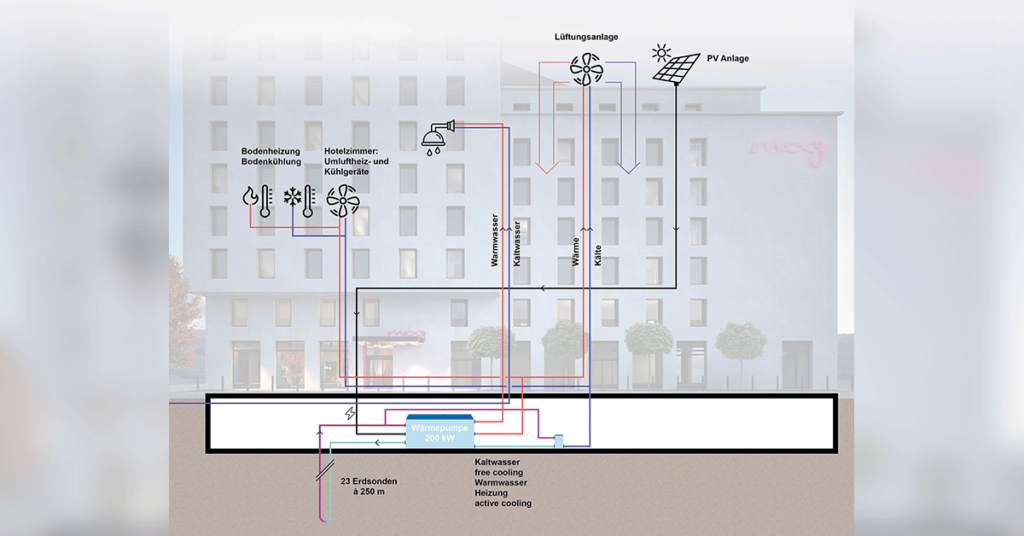
    The groundbreaking ceremony for the Hotel Rotbuche in Rapperswil-Jona took place in mid-February of last year. The three requirements and specifications for the energy supply and the energy system for the new hotel were clear: energy efficiency, ecology and comfort. In order to implement these requirements, geothermal probes were drilled as an energy source for the heat pump and a sustainable energy concept was developed in cooperation with Energie Zürichsee Linth (EZL). EZL will also operate and maintain the building technology as a contractor.

    Heat recovery measures
    "The reversible heat pump can be used to provide heat for heating purposes and for domestic hot water," explains Roman Fausch, project manager for energy services at EZL. In summer there is the possibility of cooling the building in an energy-efficient way using geothermal probes, according to the expert. If there is a high need for cooling, there is also the option of using cold from the reversible heat pump. Various heat recovery measures are also installed and, thanks to an intelligent control system, also regulated as required. "In connection with energy and sustainability, it is one of the most sustainable hotel projects that we have been able to plan and implement," says Stefano Ghisleni, general planner at Ghisleni Partner AG, based in Rapperswil, Zurich, St. Gallen and Zug.

    At the Moxy Hotel Rotbuche, the natural heat comes from a depth of around 200 to 250 meters. The 23 probes, distributed over the entire construction area, withdraw 10 to 15 degrees from the ground. The heat is fed into the heat pump in the building using a carrier fluid and converted. This is how it gets into the hotel's heating and air conditioning system. The entire length of the geothermal probe control system is more than five kilometers.

    Reduction of the room temperature by up to four degrees
    Those responsible for the project emphasize that the basic need for room cooling in the warmer seasons in the Hotel Rotbuche can be covered with the environmentally friendly free cooling system. This means that the room temperature can be reduced by up to four degrees. This has a positive side effect: the dissipated heat is in turn temporarily stored in the geothermal probes and can be used for hot water preparation or in winter for heat supply. A photovoltaic system is installed on the roof to operate the heat pump. With around thirty percent, it should provide sufficient coverage to cover part of the electricity demand. "The moderately controlled balancing of heat and cold makes a continuous room climate possible without massive temperature fluctuations," says project manager Roman Fausch. The first guests will be able to feel this for themselves from the coming autumn. At this point in time, the new “Rotbuche” hotel with its 86 rooms is due to open. ■

  • The hotel construction site in Geroldswil has been secured

    The hotel construction site in Geroldswil has been secured

    With more than 60 percent, the Geroldswilers approved an additional loan of 650,000 francs, which increases the project planning loan, which was too tight in 2017, to around 2.6 million francs. This means that work on the project can continue. A center development with a lower level garage, a major distributor in the basement and apartments on the upper floors are to be created. According to a media release by the municipality of Geroldswil , 872 voters voted for the approval of the additional funds. In contrast, there were 559 no votes with a participation of 50.45 percent.

    The leases for the Hotel Geroldswil and the pizzeria on Dorfplatz are limited in time and will expire on December 31, 2021, the municipality announced when the project was presented . Based on an economic and feasibility study, the two floors with the hotel rooms are to be converted into apartments. As a supplement, a new building with family apartments is to be built as a so-called point building in the north-western part of the property. The current community hall is to be demolished and a new, modern and well-equipped community hall will be implemented as a connecting wing between the current Hotel Geroldswil and the apartment building. There should be space for one or two restaurants on the village square, it said.

    The independent mayor Michael Deplazes is quoted in an article in the “Limmattaler Zeitung”: “The voters recognize the necessity of the project and understand why we are investing in age-appropriate apartments and in new buildings.” According to Deplazes, the planners and architects can now do their work again record: "We put a project freeze until the additional loan was approved because we cannot spend money that we don't even have."

    The next ballot will take place on June 13, 2021. Then the people should decide on the building loan. "We expect an estimated 26 million francs," said Deplazes.

  • Corona-influenced half-year results of the Zug Estates Group

    Corona-influenced half-year results of the Zug Estates Group

    • The property income increased by 5.4% compared to the same period of the previous year
    • CHF 28.2 million
    • Doctorate profit before taxes of CHF 9.5 million in the Aglaya project
    • The group result amounts to CHF 8.3 million (previous year period: CHF 26.1 million). Without
    • Revaluation and special effects reduced the group result from CHF 15.4 million.
    • to CHF 11.9 million
    • Solid capital base with an equity ratio of 55.7% (54.7% as of December 31, 2019)

    At Zug Estates, too, the first half of 2020 was dominated by the challenges we were faced with by the COVID-19 pandemic.

    In the real estate sector, many of our tenants had to close their shops during the officially ordered lockdown. This mainly affected our retail tenants and thus the Metalli shopping mall. In the Hotel & Gastronomy segment, the almost complete standstill of international business travel led to a considerable drop in sales.

    Fortunately, despite Corona, we were able to hand over all of the remaining 49 condominium units of the Aglaya doctoral project to their new owners on time. In addition, we have already been able to find a partnership-based and conclusive solution for a one-off rent waiver with over 90% of the tenants directly affected by the lockdown.

    In the first half of 2020, the group result was CHF 8.3 million, 68.3% below the previous year's period (CHF 26.1 million). Adjusted for revaluation and special effects, the declining figures in the Hotel & Gastronomy segment in particular lead to a reduction in consolidated earnings by 22.7% from CHF 15.4 million to CHF 11.9 million.

    Increase in property income with significantly lower hotel and catering sales

    The full period of validity of rental contracts, the majority of which were concluded in the previous year, increases property income in the first half of 2020 compared to the same period in the previous year by 5.4% to CHF 28.2 million. Due to the COVID-19 pandemic, rent payments of CHF 0.7 million were granted.

    Income in the Hotel & Gastronomy segment fell from CHF 8.2 million to CHF 3.6 million. The occupancy of our hotels was temporarily reduced to less than 10% during the lockdown. Since then we have been able to record growth again, but are still well below the corresponding prior-year figures. The gross operating profit (GOP) is only 7.8% compared to 39.3% in the first half of 2019.

    The sale of the last 49 condominiums in the Aglaya project resulted in income of CHF 72.5 million and a pre-tax promotion profit of CHF 9.5 million
    In the Aglaya doctoral project, we were able to generate a return on the investment volume of 17.3%. Since no sales revenue was posted in the same period of the previous year, there was an overall significant increase in operating income from CHF 36.7 million to CHF 105.4 million.

    The real estate portfolio was valued a total of CHF 13.6 million lower, which corresponds to around 0.9% of the portfolio value of all investment properties as of June 30, 2020 and is due to a slightly more conservative assessment of the market rents for retail space in general and individual specific office spaces. In the same period of the previous year there was a revaluation gain of CHF 11.5 million.

    The average interest rate of the interest-bearing debt capital could be further reduced from 1.4% to 1.3%. As expected, the significantly lower construction activity led to a decrease in capitalizable interest and a corresponding increase in financial expenses from CHF 2.5 million to CHF 3.5 million.

    Stable portfolio with a higher vacancy rate

    At CHF 1.63 billion, the market value of the portfolio is at the same level as on December 31, 2019. In the first half of 2020, the last building in construction site 1 in Rotkreuz was put into operation. As expected, this increased the vacancy rate from 3.3% as of December 31, 2019 to 5.3% as of June 30, 2020. We invested a total of CHF 16.2 million in our portfolio in the reporting period. The weighted average remaining lease term (WAULT) is 6.7 years (6.8 years as of December 31, 2019), a very high level compared to the industry.

    While our residential products are enjoying very good demand in the current market environment, we are currently noticing a certain reluctance due to the COVID-19 pandemic, especially among those who are interested in office space. However, we are confident that the centrally located, high-quality and sustainably operated office space at Zug Estates will continue to be in high demand in the future. Fortunately, the number of inquiries for retail space in Metalli remained stable. We currently have no evidence of a decline.

    Solid capital base

    With the repayment of funds from the sale of the last apartments in the Aglaya and despite the distribution of a special dividend, the interest-bearing debt capital was reduced from CHF 597.4 million to CHF 587.1 million in the first half of 2020. The average remaining term of this financing is 4.8 years (previous year: 5.2 years). With an equity ratio of 55.7% higher by one percentage point, Zug Estates has a very solid equity base.

    Project development with a focus on the Metalli habitat

    After the city of Zug and Zug Estates presented the first result of the joint planning process for the “Metalli living space” in March 2020, a feasibility study was carried out with the specialist planners. The alignment project and the application for adapting the two development plans concerned are currently being drawn up with all the relevant documents. The guideline project is to be submitted to the city of Zug in the third quarter of 2020. The legally amended development plans are expected in 2022/23.

    After receiving the building permit, the Board of Directors approved the planning phase for the last two buildings (S43 / 45) on the Suurstoffi site in Rotkreuz. The start of construction will be triggered as needed, taking into account the market recovery in connection with COVID-19.

    Step-by-step implementation of the sustainability strategy

    The connection of the Metalli-Gevierts to the lake water network Circulago could take place according to plan in April 2020. The corresponding contracts for the connection of the remaining 16 properties were signed in December 2019. Commissioning is to take place in stages in 2021, 2023 and 2025. From this point in time, Zug Estates will be able to operate its entire portfolio almost CO2-free.

    Public electric charging stations have been available to customers on the Metalli shopping street since the beginning of June. Two of the six stations are high-performance fast charging stations, the first in the city of Zug.

    The installation of the CO2-neutral cooling in the rooms of the Parkhotel Zug was completed on schedule in April 2020, which means a significant increase in comfort for the guests from now on.

    Outlook 2020

    Due to the temporary effect of the rent reductions in connection with COVID-19, we continue to expect increasing rental income for the year as a whole. As a result of increased renovation and maintenance work or lower capitalizable financing costs, real estate expenses and financial expenses will be higher.

    In the Hotel & Gastronomy segment, we are assuming that sales and GOP will be well below the previous year's level due to the considerable drop in sales due to the stoppage of international business transactions by our regular customers, although the developments in the second half of the year are difficult to forecast.

    Therefore, both an operating result before depreciation and revaluation and a consolidated result without revaluation and special effects are expected to be significantly below the previous year.

  • A lifestyle brand is stirring up the hotel industry in Zurich

    A lifestyle brand is stirring up the hotel industry in Zurich

    The German hotel company Althoff Hotels will take over the traditional hotel “Bellerive au Lac” in Zurich towards the end of the year. The historic building at Utoquai 47 has been completely rebuilt since January of this year and then opened as the third AMERON hotel in Switzerland – two hotels are located in Davos and Lucerne – and the first AMERON boutique hotel in Switzerland. "The size and the spatial plan are perfect for the conversion into an AMERON boutique hotel", Thomas H. Althoff, founder and owner of Althoff Hotels, is quoted in various media.

    High quality hotel design
    As an interior concept, Monoplan – an architecture firm based in Zurich specializing in the hotel industry – has developed a modern interpretation of the existing hotel design, which can be read on their website. This mainly includes interior design, implementation planning and creative management. “A World of Many Worlds” – that is the hotel group's credo. All hotels are characterized by a cosmopolitan interior design, which at the same time has an individual character in each house. The house will have 61 rooms and suites, an event restaurant and various conference rooms. If everything goes according to plan, the four-star hotel is due to open this winter. ■

  • From commercial building to design hotel

    From commercial building to design hotel

    On Beatenplatz, not far from Zurich's main train station, a budget design hotel of the Munich hotel group Ruby with 208 rooms and a restaurant operated by Candrian Catering is being built in the listed former “Haus Du Pont” commercial building. For more than 100 years, the building housed the ABC cinema from 1913. Historically, the “Haus Du Pont” by Zurich architects Jakob Haller and Karl Schindler has been referred to as a palace-like building. Indeed: the comparison is appropriate.

    Simple and representative appearance
    Now a look into the future: In the course of the conversion, the largely listed building will be completely renovated. This includes its supporting structure, stairwells, facade and roof structures. In order to achieve an elegant, simple and at the same time representative appearance, classic means are used, emphasize the project managers. These include, for example, a surrounding wall frieze. That means a linear, horizontal style element. This narrow strip, delimits, divides and decorates parts of the building. There are also structured wall surfaces, a terrazzo floor and seating niches in the lobby. The philosophy of the hotel group is "Lean Luxury – luxury in a small area".

    The Zurich architects Monoplan are responsible for the architecture, the interior design, the overall planning and the construction management. The owner and builder of the historic building is PSP Swiss Property, which is investing 45 million francs in the total renovation. If everything goes according to plan, the two-year construction work will be completed by the end of 2021. ■

  • From a listed school building to a private hotel

    From a listed school building to a private hotel

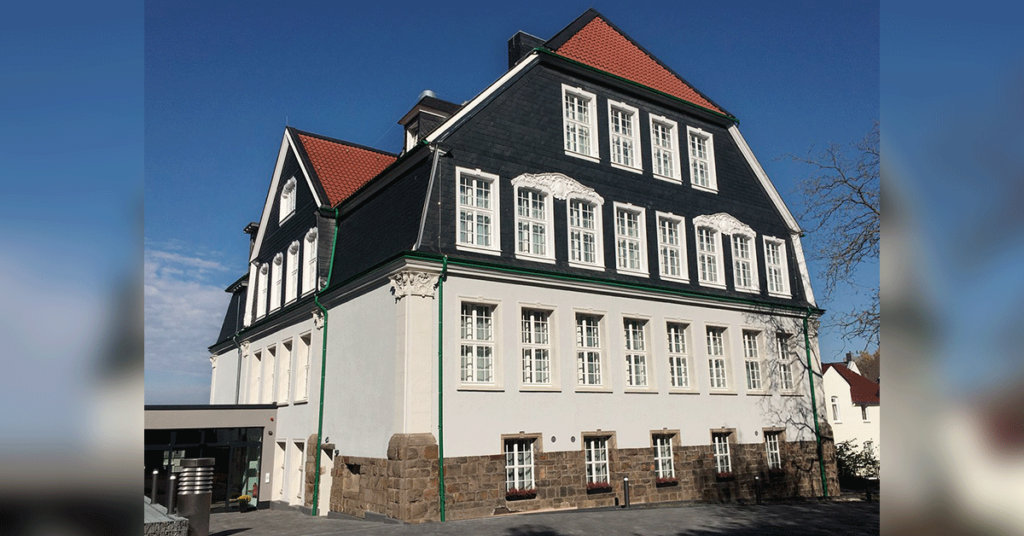
    The vision: A hotel is to be converted from a former school building, in which the original character of use and the original substance are to be retained. The Berlin hotelier Kurt Hermandung and his partner Marc Konopatzki have realized their dream of their own small private hotel. This is close to Düsseldorf, Cologne and the Ruhr metropolises. "We wanted a small, fine house with character that we can make something very special," say the owners. "After a long search, we came across this former elementary school – and an investor who could imagine turning it into a hotel and the former gymnasium into a restaurant." In terms of design and concept, the former schoolhouse from 1915 and the gymnasium added in 1980 were based on the original use of the building.

    Classrooms became elegant hotel rooms
    The local architecture firm Wilde and Wehnau implemented this ambitious conversion concept, from the design to the implementation planning and construction management. Their services also included the concept of the monument protection concept, the planning of the interior design and the lighting design. The exterior facade with its typical slate shingles, the representative bay window and the green rain gutters were restored and preserved under the watchful eye of the listed building. The former classrooms of the primary school have been transformed into elegantly furnished single and double rooms with oak parquet and spacious bathrooms. A junior suite was installed in the attic. The minibars that used to be in the rooms are a thing of the past. The alternative is much more original and ecologically more sensible: A central “school kiosk” on the ground floor offers a variety of drinks.

    A special feature in the house is the restored historical fountain with fresh drinking water, which extends over two floors, emphasize the hotel owners. Old certificates and photos are reminiscent of the earlier school days. You can find yourself in the whole building. Gym boxes serve as luggage racks in the rooms. The gym's old rung climbing wall was also given a new function. It serves as a partition to the stairs in the restaurant.

    Former gym as a restaurant
    The rather unadorned gymnasium was completely dismantled in the course of the renovation work. The result is a modern building which now houses the “Die Turnhalle” restaurant, the lounge and the bar. In the historic school building, a lift provides barrier-free access to all floors and connects the hotel rooms with the restaurant. The latter is also open to the public. A newly installed ceiling divides the former gymnasium into two floors. This enabled the area to be doubled to 800 square meters. This made space for four conference rooms and a small bar for catering in the conference area. The extension with its large glass surfaces is a successful contrast to the old and lovingly restored school building and complements it in an ideal way. ■

  • The hotel in the shopping center When construction and use match thanks to drywall construction systems from Rigips.

    The hotel in the shopping center When construction and use match thanks to drywall construction systems from Rigips.

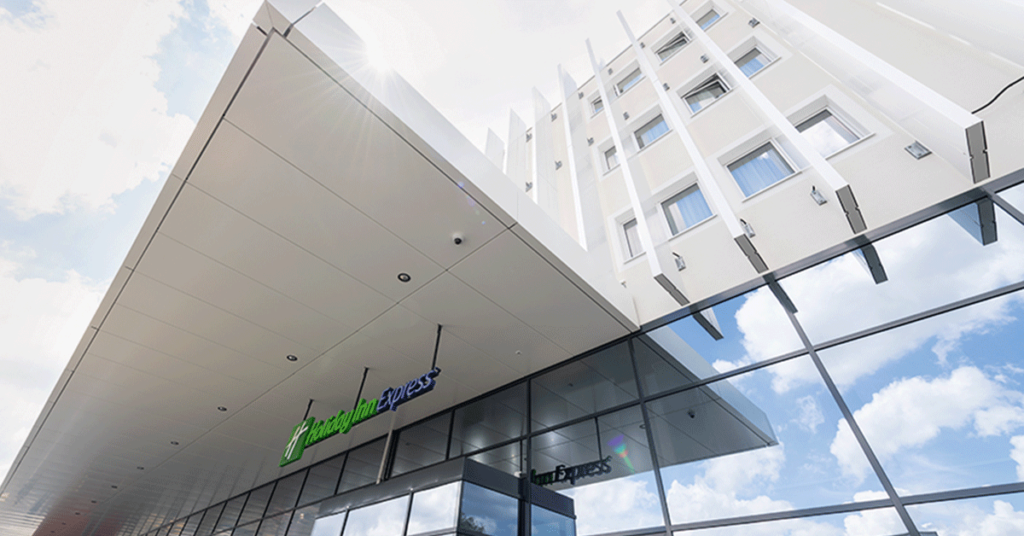
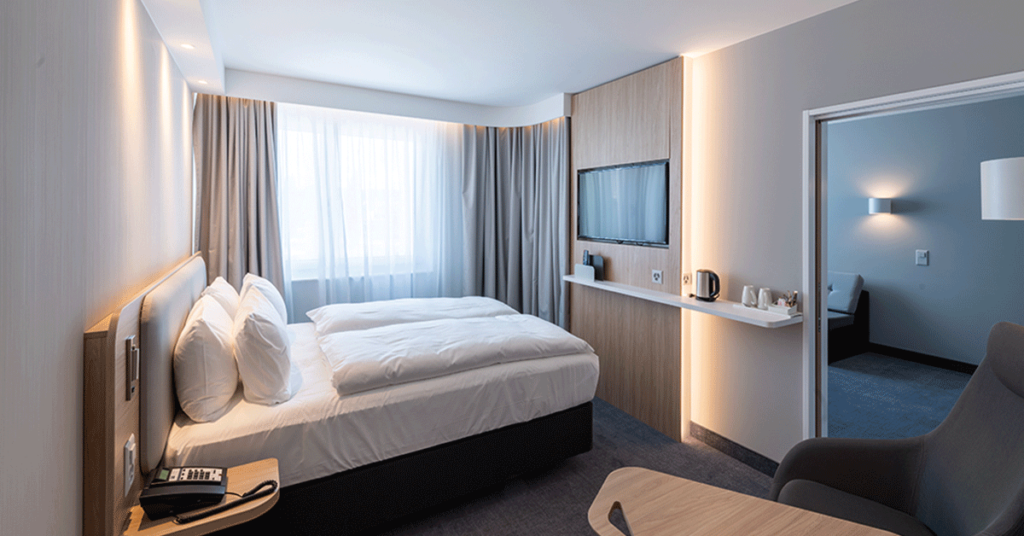
    The 3-star hotel offers 80 rooms. It has a breakfast room, a bar and a lounge. Guests can go straight to the Perry Center via a passageway, where they can shop and use the other range of restaurants and meeting rooms. It is primarily aimed at business people who are busy in the region and are looking for accommodation for one or more nights in this central location in terms of transport.

    The physical possibilities of dry gypsum construction
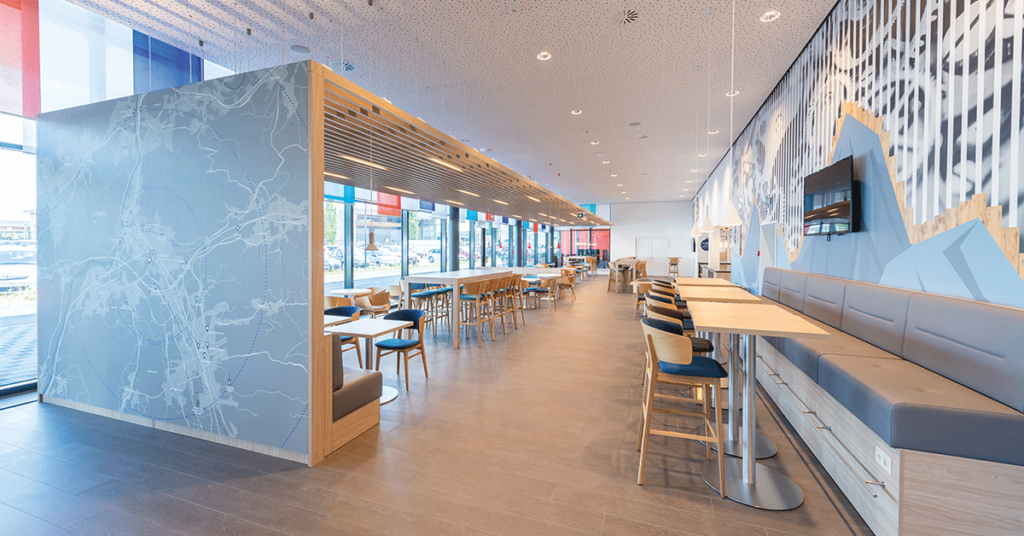
    A hotel must above all meet two requirements: peace and security for its guests. The peace and quiet is made possible not least by the good construction quality, whereby dry gypsum construction systems are in no way inferior to conventional construction methods, on the contrary. In the Holiday Inn Express, among other things, a 350 m2 Rigiton® Ambiance acoustic perforated ceiling by Rigips spans a good five meters over the entire ground floor with reception, lobby, bar as well as breakfast and self-service area. The holes of different sizes (Ø 8, 15 and 20 mm) absorb the sound and provide a pleasant acoustic feeling of space. An elongated wooden slat ceiling that appears to float is built in over the tables in the breakfast room. It is mounted using threaded rods on the Megastil® special profiles from Rigips, which were used to reinforce the ceiling substructure in this section.

    Sleep in peace and security
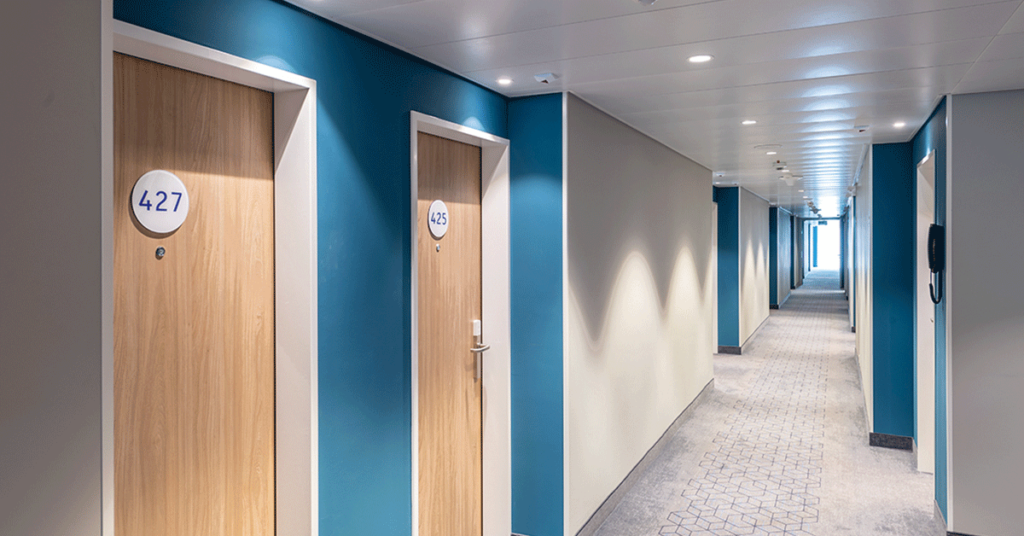
    The partition walls between the individual rooms consist of double-clad Rigips® double stud walls made of 12.5 mm plasterboard with a wall thickness of 205 mm and a sound insulation value of 65 dB. These constructions are of higher quality and yet more efficient to create than concrete or brick walls. And above all, they can be easily relocated should the spatial requirements change. The corridor walls are optimized in terms of sound and fire protection with cladding made of plasterboard, especially in the area of the shaft walls in which the building services are installed.

    Standardized systems with tested performance values
    Rigips now has a catalog of hundreds of tested standard constructions for walls, ceilings and cladding. Their sound and fire protection, but also static and climatic properties vary depending on the height, structure and possibly the combination of systems with one another. It is therefore advisable to speak to drywall specialists from the earliest planning phase. In the case of larger projects in particular, Rigips' key project management, the consultant for planners and investors, can provide information on energy efficiency, life cycle assessment and moisture protection in addition to the relevant planning parameters for wall, ceiling and floor constructions. All construction variants can be called up in a clear system finder at www.rigips.ch. The systems are without exception in accordance with the applicable standards (EN, SIA) resp. Institutions (EMPA, VKF) tested and certified.

    When space requirements change
    In our fast-paced society, space requirements are constantly changing. This can also be the case in a hotel. In order to remain attractive in the long term, a property must be able to react to changing needs and spatial dimensions. If you invest in a flexible construction method with as few load-bearing elements as possible, a wide variety of needs in the construction of the property, but also changes within the existing building envelope, can be implemented with little cost and time. Rigips® and Alba® drywall systems offer maximum freedom of planning and use. ■

  • Ein neues Kleid für das Grand Hôtel & Centre Thermal Yverdon-les-Bains

    Ein neues Kleid für das Grand Hôtel & Centre Thermal Yverdon-les-Bains

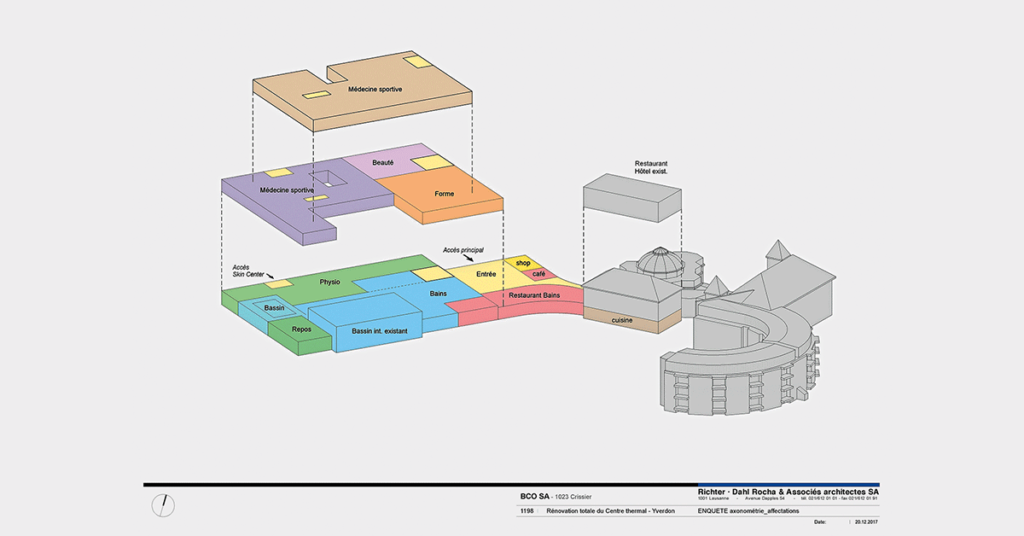
    Seit Herbst 2019 wird das historische Hotel mit 116 Zimmern und Suiten während drei Jahren umgebaut. Das Gesamtbudget von rund 32 Millionen Franken enthält die Kosten für die vollständige Renovierung der Innenräume und des Aussenbereiches sowie des Thermalbades und des Grand Hôtels. Im Grand Hôtel werden die Zimmer und Bäder, die Küche und der Aussenbereich inklusive Schwimmbad renoviert. Der Eingang zu den Thermalbädern wird neu ausgestaltet und mit Geschäftsflächen und Restaurants erweitert. Die Umkleidekabinen werden renoviert.

    Ein neues Café wird nur von den Bädern aus zugänglich sein. Die Zone um die Aussenschwimmbecken wird mit einem 350 m2 grossen Wellnessbereich mit Hamam und Sauna ergänzt. Der Fitnessbereich umfasst neu 700 m2. Während der gesamten Bauzeit wird das Thermalbad den normalen Betrieb aufrechterhalten. BCO SA, eine Tochter der BOAS-Gruppe, leitet die Bauarbeiten; das Architekturbüro Richter Dahl Rocha mit Sitz in Lausanne hat das Projekt ausgearbeitet.

    Das Thermalbad von Yverdon-les-Bains besteht aktuell aus verschiedenen, zum Teil dreistöckigen Gebäuden, die untereinander verbunden sind. Im Aussenbereich stehen zwei grosse Schwimmbecken zur Verfügung. Das 4-Sterne-Superior-Hotel liegt inmitten eines prächtigen Parks mit altem Baumbestand. Aufgrund seiner langjährigen Geschichte strahlen die verschiedenen Räumlichkeiten des Grand Hôtels jeweils ihren eigenen, ganz besonderen Charme aus. So zum Beispiel die sogenannte Rotunde (kreisförmiger Bauteil), in der sich das Restaurant und die Lounge-Bar befinden oder der vor kurzem renovierte «Belle Epoque»-Saal und insbesondere auch das zum Hotel gehörende Schloss. Über einen Glastunnel ist das Hotel mit den Thermalbädern verbunden.

    Neues Seedorf und neue Einrichtungen
    Der erste Schritt des gross angelegten Renovationsprojektes ist der Bau des Seedorfes im Park vor dem Hotel – am Ufer eines neu angelegten Weihers. Drei Holzbrücken führen die Besucher übers Wasser zu den Häusern, die verschiedene Wellnessbereiche wie Hamam, Sauna und Ruheräume beherbergen. Ein Barfussweg wird ebenfalls entstehen. Die bereits heute für die Physiotherapie und Arztpraxen genutzten Räumlichkeiten werden durch zwei Einheiten ergänzt: Entstehen soll ein Zentrum für Sportmedizin mit einem separaten Eingang. Weiter ist vorgesehen, die medizinischen Infrastrukturen räumlich zu konzentrieren, sodass die Patienten über eine grössere Privatsphäre verfügen.
    Durch die Verlegung des Thermalbadeingangs entsteht ein attraktiver, lebendiger Raum, durch den der Gast vom Hotel direkt zur Bäderzone gelangt.

    Dieser Bereich umfasst 900 m2 und umfasst eine Empfangshalle, eine Boutique, ein Restaurant und ein Café. Der bislang für den Übergang genutzte, wenig ansprechende Glastunnel wird abgebaut. Renoviert werden zudem Küche und Restaurationsbereich. Die Fassaden und Dächer der Thermalbad-Gebäude werden abgerissen. Stattdessen wird einer äusseren Einfassung Platz gemacht, die den ganzen Komplex umfasst und vereinheitlicht. Die gesamte Fläche wird um eine Etage aufgestockt. Damit entsteht Raum für moderne, besser durchdachte, architektonisch homogen und stilvoll integrierte Inf-
    rastrukturen. Auch die Infrastruktur des Thermalzentrums wird optimiert: Das Hallenbad wird komplett renoviert und um ein neues Schwimmbad mit Spielbereich erweitert.

    Infrastruktur des Neubaus in der Übersicht:
    Erdgeschoss
    Neuer Eingang, 600 m2
    Boutiquen, Café / Restaurant, 360 m2
    Bäder-Restaurant
    Bereich Physiotherapie (960 m2) mit unabhängigem Rehabilitationsbecken
    Neue Umkleideräume und Duschen
    Neues Innen-Schwimmbecken
    (Unterricht und Erholung)
    Inneres Becken vollständig renoviert
    Zwei Aussen-Schwimmbecken

    Erste Etage
    Fitness-Raum, 700 m2
    Schönheitspflege, 340 m2
    Sportmedizinisches Zentrum (1160 m2) mit Anbindung an den Physiotherapiebereich und neuem separatem Eingang

    Über BOAS Swiss Hotels
    Boas Swiss Hotels ist eine private Hotelgruppe mit Sitz in Crissier / Lausanne. Zur Gruppe gehören zehn Beherbergungsbetriebe in den Kantonen Wallis, Waadt und Genf. Die Hotels gehören mehrheitlich zur Kategorie der 3- und 4-Sterne-Superior-Betriebe. ■

  • Jean Nouvel is renovating the Grand Hotel Geneva

    Jean Nouvel is renovating the Grand Hotel Geneva

    At the beginning of the year, the Grand Hotel Geneva changed operators: Fairmont Hotels & Resorts, one of the luxury brands from the Accor Group, is taking over from the Kempinski Group. At the same time, the owner, Le Palace Genève SA, announced the extensive renovation of the hotel.

    The Geneva 5-star hotel directly on the lake with a view of Mont Blanc is being remodeled by the French star architect Jean Nouvel. With his architecture office, he secured the contract in the context of an international architecture competition. Brigitte Jucker-Diserens' Geneva partner office is coordinating the project. The KKL Luzern, the Lyon Opera, the Galerie Lafayette in Berlin and the national museum in Doha all came from Nouvel's hands. He was awarded the Pritzker Prize in 2008 and has so far created over 200 structures.

    Targeting the highest energy efficiency standards
    The renovation work should begin at the end of 2020 / beginning of 2021, once all permits have been received. One focus of the renovation is on the facade. It should be perfectly integrated into the environment and should be based on the design and materials of the other houses in the bay. The inner courtyard, the public areas and the restaurants are also being renovated. In addition, the hotel should meet the highest energy efficiency standards after the renovation. It is currently being clarified whether a thermal heating solution can be implemented. Then the hotel would be heated and cooled with water from Lake Geneva. This focus on sustainability is in line with the philosophy of the Fairmont brand.

    The hotel has 412 rooms, including 33 suites and 14 apartments; three restaurants, a lounge and bar with a view of the lake, a heated indoor pool and a spa and fitness center. The number of rooms will be unchanged after the renovation, as the press officer at Fairmont Hotels & Resort, Philippe Eberhard, announced. The centrally located hotel will remain open during the renovation. According to Eberhard, the costs are likely to amount to tens of millions of francs.

    Fairmont's portfolio currently includes 77 hotels in 29 countries, including the GrandHotel Geneva. The Fairmont Le Montreux Palace is also located on Lake Geneva. ■

  • La Margna becomes the Grace Hotel St. Moritz

    La Margna becomes the Grace Hotel St. Moritz

    The renovation work has been underway since September 2016: In St. Moritz, the former Hotel La Margna on Via Serlas is becoming the Grace Hotel. The owner is the internationally active Grace Hotel Group. She has the building carefully renovated and expanded with an annex. The opening was originally planned for 2017, was then postponed to autumn 2019 and is now to take place in 2022. The reason for the delay: the project was modified and expanded again after construction began. The number of hotel rooms was increased by a third to 56, as a correspondingly high demand is expected.

    Upon completion, the hotel will include the historic “La Margna Wing” and the modern, newly built “Grace Wing”. In the "Grace Wing" an underground car park, a spa area as well as hotel rooms and suites are being built. In the “La Margna Wing”, the rooms on the upper floors are being completely renovated. The rooms on the lower floors are being restored so that the historical building fabric is preserved. Here guests will discover vaults, arches and other architectural features of Art Nouveau.

    Art Nouveau meets modernity
    The former Hotel Margna was built in 1906 and 1907 according to plans by the architect Nicolaus Hartmann in the Engadin style. In 1911 the east wing was increased by three storeys. After that, renovations and renovations took place again and again, but the external appearance was never significantly changed. The striking facade is to be retained even after the current renovation.

    The drafts for the project come from the pen of the architect Nikolas Travasaros from Divercity Architects. For him, the main challenge was to freshen up the original architecture and at the same time create a modern extension for additional rooms and a spa. In addition to taking into account the strict building regulations and the given restrictions due to the sloping terrain, Travasaros had to plan hotel rooms that can also be converted into long-term apartments.

    His plans combine old and new by expanding the base of the existing building. The extension follows the natural gradient and fits seamlessly into the landscape. The new wing is deliberately kept discreet and does not overshadow the traditional architecture and the breathtaking alpine surroundings. Panoramic windows and adaptable, open interiors create a feeling of light and space.

    Blarer & Reber Architects in Samedan are responsible for the planning and implementation on site. The preservation of monuments in Graubünden was included in the project development so that the greatest possible preservation of the historically valuable building fabric is guaranteed. The STW AG for spatial planning based in Chur was also included in the project team.

    All rooms and suites of the boutique hotel Grace St. Moritz will offer lake or panoramic views. Three restaurants and a spacious spa area with swimming pool as well as a fitness center on over 800 square meters are planned. The hotel has a private car park and is just a 2-minute walk from the train station and the bus stop. A ski shop and ski room are also planned. Serviced apartments are also to be offered for sale in both wings. ■

  • "Because of the Corona crisis, all investment projects will probably be put on hold"

    "Because of the Corona crisis, all investment projects will probably be put on hold"

    Mr. Allemann, there has been a structural change in the Swiss hotel industry for a long time, with a trend towards larger hotels. Nevertheless, almost 90 percent of the hotels have fewer than 55 beds. How are these companies responding to this change?

    The biggest problem are businesses with ten to twenty rooms and 15 to 30 beds. These houses are struggling to be profitable. Many small businesses, however, have a very large share of the catering industry, some of which generate over eighty percent of sales. The hotel industry is not part of the main business there.

    Hotel guests are becoming more and more demanding. How can the aging hotels keep up with this trend?

    This is actually a problem. We have many plants in Switzerland that were built at the end of the 19th century and the beginning of the 20th century. These often have fewer than thirty rooms and are very entertaining. If you are in destinations that are no longer as attractive today, such as transit routes, this is an aggravating circumstance. Missing frequencies then automatically lead to profitability problems and pent-up maintenance.

    Does the operation of a hotel require high investments?

    Yes, because the hotel industry is very investment-intensive. A hotel should be completely renovated after thirty to forty years. Depending on how trend-oriented or traditionally timeless a hotel is architecturally positioned with its furnishings in the market, shorter renewal cycles are necessary, especially for the rooms.

    Do the hotels generally have the necessary financial resources to carry out the necessary renovations and refurbishments?

    In principle, investments should be financed from cash flow. In recent decades this has become increasingly difficult for many companies, also because of the various crises. At the moment, of course, especially because of the Corona crisis. In the luxury sector, there are often patrons who have either fallen in love with the house or with the region and are ready to invest in hotel properties. They see the motivation of their investments not only in economic terms, but as an «A-fonds-perdu-contribution. In this way, their hotel operations achieve their extraordinary positioning in the market. I see the critical segment in the middle-class hotels, which because of insufficient occupancy or insufficient positioning are unable to make the necessary investments or can only generate them through borrowing.

    Does your association financially support the renovation of hotels?

    No, this is not the association's task; we would not have the resources to do so either. The association has the competence to offer and supports its members to be competitive. We have built up a network of specialized consulting firms that can support our members in a wide variety of subject areas. We also work very closely with the Swiss Hotel Association (SGH), which has the specific financing expertise.

    This means?

    The SGH is a federal instrument to promote the accommodation industry. Subordinate to the banks and subsidiary to private donors, it can grant loans for investment projects to hotels in tourist areas and health resorts.

    What other challenges need to be tackled?

    Succession arrangements are particularly difficult for companies with an investment backlog and / or over-indebtedness. This is practically impossible within the family or cannot be expected of the children. Since the second home initiative was adopted, it is practically no longer possible to convert hotel properties. Demolition is not an option, especially for listed properties. Complete renovations or partial re-use are also very costly due to the requirements of monument protection. So there is still hope of finding a patron. Unfortunately, these are not just in front of the door. If the substance of the house is still intact and there is potential for demand in the destination, I see the merger of several companies as an alternative to cross-company cooperation as an opportunity out of this dilemma. For example, by bundling purchasing, costs can be saved and more sales can be achieved with joint marketing activities.

    What advice would you give a hotelier: renovate, demolish or try to get a loan?

    Look, one criterion is the existing building fabric, especially for hotels from the turn of the century. However, if only the shell is historical, this hotel hardly offers guests any incentives to stay here. Keeping a house steeped in history alive takes a lot of personal commitment. First of all, it is important to deal with the era of hotel construction. This requires a certain affinity with the history of the hotel. This also has to be told. So you need someone who is willing to renovate the establishment of the company gently and with great sensitivity and to bring it up to the state of today's guest needs. ■

  • Coop verwandelt den Basler Märthof in ein Boutique-Hotel

    Coop verwandelt den Basler Märthof in ein Boutique-Hotel

    Im ersten Halbjahr 2021 soll im historischen Gebäude des Märthofs in Basel das Boutique-Hotel Märthof eröffnen. Die Eigentümerin, die Coop Immobilien AG, hat das Architekturbüro Burckhardt + Partner mit der umfassenden Renovation beauftragt. Geführt wird das Hotel nach der Eröffnung von der zu Coop gehörenden Bâle Hotelgruppe. Sie betreibt bereits die Hotels Pullman Basel Europa an der Clarastrasse sowie das Victoria am Centralbahnplatz und das Hotel Baslertor in Basel-Muttenz.

    Das Gebäude des Märthofs entstammt dem 19. Jahrhundert und bestand ursprünglich aus fünf einzelnen Häusern, die 1981 zu einem Gebäudekomplex zusammengeführt wurden. Die freiwillige Denkmalpflege Basel wehrte sich Anfang der 70er-Jahre gegen den geplanten Warenhaus-Neubau, der anstelle des alten Gebäudes vorgesehen war. Der Abbruch wurde 1976 in einer Volksabstimmung abgelehnt. Nun soll ein Hotel der oberen 4-Sterne-Kategorie entstehen, wobei die Fassade mit einem neuen Anstrich in ihrer jetzigen Form erhalten bleibt. Das Mauerwerk selber bleibt unverändert – auch die Natursteinpartien werden nur gereinigt.

    Laut Coop-Mediensprecherin Rebecca Veiga sollen im neuen Boutique-Hotel die Stilepochen der ehemals fünf bestehenden Gebäude unverkrampft und spielerisch vermischt werden. «Verspielte Motive des Neubarocks und die funktionale Gestaltung der Geschäftsfassade aus dem Jahre 1927 treffen im Inneren des Gebäudes auf die lineare 80er-Jahre-Struktur», sagt Veiga.

    Offene Übergänge und eine freundliche Atmosphäre
    Auf die insgesamt 68 geplanten Zimmer, davon acht Suiten und acht Juniorsuiten, werden Stehleuchten, Wandleuchten, Sessel und weiteres Mobiliar individuell verteilt – kein Zimmer wird exakt wie das andere aussehen. Die Zimmer erhalten unterschiedliche Farbschemen und widerspiegeln die Geschichte vom jeweiligen Gebäudeteil, in dem sie sich befinden. Die Farben sind abwechslungsreich und sollen nicht polarisieren – sodass sie das ganze Jahr hindurch auf die Gäste angenehm wirken.

    Des Weiteren sind ein Fitnessraum, eine Bibliothek, ein Res-
    taurant sowie eine Bar auf der Dachterrasse im 6. Stock mit 55 Sitzplätzen vorgesehen – und eine weitere im Erdgeschoss. Alle funktionalen Räumlichkeiten sind analog einer starken Wirbelsäule um den Erschliessungskern des Hauses angeordnet und stossen von innen nach allen drei Aussenseiten. Die Übergänge der unterschiedlichen Nutzungsflächen im Erdgeschoss sind offen gestaltet, sodass es als Fläche ohne Unterbrüche wahrgenommen wird.

    Eine helle und freundliche Atmosphäre empfängt den Gast im Standardzimmer. Der Raum wird mit Ausnahme der abgeschlossenen Dusche und einem separaten WC grosszügig offen gestaltet. Nebst der eingebauten Schrankzeile im Eingang sind alle Möbelstücke freistehend. Sanfte Rundungen gemäss dem Gesamtkonzept des Hauses werden auch im Zimmer durchdekliniert.
    Die Aussenbestuhlung und die grossen Fenster verbinden das Gebäude mit dem Marktplatz. «Die einmalige Lage und das lebendige Geschehen am Marktplatz soll nach innen spielen und umgekehrt», sagt Veiga. Das Boutique-Hotel will internationale wie auch lokale Gäste ansprechen und durch Restaurant und Bar entlang der Eisengasse als Treffpunkt für die lokale Bevölkerung und die Hotelgäste dienen. ■

  • Graubünden luxury residences should be vacant less often

    Graubünden luxury residences should be vacant less often

    The University of Applied Sciences of Graubünden has examined how the added value of luxury residences that are often vacant can be improved. In this context, the Institute for Tourism and Leisure ( ITF ) investigated the question of how their owners can become convinced renters. In Graubünden they have been “neglected”, writes the FH in a press release . However, because the trend is moving from overnight stays in a hotel to one's own holiday home, this clientele should not be neglected.

    However, the existing data is too thin for a needs analysis. Therefore, in their study, the researchers examined the willingness to rent similar prestige properties. In the global yacht charter market, they identified high administrative hurdles as well as psychological motives as an obstacle to renting out. These include encroachments on privacy and limited flexibility in personal use.

    The most important finding from this needs analysis, however, is "that both the rental of superyachts and luxury residences are a matter of trust". So that the potential of the often vacant luxury properties in the high-priced Alpine destinations can be used, "all tasks that arise must be managed by a coordinator role". It is your job to guarantee that all service participants work together as smoothly as possible. “The rest then comes naturally, because satisfied landlords generate satisfied tenants,” says the message.