Tag: Infrastrukturen

  • Researchers call for a paradigm shift in building and energy planning

    Researchers call for a paradigm shift in building and energy planning

    Matthias Sulzer from the Swiss Federal Laboratories for Materials Science and Technology(Empa) and his colleague Michael Wetter from the Lawrence Berkeley National Laboratory in California are advocating a paradigm shift in the planning of building and energy systems. “Due to the complexity and required flexibility of future energy systems and the urgency of change, today’s planning processes are not suitable,” explains Sulzer, who heads Empa’s Urban Energy Systems department and is also a researcher at the Lawrence Berkeley National Laboratory, in an Empa press release. “There is little to no interaction between the disciplines in order to design buildings or energy infrastructures as a holistic system.”

    Sulzer and Wetter are in favour of transferring the so-called platform-based design developed for the automation of chip production to the planning of building and energy systems. The methodology is based on various levels of abstraction on which mutually influencing systems are holistically analysed and optimised. Generally valid models are created at each level, which specify how a system is to be defined and built. The individual models can then be individually combined in practice. Such a paradigm shift could “revolutionise our planning, construction and operating processes and promote the digitalisation and automation that are essential for achieving our ambitious decarbonisation goals,” says Sulzer.

  • Green cities as trailblazers for global climate impact

    Green cities as trailblazers for global climate impact

    The MCC study, published in the journal Nature Cities, highlights four key methods of CO2 removal in urban environments that could sequester one gigatonne of CO2 annually by the middle of the century. The methods analysed include adding biochar to cement, increasing the use of wood in construction, enriching urban soils with biochar and installing CO2 filters in commercial buildings. Together, these approaches could make a significant contribution to achieving net-zero urban emissions.

    Urban strategies for the climate and more
    Quirina Rodriguez Mendez, PhD student at the MCC and lead author of the study, emphasises that these techniques are of great benefit not only in terms of climate protection, but also for environmental quality and well-being in cities. For example, the use of special colour pigments and surface materials to improve the reflectivity of urban surfaces could significantly lower the temperature in cities and reduce the energy required for air conditioning systems.

    Local actions with a global impact
    The study emphasises the role of cities as “test laboratories” for climate protection, where local measures can be implemented quickly and potentially scaled up globally. Felix Creutzig, head of the MCC working group and co-author of the study, emphasises that local climate solutions, although often underestimated, can have an impressive impact and improve quality of life. The research findings offer important insights and recommendations for policymakers shaping urban infrastructure and policies.

  • New pipeline cadastre portal creates transparency and added value in the construction industry

    New pipeline cadastre portal creates transparency and added value in the construction industry

    Zurich has introduced a new, advanced system for visualising infrastructure networks. The canton of Zurich’s pipeline register provides a complete visualisation of all above-ground and underground pipelines responsible for water, wastewater, electricity, district heating, gas and communications. Centralising this data in a single information system makes it much easier to access relevant information for planning, construction and maintenance work.

    Simplified access to information
    Previously, interested parties had to obtain information on pipelines individually from the respective owners or operators – a time-consuming process. With the new pipeline cadastre portal, the canton of Zurich now offers a central point of contact that enables users to access this important data quickly and easily. Over 500 works operating in the canton regularly update their data in this system, ensuring the accuracy and reliability of the information.

    Wide range of applications
    The portal serves a wide range of users, including public administrations, construction companies, rescue and security services and private individuals. The precise information on the type and location of pipelines improves planning reliability for construction projects and facilitates the maintenance and expansion of existing infrastructure. Although the portal is not intended to be used for the direct planning of excavation work, it helps to significantly reduce the risk of damage by providing clear documentation of pipe routes.

    Simple operation and access to data
    The pipe cadastre portal is designed to be user-friendly. Users can search by municipality, parcel or street and select the medium of interest. The corresponding pipes are then displayed on the digital map. The data is easily accessible and available in standard formats. Additional information such as ownership and contact details of the relevant works are also provided.

    The portal can be accessed at: https://leitungskataster.zh.ch. Prior registration is required to use the portal.

  • 4. Competition Gardens & Public Spaces Valais 2024

    4. Competition Gardens & Public Spaces Valais 2024

    The competition is open to innovative and high-quality projects in the field of public spaces and infrastructure that have been realised in the last five years and are open to the public. The prize recognises the work of landscape architects, planners and gardening companies whose projects have strengthened the link between the built and natural environment and enriched the landscape aesthetics of Valais.

    This year’s jury, which is made up of experts from the horticultural sector in western Switzerland, has the task of selecting the most worthy projects by 30 April 2024. The detailed application guidelines can be viewed at www.jardinsuisse-valais.ch

  • Spatial planning, the measure of all things?

    Spatial planning, the measure of all things?

    Source: Swiss Confederation

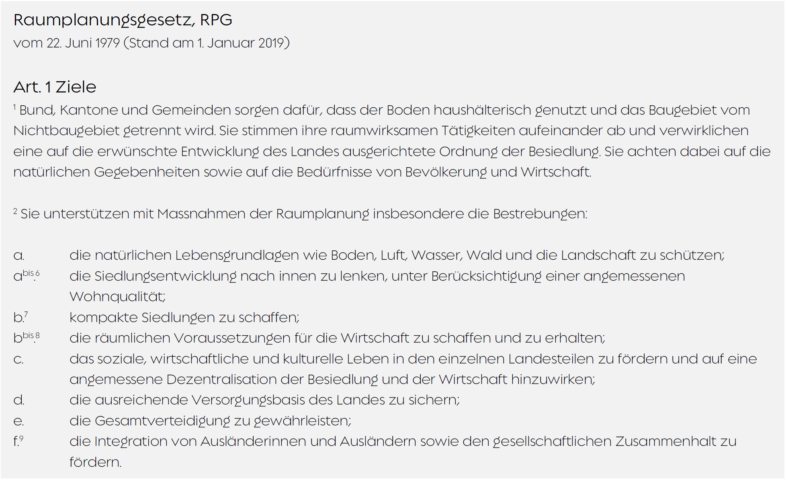
    In reality, however, the cantonal and municipal planning instruments are incomplete, rigid, purely quantitative and do not pursue a three-dimensionally developed picture of the future. The consequences are well known: Inconsistent cityscapes, insufficient densification potential, growing traffic volumes, uncoordinated infrastructural facilities and, finally, a dissatisfied population.

    Forward-looking spatial planning with new concepts is indispensable, because the current sluggish planning instruments of spatial planning are obviously at odds with the dynamic process of urban planning and to date fail to achieve the goals defined in the RPG.

    With the use of the already existing GIS data, the potential impacts on all relevant topics such as interior densification, land use, transport, energy consumption, greenhouse gas emissions and many others could be visualised, evaluated and communicated in a participatory manner throughout Switzerland on the basis of qualitative future scenarios – and beyond the cantonal borders.

    Buildings in the context of spatial planning
    Spatial planning also creates the framework conditions for the development of neighbourhoods and ultimately of the building stock. When we talk about sustainable buildings, it is not enough to look at them in isolation and focus solely on their substance. Buildings are to be understood in their context and thus in consideration of their contribution to the reduction of traffic volume, to densification and to social integration. Following this logic, the two standards SNBS Building Construction for Building and SSREI for Existing Buildings have been developed in Switzerland. In terms of their content, both are unique in an international comparison.

    Source www.ssrei.ch