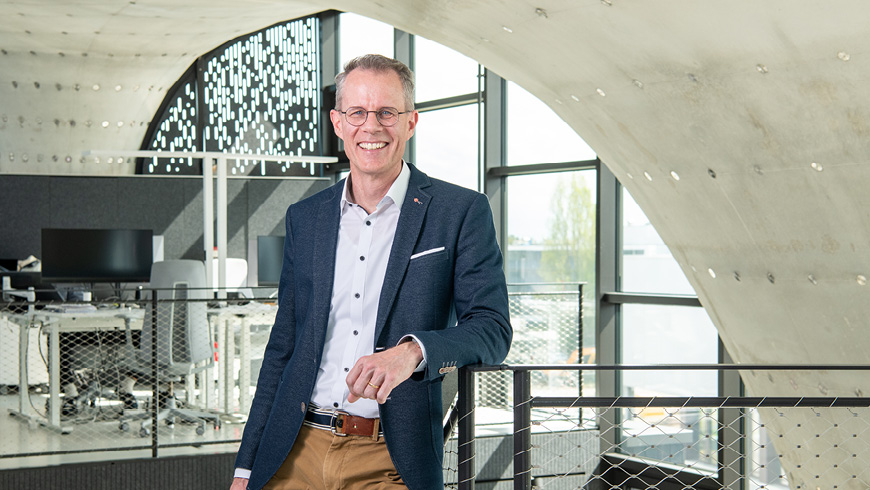
Matthias Sulzer is not your typical researcher. His career path took him from a trade to engineering studies to founding a company and finally back to research. Today he heads the Empa Department of Engineering Sciences, where he is helping to shape the built environment of tomorrow. His office is just as structured as his way of thinking. On a poster he drew himself, a mountain road shows the stages of a strategic development. For Sulzer, visualizations are not just a working tool, but an expression of pragmatic, goal-oriented thinking.
He recognized early on that sustainable change can only succeed if research and practice work closely together. Even when he founded his company, he focused on scientific cooperation. This attitude later led him to Empa as a senior researcher, where he led national innovation projects and translated scientific findings into concrete applications.
Innovation as a combination of systems thinking and responsibility
Today, Sulzer deals with a wide range of topics, from sustainable robotics and new materials to the decarbonization of entire energy systems. Its work is particularly impressive in the context of climate change. After all, the built environment is responsible for a large proportion of resource consumption. Sulzer sees this not only as a technological task, but also a social one. His vision ranges from closed material cycles to the recovery of atmospheric carbon. For him, climate protection begins in the laboratory, but it ends in application.
His department covers the entire spectrum of research, from molecular material developments to the evaluation of national energy strategies. From drones for infrastructure repairs to biocompatible implants, the work of the Empa teams is as diverse as it is relevant. According to Sulzer, it is crucial that the various disciplines work together. Where individual experts used to work side by side, today the focus is on real teamwork.
Research that empowers people
For Sulzer, however, the focus is not on technology, but on people. Research should not only be measured in terms of excellence, but must also empower the next generation to take responsibility. He sees himself as an enabler who creates spaces for scientific excellence. And he believes in the added value of teams in which individual strengths are combined to create collective intelligence. Where disciplinary boundaries are crossed, new solutions emerge, often with an impact beyond research.
With Matthias Sulzer, Empa is not only gaining a technically skilled head of department, but also a leader who brings together science, entrepreneurship and social responsibility. At a time when technological developments alone are no longer enough, Sulzer relies on attitude, cooperation and a clear vision. Research that works through people, for people.
